
Floods kill 3 in Taiwan and Japan as Mekkhala and Higos fuel heavy rain and landslides
Flooding triggered by Tropical Storm Mekkhala killed two people in Taiwan after nearly 1 m (3 feet) of rain inundated parts of the island on Saturday, June 27, 2026. Meanwhile, one fatality was reported in Japan which remained on high alert for flooding and landslides as tropical moisture from Mekkhala and Tropical Storm Higos interacted with the seasonal Baiu rain front, prompting evacuations, transport disruptions and widespread weather warnings.
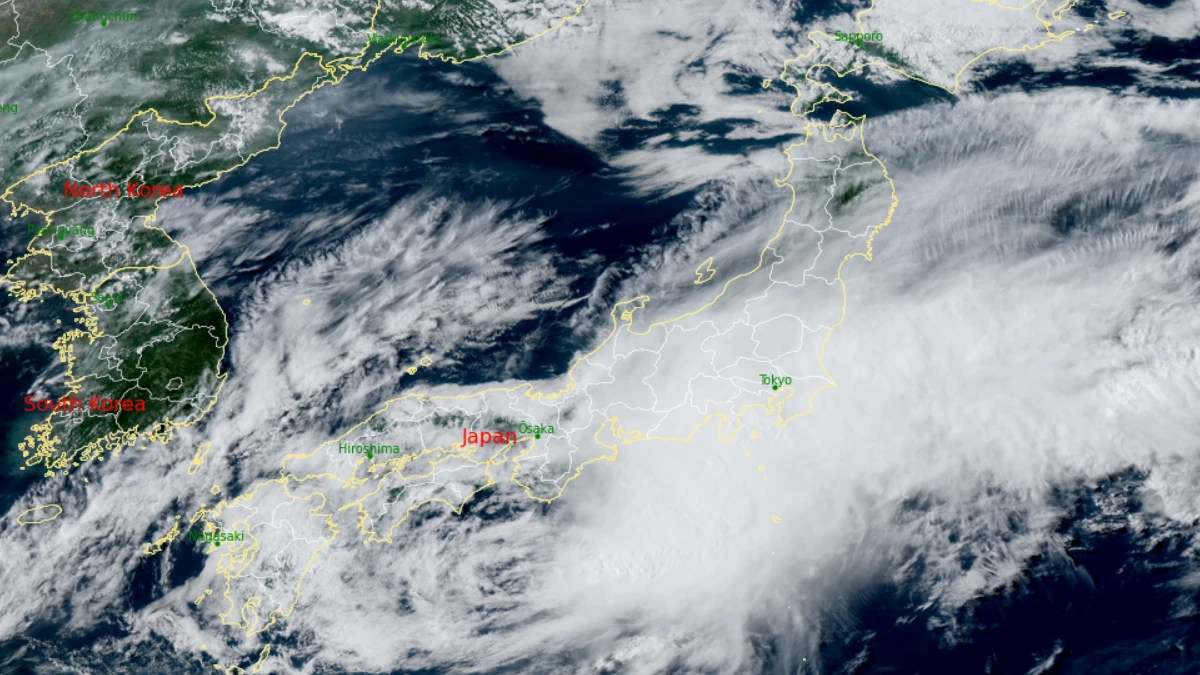
Satellite image of Tropical Storm Mekkhala at 0630 UTC on June 27, 2026. Credit: JMA/Himwari-9, RAMMB/CIRA, The Watchers
Flooding triggered by heavy rain associated with Tropical Storm Mekkhala killed two people in Taiwan on Saturday, June 27, while authorities in Japan warned of continued flooding and landslide risks as tropical moisture from Mekkhala and Tropical Storm Higos interacted with the seasonal Baiu rain front.
The deteriorating weather came just hours after a powerful earthquake shook Yamanashi Prefecture, adding to emergency operations across parts of central Japan.
As Mekkhala tracked northeastward south of Shikoku and Higos made its closest approach to the Tokai and Kanto regions before weakening into an extratropical cyclone over the Pacific east of Japan, heavy rain intensified across central and eastern parts of the country.
Level 4 landslide warnings were issued for Tokyo’s Izu Oshima as well as parts of Shizuoka, Kanagawa and Chiba prefectures, with forecasters warning that dangerous downpours would continue through Saturday night.
Taiwan experienced the most severe impacts as Mekkhala passed near the island. A 73-year-old woman was swept away by floodwaters in the southern port city of Kaohsiung on Friday. A 49-year-old woman was found dead inside a submerged vehicle in Hsinchu County while a 65-year-old man remained missing after leaving to check the farmland in Hsinchu.
Emergency officials carried out flood response operations across several counties as rivers overflowed and widespread inundation affected communities in southern Taiwan.
Rainfall totals approached 1 m (3 feet) in parts of Pingtung County, with extensive flooding also reported in Kaohsiung and Tainan. Schools and government offices were closed in several jurisdictions, while sections of Taiwan’s north-south railway were suspended because of flooding.
Authorities also evacuated about 200 residents downstream of a newly formed barrier lake in Hualien County after days of exceptional rainfall raised concerns that the natural dam could fail. Barrier lakes form when landslides block river valleys and can pose a significant downstream flood hazard if breached.
Heavy rainfall intensified across Japan as the two tropical systems interacted with the stationary Baiu rain front. Chiba Prefecture reportedly saw record-breaking rainfall rates through Friday into Saturday.
55.5 mm (2.19 inches) fell in one hour at Kimitsu and 42 mm (1.65 inches) at Ichihara, both establishing new hourly rainfall records in June.
Strong wind gusts accompanied the storms, reaching 105 km/h (65 mph) on Tokyo’s Izu Oshima and Katsuura, Chiba Prefecture.
The severe weather left a growing trail of damage across the country. A landslide destroyed a house in Hirao, Yamaguchi Prefecture, leaving a man in his 70s missing.
Meanwhile, authorities in Hyogo Prefecture say the body of a man who had been delivering newspapers was found in a river on Friday. He is believed to have fallen and drowned in the swollen river due to the flooding.
Eight people were injured in Nara, Yamaguchi, Kumamoto, and Kagoshima prefectures, while damage to homes was reported in five prefectures, including Osaka and Kyoto, where eight houses sustained damage. Approximately 400 homes, mainly in western Japan, experienced above- or below-floor flooding.
Japan’s Ground Self-Defense Force responded to requests from local authorities and joined search-and-rescue operations in affected areas.
Japanese authorities issued evacuation information affecting about one million people in areas vulnerable to flooding and landslides. Separately, evacuation advisories were issued for approximately 70 000 households in Chiba and Kanagawa prefectures.
More than 200 flights were cancelled, several rail services were suspended and road closures were reported in flood-prone areas. While some sections of the Tokaido Line in the Tokyo metropolitan area were suspended from the first trains of the day, the Tokaido and Tohoku Shinkansen continued operating largely on schedule. All Nippon Airways cancelled six flights serving Hachijojima Island.
As Mekkhala accelerated northeastward away from Taiwan, the Joint Typhoon Warning Center (JTWC) said the cyclone had begun transitioning into an extratropical system.
Satellite imagery showed a partially exposed low-level circulation center, with the deepest convection displaced into the eastern semicircle as increasing vertical wind shear affected the storm’s structure.
Despite the unfavorable shear, strong poleward outflow and upper-level divergence associated with a powerful jet streak over northern Honshu continued supporting vigorous convection east of the center. The JTWC said Mekkhala was being steered northeastward by deep-layer westerly flow and expected the strongest winds to remain offshore even as the storm passed near the Kanto Plain.
Earlier Saturday morning, the storm was located about 220 km (137 miles) south-southwest of Cape Muroto, Kochi Prefecture, and was forecast to pass near the Tokai and Kanto regions before moving east of the Boso Peninsula by Sunday morning while gradually losing tropical characteristics.
The Japan Meteorological Agency (JMA) analyzed Mekkhala at 05:00 UTC (14:00 JST) on June 27 with a central pressure of 992 hPa, maximum sustained winds of 72 km/h (45 mph), and movement toward the east-northeast at 55 km/h (34 mph).
Although Mekkhala was moving away from Japan, forecasters stressed that the main hazard had shifted from damaging winds to prolonged heavy rainfall. Moisture supplied by Mekkhala and Higos continued feeding into the stationary Baiu rain front, significantly enhancing rainfall efficiency and increasing the risk of flash flooding, river flooding, and landslides across central and eastern Japan.
The JMA forecast up to 250 mm (10 inches) of additional rainfall across the Tokai region during the 24 hours ending 06:00 JST Sunday, with up to 200 mm (8 inches) expected in Kanto-Koshin and 150 mm (6 inches) in the Kinki region. The agency urged residents to remain on high alert for landslides, flooding of low-lying areas, and rapidly rising rivers.
Heavy rainfall is expected to continue through the weekend as the Baiu rain front remains active over central Japan, even as both tropical systems move farther into the northwestern Pacific.
References:
1 Typhoon Mekkhala Nears Tokai, Kanto; 1 Missing in Yamaguchi Landslide – The Japan News – June 27, 2026
2 Heavy rain continues as tropical storm moves through Japan – NHK World – June 27, 2026
3 Prognostic Reasoning For Tropical Storm Mekkhala Warning No. 34 – JTWC – June 27, 2026

I am an Assistant Editor and Severe Weather & Science Journalist at The Watchers, specializing in real-time severe weather coverage, geophysical event reporting, and research-driven scientific analysis. You can reach me at rishav(at)watchers(.)news.

Commenting rules and guidelines
We value the thoughts and opinions of our readers and welcome healthy discussions on our website. In order to maintain a respectful and positive community, we ask that all commenters follow these rules.