
Typhoon Bavi makes landfall in Zhejiang, China, after triggering mass evacuations
Typhoon Bavi made landfall in Zhejiang Province, eastern China, at 23:20 local time (LT) on July 11, 2026, with 10-minute maximum sustained winds of 144 km/h (90 mph). The storm prompted the evacuation of more than 1.7 million people across eastern China. Bavi passed north of Taiwan before reaching the mainland and enhanced the southwest monsoon over the Philippines, where flooding and landslides caused fatalities.
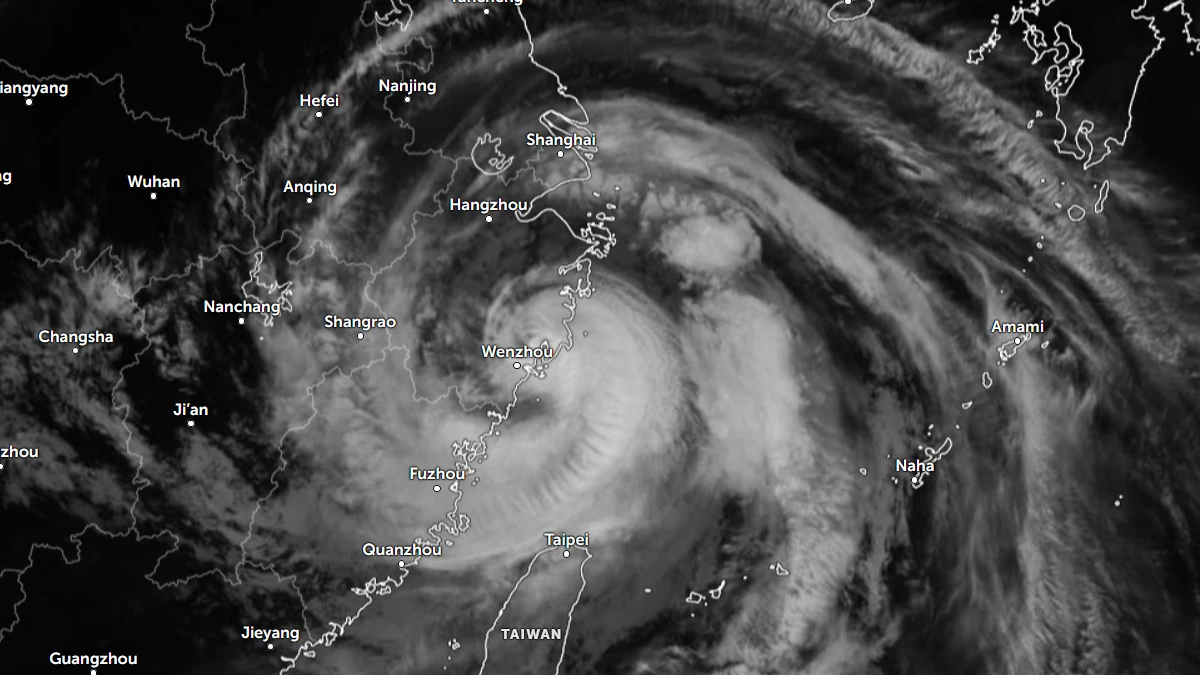
Satellite image of Typhoon Bavi making landfall over eastern China at 15:20 UTC, July 11, 2026. Credit: JMA/Himawari-9, Zoom Earth, The Watchers
Typhoon Bavi made landfall in Yuhuan City in eastern China’s Zhejiang Province at approximately 23:20 LT on Saturday, July 11, according to the Zhejiang Provincial Meteorological Observatory.
At the time of landfall, the typhoon’s 10-minute maximum sustained winds reached up to 144 km/h (90 mph). It is expected to continue weakening as it moves northwestward.
Although the storm weakened from its earlier super typhoon intensity before reaching the Chinese coast, official agencies warned that its broad circulation remained a major hazard. Heavy to torrential rainfall, flooding, landslides, and dangerous coastal conditions are expected across the affected regions.
Typhoon Bavi lashes Zhejiang coast, bringing strong winds, heavy waves on July 11.#China #TyphoonBavi pic.twitter.com/20PojJ8fcn
— CCTV+ (@CCTV_Plus) July 11, 2026
The National Meteorological Center (NMC) maintained an Orange Typhoon Warning and issued China’s first Red Rainstorm Warning of 2026.
Chinese authorities evacuated more than 1.7 million people ahead of landfall, while Taiwan reported more than 100 weather-related injuries and widespread transportation disruptions. In the Philippines, the storm enhanced the southwest monsoon (habagat), contributing to deadly flooding and landslides despite remaining offshore.
Neighboring Fujian Province evacuated more than 100 000 people and deployed over 17 000 emergency rescue personnel in anticipation of flooding, landslides, and storm surge. Shanghai also evacuated approximately 34 000 residents as the typhoon’s outer rainbands approached the municipality.

Earlier, Taiwan’s Central Weather Administration (CWA) issued both sea and land typhoon warnings from July 10 to 11, forecasting exceptionally heavy rainfall over northern and mountainous areas, with localized totals of up to 1 000 mm (40 inches). Authorities warned of flash flooding, landslides, debris flows, river flooding, and dangerous coastal conditions.
Taiwan also reported at least 113 weather-related injuries, while nearly all domestic flights and hundreds of international flights were canceled or delayed. Government officials evacuated more than 14 000 residents from vulnerable mountain communities before the storm’s closest approach.
Schools, government offices, and many businesses suspended operations across parts of the island as heavy rain and strong winds swept across northern Taiwan.


Seventeen people were reported dead, and about 514 700 others were affected by the southwest monsoon (habagat) enhanced by Typhoon Inday, the National Disaster Risk Reduction and Management Council (NDRRMC) said on Saturday.
The fatalities were attributed to drowning and landslides. Two deaths were reported in Bukidnon, 10 in Malapatan, Sarangani, and five in Calanogas, Lanao del Sur.
Four people were injured, also due to landslides, in Torrijos, Marinduque, Malapatan, and Calanogas. Nine people remained missing, three from Malapatan and six from Calanogas. As of July 11, about 14 000 families had been displaced, including 2 900 staying in evacuation centers.
References:
1 Typhoon Bavi makes landfall in east China’s Zhejiang – Xinhua – July 11, 2026
2 NDRRMC: 17 reported dead due to Inday, ‘habagat’ – PNA – July 11, 2026
3 Typhoon Bavi makes landfall in eastern China as more than 1 million are evacuated – AP – July 11, 2026

Rishav Kothari is Editor-in-Chief of The Watchers, where he runs the newsroom and covers earthquakes, volcanoes, severe weather and space weather.
Published in the last 24 hours
- A meteorite blew a crater beside a village near Lake Titicaca in 2007, and dozens of villagers who went to see it got headaches and nausea, though tests found nothing the rock had added to the water Epicenter
- The people who pay closest attention to the weather are the ones storms have already cost the most, a study of 946 students found, with one damaging storm making little difference to how much attention a student paid, but two or more making a clear one Epicenter
- The sea is falling in Juneau, Alaska, because land freed from melted glaciers is rising about 0.6 inches a year Epicenter
- A dam above Los Angeles collapsed just before midnight on March 12, 1928, and the flood killed more than 400 people, hours after the engineer who built it had spent two hours looking at a new leak and decided there was no danger Epicenter
