
‘Historically rare’ tornado strikes Huanggang, causing extensive urban damage in Hubei Province, China
A rare tornado struck the urban area of Huanggang, Hubei Province, between 20:10–20:30 LT on July 6, 2026, causing widespread destruction across residential neighborhoods, industrial facilities, and logistics parks. Huanggang’s on-site command headquarters said the tornado produced winds exceeding Force 15 on the Chinese wind scale during what it described as a historically rare event for the city. Preliminary numbers mention up to 12 fatalities and hundreds injured.
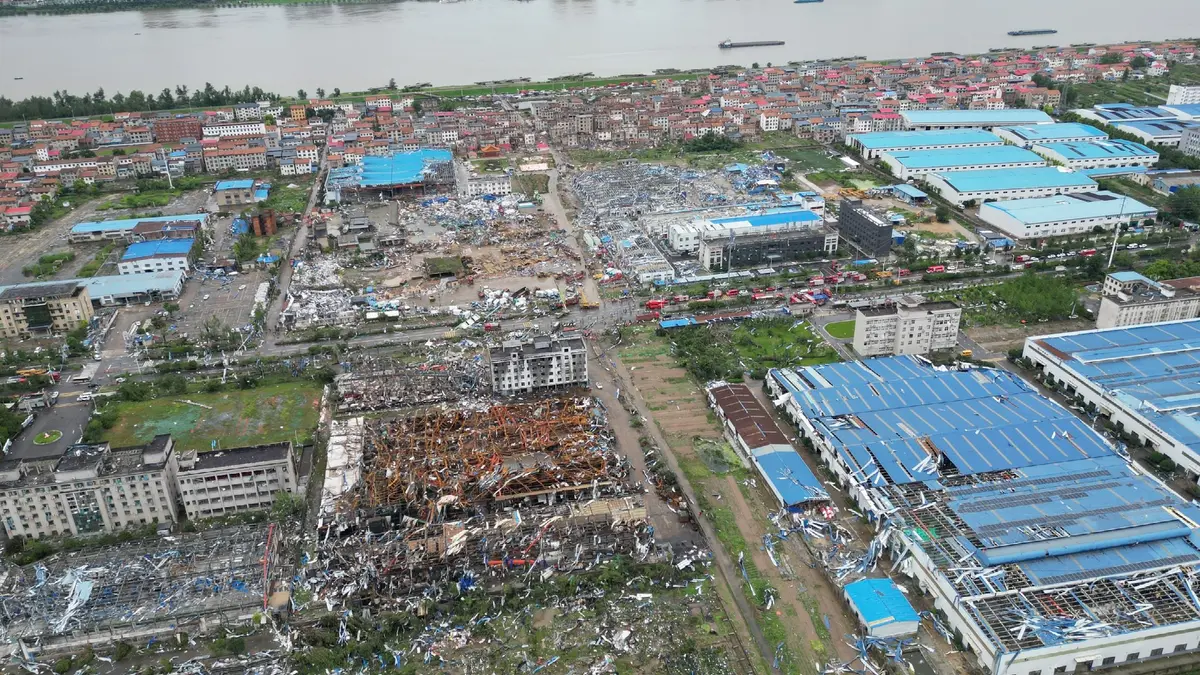
Daylight reveals extensive tornado damage across Huanggang, Hubei Province, after the rare tornado on July 6, 2026, Credit: Eric Wang/X
The tornado tore through major and secondary roads, residential communities, factory complexes, and logistics facilities across Huangzhou District.
The southern section of Baota Avenue, the Qicheng Logistics Company, and the first phase of the Changjiang Community warehouse project sustained some of the heaviest damage. Several heavy trucks were lifted and displaced by as much as 30 m (98 feet), illustrating the intensity of the winds.
As of 06:00 LT on July 7, authorities said the tornado had affected 5 975 people and damaged more than 1 000 mu of farmland, equivalent to about 67 ha (166 acres). Designated hospitals admitted 178 injured people, including five in critical condition.
Casualty figures circulating on social media varied during the overnight rescue effort, with some posts claiming between nine and 12 deaths before authorities completed their preliminary assessment. Huanggang’s on-site command headquarters later reported four fatalities, one missing person, and 178 hospitalized injuries as of 06:00 LT on July 7.
Emergency officials also reported that 111 people carried out precautionary evacuations, while another 269 residents were relocated to temporary shelters.
Huanggang activated its emergency response immediately after the tornado struck, deploying more than 3 000 rescue personnel overnight. The city’s Emergency Management Bureau sent more than 250 rescuers, together with three large emergency lighting vehicles and five emergency rescue vehicles, to the disaster area.
The killer tor that hit Huanggang, Hubei Province has lead to at least 12 fatalities per authorities, >331 injuries. The death toll could rise with further search and rescue. This would make it become the deadliest tor since Funing 2016 EF4. pic.twitter.com/9mhtCXRly3
— Eric1101 (@Ericwang1101) July 7, 2026
Huanggang Fire and Rescue deployed 24 fire engines, 169 firefighters, and four search dogs to conduct citywide search-and-rescue operations. The Hubei Provincial Fire and Rescue Corps reinforced the response with another 30 rescue vehicles, 143 firefighters, five search dogs, and 20 members of the Blue Sky Rescue Team. An additional 980 provincial firefighters equipped with full rescue equipment were also dispatched to Huanggang.
Police deployed 1 080 officers to maintain public order, direct traffic and inspect hazardous areas, while 250 urban management personnel cleared debris from roads and public spaces.
Around 200 power utility workers carried out emergency repairs to the electricity network. Emergency management authorities distributed more than 3 000 relief items, and financial authorities allocated dedicated disaster-relief funding to support emergency shelter operations and reconstruction.
Officials said electricity, water supply, natural gas, telecommunications, and most transportation services had largely been restored by around 10:00 LT on July 7, although recovery operations continued in the hardest-hit parts of Huangzhou District.
Numerous videos shared online captured the tornado approaching Huanggang’s city center from several locations. One widely circulated video was reportedly recorded by a resident who was later injured, although officials have not released information confirming the circumstances.
Other footage showed severe destruction around industrial sites and construction areas, with homes reduced to rubble, steel beams thrown long distances, and heavy trucks overturned or mangled. Separate videos circulating online also showed significant tornado damage near Daye in Hubei Province, where several brick homes appeared to have lost upper floors, and vehicles were reportedly thrown considerable distances.
The event drew considerable attention across the online weather community. Some social media users compared the Huanggang tornado to the EF4 tornado that struck Rowlett, Texas, in December 2015 because of its apparent size, urban setting, and the displacement of heavy vehicles.
Others noted similarities between videos showing illuminated rotating debris within the circulation and footage recorded during the 2023 Rolling Fork, Mississippi EF4 tornado. Those comparisons remain opinions expressed by weather enthusiasts and storm observers and are not part of any official damage assessment.
Updates
09:59 UTC, July 8
The death toll from the severe convective storms and tornadoes that struck eastern Hubei Province on July 6 has risen to 11, with 1 person still missing and 331 people injured, according to provincial authorities cited by Xinhua.
The storms affected Huangshi, Huanggang, Ezhou, and Xianning between 19:00 and 23:00 LT on July 6 (11:00–15:00 UTC), with two townships recording level-13 gales.
The severe weather affected about 14 600 people, destroyed 22 buildings, and damaged another 4 855. Authorities said 246 residents were relocated, while rescue, relief, and secondary-disaster prevention work continued.
Huanggang remained one of the hardest-hit areas. Xinhua reported that a rare EF2 tornado struck the city, heavily damaging a logistics company and a warehouse. Multiple trucks were lifted and displaced by winds by as much as 30 m (98 feet).
Meteorological experts cited by Chinese state media said tornadoes are rare in Hubei, where the previous recorded tornado occurred in May 2021. The July 6 event was linked to several contributing factors, including severe convective weather and the remnants of Tropical Storm Maysak.
References:
1 湖北黄冈遭遇罕见龙卷风灾害 多方全力抢险救灾 – XINHUA – July 7, 2026

I’m a science journalist and researcher at The Watchers, contributing to the Epicenter edition, where I cover peer-reviewed scientific research and emerging discoveries across Earth and space sciences. With a background in astronomy and a passion for environmental science, I’ve worked in shark and coral conservation in Fiji, conducting reef and shark-behavior research, contributing to mangrove restoration, and earning PADI Open Water and Coral Reef Certifications. I bring a blend of scientific rigor and storytelling to illuminate the discoveries shaping our planet and beyond.

Commenting rules and guidelines
We value the thoughts and opinions of our readers and welcome healthy discussions on our website. In order to maintain a respectful and positive community, we ask that all commenters follow these rules.