
Strong strombolian activity and ash emissions at Etna volcano, Italy
Strong strombolian activity is taking place at Etna’s summit craters on July 5, 2026, accompanied by strong ash emissions. The Aviation Color Code has been raised from Orange to Red.
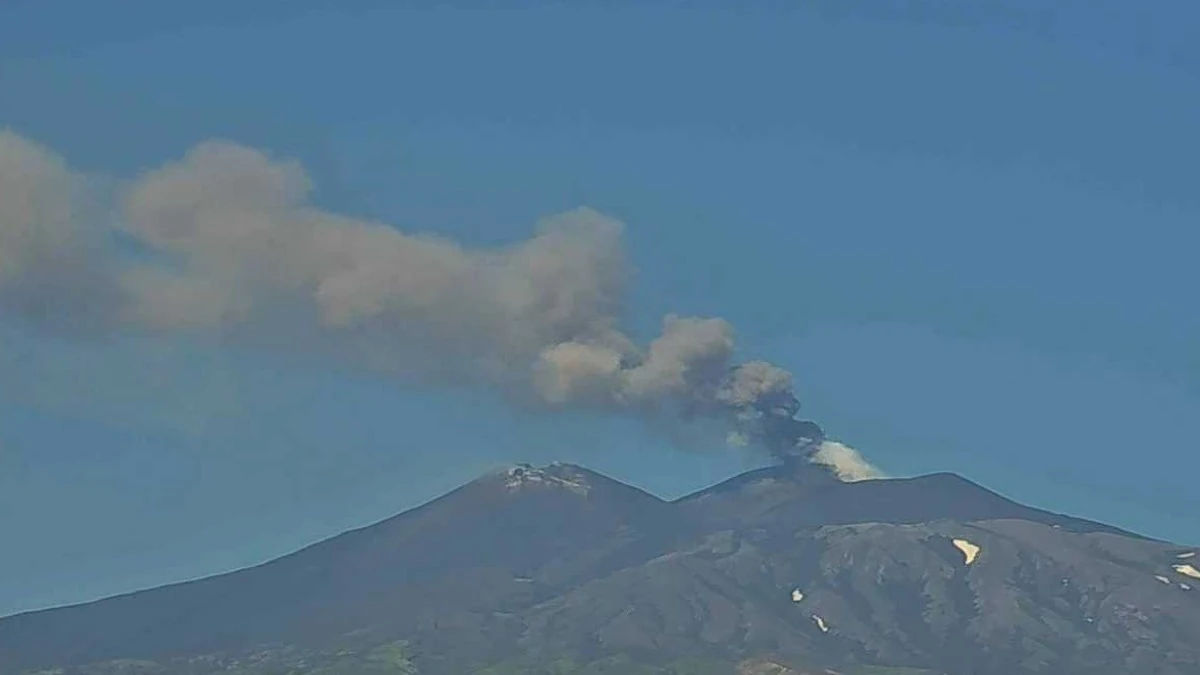
Ash column rising over Etna volcano at 08:48 UTC on July 5, 2026. Credit: INGV-OE
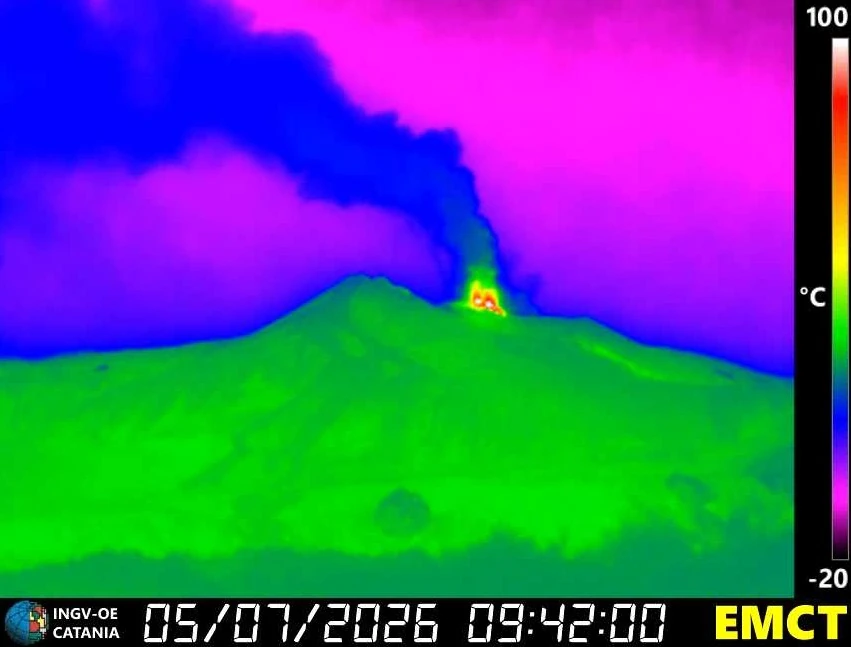
Etna Observatory reports that ash emissions began from the vent on the upper eastern flank of Voragine crater at approximately 05:45 UTC on July 5. As a result, the Aviation Color Code was raised from Orange to Red at 06:08 UTC.
The emissions further intensified at around 06:45 UTC, generating an eruptive cloud approximately 1.5 km (0.9 miles) above the summit of the volcano and drifting toward the south and south-southeast sectors. Forecast models based on meteorological data indicate ash dispersion toward the south over the coming hours.
The average amplitude of volcanic tremor remains within the high-value range and continues to show a steady increasing trend, INGV said. Since yesterday, this trend has been characterized by strong fluctuations, which have become more pronounced in recent hours.
At 06:30 UTC, the maximum tremor-amplitude value for this eruptive episode was recorded. The centroid of tremor sources remains in the Voragine crater area, at an elevation of approximately 3 000 m (9 843 feet) above mean sea level.
Infrasonic activity is currently at a low level in terms of the number of events and released energy. However, in recent hours, it has been characterized by periods of intense activity reaching very high levels.
The sources are located in the Voragine crater area, although weak activity was also observed at the Northeast Crater in recent hours.
Deformation-monitoring networks are currently not detecting significant changes.
Variations have been observed at the summit clinometric station ECPN since 05:45 UTC, amounting to approximately 0.3 microradians through 07:30 UTC, and at the DRUV dilatometric station, showing decompression of approximately 8 nanostrain through 07:00 UTC.
In recent days, Strombolian activity has continued at the vent on the flank of Voragine, while effusive activity from the vent at an elevation of 3 030 m (9 941 feet) above sea level, which began on June 26, gradually waned and ended on July 4.
In addition, during the night of July 2–3, a second small lava flow formed from a point located between the vent producing Strombolian activity and the effusive vent. The flow traveled just over 100 m (328 feet) before stopping on the morning of July 3.
References:
1 VONA Etna – Etna Volcano Observatory – Issued at 06:08 UTC on July 5, 2026
2 Comunicato Etna – INGV – Issued at 07:43 UTC on July 5, 2026

I'm a dedicated researcher, journalist, and editor at The Watchers. With over 20 years of experience in the media industry, I specialize in hard science news, focusing on extreme weather, seismic and volcanic activity, space weather, and astronomy, including near-Earth objects and planetary defense strategies. You can reach me at teo /at/ watchers.news.

Commenting rules and guidelines
We value the thoughts and opinions of our readers and welcome healthy discussions on our website. In order to maintain a respectful and positive community, we ask that all commenters follow these rules.