
Anak Krakatau alert raised to Level III after renewed eruptions, Indonesia
Indonesia’s Geological Agency raised Anak Krakatau alert from Level II (Waspada) to Level III (Siaga) at 16:30 WIB (09:30 UTC) on July 2, 2026, after an eruption at 14:05 WIB (07:05 UTC) sent a dense gray-to-black ash plume about 200 m (656 feet) above the summit. The agency set a 3 km (1.9 miles) exclusion zone around the active crater.
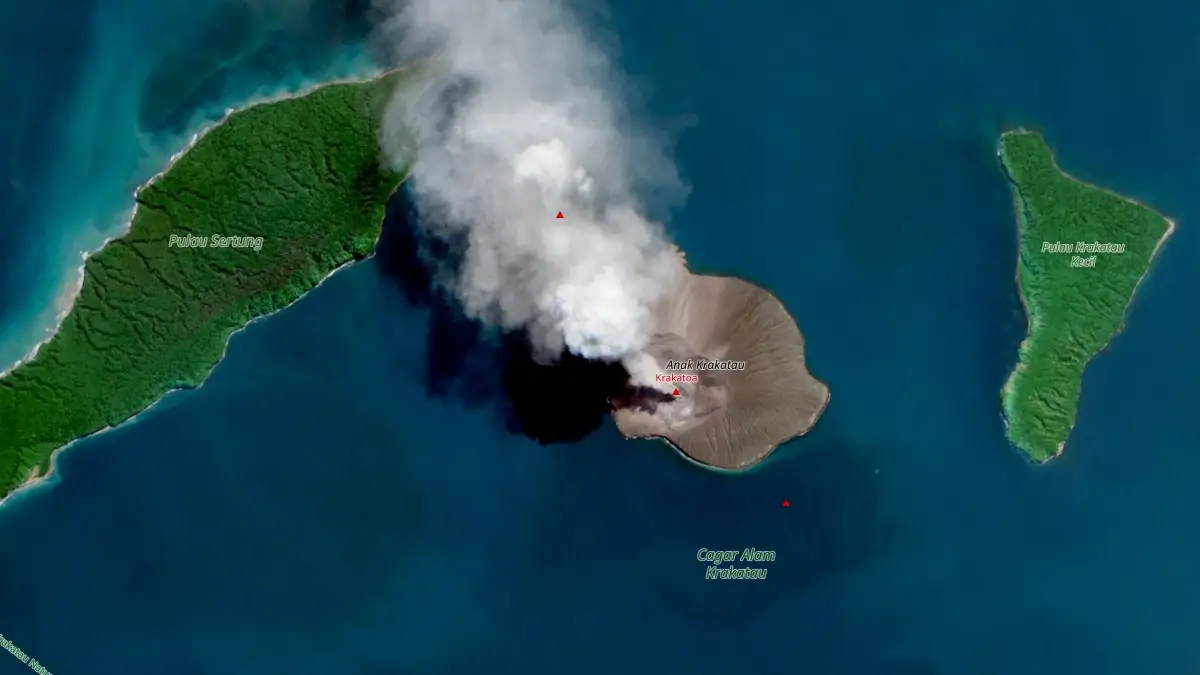
Satellite image of Anak Krakatau erupting on July 2, 2026. Credit: CopernicusEU/Sentinel-2, The Watchers
MAGMA Indonesia’s latest report, covering a period from 12:00–18:00 WIB on July 3, retained Level III and the 3 km (1.8 miles) exclusion zone. Observers recorded white-to-gray emissions rising about 10–100 m (33–328 feet) above the summit, two shallow volcanic earthquakes with amplitudes of 13–18 mm, and continuous tremor with amplitudes of 1–4 mm.
Authorities advised residents, visitors, tourists, and climbers not to enter the exclusion zone. The Level III alert includes potential hazards from hot clouds, lava, incandescent ejecta, and heavy ashfall.
The country’s Geological Agency reported sulfur dioxide emissions and thermal anomalies in Sentinel satellite observations from June 1, with crater hotspots identified from June 10. On June 18 and 19, the combined daily average of exhalation, hybrid or multiphase, and low-frequency earthquakes exceeded 50 events.
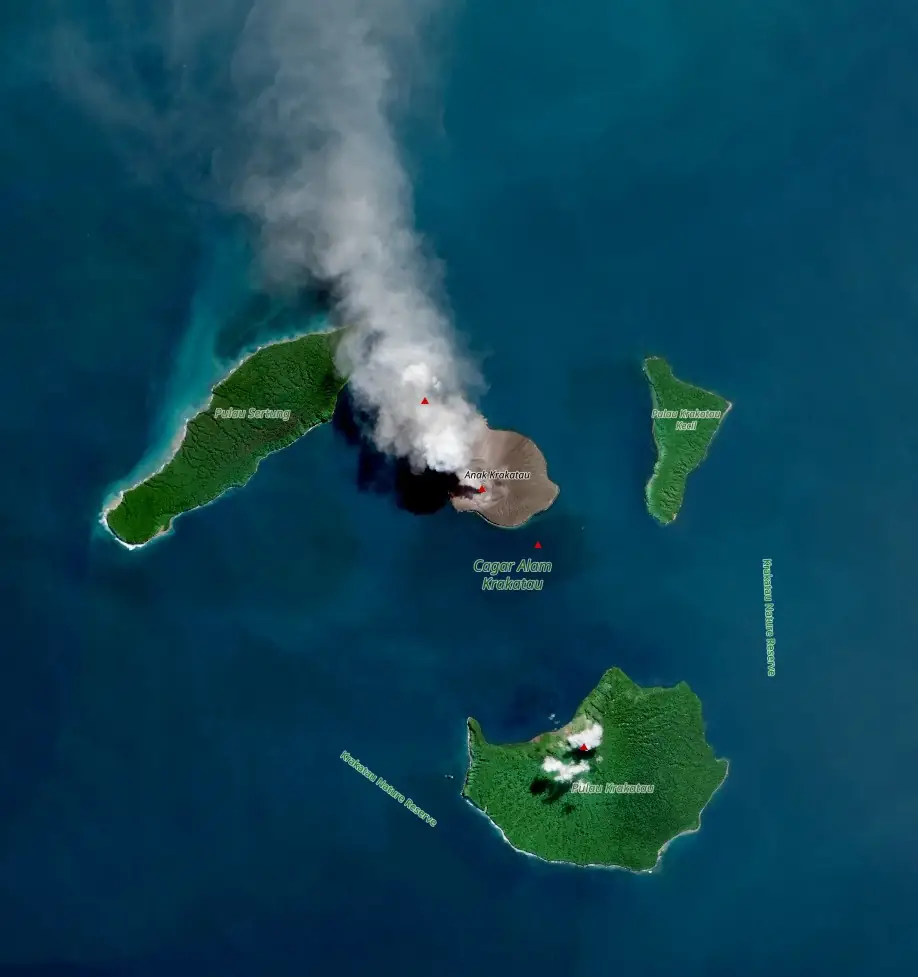
Between June 16 and July 2, instruments recorded 740 exhalation earthquakes, 24 harmonic earthquakes, 247 low-frequency earthquakes, and 520 hybrid or multiphase earthquakes. The period also included 16 continuous-tremor events, two shallow volcanic earthquakes, three deep volcanic earthquakes, one local tectonic earthquake, and five distant tectonic earthquakes.
The agency reported fluctuating but generally flat trends in the Y component at the Kras and Lava93 tiltmeter stations. The Tanjung station showed fluctuating low-scale inflation, which the agency assessed alongside the elevated shallow seismicity.
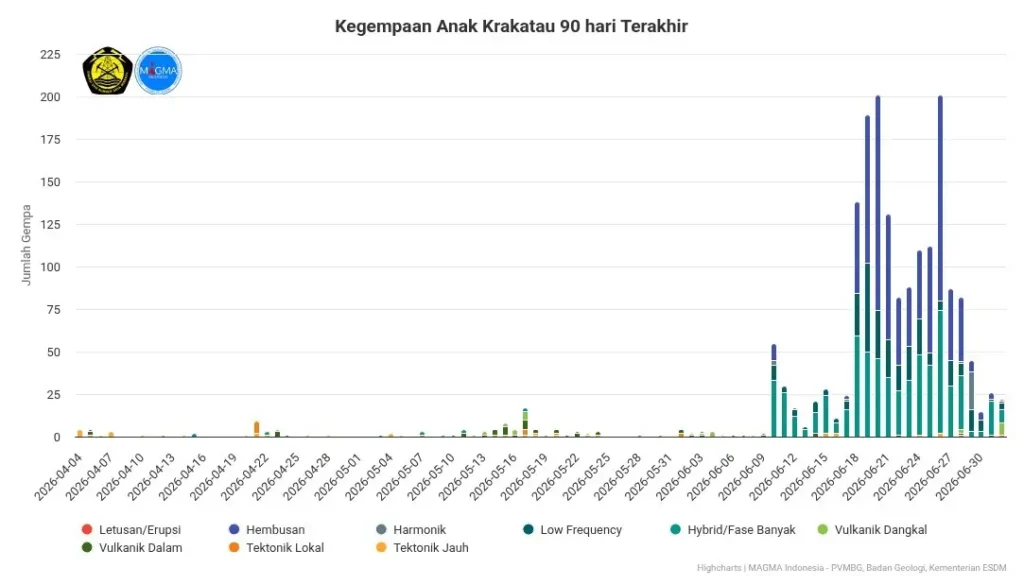
On June 26, the rate of exhalation earthquakes increased alongside gray, ash-bearing crater emissions drifting west to northwest.
Coastal communities in Banten and Lampung were advised to remain calm, follow local disaster-management guidance, and not rely on claims that Anak Krakatau’s eruption would trigger an immediate tsunami.
Anak Krakatau has a documented history of generating a tsunami through volcanic flank collapse. On December 22, 2018, an eruption at 20:56 WIB triggered the collapse of about 64 ha of the volcano’s flank, according to Indonesia’s Meteorology, Climatology, and Geophysics Agency (BMKG).
The collapse displaced seawater in the Sunda Strait and produced tsunami waves that struck coastal areas of Banten and Lampung. Scientific studies identify the event as a sector collapse on Anak Krakatau’s southwestern flank, not a tectonic-earthquake tsunami.
The 2018 disaster showed why volcanic islands require separate tsunami-risk assessment during eruptive episodes. Satellite-radar and seismic analyses found that a landslide from Anak Krakatau’s southwestern flank generated the tsunami, which killed 437 people along the coasts of western Java and southern Sumatra.
The tsunami-generating mechanism was the rapid movement of volcanic material into the sea, which displaced water and produced multiple waves around the volcano.
That history does not mean every Anak Krakatau eruption produces a tsunami. Ash emissions, lava activity, or an alert-level increase alone do not establish that tsunami generation is expected.
References:
1 Kenaikan tingkat aktivitas Gunungapi Anak Krakatau Provinsi Lampung dari Level II (Waspada) menjadi Level III (Siaga) tanggal 2 Juli 2026 pukul 16.30 WIB – Badan Geologi – July 3, 2026

I'm a dedicated researcher, journalist, and editor at The Watchers. With over 20 years of experience in the media industry, I specialize in hard science news, focusing on extreme weather, seismic and volcanic activity, space weather, and astronomy, including near-Earth objects and planetary defense strategies. You can reach me at teo /at/ watchers.news.

Commenting rules and guidelines
We value the thoughts and opinions of our readers and welcome healthy discussions on our website. In order to maintain a respectful and positive community, we ask that all commenters follow these rules.