
Monsoon floods in Pakistan leave 47 dead as active flood alerts trigger evacuations
At least 47 people have died and 123 others have been injured across Pakistan since the start of the 2026 monsoon season on June 26, as house collapses and flash floods triggered by heavy rainfall continue to affect several provinces while active flood alerts and evacuations remain in place along major rivers in Punjab.
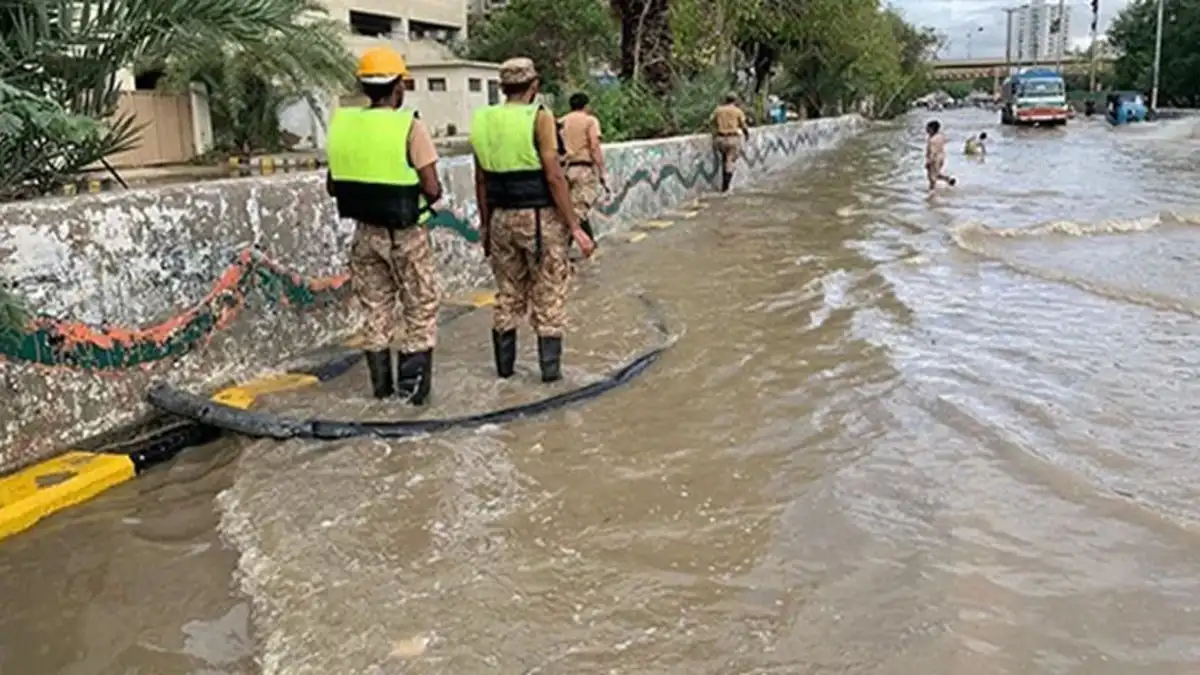
Flooding in Karachi, Pakistan on March 19, 2026. Credit: Radio Pakistan
At least 47 people have died, and 123 others have been injured across Pakistan since the 2026 monsoon season began on June 26, with house collapses and flash floods accounting for most casualties as authorities maintain active flood alerts and evacuation operations along the Chenab, Jhelum and Ravi rivers through July 24. Additional rainfall is forecast over the coming weeks.
Pakistan entered the 2026 monsoon amid significant underlying vulnerability. The country ranks 18th among 191 countries in the INFORM Risk Index because of its high exposure to natural hazards, vulnerability and limited coping capacity.
Disaster-related losses have exceeded USD 18 billion over the past decade, while recent climate assessments place Pakistan among the world’s ten most climate-vulnerable countries despite contributing less than 1% of global greenhouse gas emissions.
According to the humanitarian situation report, the National Disaster Management Authority (NDMA) forecasts seasonal rainfall totals 22–26% above the previous monsoon season. Combined with accelerated melting across Pakistan’s more than 7 000 glaciers, the outlook has increased concerns over flooding, landslides and glacial lake outburst floods.
The report notes that NDMA’s latest daily situation report listed 38 fatalities before the humanitarian compilation increased the nationwide total to 47 as additional impacts were recorded, illustrating the rapidly evolving nature of the emergency.
Provincial data show Khyber Pakhtunkhwa has suffered the greatest human impact, recording 29 deaths and 45 injuries, largely from house collapses and flash floods. Punjab has reported 10 deaths and 65 injuries while remaining under active riverine and urban flood alerts through July 24.
Balochistan has recorded five deaths and 13 injuries, primarily following house collapses in Zhob district, while Azad Jammu and Kashmir has reported three fatalities amid active landslide alerts. Gilgit-Baltistan remains under a high-risk designation because of glacier melt and road blockages, although no fatalities had been reported there as of July 20, while Sindh remains under a downstream riverine flood watch later in the season. Overall, 65.8% of reported deaths resulted from house collapses.
The monsoon has damaged 178 houses nationwide, including 77 destroyed and 101 partially damaged, while 179 livestock have perished. Assessments also document damage to 3.42 km (2.13 miles) of roads and one bridge. Khyber Pakhtunkhwa reported 81 damaged houses and 168 livestock losses, Gilgit-Baltistan recorded 49 damaged houses and 2.52 km (1.57 miles) of damaged roads, Azad Jammu and Kashmir reported 25 damaged houses, Punjab 16 and Balochistan seven.
Authorities reported significant local impacts in Neelum Valley after a cloudburst damaged houses, shops, government schools and bridges while causing livestock losses. The Azad Jammu and Kashmir State Disaster Management Authority has coordinated response and relief operations with government departments and local authorities to support affected communities.
The National Disaster Management Authority and Provincial Disaster Management Authorities in Punjab, Sindh, Balochistan, Azad Jammu and Kashmir, Khyber Pakhtunkhwa and Gilgit-Baltistan remain engaged in coordinated monitoring, preparedness and response operations alongside provincial relief commissioners and humanitarian partners. Authorities have continued pre-positioning emergency stocks while scaling up assistance in areas affected by flooding and landslides.
Between June 26 and July 20, cumulative relief assistance included 84 tents, 461 food packs, 1 440 blankets, 24 mosquito nets, 440 jerry cans, 308 tarpaulins, 172 water tanks, 1 850 clothing items, 400 solar units and 520 camping heaters.
Provincial distributions varied according to operational needs, with Punjab receiving the largest allocation of blankets, clothing, solar units and camping heaters, while Sindh received food packs, jerry cans, tarpaulins and water tanks. Gilgit-Baltistan and Khyber Pakhtunkhwa also received tents, food assistance and other emergency supplies.
The report notes that the current emergency is unfolding while many communities are still recovering from the devastating 2025 floods, which killed more than 1 037 people and displaced approximately 2.9 million at the peak of the disaster.
Although OCHA’s relief and early recovery support plan continued through April 2026, persistent food insecurity and housing shortages have left many households with reduced capacity to withstand another severe monsoon season.
Islamic Relief Pakistan said it continues to coordinate closely with the NDMA, Water and Sanitation Agencies and District Disaster Management Authorities while monitoring the evolving situation. The organization said its Surge Emergency Response Team remains on high alert for immediate deployment if conditions deteriorate further.
Islamic Relief noted that it has implemented humanitarian programs exceeding USD 270 million between 2022 and 2026, reflecting extensive operational experience responding to floods and displacement emergencies across Pakistan.
Forecasts contained in the humanitarian report indicate that active flood alerts will remain in effect for the Chenab, Jhelum and Ravi rivers through July 24, while Punjab authorities have issued a pre-alert for another weather system expected to affect the Sutlej, Ravi, Chenab and Jhelum river basins later this month.
With August and September representing the climatological peak of Pakistan’s monsoon season and NDMA forecasting above-normal rainfall, authorities caution that the current casualty and damage figures should be viewed as part of an ongoing emergency rather than the final impact of the 2026 monsoon season.
References:
1 HUMANITARIAN SITUATION REPORT – Islamic Relief Pakistan – July 21, 2026

I’m a science journalist and researcher at The Watchers, contributing to the Epicenter edition, where I cover peer-reviewed scientific research and emerging discoveries across Earth and space sciences. With a background in astronomy and a passion for environmental science, I’ve worked in shark and coral conservation in Fiji, conducting reef and shark-behavior research, contributing to mangrove restoration, and earning PADI Open Water and Coral Reef Certifications. I bring a blend of scientific rigor and storytelling to illuminate the discoveries shaping our planet and beyond.

Commenting rules and guidelines
We value the thoughts and opinions of our readers and welcome healthy discussions on our website. In order to maintain a respectful and positive community, we ask that all commenters follow these rules.