
An asteroid was spotted 19 hours before it exploded over Sudan in 2008, and students picked its pieces off the desert
Asteroid 2008 TC3 was discovered about 20 hours before it entered Earth’s atmosphere over northern Sudan on October 7, 2008, becoming the first object detected in space before hitting Earth. Two months later, University of Khartoum students and staff recovered its meteorites from the Nubian Desert, giving scientists the first physical samples from an asteroid whose approach had been observed before impact.
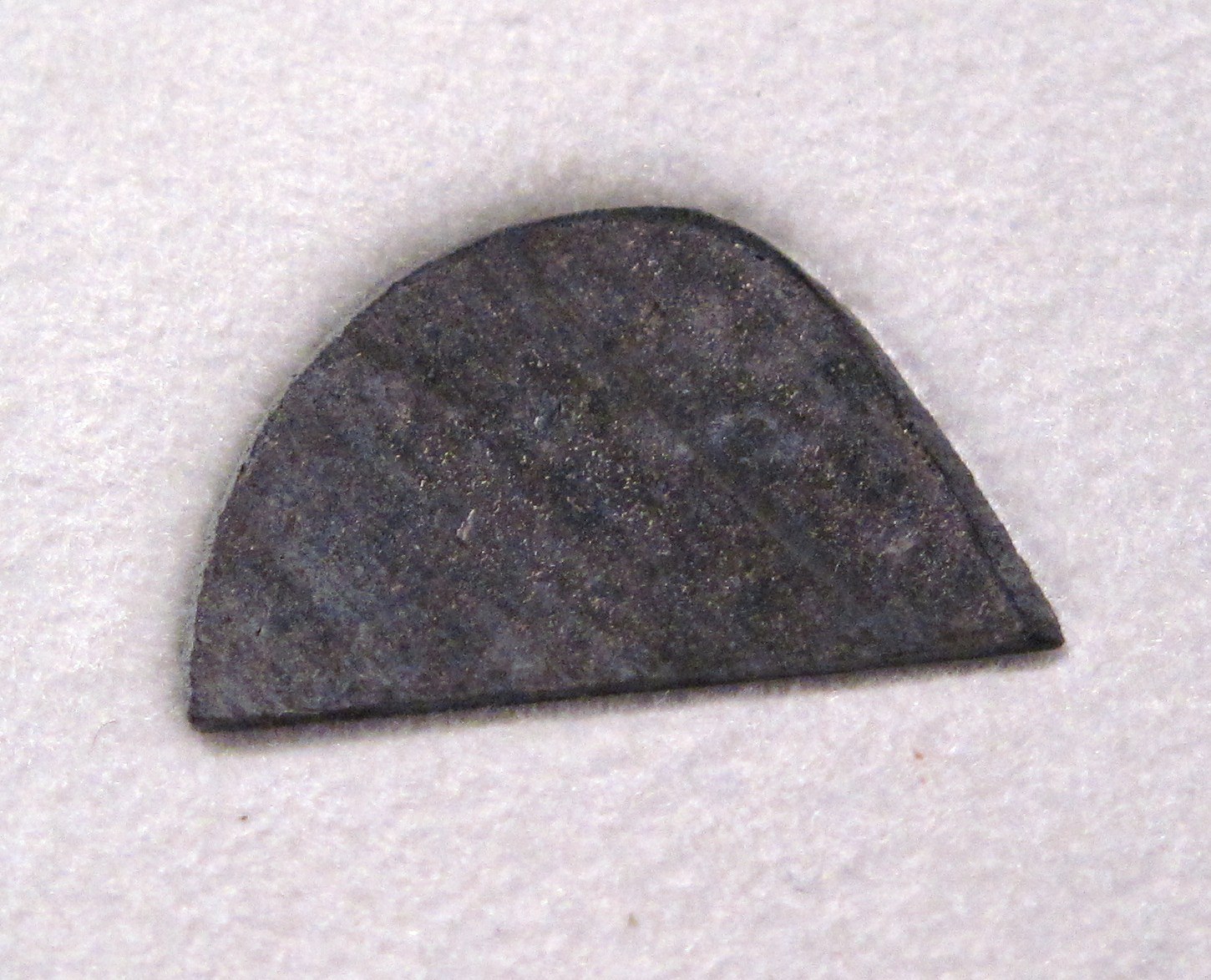
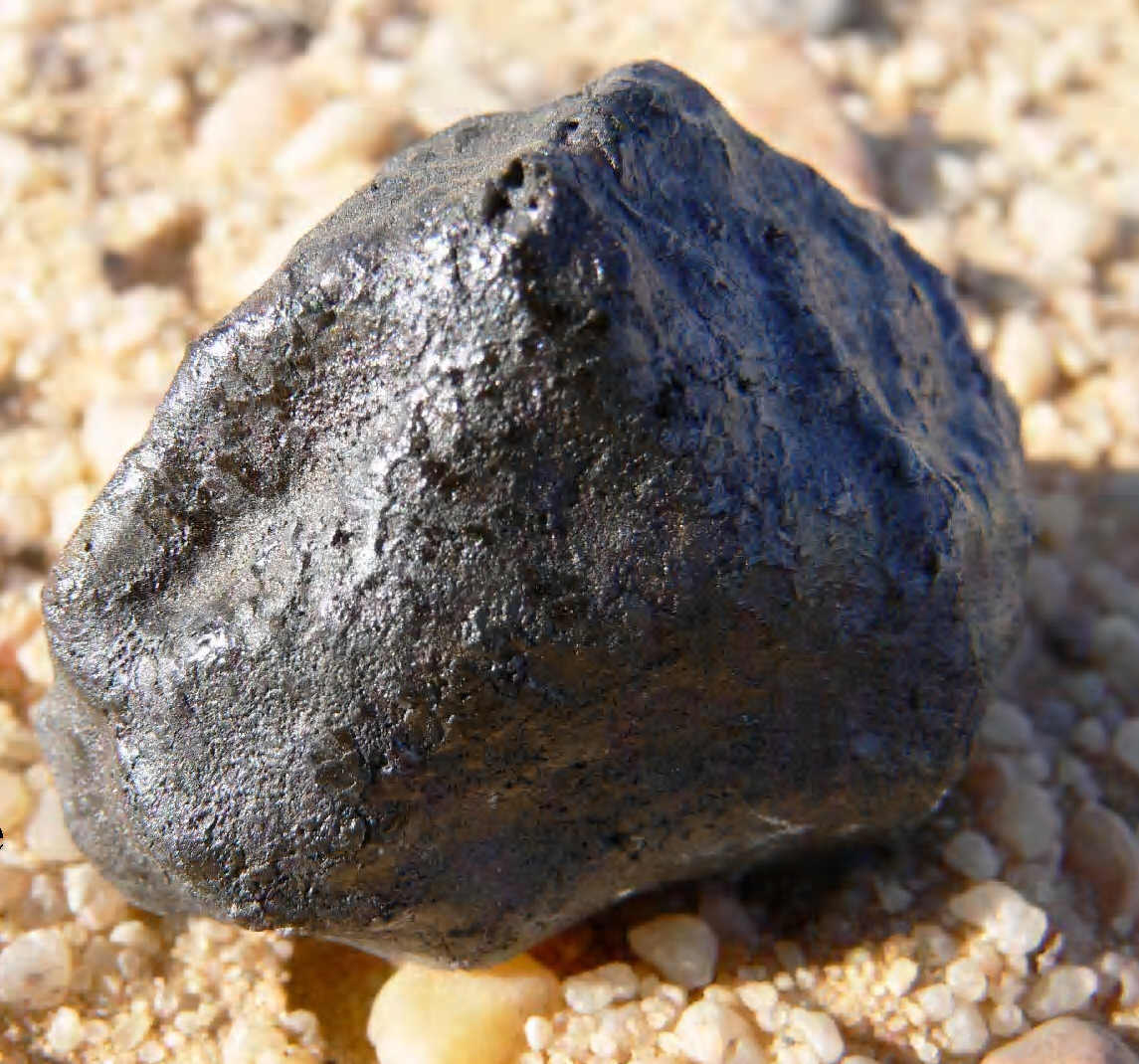
Almahata Sitta meteorite. Credit: Jon Taylor (CC BY-SA 2.0), via Wikimedia Commons.
Richard Kowalski of the Catalina Sky Survey discovered 2008 TC3 at 06:39 UTC on October 6, 2008, using the 1.5 m telescope at Mount Lemmon Observatory in Arizona. Follow-up calculations rapidly established that the 3–4 m (10–13 feet) object was on a collision course with Earth.
The discovery gave astronomers an opportunity that had not existed for any previous asteroid impact. Instead of reconstructing an object’s path only after a meteorite fall, they could measure an incoming asteroid in space, predict its atmospheric entry and, if material survived, connect laboratory samples directly with a body whose pre-impact orbit and physical properties had been observed.
Observatories in the United States, Australia, Asia and Europe followed 2008 TC3 during the short interval before impact. ESA reports that more than 800 astrometric observations were obtained, producing an extremely accurate trajectory, while a spectrum and lightcurve supplied information about the object’s composition, shape and tumbling rotational state.
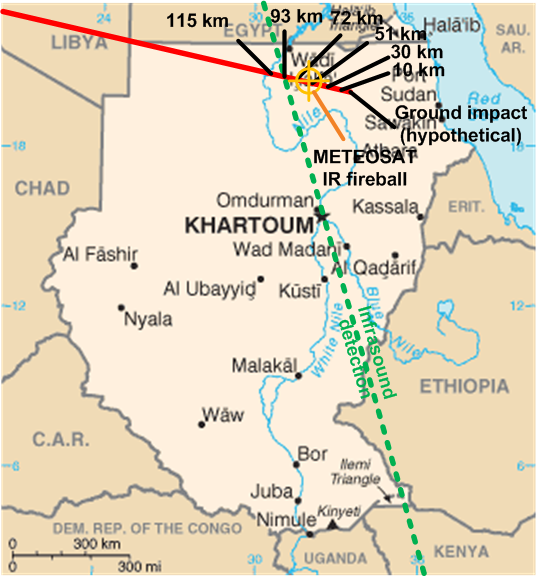
NASA/JPL’s final reconstruction places the impact 20.5 hours after discovery. ESA and the later peer-reviewed recovery study round the interval to about 20 hours. The separate figure of 19 hours refers to the point when the asteroid entered Earth’s shadow and could no longer be observed optically, not to the atmospheric impact.
Within about an hour of receiving the initial observations, JPL predicted atmospheric entry over northern Sudan at approximately 02:46 UTC on October 7. The later recovery study gives an entry velocity of 12.4 km/s (7.7 miles/s) relative to Earth’s surface and atmosphere, with the asteroid approaching on a shallow 19.14° elevation angle.
2008 TC3 fragmented at an altitude of approximately 37 km (23 miles) above the Nubian Desert. ESA estimates the energy of the atmospheric explosion at 1.1–2.1 kilotons of TNT. METEOSAT-8 recorded the event, and at least one infrasound sensor operated by the International Monitoring System detected the disturbance.
The high fragmentation altitude initially made meteorite recovery appear unlikely. University of Khartoum staff searched near reported locations without finding material, and the recovery study records that researchers initially assumed the asteroid had fragmented too high in the atmosphere for recoverable meteorites to remain.
Peter Jenniskens travelled to Sudan at the invitation of the University of Khartoum and gave a presentation at its Physics Department on December 3, 2008. Jenniskens and University of Khartoum physicist Muawia H. Shaddad then travelled through the fall area with eyewitness Mohammed Elhassan, interviewing people who had seen the fireball and persistent atmospheric trail.
The eyewitness reports and reconstructed trajectory helped define where a systematic ground search should begin. On December 6, 45 students and staff from the University of Khartoum entered the Nubian Desert and began walking across the predicted fall area.
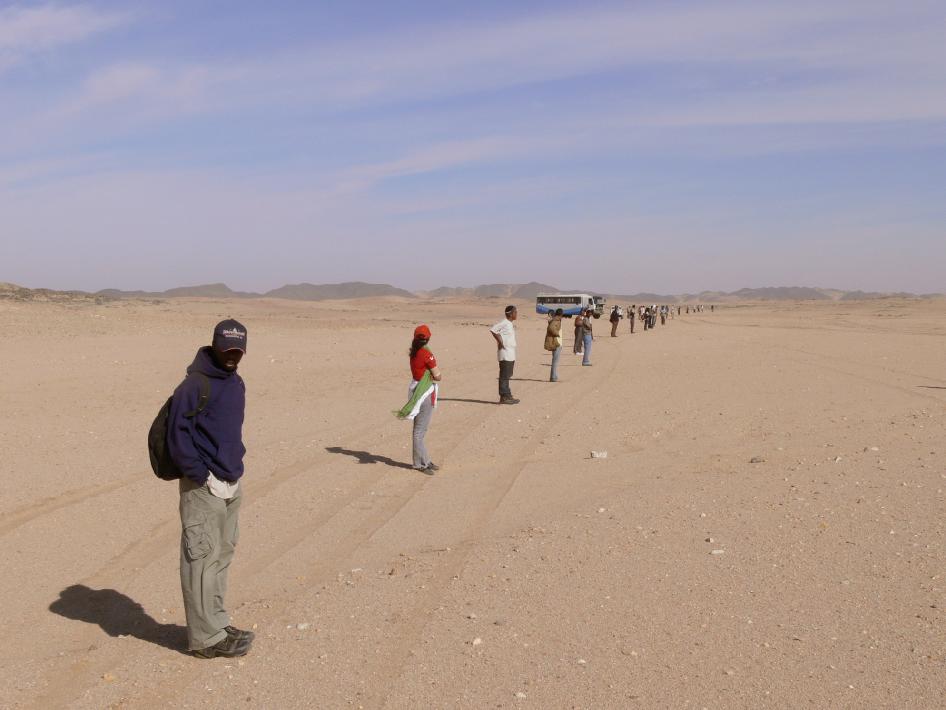
Searchers generally walked about 10–30 m (33–98 feet) apart. GPS-equipped members helped the line maintain its direction while participants scanned the desert surface for dark stones that differed from the surrounding terrain.
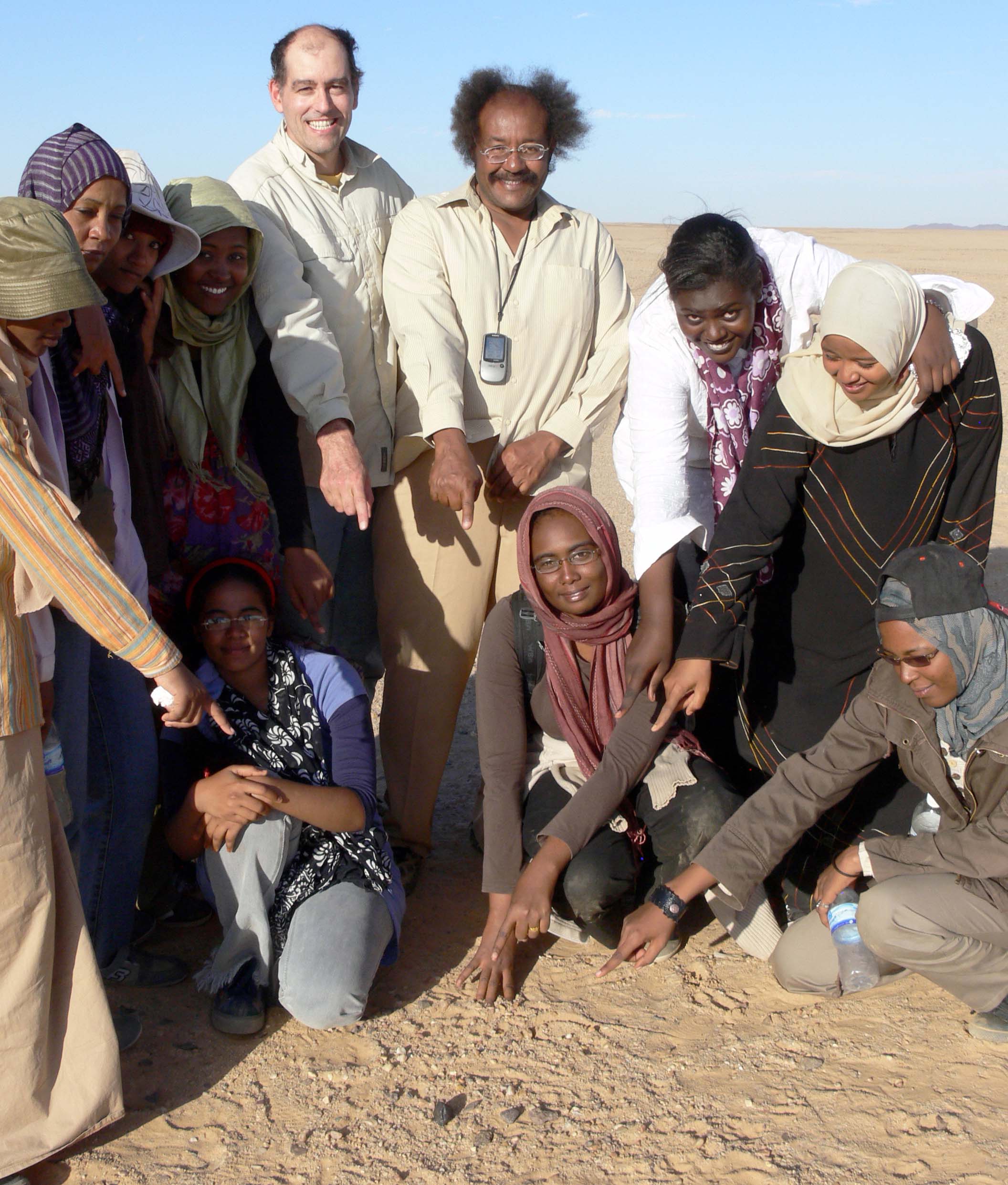
Student Mohammed Alameen found the first meteorite after about two hours of searching during the afternoon of December 6. The first specimen listed in the recovery study weighed 4.412 g (0.156 oz).
The find established that part of the fragile asteroid had survived the high-altitude disruption. It also completed a connection that meteorite researchers normally do not have: material recovered on Earth could be linked directly to an asteroid whose motion and physical properties had been measured before it entered the atmosphere.
The first organized campaign ran from December 6–8, 2008, with 1, 4 and 10 meteorites found on the three respective days. A second campaign involving 72 participants ran from December 26–30 and recorded 0, 0, 2, 4 and 29 finds.
Searches resumed from February 27 to March 2, 2009, with 54 participants. A sandstorm prevented searching on the first day, followed by 7, 112 and 95 finds. A fourth campaign from December 9–12, 2009, involved 74 participants and recorded approximately 0, 26, 290 and 8 finds on successive days. The study treats parts of the later tally as approximate because some specimens were grain-sized and some suspected material remained uncertain.
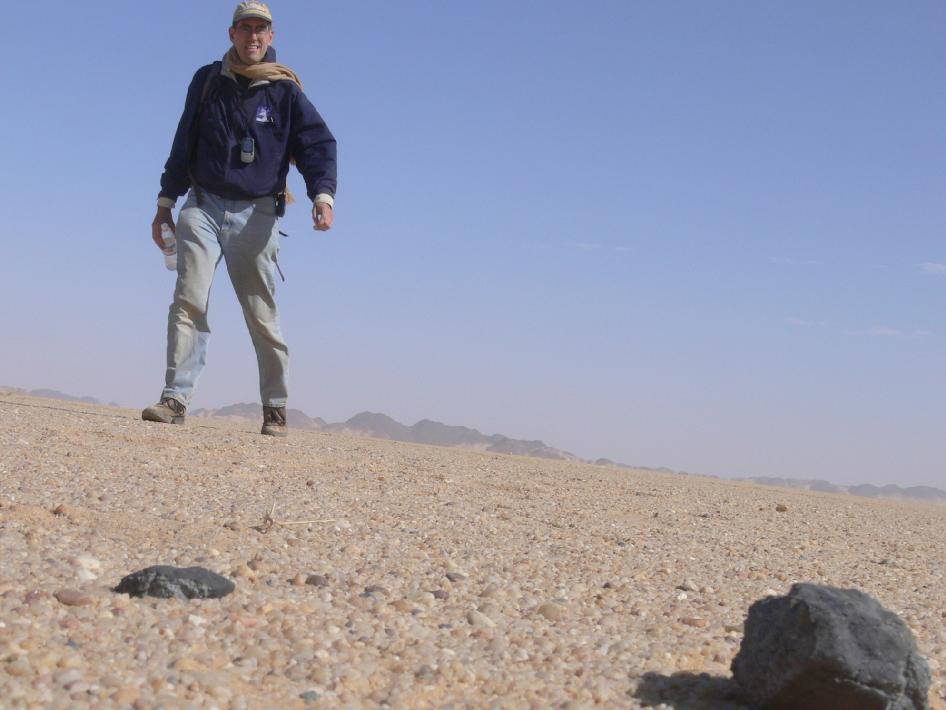
About 150 individuals took part across the organized searches. When a possible meteorite was located, participants were instructed not to touch it immediately. The position and finder were recorded, specimens were often photographed where they lay, and recovered material was wrapped in aluminium foil.
By the time Shaddad and colleagues published the detailed recovery study in 2010, more than 600 meteorites had been recovered. Individual specimens ranged from 0.2 to 379 g (0.007 to 13.4 oz) and had a combined mass of 10.7 kg (23.6 lb).
The recovered material was distributed across an approximately 30 × 7 km (18.6 × 4.3 mile) strewn field. The authors estimated that 39 ± 6 kg (86 ± 13 lb) of material in total reached the ground, meaning the documented 10.7 kg (23.6 lb) collection represented roughly one-quarter of the estimated surviving mass.
The strewn field was displaced nearly 1.8 km (1.1 miles) south of the calculated asteroid path. The recovery study examined atmospheric winds and the dark-flight phase of the fragments to understand the distribution.
Dark flight begins after a meteorite fragment has lost most of its cosmic velocity and falls mainly under gravity and aerodynamic drag. Winds can then carry smaller pieces sideways before they reach the ground, so modeling this stage helps connect an observed atmospheric breakup with the distribution of meteorites on the surface.
The recovered meteorites were named Almahata Sitta, Arabic for “Station 6,” after the railway station near the fall area on the line between Wadi Halfa and Abu Hamad. The station and surrounding desert provided reference points during the eyewitness interviews and search campaigns.
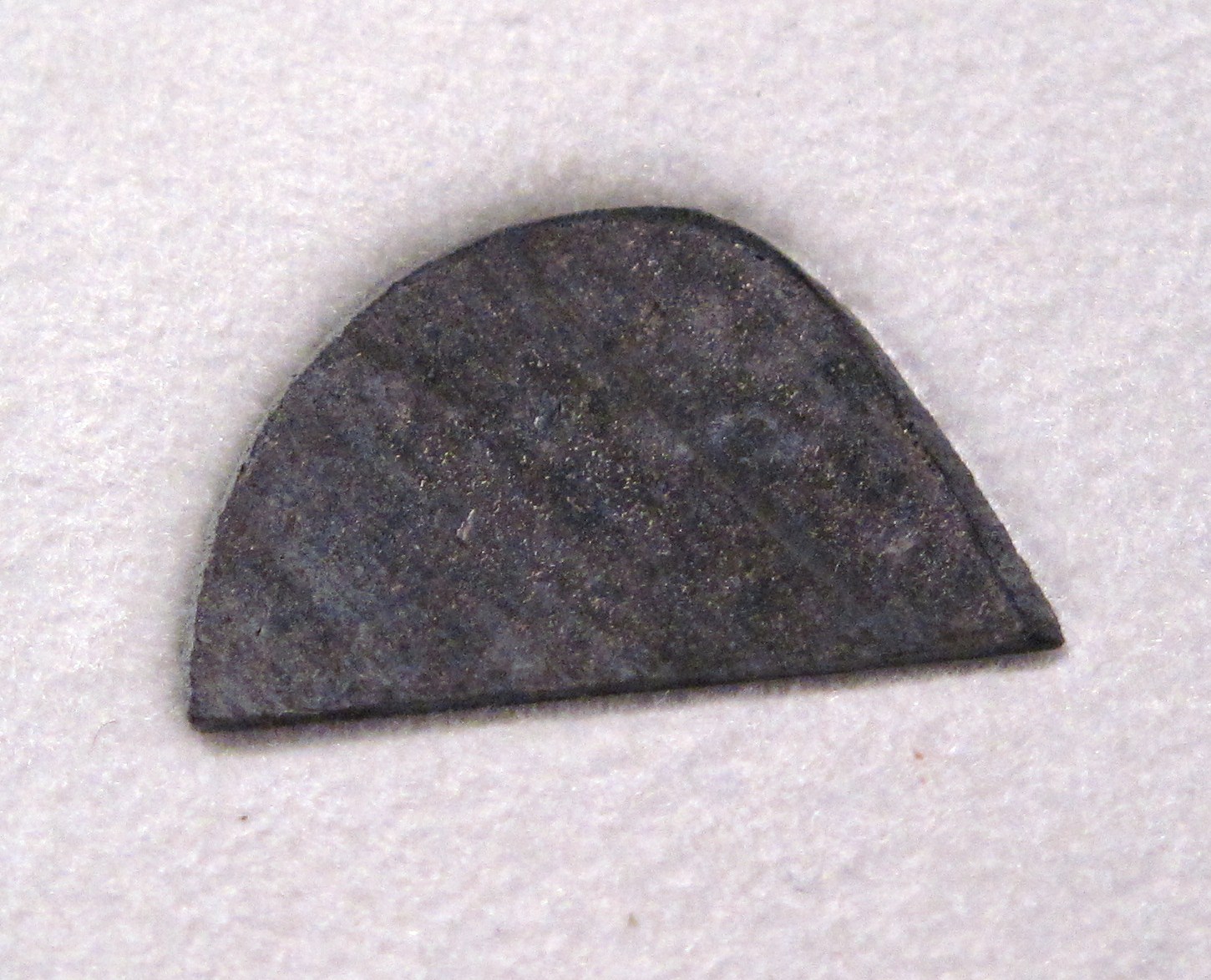
The collection also revealed that 2008 TC3 was compositionally unusual. Most specimens were ureilites, a comparatively rare group of stony meteorites, but the recovery paper estimates that 20–30% of the collected mass consisted of ordinary, enstatite and carbonaceous chondrites.
The authors did not interpret the different meteorite types as unrelated stones collected accidentally from the same desert. Their fresh appearance and matching distribution in the strewn field led the researchers to conclude that the different materials had been components of 2008 TC3 before atmospheric breakup.

ESA identifies 2008 TC3 as the first object detected in space before impacting Earth. The Shaddad et al. recovery study establishes the corresponding first on the ground: the first recovery of meteorites from an asteroid that had already been observed in space.
The distinction matters because asteroid astronomy and meteorite science usually examine two incomplete parts of the same problem. Telescopes can measure an asteroid’s orbit, brightness and spectrum, while laboratory analysis can reveal the mineralogy and physical structure of meteorites, but most recovered meteorites cannot be traced to a specifically observed object before their fall. 2008 TC3 connected those datasets directly.
The event also provided an early real-world test of the asteroid warning chain. Discovery observations were circulated internationally, additional measurements refined the orbit, JPL predicted the time and region of atmospheric entry, and the subsequent search used the trajectory and eyewitness evidence to locate surviving material.
That sequence has since been repeated. ESA’s Past Impactors catalogue, last updated at 10:00 UTC on September 24, 2026, lists 13 asteroids detected before entering Earth’s atmosphere. 2008 TC3 remains the earliest object in that record.
The later detections do not diminish the scientific value of the Sudan fall. The unusual combination of astronomical measurements, a predicted atmospheric entry and hundreds of recovered meteorites made 2008 TC3 a reference case for connecting the properties of a small asteroid in space with the material that survives its passage through Earth’s atmosphere.
References:
1 Shaddad, M. H., Jenniskens, P., Numan, D., Kudoda, A. M., Elsir, S., Riyad, I. F., Ali, A. E., Alameen, M., Alameen, N. M., Eid, O., Osman, A. T., AbuBaker, M. I., Yousif, M., Chesley, S. R., Chodas, P. W., Albers, J., Edwards, W. N., Brown, P. G., Kuiper, J., & Friedrich, J. M. (2010). The recovery of asteroid 2008 TC3. Meteoritics & Planetary Science, 45, 1557–1589. DOI: 10.1111/j.1945-5100.2010.01116.x
2 2008 TC3 – European Space Agency Near-Earth Object Coordination Centre – accessed November 20, 2026
3 Asteroid 2008 TC3 Strikes Earth: Predictions and Observations Agree – NASA/JPL Center for Near Earth Object Studies – November 4, 2008
4 NASA Team Finds Riches in Meteorite Treasure Hunt – NASA Science – March 27, 2009
5 Past Impactors – European Space Agency Near-Earth Object Coordination Centre – last updated September 24, 2026

I’m a science journalist and researcher at The Watchers, contributing to the Epicenter edition, where I cover peer-reviewed scientific research and emerging discoveries across Earth and space sciences. With a background in astronomy and a passion for environmental science, I’ve worked in shark and coral conservation in Fiji, conducting reef and shark-behavior research, contributing to mangrove restoration, and earning PADI Open Water and Coral Reef Certifications. I bring a blend of scientific rigor and storytelling to illuminate the discoveries shaping our planet and beyond.
Published in the last 24 hours
- A wave up to 3 m (10 feet) high rose out of Lake Michigan on a sunny June morning in 1954 and swept fishermen off Chicago’s piers, and when a second came 10 days later, warnings had cleared the shore Epicenter
- Just 12 inches of rushing water can carry away most cars, and more than half of US flood drownings happen to people who drive into flood water Epicenter
- People who hid under an Oklahoma highway overpass from a 1999 tornado lost fingers, ears and noses, and three people died near or under overpasses that day Epicenter
- In January 1862, California’s new governor took a rowboat to his own inauguration, after 45 days of storms had turned the Central Valley into a lake up to 300 miles long Epicenter
