
The hole in the ozone layer over Antarctica was about twice the size of the US this year, and scientists say it would have been bigger still if ozone-eating chemicals were at their 2000 levels
The Antarctic ozone hole averaged 18.71 million km² (7.23 million mi²) during the main 2025 depletion season — about twice the area of the contiguous United States — and scientists estimate it would have been more than 2.59 million km² (1 million mi²) larger if stratospheric chlorine had remained near its level around 2000. A year later, an unusually powerful polar vortex helped expand the 2026 seasonal mean to about 25 million km² (9.6 million mi²), showing how long-term chemical recovery can coexist with large year-to-year swings in the ozone hole.
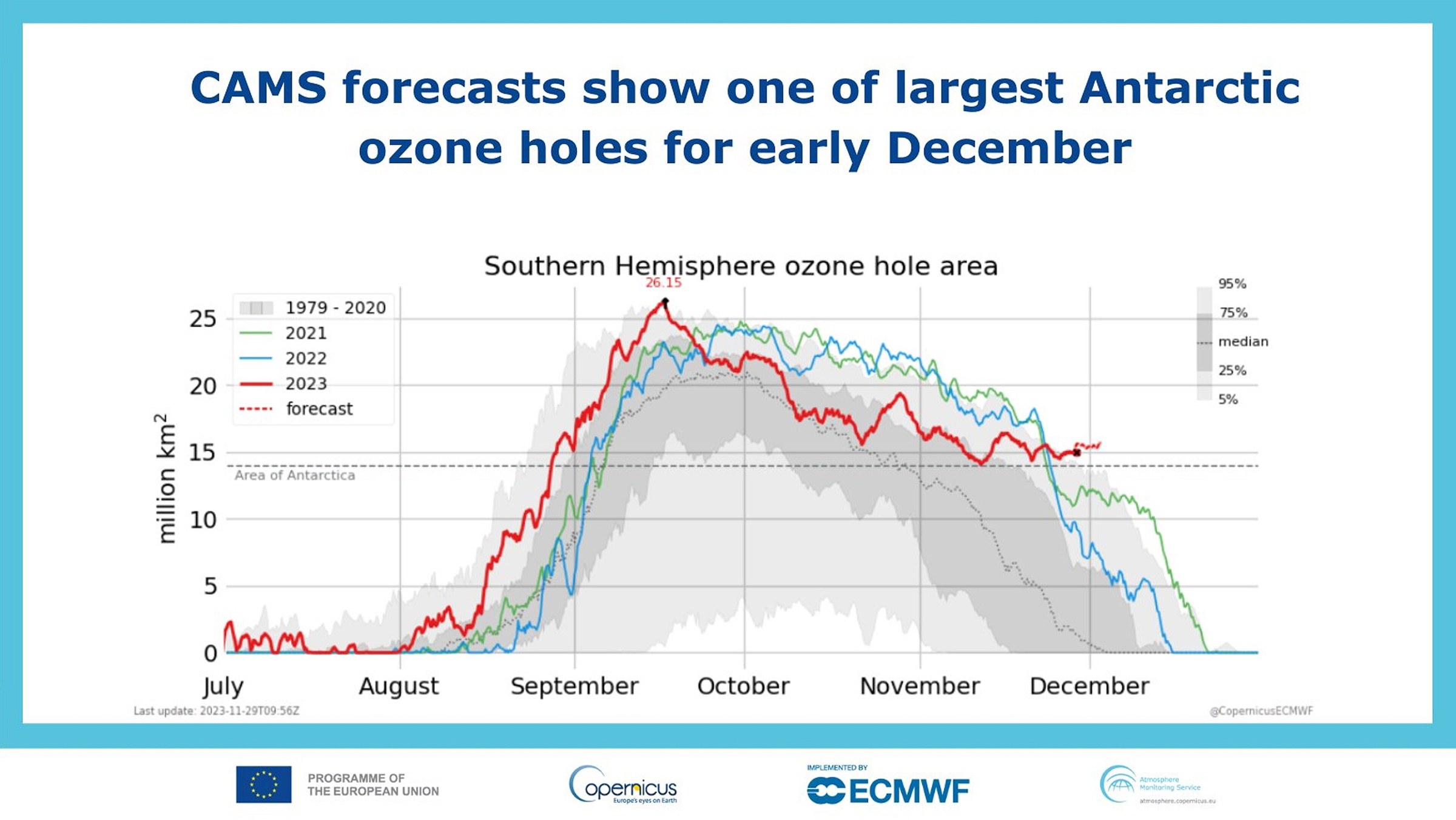
Antarctica’s Ozone Hole, unusually large for this time of the year (Copernicus). Credit: Antarctica’s Ozone Hole, unusually large for this time of the year (Attribution), via Wikimedia Commons.
The 2025 figure describes the mean area of the ozone hole from September 7 through October 13, not its greatest extent on a single day. The hole reached its maximum area on September 9 at 22.86 million km² (8.83 million mi²), compared with the 18.71 million km² (7.23 million mi²) seasonal mean used for the comparison with the contiguous United States.
The ranking also depends on the comparison period. NOAA and NASA ranked the 2025 seasonal mean as the fifth-smallest since 1992. When the agencies compared it with the longer satellite record beginning in 1979, the same season ranked 14th-smallest over 46 years of observations.

The smaller 2025 hole reflected both the declining abundance of ozone-depleting chemicals and atmospheric conditions over Antarctica. Stephen Montzka of NOAA’s Global Monitoring Laboratory reported that ozone-depleting substances in the Antarctic stratosphere had declined by about one-third from their peak around 2000, relative to pre-ozone-hole levels.
Paul Newman, a senior scientist associated with NASA’s ozone research program, estimated that the 2025 hole would have been more than 2.59 million km² (1 million mi²) larger if the stratosphere still contained as much chlorine as it did about 25 years earlier. The estimate describes a counterfactual calculation rather than an observation of a second atmosphere: scientists use the measured decline in ozone-depleting substances to estimate how much additional depletion would have occurred had chlorine remained near its earlier level.

Human-made compounds containing chlorine and bromine are transported into the stratosphere, where ultraviolet radiation breaks them down and releases reactive forms of the two elements. During the Antarctic winter and spring, very low stratospheric temperatures allow polar stratospheric clouds to form. Chemical reactions on those cloud particles convert chlorine into forms capable of rapidly destroying ozone after sunlight returns to the polar region.
The stratospheric polar vortex controls much of that seasonal environment. The vortex is a broad circulation of winds around Antarctica that isolates cold polar air. A strong, cold vortex can maintain a large region favorable for polar stratospheric clouds and ozone destruction, while a weaker or more disturbed vortex promotes warmer conditions and atmospheric mixing that limit the area and duration of severe depletion.
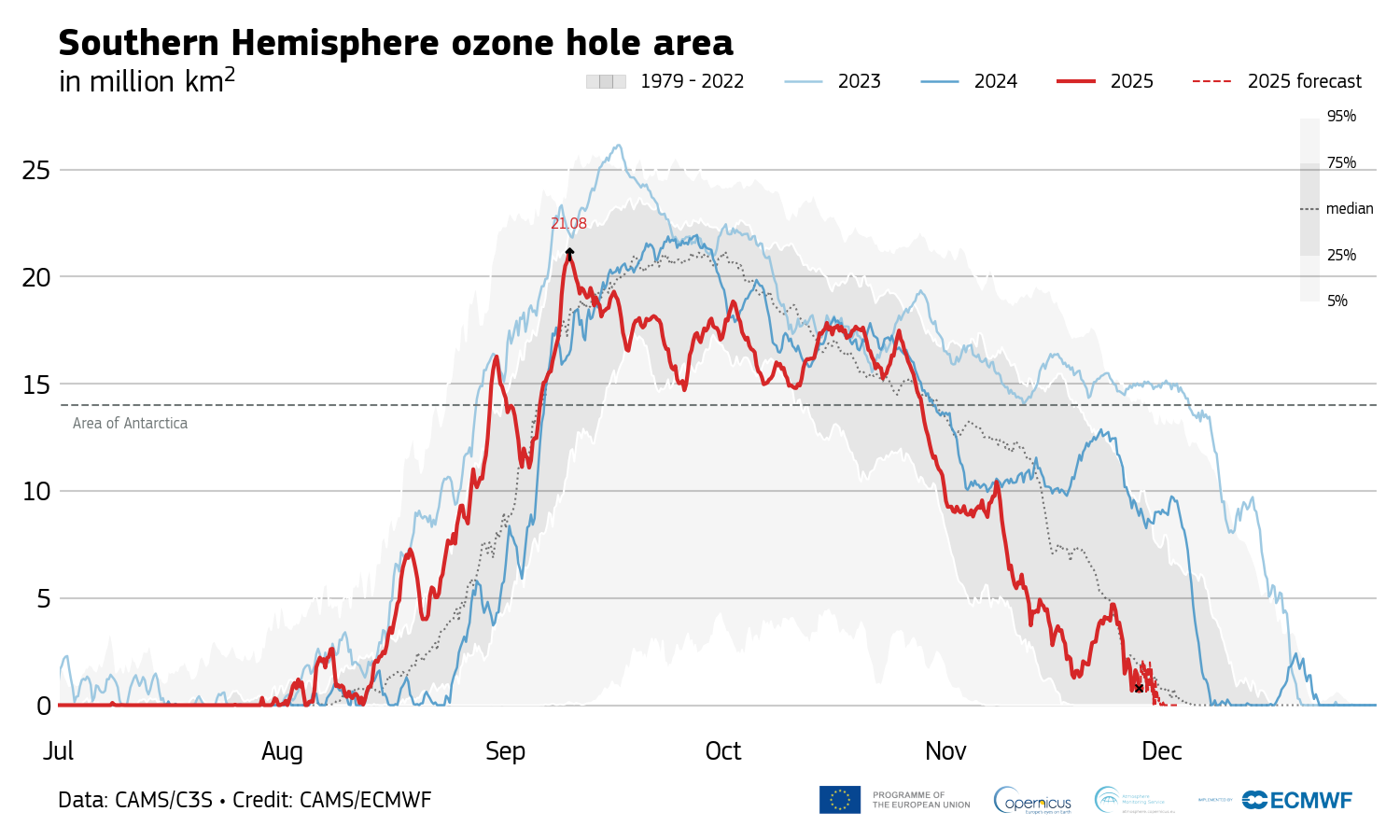
NOAA meteorologist Laura Ciasto reported that the polar vortex was weaker than normal during August 2025, helping to keep stratospheric temperatures above average and contributing to the smaller ozone hole. That meteorological influence makes an individual season an incomplete measure of the underlying chemical recovery trend.


The contrast became much stronger in 2026. Between September 7 and October 13, the Antarctic ozone hole averaged about 25 million km² (9.6 million mi²), ranking seventh-largest by seasonal mean area in 48 years of monitoring. Its maximum area reached 27.1 million km² (10.5 million mi²) on September 18.

NOAA and NASA attributed much of the larger 2026 extent to an unusually powerful polar vortex. Amy Butler of NOAA’s Chemical Sciences Laboratory reported that planetary-scale weather systems that normally propagate upward from the lower atmosphere and disrupt the vortex were especially weak during August and September. The strongest vortex winds remained farther from the South Pole, enlarging the region where temperatures favored ozone depletion.
The 2026 season nevertheless retained a measurable signal from the reduction in ozone-depleting substances. Newman estimated that the hole would have been roughly another 2.6–5.2 million km² (1–2 million mi²) larger if those substances had remained as abundant as they were around their 2000 peak.
The 2025 and 2026 counterfactuals address a different question from the measured annual area. The observed size records what happened under the atmospheric conditions of each season; the counterfactual estimates how much additional ozone depletion the same atmosphere could have sustained if chlorine loading had remained substantially higher.
Scientists define the Antarctic ozone hole as the region south of 40°S where total-column ozone falls below 220 Dobson Units (DU). A Dobson Unit expresses the total amount of ozone in the atmospheric column above a location. A column containing 100 DU would form a layer of pure ozone 1 mm (0.04 inches) thick if compressed to standard temperature and pressure at sea level.
Area and minimum ozone are different measurements. A hole can cover a large geographic area without reaching the lowest ozone concentrations ever measured. NOAA instruments above the South Pole recorded a 2025 minimum of 147 DU on October 6. In 2026, the annual minimum directly above the station reached 105 DU on October 17. The lowest value cited by NOAA and NASA for the South Pole remains 92 DU, recorded in October 2006.
Monitoring combines satellite observations with measurements made directly from Antarctica. NASA and NOAA use instruments aboard NASA’s Aura satellite, NOAA-20, NOAA-21 and the Suomi National Polar-orbiting Partnership satellite. At the South Pole, NOAA also uses balloon-borne ozonesondes and a Dobson ozone spectrophotometer to measure the vertical ozone profile and total ozone overhead.
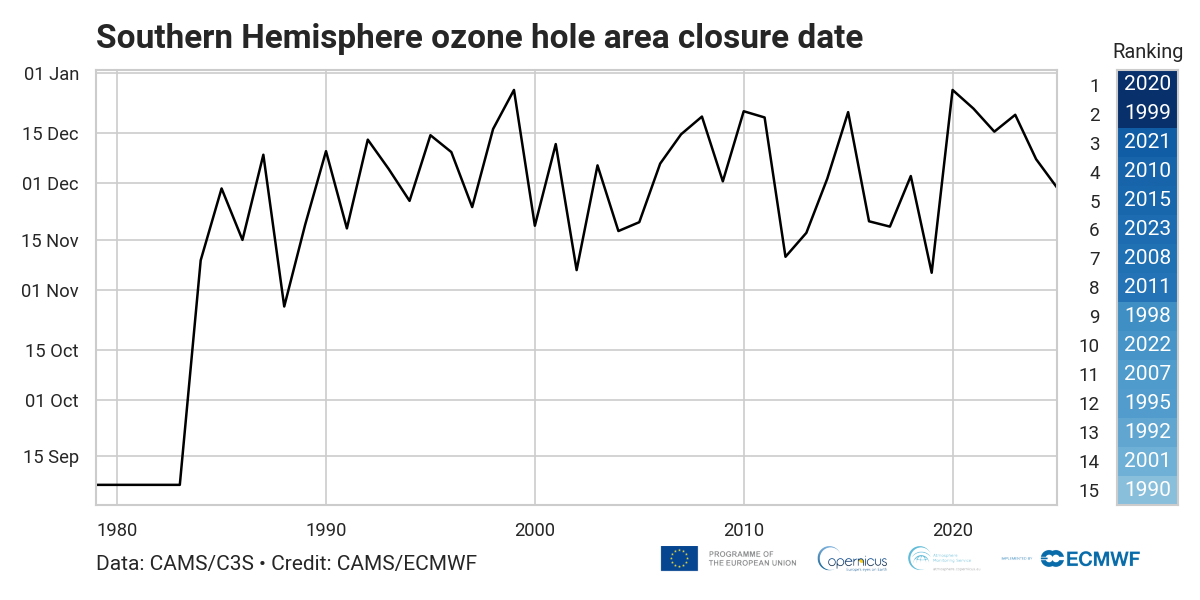
The 2025 season also ended earlier than several recent Antarctic ozone-hole seasons. The closure record maintained by the Copernicus Atmosphere Monitoring Service shows how strongly the duration of the hole can vary from year to year, reinforcing the distinction between short-term atmospheric dynamics and the multi-decadal decline in ozone-depleting substances.

The latest international assessment places that recovery on a multi-decadal timescale. The Scientific Assessment of Ozone Depletion: 2026 reports that Antarctic total-column ozone continues to recover despite substantial variability in the area, depth and longevity of individual ozone holes. Under its middle-of-the-road greenhouse-gas scenario, Antarctic total-column ozone is projected to return to 1980 values during the 2060s.
The assessment identifies atmospheric dynamics as the main source of year-to-year variability while concentrations of controlled ozone-depleting substances continue to decline. That distinction explains why a comparatively small hole in 2025 could be followed by one of the larger seasonal means in the observational record in 2026 without reversing the longer-term recovery.
The two seasons represent different combinations of the same physical controls. Declining chlorine and bromine are reducing the chemical capacity for Antarctic ozone destruction over decades, while the strength, temperature and extent of the polar vortex determine how much of that remaining capacity is realized in a particular spring. A single year’s hole size cannot resolve those two timescales on its own.
References:
1 NOAA, NASA: 2025 ozone hole is 5th smallest since 1992 – National Oceanic and Atmospheric Administration – November 24, 2025
2 NOAA, NASA release measurements of 2026 ozone hole – National Oceanic and Atmospheric Administration – November 4, 2026
3 Executive Summary, Scientific Assessment of Ozone Depletion: 2026 – World Meteorological Organization / United Nations Environment Programme – 2026

I’m a science journalist and researcher at The Watchers, contributing to the Epicenter edition, where I cover peer-reviewed scientific research and emerging discoveries across Earth and space sciences. With a background in astronomy and a passion for environmental science, I’ve worked in shark and coral conservation in Fiji, conducting reef and shark-behavior research, contributing to mangrove restoration, and earning PADI Open Water and Coral Reef Certifications. I bring a blend of scientific rigor and storytelling to illuminate the discoveries shaping our planet and beyond.
