
Radio pulses every 7.9 minutes reveal binary with white dwarf and Sun-like star
Astronomers have identified GPM J071507−114153, a long-period radio transient producing pulses every 7.9 minutes, as a binary containing a low-mass white dwarf and a G-type star similar to the Sun. The system expands the known range of white-dwarf long-period transients beyond binaries with cool M-dwarf companions, while pulse timing places the radio source close to the white dwarf without yet establishing the physical mechanism that generates the emission.
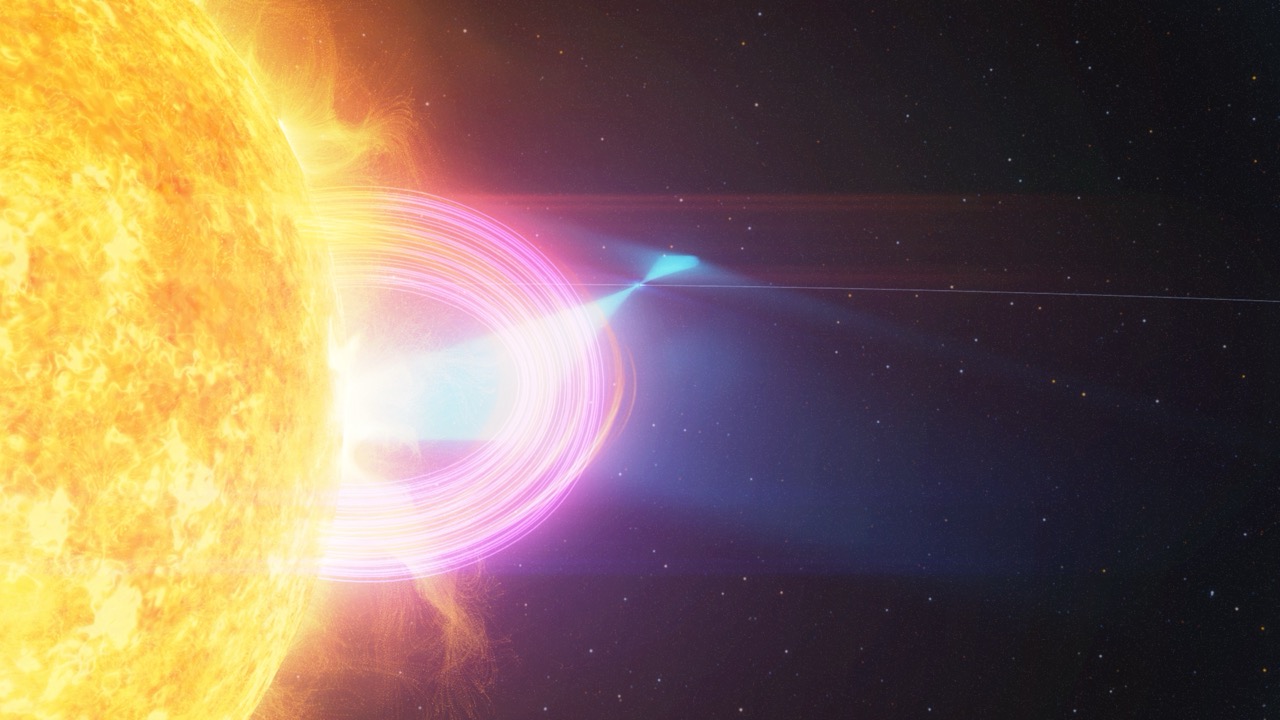
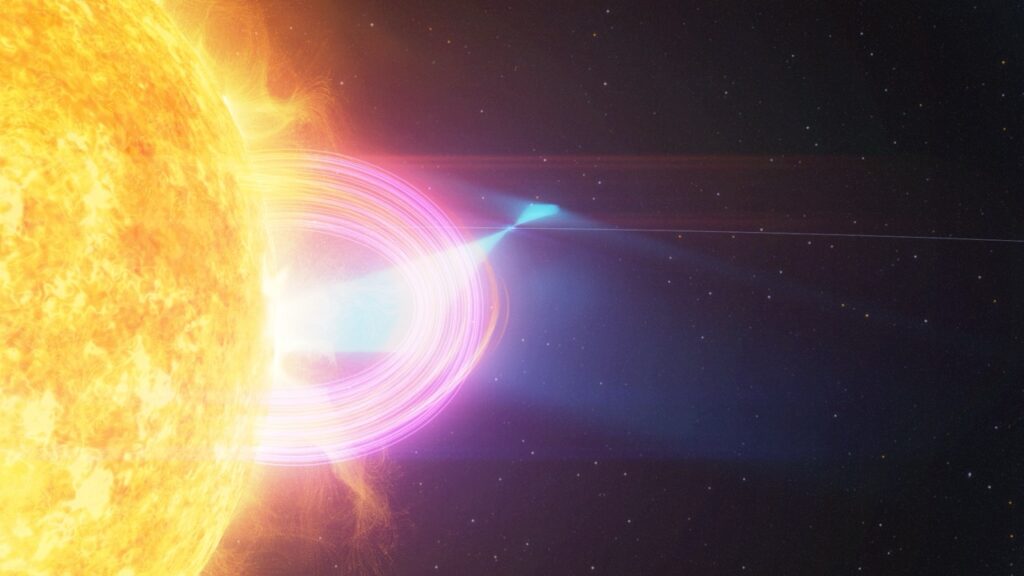
Radio beams from the compact component pass through the atmosphere and magnetic environment of the G-type companion, allowing the signal to probe plasma around the star. Credit: N Hurley-Walker
Long-period transients (LPTs) are an emerging class of repeating radio sources whose pulses recur over periods ranging from minutes to hours. They typically have short duty cycles, strongly polarized radio emission and brightness temperatures that require a coherent emission process rather than ordinary thermal radiation. Before GPM J071507−114153, optical follow-up had confirmed at least 4 of 12 LPTs as binaries containing a white dwarf and an M dwarf.
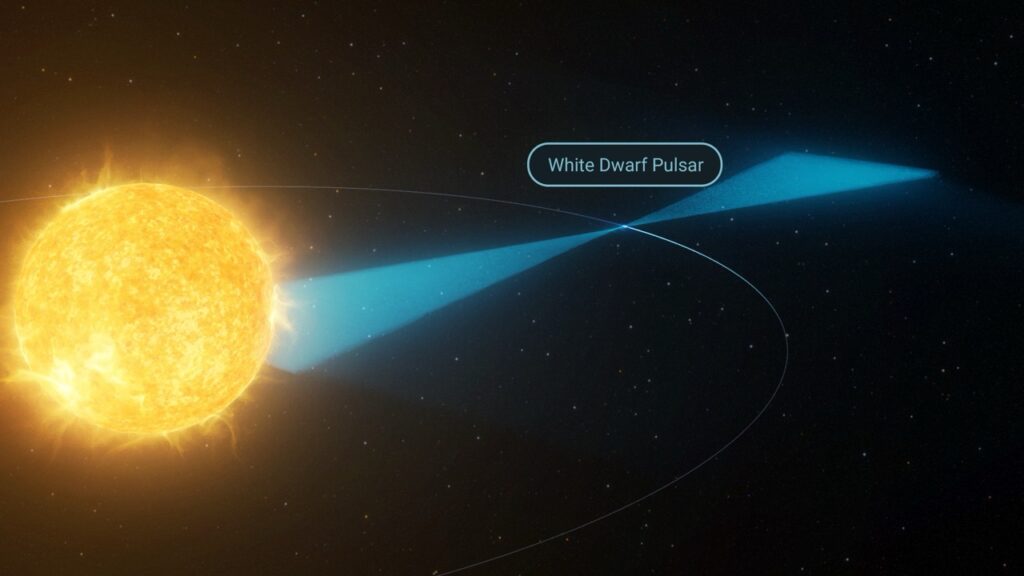
The new system changes that established pattern. Optical spectroscopy identifies the visible companion as a G-type star, the same broad stellar class as the Sun, while the compact member of the binary is a low-mass white dwarf. ICRAR describes it as the first system in which radio pulses have been detected from a white dwarf orbiting a Sun-like star.
The 7.9-minute radio period is accompanied by a second, much slower modulation of about 1.3 days (about 31 hours). The researchers interpret that longer cycle as the orbital period of the binary. Changes in pulse arrival times across the cycle allowed the team to constrain the orbital configuration and follow the motion of the compact component around its companion.
Pulse timing also addresses one of the central uncertainties surrounding white-dwarf LPTs: which part of the binary produces the radio signal. ICRAR reports that the pulses are clear enough to place their origin in a region close to the white dwarf, while leaving open the possibility that the white dwarf itself is the emitter. The observations narrow the source location without resolving the underlying emission mechanism.
The orbital solution provides another constraint on the interaction between the stars. The timing analysis suggests that the G-type star does not fill its Roche lobe, the gravitational region around a star within which material remains bound to that component of the binary. The result limits the geometry available to models of the system without establishing how energy from the binary interaction is converted into coherent radio pulses.
Polarization measurements supplied a separate probe. Near superior conjunction, when the white dwarf passes behind the G-type companion from Earth’s perspective, the researchers measured rapid changes in rotation measure. Rotation measure describes how magnetized plasma rotates the polarization angle of radio waves passing through it. The measured changes are consistent with Faraday rotation induced by the companion star’s corona.
The same geometry allowed the team to examine magnetic activity around the Sun-like star. ICRAR reports stellar flaring and says the white dwarf moved behind a region with a strong magnetic field that the researchers interpret as most probably a stellar prominence, a large magnetically supported loop of plasma extending from the star. The observations show how the repeating radio beam can act as a probe of an otherwise unresolved stellar environment more than 5 000 light-years (more than 1.5 kiloparsecs) away.
Animation of the unusual white-dwarf and Sun-like-star binary associated with GPM J071507−114153. Credit: ICRAR / Natasha Hurley-Walker
The system was discovered through a sequence of radio and optical observations. Researchers first detected the pulses during a Galactic survey with the Murchison Widefield Array (MWA) at Inyarrimanha Ilgari Bundara, the CSIRO Murchison Radio-astronomy Observatory in Western Australia. The MWA surveys large areas of the low-frequency radio sky, allowing transient sources to be identified through repeated observations.

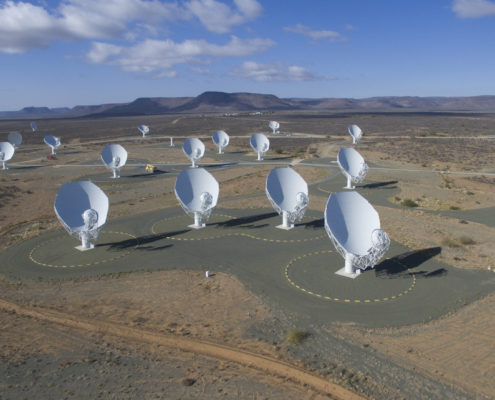
Follow-up observations with the MeerKAT radio telescope in South Africa then refined the source position.2 MeerKAT is a 64-dish radio array operated by the South African Radio Astronomy Observatory, and its higher positional precision allowed the team to connect the transient radio source with an optical stellar counterpart.
Optical observations with the W. M. Keck Observatory on Maunakea, Hawaiʻi Island, then established that the visible companion is a G-type star. The study compares the Keck spectrum with model spectra representing F-, G- and K-type stars. The G-type comparison, at about 5 500 K, matches the observed spectral features better than the hotter F-type and cooler K-type models.

The research team processed more than 100 hours of radio observations at the Pawsey Supercomputing Research Centre while validating the pulse timing and orbital motion. The peer-reviewed study also makes the measured pulse properties and dynamic spectra available through Zenodo and provides the code used to process the dynamic spectra through a public GitHub repository.
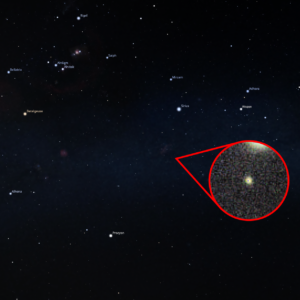
GPM J071507−114153 adds a different stellar configuration to the small LPT population. Earlier optically identified white-dwarf LPT binaries paired the compact object with M dwarfs, whereas the new source shows that a G-type companion in a day-scale orbit can also participate in the phenomenon. The result widens the range of binaries that models of coherent LPT emission must be able to explain.
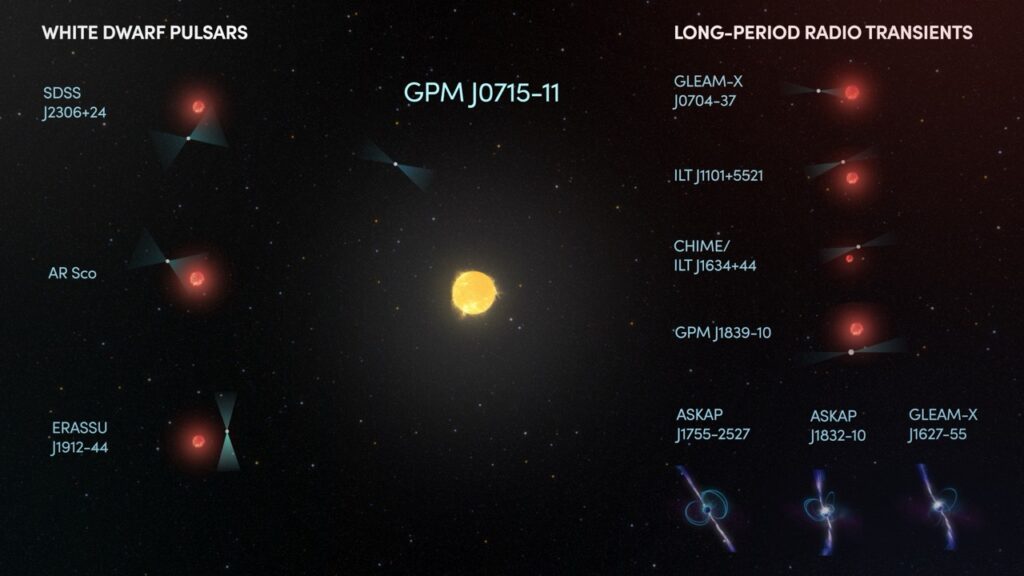
The study’s central interpretation is that coherent pulsed radio emission in white-dwarf LPT binaries depends critically on interaction with the companion star. GPM J071507−114153 shows that the companion involved in that interaction does not need to be an M dwarf. The measurements do not yet identify the physical process that converts the interaction into the observed radio pulses.
A larger sample will be needed to determine whether Sun-like companions are rare exceptions or part of a wider range of binary configurations capable of producing long-period radio transients. The MWA and MeerKAT are precursors to the SKA-Low and SKA-Mid telescopes, and ICRAR researchers expect the greater capabilities of the SKA Observatory to reveal more systems and provide more detailed measurements of their signals.2 Those detections will test whether the pattern emerging from the current small population survives as the sample grows.
References:
1 McSweeney, S. J., Hurley-Walker, N., Bahramian, A., Horváth, C., Rea, N., Rodriguez, A. C., & Pelisoli, I. (2026). A long-period transient with a Sun-like companion. Nature Astronomy. DOI: 10.1038/s41550-026-03016-z
2 Researchers discover rare star system that emits radio signals every eight minutes – International Centre for Radio Astronomy Research – November 12, 2026

I’m a science journalist and researcher at The Watchers, contributing to the Epicenter edition, where I cover peer-reviewed scientific research and emerging discoveries across Earth and space sciences. With a background in astronomy and a passion for environmental science, I’ve worked in shark and coral conservation in Fiji, conducting reef and shark-behavior research, contributing to mangrove restoration, and earning PADI Open Water and Coral Reef Certifications. I bring a blend of scientific rigor and storytelling to illuminate the discoveries shaping our planet and beyond.
Published in the last 24 hours
- Hera begins close survey to explain why DART deflected Dimorphos so strongly Epicenter
- Hubble gravitational lenses prepare Roman to test dark matter on small scales Epicenter
- NASA’s STRIVE mission targets long-standing 3D observing gap in the upper atmosphere Epicenter
- Three Australian estuarine fish species maintain performance across thermal extremes Epicenter
