
Northern lights are possible at high latitudes on November 17 and 18 as NOAA forecasts minor (G1) geomagnetic storms from coronal hole wind
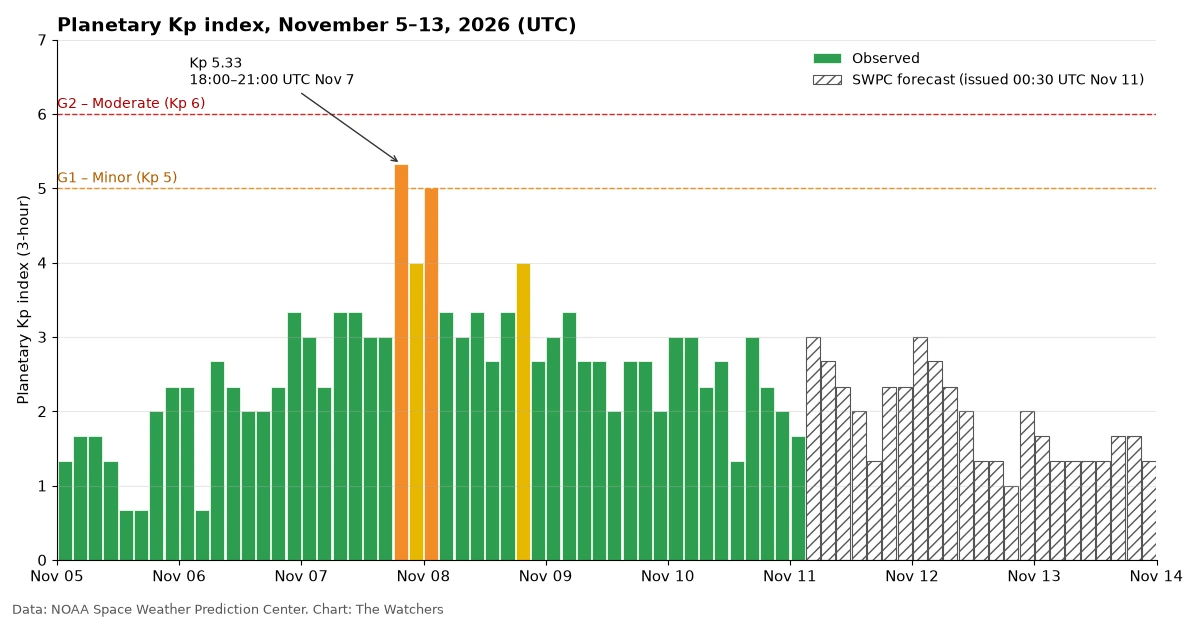
A high-speed solar wind stream from a large negative-polarity coronal hole pushed Earth’s magnetic field to G1 – Minor geomagnetic storm levels late on November 7, 2026. The planetary Kp index reached 5.33 during the 18:00–21:00 UTC period and returned to 5.00 between 00:00 and 03:00 UTC on November 8.1, 2
NOAA’s Space Weather Prediction Center (SWPC) had issued a G1 – Minor geomagnetic storm watch at 19:04 UTC on November 4 and extended it twice, at 17:45 UTC on November 5 and 06:26 UTC on November 7, the last version covering November 7, 8 and 9. A warning for Kp 5 followed at 19:35 UTC on November 7, valid until 21:00 UTC on November 8, and the Kp 5 threshold was crossed at 19:45 UTC on November 7 and again at 02:03 UTC on November 8.2
Activity did not reach G2 – Moderate (Kp 6) at any point during the event. After the second G1 interval, the field stayed mostly unsettled, with Kp at 4.00 again between 18:00 and 21:00 UTC on November 8. SWPC kept a Kp 4 warning in effect from 05:56 UTC on November 9 through 12:00 UTC on November 10.2, 3
At G1 levels, SWPC says weak power grid fluctuations can occur, minor impacts on satellite operations are possible, and aurora may be visible at high latitudes, including the northern tier of the U.S. such as northern Michigan and Maine. Under G2 conditions, which some forecasts had raised as a possibility for the weekend, aurora can be seen as low as New York, Wisconsin and Washington state.2
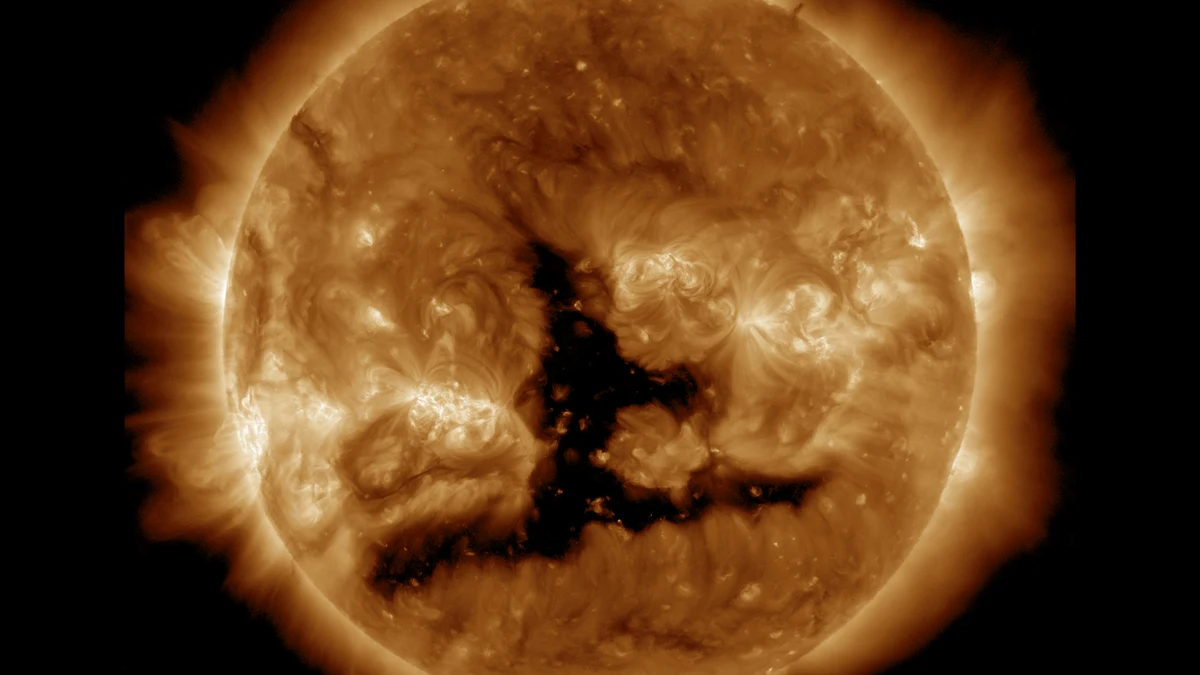
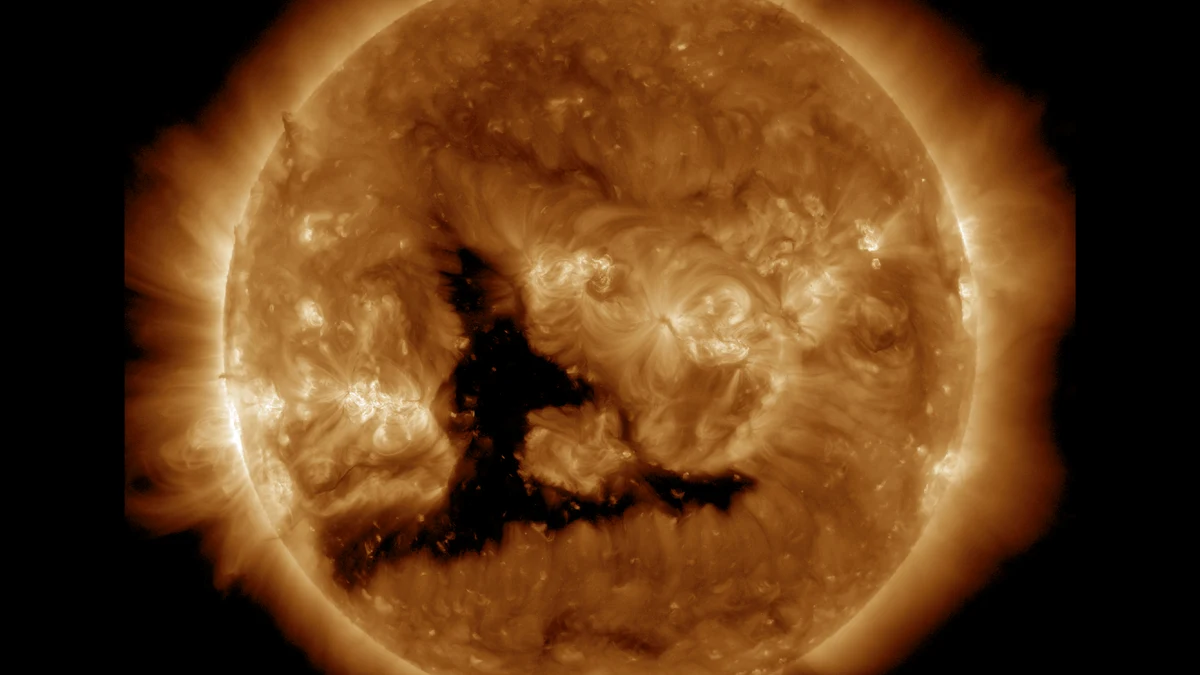
SWPC attributed the rise in activity at the end of the week to the onset of a negative-polarity coronal hole high-speed stream (CH HSS). Coronal holes are regions where the Sun’s magnetic field opens into space, allowing solar wind to escape faster than from the surrounding corona. They appear dark in extreme ultraviolet imagery because the plasma there is cooler and less dense. The hole responsible for this stream crossed the center of the visible solar disk on November 5 and 6, when it faced Earth.4
The stream kept the solar wind fast for several days after the storm. Real-time measurements at the L1 point, about 1.5 million km sunward of Earth, show a peak of 706 km/s at 09:22 UTC on November 10, far above the typical background speed of about 400 km/s. SWPC said solar wind speed decreased from approximately 705 km/s to near 600 km/s in the 24 hours to 00:30 UTC on November 11, and it measured 526 km/s at 05:52 UTC.1, 5
Fast wind alone does not drive strong storms. Over the same period, the total interplanetary magnetic field ranged from just 2 to 5 nT, and its north–south component, Bz, varied between +5 and −3 nT. With little sustained southward field to couple to Earth’s magnetosphere, the geomagnetic field remained quiet to unsettled on November 10.1
The stream’s more lasting effect has been on the outer radiation belt. The greater than 2 MeV electron flux at geosynchronous orbit crossed SWPC’s 1 000 particle flux unit (pfu) alert threshold at 22:45 UTC on November 8, as measured by GOES-19, and SWPC has kept the alert running since. Daily peaks rose from 1 228 pfu at 23:35 UTC on November 8 to 4 674 pfu at 16:30 UTC on November 9 and 6 420 pfu at 15:50 UTC on November 10.1, 2, 6
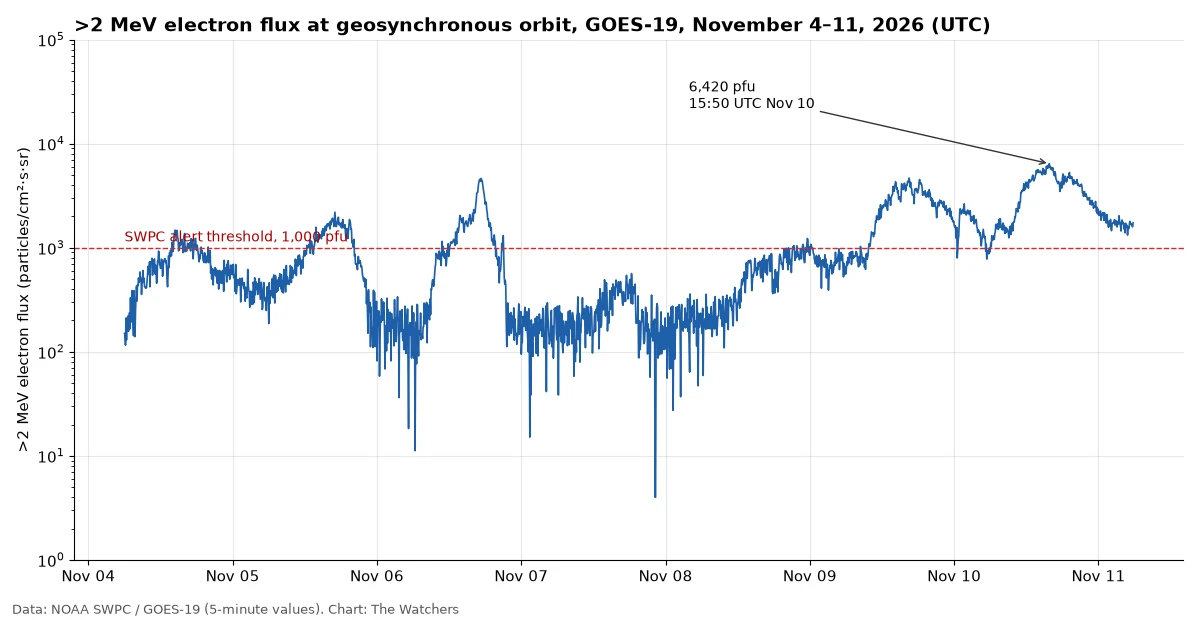
Elevated high-energy electron flux raises the risk of internal charging on satellites in geosynchronous orbit. SWPC expects the flux to stay at high levels through November 13.1
On the Sun, Region 4566 has been the main source of flaring. It produced all seven M-class flares recorded between November 2 and 8, the largest an M3.5/2b that peaked at 18:33 UTC on November 5, as well as 75 of the 80 C-class flares in that period. The CME launched with the M3.5 flare was determined to be traveling too far east to affect Earth.3
The region, located at S07W34 on November 11, has a beta-gamma-delta magnetic configuration and produced the largest flare of the past 24 hours, a C9.3 at 08:34 UTC on November 10. SWPC noted the spot group was showing signs of decay but still contained several small delta areas. No Earth-directed CMEs were observed. SWPC gives a daily 60% probability of R1–R2 (Minor–Moderate) radio blackouts, a 15% probability of R3 (Strong) or greater blackouts and a 15% probability of an S1 – Minor solar radiation storm through November 13.1, 7
Region 4566 is expected to rotate off the visible disk around November 14 and return around November 28.3
The 3-day forecast issued at 00:30 UTC on November 11 calls for a maximum Kp of 3, below storm levels, through November 13, with no significant transient or recurrent solar wind features expected. SWPC expects the solar wind to gradually diminish over November 11 and 12 and return to nominal conditions by November 13.1, 7
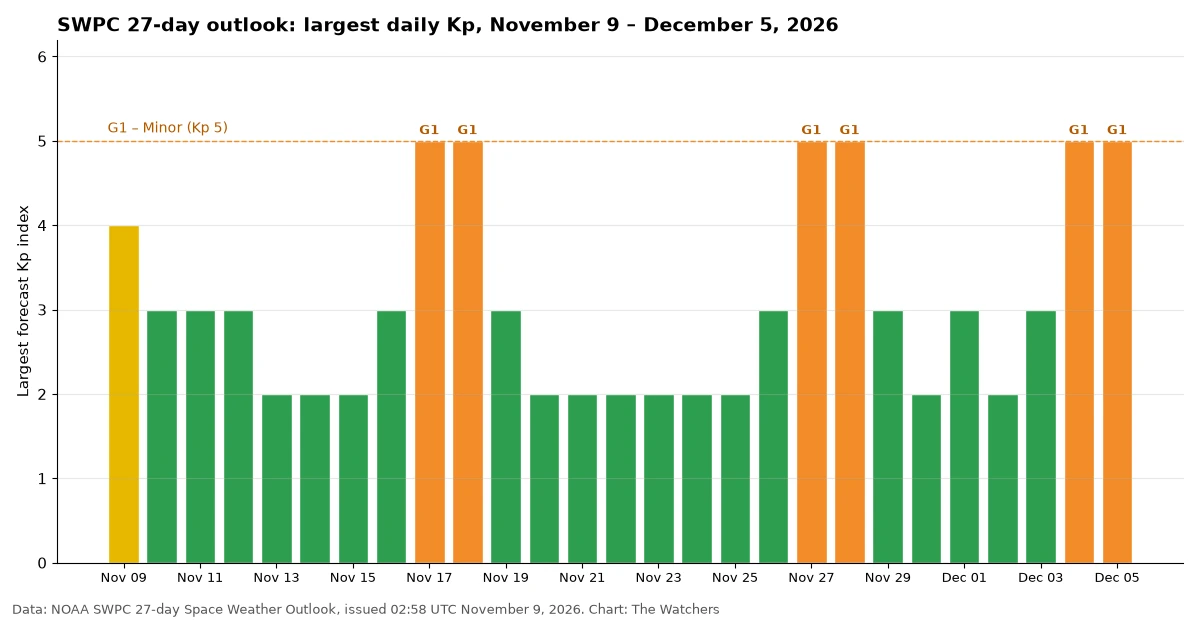
Further coronal hole streams are expected later in the month. SWPC’s 27-day outlook, issued at 02:58 UTC on November 9, forecasts G1 – Minor storm levels on November 17 and 18, November 27 and 28, and December 4 and 5, with unsettled to active periods on November 16–19, November 26–28 and December 4–5. SWPC attributes the forecast activity to CH HSS influences. The December 4–5 window falls one solar rotation, about 27 days, after the November 7–8 storm.3, 8
The previous storm, on October 31 and November 1, came from a separate, recurrent positive-polarity coronal hole stream and reached Kp 6 (G2 – Moderate) at 19:14 UTC on October 31.2
Aurora visibility during these periods will depend on the orientation of the magnetic field carried by each stream, local cloud cover and darkness.
References:
1 Forecast Discussion – NOAA/SWPC – Issued at 00:30 UTC on November 11, 2026
2 Alerts, Watches and Warnings – NOAA/SWPC – October 28 to November 11, 2026
3 Weekly Highlights and Forecasts – NOAA/SWPC – Issued at 02:58 UTC on November 9, 2026
4 SDO/AIA 193 imagery – NASA SDO, Helioviewer – November 5–6, 2026
5 Real Time Solar Wind – NOAA/SWPC – November 10–11, 2026
6 GOES Electron Flux – NOAA/SWPC – November 4–11, 2026
7 3-Day Forecast – NOAA/SWPC – Issued at 00:30 UTC on November 11, 2026
8 27-day Space Weather Outlook – NOAA/SWPC – Issued at 02:58 UTC on November 9, 2026

The Watchers Staff covers earthquakes, volcanoes, severe weather, space weather and other natural events. Published since 2011, The Watchers reports on a changing planet and the science behind it.
Published in the last 24 hours
- In February 2022, SpaceX launched 49 Starlink satellites into a solar storm so mild that forecasters rated it minor, and within days 38 of them had fallen back and burned up, because the storm had swollen the thin air they were flying through Epicenter
- On a Friday night in October 1992, a fireball over the eastern US was filmed by fans at high school football games before it punched through the trunk of a teenager’s $400 Chevy Malibu in Peekskill, New York, and she sold the wrecked car for $10,000 Epicenter
- Green Lake, Hawaii's largest freshwater lake, was gone by the afternoon of June 2, 2018, after lava from Kilauea filled its basin. The water was about 20 feet deep, not the 200 feet often claimed. Epicenter
- Flying glass cut a teacher in Russia but none of her 44 pupils, because when a meteor flashed across the sky in 2013, she told them to get under their desks Epicenter
