
On a Friday night in October 1992, a fireball over the eastern US was filmed by fans at high school football games before it punched through the trunk of a teenager’s $400 Chevy Malibu in Peekskill, New York, and she sold the wrecked car for $10,000
On the evening of October 9, 1992, 18-year-old Michelle Knapp was watching TV at her parents’ house in Peekskill, New York. Just before 8 p.m., she heard a crash outside that sounded like several cars colliding.
She went out to the driveway and found her red 1980 Chevy Malibu with a hole through the back of the trunk. Under the car, in a small crater in the driveway, was a rock about the size of a football. It was still warm and smelled of sulfur.
A fireball seen across several states
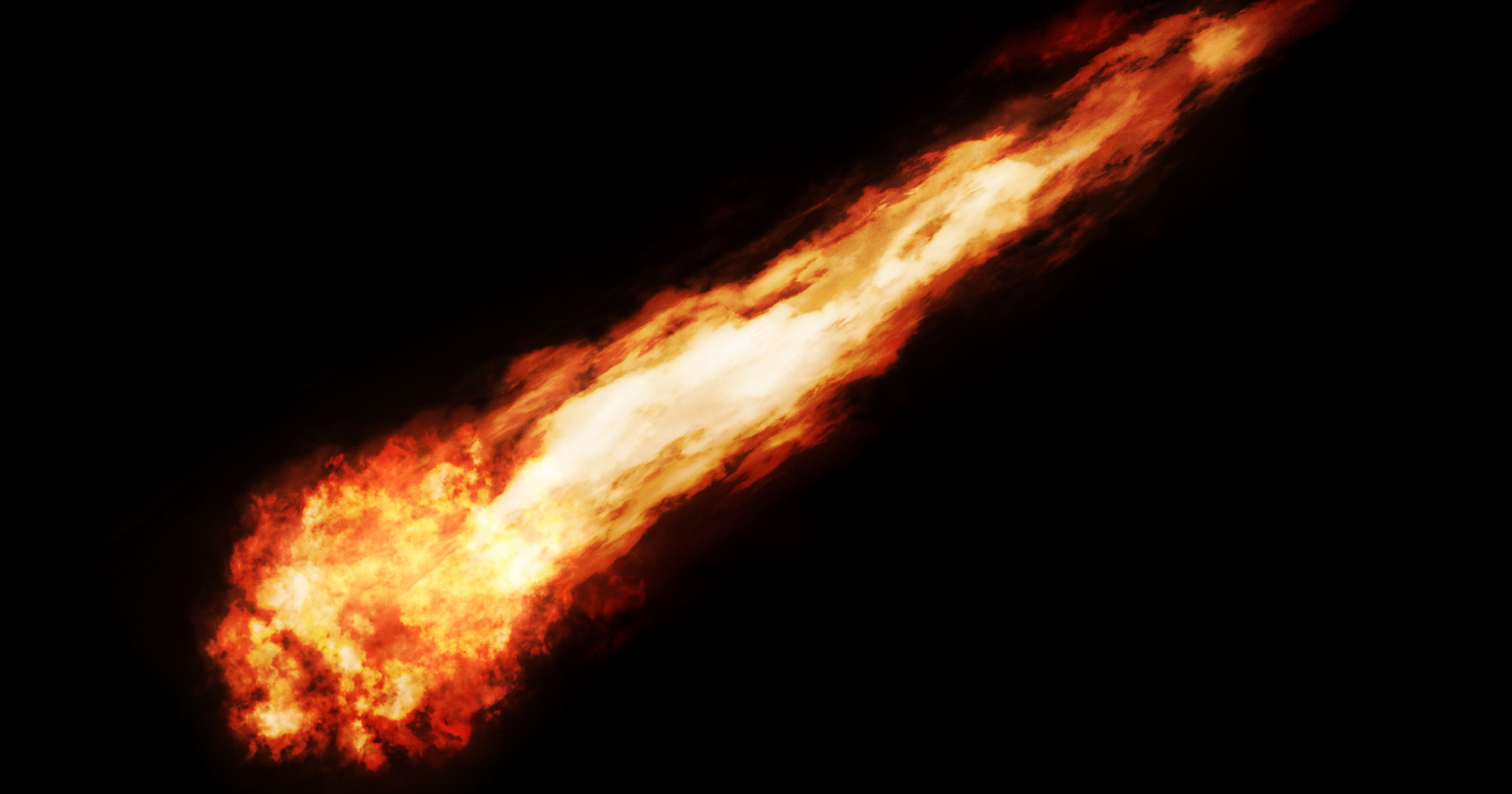
A few seconds earlier, a brilliant greenish fireball had streaked across the evening sky over the eastern United States. People saw it over Kentucky, West Virginia, Pennsylvania and Maryland as it travelled northeast toward New York.
It wasn’t one solid object for long. As it plunged through the atmosphere, the space rock broke into dozens of fragments, flashing and crackling as it went. Many witnesses said it was the brightest thing they had ever seen in the sky.
Filmed by football fans
The timing was remarkable. It was a Friday night in autumn, which meant high school football games were being played across the region, and many parents had brought camcorders to film their children.
When the fireball appeared, some of them turned their cameras to the sky. At least 14 to 16 separate videos captured it from different locations. Until then, scientists had almost never had video of a meteorite fall, let alone several angles of the same one.
Why the videos mattered to scientists
Because the fireball was filmed from several places, scientists could reconstruct its path through the atmosphere in detail. That allowed them to work backward and calculate the rock’s orbit around the Sun before it hit Earth.
At the time, the Peekskill meteorite was only the fourth recovered meteorite with detailed data on its trajectory. Linking a meteorite to its orbit helps scientists understand where in the solar system these rocks come from, usually the asteroid belt between Mars and Jupiter.
The rock that hit the Malibu weighed about 12.4 kilograms, or roughly 27 pounds. It is an ordinary chondrite, a common type of stony meteorite, and about 4.4 billion years old. Scientists believe other fragments also reached the ground, but only this one has been found.
A $400 car becomes a collector’s item
At first, local police thought the damage might be vandalism. It soon became clear that Knapp’s car had been hit by a meteorite, and it quickly became famous.
Knapp had bought the Malibu, reportedly from her grandmother, for $400 only weeks earlier. Within days, a meteorite dealer bought the wrecked car for $10,000. She also sold the meteorite itself to collectors for a much larger sum, reported as around $50,000.
The car has since been displayed in museums and exhibitions around the world, including in New York, Paris, Munich and Tokyo. Pieces of the meteorite have been sold to collectors and institutions, and one small slice sold for several thousand dollars at a Christie’s auction in 2021.
How often does this happen?
Space rocks hit Earth’s atmosphere every day, but most are small and burn up completely. Bright fireballs are fairly common, and the American Meteor Society receives thousands of reports of them every year.
Meteorites that survive to the ground are much rarer, and ones that hit buildings or cars are rarer still. Most land in oceans, deserts or remote areas, where no one sees them fall. That’s why a meteorite landing in a driveway, filmed by football fans, became one of the best-known falls in history.
What to do if you see a fireball
If you see an unusually bright meteor, note the time, your location, the direction it travelled and any colors or sounds. You can report it to the American Meteor Society or a similar organization in your country. Reports from many people help scientists work out where any fragments may have landed.
If you think you’ve found a meteorite, keep it dry, avoid handling it more than necessary, and take photos of where you found it. Then contact a local university, museum or geology department. They can tell you whether it’s genuine and whether it may be scientifically important.

The Watchers Staff covers earthquakes, volcanoes, severe weather, space weather and other natural events. Published since 2011, The Watchers reports on a changing planet and the science behind it.
Published in the last 24 hours
- Green Lake, Hawaii's largest freshwater lake, was gone by the afternoon of June 2, 2018, after lava from Kilauea filled its basin. The water was about 20 feet deep, not the 200 feet often claimed. Epicenter
- Flying glass cut a teacher in Russia but none of her 44 pupils, because when a meteor flashed across the sky in 2013, she told them to get under their desks Epicenter
- A South Dakota man put the widest and heaviest hailstone on US record in his freezer, and a power cut melted part of it before NOAA measured it at 8 inches across and nearly 2 pounds in 2010 Epicenter
- Black kites and brown falcons in northern Australia have been seen snatching smoldering sticks from wildfires, flying them into unburned grass and dropping them, starting new fires that send lizards, rodents and insects running straight toward the waiting birds Epicenter
