
Fiber-optic sensing reveals hidden rupture stages inside a small California earthquake
A small earthquake in California’s Brawley Seismic Zone broke in two distinct stages only 42 milliseconds apart, exposing fault behavior that conventional observations have struggled to resolve at this scale. Dense fiber-optic measurements allowed researchers to reconstruct rupture stopping and restarting nearby, opening a much finer observational window into how microearthquakes grow, interact and terminate.
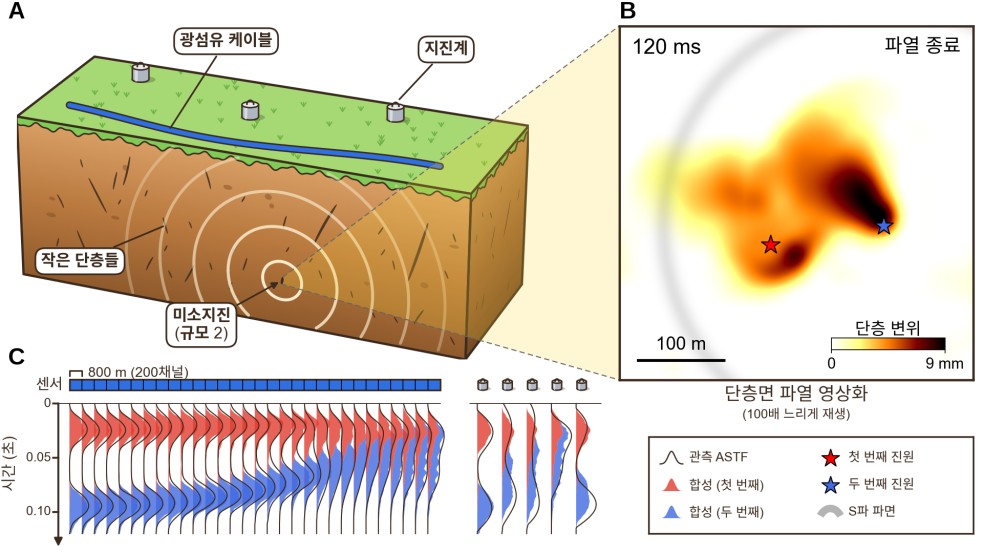
Small earthquakes below M3 are commonly represented as compact, roughly circular ruptures, partly because their weak seismic waves and brief source durations leave much of their internal fault motion unresolved. Han et al. (2026) reconstructed an M2-class earthquake in California’s Brawley Seismic Zone at millisecond scale and found a more fragmented process: rupture developed in one part of the fault, stopped, and then began again immediately nearby.
The result addresses an observational gap in earthquake physics. Complex multi-stage rupture can be resolved more readily in large earthquakes because those events last longer and radiate stronger signals, while the internal behavior of much more common microearthquakes is difficult to recover. The Brawley measurements show that a very small earthquake can contain resolvable internal rupture structure, giving seismologists another scale at which to test how rupture starts, propagates, stops and interacts with neighboring fault patches.
The earthquake belonged to a short sequence recorded on May 14, 2021, by the Imperial Valley Dark Fiber project. The experiment used approximately 28 km (17.4 miles) of existing telecommunications fiber between Calipatria and Imperial in Southern California, passing through the Brawley Geothermal Field and the surrounding Brawley Seismic Zone.
Distributed acoustic sensing, or DAS, turns an optical fiber into a dense line of vibration measurements. An interrogator sends laser pulses through the cable and analyzes light scattered back by microscopic variations in the fiber. When seismic waves stretch or compress the cable, the optical signal changes, allowing strain or strain rate to be measured at closely spaced positions along the fiber.
View credited image at source. Distributed acoustic sensing uses laser pulses and Rayleigh backscattering to measure deformation along an optical fiber. A single cable can provide spatially continuous measurements over tens of kilometers. Credit: Davie Loria/EarthScope Consortium
The archived Imperial Valley experiment describes approximately 6 900 virtual sensors along the active cable section at a mean channel spacing of about 4 m (13 feet). Earlier technical documentation of the experiment gives a total of 6 912 channels across the approximately 28 km section, showing why institutional summaries sometimes round the system to about 7 000 sensing points.
The Brawley sequence in numbers
| Parameter | Verified value | What it describes |
|---|---|---|
| Sequence date | May 14, 2021 | Physical earthquake sequence analyzed in the archived dataset |
| Fiber section | ~28 km (17.4 miles) | Telecommunications cable interrogated by DAS |
| Virtual sensors | ~6 900 | Spatial measurement channels along the fiber |
| Mean channel spacing | ~4 m (13 feet) | Distance between neighboring DAS measurements |
| Recorded local events | 16 | Earthquakes in the approximately three-hour sequence |
| Local magnitude range | ML0.78–2.03 | Magnitude range of the archived events |
| Rupture-zone diameter | ~0.5 km (0.31 miles) | Compact area containing the relocated events |
| Hypocentral depths | ~8.9–9.4 km (5.5–5.8 miles) | Relocated earthquake depths |
| Rupture-stage separation | 42 milliseconds | Interval reconstructed between the two source episodes of the focal event |
The dataset contains 16 local earthquakes recorded during approximately three hours, ranging from ML0.78 to ML2.03. Six were identified in the Southern California Seismic Network catalog; another 10 were detected using the DAS array. Relocation placed all 16 on a strike-slip fault within a compact zone about 0.5 km (0.31 miles) in diameter at depths of approximately 8.9 to 9.4 km (5.5 to 5.8 miles).
Those measurements establish the geometry of the sequence, but the principal result came from reconstructing the largest event. The researchers inverted fiber-derived apparent source time functions, using differences in the timing and shape of seismic signals measured along the array to estimate how rupture evolved on the fault.
An inversion is a reconstruction from measured data rather than a direct image of an underground fault surface. The fiber records ground deformation produced by seismic waves; mathematical analysis then works backward from those measurements to estimate the timing and spatial distribution of slip that produced them.
What was measured directly, and what was reconstructed?
Measured: strain-related seismic signals along the fiber, their timing, the earthquake sequence, and the dense spatial variation of the recorded wavefield.
Derived or reconstructed: earthquake locations on the fault plane, apparent source time functions and the spatial-temporal evolution of the focal rupture.
Interpreted: rupture arrest followed by dynamic renucleation, stress interaction between nearby patches and the role of fragmentation in restricting rupture growth.
The reconstruction resolved two distinct rupture episodes separated by 42 milliseconds, or 0.042 seconds. Han et al. interpret the sequence as rupture arrest followed by dynamic renucleation: the first failure stopped before another rupture initiated on an adjacent part of the fault instead of continuing outward as one uninterrupted crack.
The short interval is physically important because observational resolution determines whether separate stages can be distinguished at all. At coarser resolution, two source episodes only tens of milliseconds apart can be blended into one apparently simple event. The dense near-source array preserved enough spatial and temporal information for the researchers to separate the stages.
“Forty-two milliseconds is not very much time at all, especially in geological terms.”
Jonathan Ajo-Franklin, Rice University
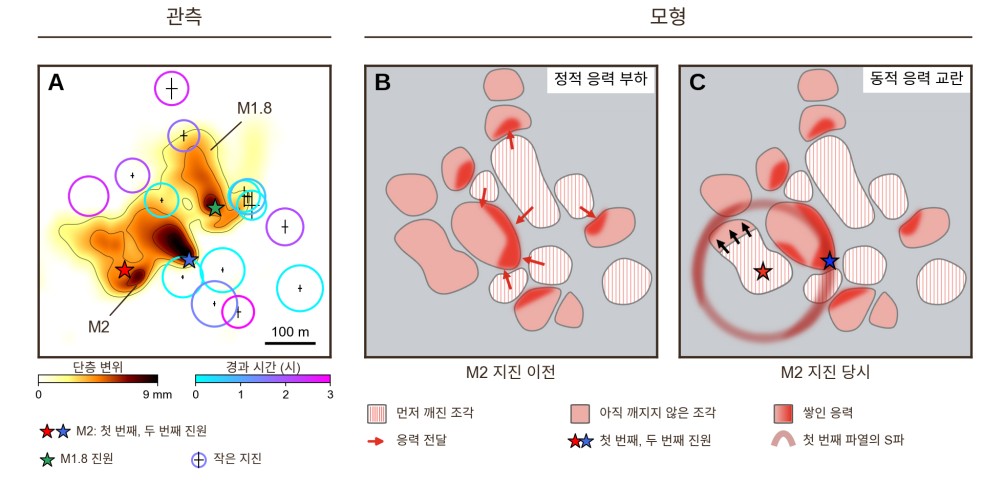
Rice University reported that the two reconstructed rupture areas were separate but immediately adjacent. YoungHee Kim, professor of geophysics at Seoul National University and a co-lead author of the study, said the data support an interpretation in which the first rupture triggered the second. The peer-reviewed paper describes the process more specifically as rupture arrest followed by dynamic renucleation.
The analysis then expanded from the ML2.03 focal event to the surrounding sequence. Adjacent, largely non-overlapping fault patches activated successively during the approximately three-hour interval. Han et al. describe the pattern as complementary slip partitioning, meaning that successive earthquakes occupied neighboring parts of the compact fault zone rather than repeatedly reproducing the same rupture area.
The spatial pattern provides another constraint on how the sequence evolved. Earthquake size depends in part on whether a rupture continues into surrounding fault material or stops. Han et al. interpret fragmentation within the M2-class event and across the surrounding sequence as a process that restricted rupture growth, consistent with the absence of one dominant mainshock.
Why this does not mean small earthquakes can now predict large ones
The study resolves rupture mechanics in one closely observed microearthquake sequence. It does not establish a rule that fragmented rupture prevents a larger earthquake, does not determine whether another swarm will remain small and does not provide a method for predicting the time, location or magnitude of a future large earthquake.
Its immediate scientific value is narrower and more defensible: fiber-optic sensing gives researchers access to source processes inside earthquakes that have often been too small and too brief to image at comparable detail.
The distinction between observation and interpretation is therefore essential. The 42-millisecond separation is recovered from the seismic analysis. Rupture arrest, dynamic renucleation, triggering between adjacent patches and the role of fragmentation in limiting growth are physical interpretations based on the reconstructed source process.
Why fiber changes the observational problem
Conventional seismic networks remain the foundation of regional earthquake monitoring, but their instruments are positioned at discrete sites. A DAS cable samples ground deformation at thousands of closely spaced points along a continuous path. When the fiber lies near an earthquake source, variations along that path can preserve differences in timing that would be difficult to resolve with a much more widely spaced network.
The Imperial Valley project was originally designed around the use of existing dark fiber for geothermal and seismic research. Dark fiber is telecommunications fiber that has been installed but is not carrying ordinary communications traffic. Connecting a DAS interrogator can repurpose that infrastructure as a dense geophysical sensor without placing thousands of separate instruments along the route.
Keep reading
The SCSN live display above comes from a different Southern California fiber deployment and should not be confused with the Imperial Valley experiment. Its value here is visual: instead of producing a single seismogram, DAS generates measurements across many cable positions simultaneously, creating a moving wavefield across distance and time.
The Brawley experiment recorded at a 4 m channel interval across 6 912 channels in its approximately 28 km active section. Earlier documentation of the system reports a 10 m gauge length, a 2 kHz laser pulse rate and a 500 Hz recording rate, parameters that produced the dense dataset later used for earthquake-source analysis.
The monitoring application in the seminar is distinct from the Brawley rupture study. The connection is technological rather than evidentiary: both use telecommunications fiber to increase the density of seismic observations, while the Brawley work applies that dense sampling to reconstruct the source process of a very small earthquake.
View credited image at source. YoungHee Kim, Sangwoo Han and Jonathan Ajo-Franklin, from left, are among the researchers who analyzed the Brawley Seismic Zone earthquake sequence using near-source distributed acoustic sensing. Credit: Rice University
Small earthquakes as natural rupture experiments
Microearthquakes are attractive for fault-mechanics research because they occur far more frequently than major earthquakes. Their abundance creates many more opportunities to compare rupture under different conditions, but only if instruments can recover enough detail from sources that may evolve in a fraction of a second.
The new analysis uses the Brawley sequence as such an experiment. Rather than treating the fiber system itself as the main result, the study uses its dense observations to expose source structure inside an event that would otherwise be described primarily by its location, magnitude and overall seismic waveform.
The approach also fills part of the scale gap between laboratory rupture experiments and large natural earthquakes. Laboratory experiments can follow fracture and friction with very high spatial and temporal precision but operate on small rock samples. Large earthquakes reveal fault behavior over kilometers but occur infrequently and cannot normally be surrounded in advance by instruments spaced only metres apart.
Fiber-recorded microearthquakes occupy an intermediate observational scale: they are natural fault failures, yet a nearby cable can sample their seismic wavefield densely enough to recover source behavior on millisecond timescales. Han et al. conclude that such events can provide direct constraints on fault mechanics across scales, helping connect laboratory observations with the behavior of larger earthquakes.
Study boundaries and unresolved questions
The result comes from one M2-class earthquake embedded in one compact 16-event sequence in the Brawley Seismic Zone. It does not establish how common two-stage rupture is among microearthquakes globally.
Comparable observations from other fault systems are needed to determine whether rupture arrest and dynamic renucleation recur under different tectonic, frictional and stress conditions.
A second question is whether complementary slip partitioning is common in small swarms or reflects the particular geometry and stress state of the Brawley fault patches sampled in this sequence.
Those limits are central to the significance of the result. The study does not show that every small earthquake contains hidden complexity, but it demonstrates that such complexity can exist at scales where conventional observations have often been insufficient to resolve it.
Future near-source fiber observations can test how often rupture stops and restarts inside small earthquakes, whether neighboring events repeatedly partition slip across fault patches, and how those patterns vary between tectonic settings. The immediate advance is not earthquake prediction; it is the ability to ask those questions using natural earthquakes that were previously too small and too fast to examine at comparable detail.
Primary research and data
References:
1 Han, S., Kim, Y., Kim, J., Nayak, A., Yin, F., & Ajo-Franklin, J. (2026). Millisecond-scale imaging of fragmented earthquake rupture by near-source fiber-optic sensing. Science, 394(6827), 996–1001. DOI: 10.1126/science.aei0507
2 Imperial Valley Dark Fiber Project (IVDF): Brawley EQ Cluster Catalog and DAS Event Dataset – Open Energy Data Initiative / U.S. Department of Energy – Updated July 16, 2026
3 New technology unearths surprising complexity in small earthquakes – Rice University – November 26, 2026
4 Team discovers new method of capturing small earthquake ruptures – Korea.net – November 27, 2026
5 Cheng, F., Ajo-Franklin, J. B., Nayak, A., Tribaldos, V. R., Mellors, R., Dobson, P., & the Imperial Valley Dark Fiber Team. (2023). Using dark fiber and distributed acoustic sensing to characterize a geothermal system in the Imperial Valley, Southern California. Journal of Geophysical Research: Solid Earth, 128, e2022JB025240. DOI: 10.1029/2022JB025240
6 Distributed Acoustic Sensing – EarthScope Consortium

I’m a science journalist and researcher at The Watchers, contributing to the Epicenter edition, where I cover peer-reviewed scientific research and emerging discoveries across Earth and space sciences. With a background in astronomy and a passion for environmental science, I’ve worked in shark and coral conservation in Fiji, conducting reef and shark-behavior research, contributing to mangrove restoration, and earning PADI Open Water and Coral Reef Certifications. I bring a blend of scientific rigor and storytelling to illuminate the discoveries shaping our planet and beyond.
More reporting
- Rapid ice-loss events could accelerate Arctic transition toward first ice-free summer
- Hundreds of deforming bedrock landslides cluster near glaciers across southern Alaska
- Projected 5G leakage can alter the satellite data behind weather forecasts
- Global analysis finds glacial lakes amplify ice loss while climate and glacier geometry remain dominant
