
Hera finds DART transformed Dimorphos in ways Earth-based observations could not resolve
ESA’s Hera spacecraft has found that NASA’s 2022 DART impact flattened one face of the 151 m (495 feet) asteroid Dimorphos into a crater spanning the impacted face, left the moonlet tumbling chaotically and produced hundreds of boulders around the Didymos binary system. The close-range observations are beginning to explain why humanity’s first controlled asteroid-deflection experiment changed Dimorphos’s orbit far more than the spacecraft’s direct momentum alone could account for.
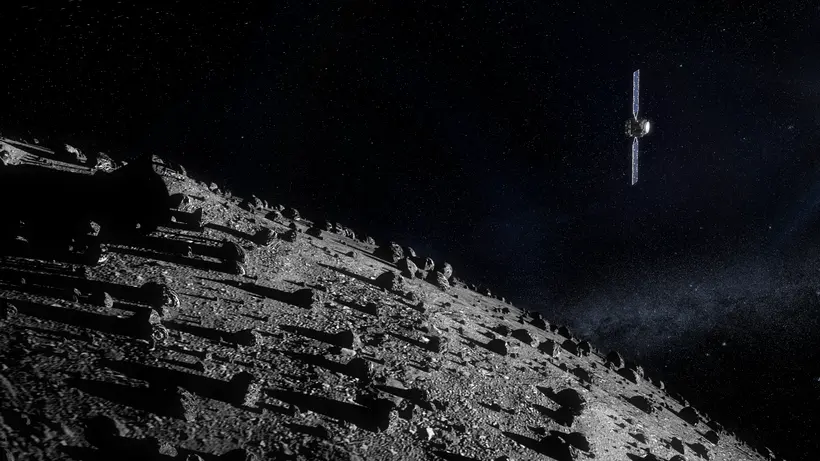
DART’s impact had already produced one unambiguous result before Hera arrived: Dimorphos completed each orbit around the larger asteroid Didymos about 33 minutes faster after the collision. Earth-based light curves and radar measured that change accurately, but they could not determine the moonlet’s mass, internal structure, exact post-impact shape or the amount of momentum added by material thrown from the surface.
Those unknowns determine how useful the DART experiment is for planetary defence. A kinetic impactor does not move an asteroid through the spacecraft’s momentum alone. Material excavated from the target recoils in the opposite direction and gives the asteroid an additional push. The size of that contribution depends on the target’s mass, density, porosity, structure and surface properties, so measuring an orbital change does not by itself establish how another asteroid would respond to the same technique.
What DART changed
NASA’s Double Asteroid Redirect Test (DART) struck Dimorphos at 23:14 UTC on September 26, 2022. The spacecraft hit at about 6.1 km/s (3.8 miles/s), deliberately colliding with the smaller member of the Didymos binary asteroid system.
Dimorphos now measures about 151 m (495 feet) across in ESA’s close-range reporting. Didymos measures about 730 m (2 395 feet), and the moonlet orbits the larger body at an average distance of about 1 km (0.6 miles).
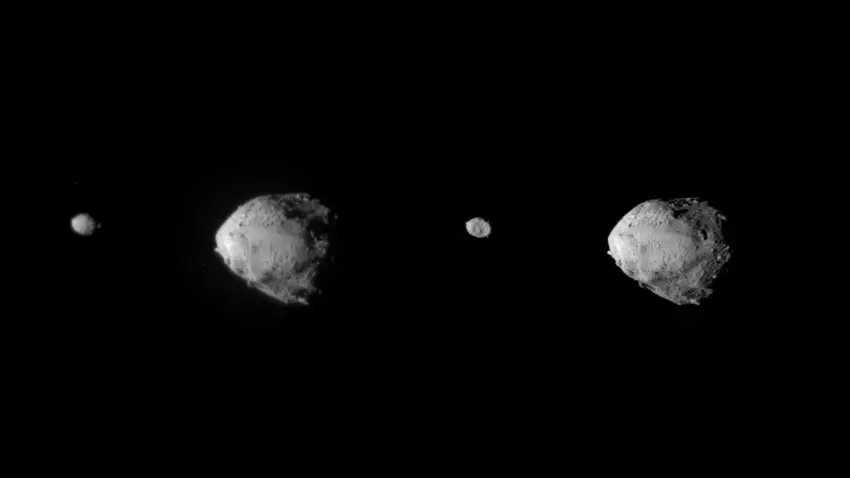
The experiment used a binary asteroid because the orbital change could be measured far more precisely than a small immediate change in the system’s solar orbit. Before impact, astronomers monitored repeated changes in brightness as Didymos and Dimorphos passed in front of and behind one another. After the collision, optical light curves and radar observations measured the change in the orbital period.
Thomas et al. (2023) determined that DART shortened Dimorphos’s orbital period by 33.0 ± 1.0 minutes at three-sigma uncertainty. A direct transfer of the spacecraft’s momentum without a substantial contribution from ejecta was expected to shorten the orbit by only about seven minutes.
| Measurement | Verified value | What it represents |
|---|---|---|
| DART impact time | 23:14 UTC on September 26, 2022 | Collision with Dimorphos |
| DART impact speed | 6.1 km/s (3.8 miles/s) | Relative impact velocity |
| Orbital-period change | -33.0 ± 1.0 minutes | Shortening of Dimorphos’s orbit |
| Along-track velocity change | -2.70 ± 0.10 mm/s (-0.106 ± 0.004 inches/s) | Immediate change inferred from the altered orbit |
| Dimorphos diameter | 151 m (495 feet) | Current ESA close-range value |
| Didymos diameter | 730 m (2 395 feet) | Current ESA close-range value |
| First crater-image distance | 29 km (18 miles) | Hera observation distance on November 7 |
| Crater-image resolution | 2.7 m (8.9 feet) per pixel | Spatial resolution of the November 7 AFC image |
The much larger orbital change showed that impact ejecta contributed additional momentum. Cheng et al. (2023) calculated an instantaneous reduction in Dimorphos’s along-track orbital velocity of 2.70 ± 0.10 mm/s (0.106 ± 0.004 inches/s).
What does the momentum-enhancement factor β mean?
The momentum-enhancement factor, written as β, compares the total momentum imparted to the asteroid with the momentum supplied directly by the incoming spacecraft in the direction relevant to the ejecta. A value greater than one means material expelled from the asteroid supplied additional recoil.
Cheng et al. calculated β values between 2.2 and 4.9 for assumed Dimorphos bulk densities ranging from 1 500 to 3 300 kg/m3 (94 to 206 lb/ft3). If Dimorphos and Didymos are assumed to have the same density of 2 400 kg/m3 (150 lb/ft3), their analysis gives β = 3.61 +0.19/-0.25 at one-sigma uncertainty. Hera is intended to reduce the uncertainty by measuring the physical properties of Dimorphos directly.
Hera sees what happened to the asteroid
Earth-based observations established that the orbit changed, but they could not resolve the impact site. Hera arrived at the Didymos system in 2026 to measure the physical outcome directly.
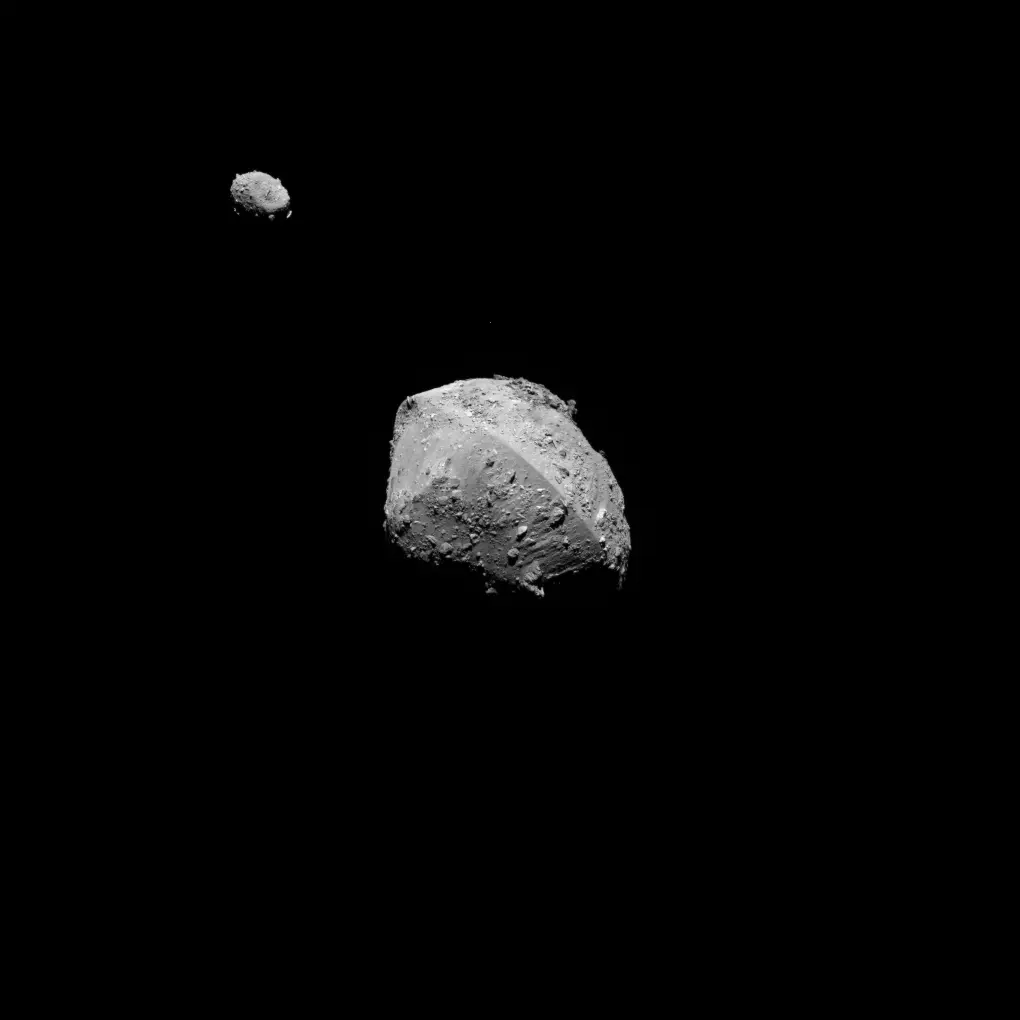
ESA’s first detailed images released on November 25 show that the DART-facing side of Dimorphos has been flattened into a broad impact crater that appears to extend across the impacted face. Regions away from the impact retain boulder fields resembling those visible in DART’s final approach images.
“NASA’s DART mission demonstrated that we can change an asteroid’s orbit. Hera is now revealing what happened to the asteroid itself.”
Ian Carnelli, ESA Hera mission manager
The result resolves a question that remained open after DART. Impact simulations had allowed several outcomes, ranging from a recognizable crater to extensive global deformation of the weakly bound moonlet. Hera’s initial images instead show a heavily altered impact-facing region while the first released observations do not show comparable changes across the remaining boulder-covered terrain.
Repeated Hera images have also established that Dimorphos is tumbling chaotically in its orbit rather than maintaining a simple stable orientation. Measuring the rotational state provides another constraint on how the collision transferred energy and angular momentum through the asteroid.
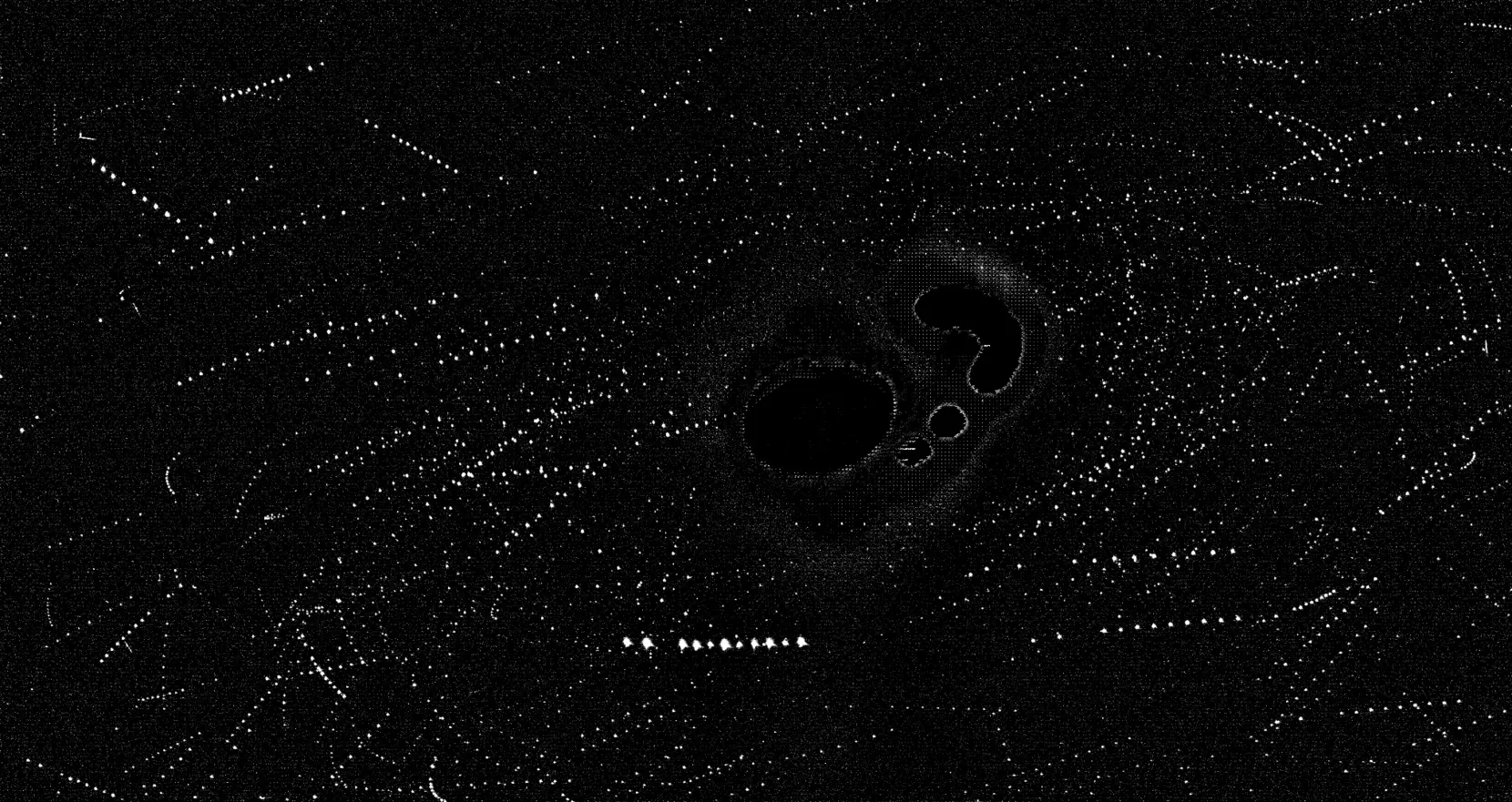
Hundreds of previously unknown boulders only a few metres across are also moving around the binary system. HyperScout H recorded the population in long exposures, turning the surrounding objects into trails as they moved during the exposures.
The boulders preserve information about the mechanical aftermath of the collision, but they also matter operationally. Hera’s navigation team has to account for the surrounding objects as the spacecraft moves closer to the binary pair.
Twenty-five spectral bands reveal more than shape
Hera is not relying on monochrome photographs alone. HyperScout H observes the asteroids in 25 spectral bands extending from visible red into the near infrared. Materials reflect different wavelengths by different amounts, allowing the instrument to search for spatial differences in surface composition and alteration.
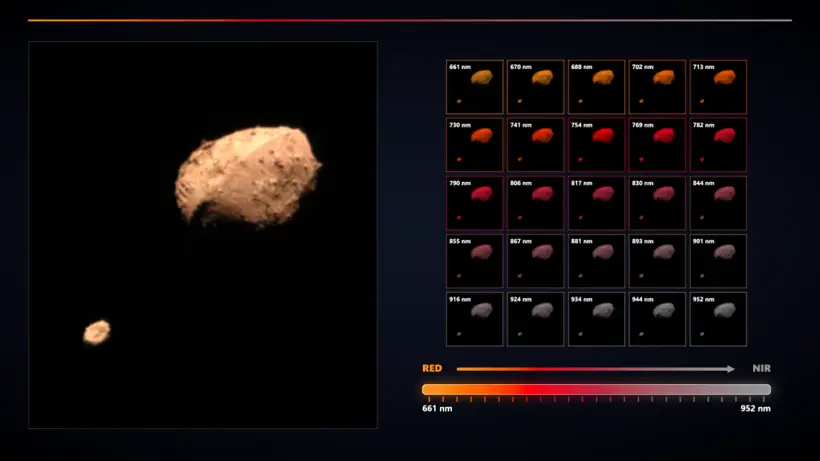
ESA’s November 3 multispectral observation was acquired from 32.8 km (20.4 miles), with a spatial resolution of 4.3 m (14.1 feet) per pixel. Combining these spectral measurements with the shape and geological context of individual surface regions can show whether the collision exposed material that differs from the surrounding surface.
Keep reading
Thermal imaging adds the asteroid’s heat response
The Thermal Infrared Imager (TIRI), supplied by the Japan Aerospace Exploration Agency (JAXA), measures infrared radiation emitted by the asteroid surfaces rather than visible sunlight reflected from them. Surface temperature changes can constrain thermal inertia, which describes how quickly a material heats and cools and is related to properties such as grain size, rock abundance and porosity.
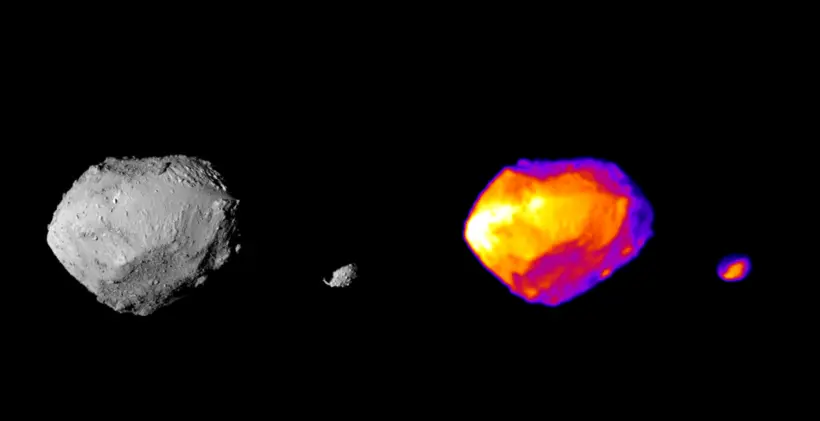
The November 9 comparison shows the warmer sunward side of Didymos and cooler shaded terrain in the thermal data. More of shaded Dimorphos is detectable thermally than in the visible-light image because TIRI records emitted heat rather than requiring direct illumination.
Why do thermal measurements matter for asteroid deflection?
A kinetic impact is controlled partly by the physical state of the target. Fine regolith, coherent rock, void-rich rubble and highly porous material do not necessarily respond to an impact in the same way. Thermal inertia does not provide a complete interior model, but it gives an independent constraint on the nature of the near-surface material when combined with imaging, spectroscopy and dynamical measurements.
Moving closer to Dimorphos
ESA reported on November 25 that Hera was operating approximately 25–30 km (16–19 miles) from Didymos and Dimorphos. The spacecraft was using thruster-controlled rectangular trajectories around the ultra-low-gravity binary system at an average relative velocity of about 12 cm/s (4.7 inches/s).
The mission is scheduled to move to approximately 13 km (8 miles) from the pair during December 2026, allowing progressively higher-resolution mapping. ESA then plans to deploy the Juventas and Milani CubeSats in January 2027.
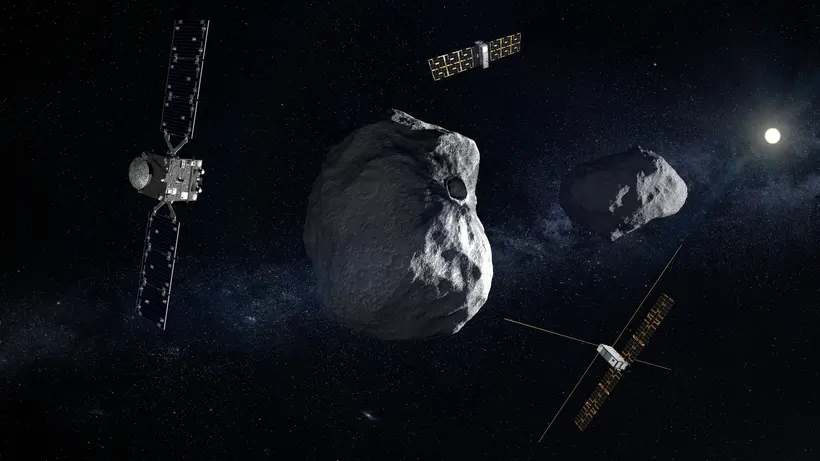
Juventas carries a low-frequency radar designed to probe inside Dimorphos. ESA describes it as the smallest radar instrument flown in space and plans to use it for the first radar sounding of an asteroid interior. The instrument will transmit repeated radio signals and analyse the returning echoes to investigate how material is distributed beneath the surface.
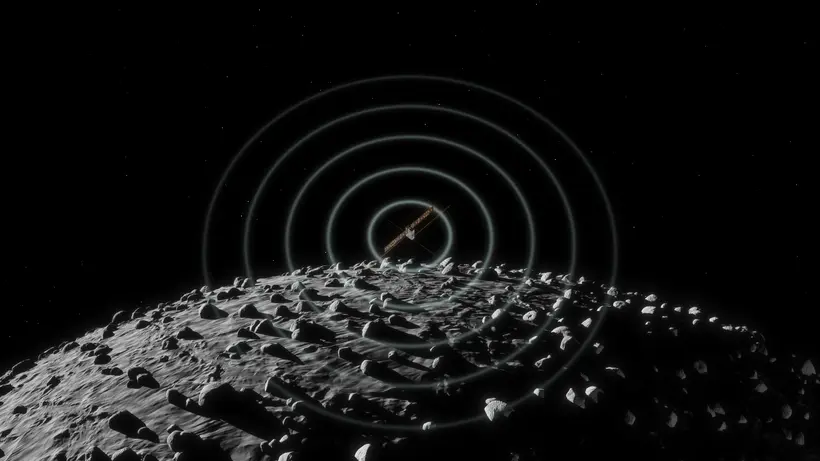
Milani will examine surface materials and surrounding dust. Together, Hera and the two CubeSats are intended to separate the visible consequences of DART from the deeper physical properties that controlled the impact response.
What Hera still needs to measure
The first imagery establishes that DART produced a broad crater, altered Dimorphos’s rotational state and generated a complex surrounding boulder population. A complete physical reconstruction still requires the moonlet’s mass, more precise post-impact orbital parameters, detailed shape and surface mapping, thermal and compositional measurements, and constraints on its internal structure. Those measurements are needed before the DART result can be scaled confidently to asteroids with different physical properties.
A spacecraft built for a low-gravity investigation
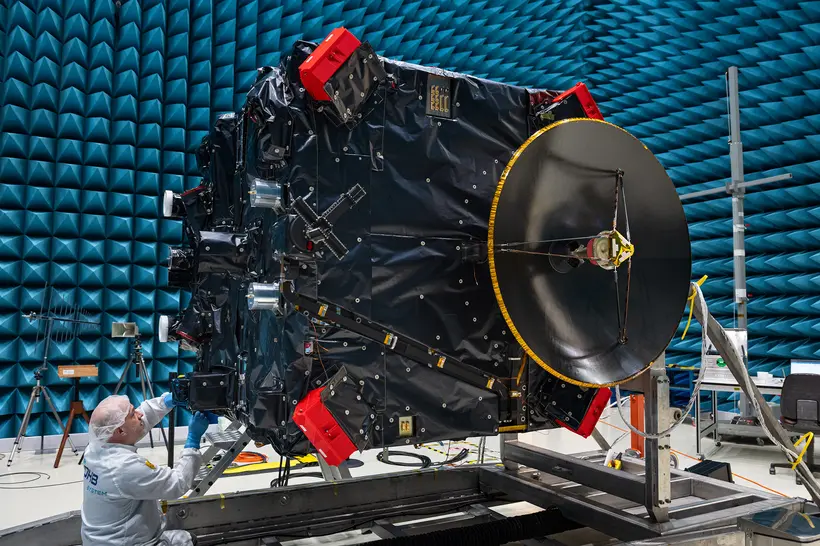
Hera must operate around objects whose gravitational fields are extremely weak. Rather than flying in the kind of closed orbit used around a planet, the mission maintains controlled trajectories through regular thruster corrections while continuously tracking the position and orientation of the asteroid pair.
The investigation is designed to combine those navigation measurements with imaging and other instruments. The spacecraft’s response to the gravitational field helps constrain the masses of the asteroids, while detailed shape models and measurements of Dimorphos’s orbit connect that mass to the deflection recorded after DART.
What the experiment means for planetary defence
A kinetic impactor is most useful when a hazardous asteroid is discovered sufficiently early. A small velocity change applied years before a predicted encounter can accumulate into a much larger difference in position by the time the asteroid reaches Earth’s orbit.
DART established that a spacecraft impact can measurably change an asteroid moonlet’s motion. It did not establish a universal deflection efficiency. Asteroids differ in density, cohesion, porosity, rotation, shape and internal structure, and those differences affect how much material is excavated and how efficiently momentum is transferred.
Did DART or Hera create an Earth-impact risk?
No. Didymos and Dimorphos did not pose an impact hazard to Earth before the DART experiment, and ESA states that the system remains non-hazardous afterward. DART changed the orbit of Dimorphos around Didymos; it did not redirect the binary asteroid system toward Earth.
Hera’s purpose is therefore not to respond to a current asteroid emergency. Its scientific task is to turn a successful one-off deflection demonstration into a physically understood experiment whose result can be compared with models and, eventually, with targets having different structures.
The new close-range images answer one of the most visible questions left by DART: what the asteroid looked like after impact. The harder problem now shifts below the surface. Hera’s remaining measurements must establish how much Dimorphos weighs, how its interior is organised and how those properties produced the observed momentum transfer.
DART answered whether a spacecraft could measurably alter the motion of an asteroid. Hera is addressing the question that determines whether the method can become predictable: how the physical nature of the target controls the amount of deflection produced by a known impact.
References:
1 Thomas, C. A., Naidu, S. P., Scheirich, P., Moskovitz, N. A., Pravec, P., Chesley, S. R., Rivkin, A. S., Osip, D. J., Lister, T. A., Benner, L. A. M., Brozović, M., Contreras, C., Morrell, N., Rożek, A., Kušnirák, P., Hornoch, K., Mages, D., Taylor, P. A., Seymour, A. D., … Agrusa, H. F. (2023). Orbital period change of Dimorphos due to the DART kinetic impact. Nature, 616(7957), 448–451. DOI: 10.1038/s41586-023-05805-2
2 Cheng, A. F., Agrusa, H. F., Barbee, B. W., Meyer, A. J., Farnham, T. L., Raducan, S. D., Richardson, D. C., Dotto, E., Zinzi, A., Della Corte, V., Statler, T. S., Chesley, S., Naidu, S. P., Hirabayashi, M., Li, J.-Y., Eggl, S., Barnouin, O. S., Chabot, N. L., Chocron, S., … Zanotti, G. (2023). Momentum transfer from the DART mission kinetic impact on asteroid Dimorphos. Nature, 616(7957), 457–460. DOI: 10.1038/s41586-023-05878-z
3 Hera reveals stadium-sized asteroid crater from spacecraft impact – European Space Agency – November 25, 2026
4 Didymos and Dimorphos with DART impact site visible – European Space Agency – November 25, 2026
5 Pre- and post-DART impact comparison of the Didymos system – European Space Agency – November 25, 2026
6 Long exposure Hyperscout H image reveals boulders – European Space Agency – November 25, 2026
7 Hyperscout H multispectral surface prospecting – European Space Agency – November 25, 2026
8 AFC and TIRI images of Didymos and Dimorphos – European Space Agency – November 25, 2026
9 First thermal images from TIRI onboard the Hera spacecraft of the binary asteroid, Didymos-Dimorphos – Japan Aerospace Exploration Agency – November 24, 2026
10 Hera Frequently Asked Questions – European Space Agency – April 12, 2024

I’m a science journalist and researcher at The Watchers, contributing to the Epicenter edition, where I cover peer-reviewed scientific research and emerging discoveries across Earth and space sciences. With a background in astronomy and a passion for environmental science, I’ve worked in shark and coral conservation in Fiji, conducting reef and shark-behavior research, contributing to mangrove restoration, and earning PADI Open Water and Coral Reef Certifications. I bring a blend of scientific rigor and storytelling to illuminate the discoveries shaping our planet and beyond.
More reporting
- Hubble’s impact craters reveal the hidden role of cosmic dust in spacecraft damage
- Hundreds of deforming bedrock landslides cluster near glaciers across southern Alaska
- Projected 5G leakage can alter the satellite data behind weather forecasts
- Global analysis finds glacial lakes amplify ice loss while climate and glacier geometry remain dominant
