
Study links Fentale magma intrusion to methane outburst from buried sediments, Ethiopia
A large methane outburst detected at Fentale Volcano in Ethiopia during the 2025 volcanic crisis came mainly from hydrocarbon-rich sedimentary rocks rather than directly from magma, according to new research. The authors propose that an underground magma intrusion fractured a seal over accumulated thermogenic methane, allowing the gas to escape without a conventional volcanic eruption.
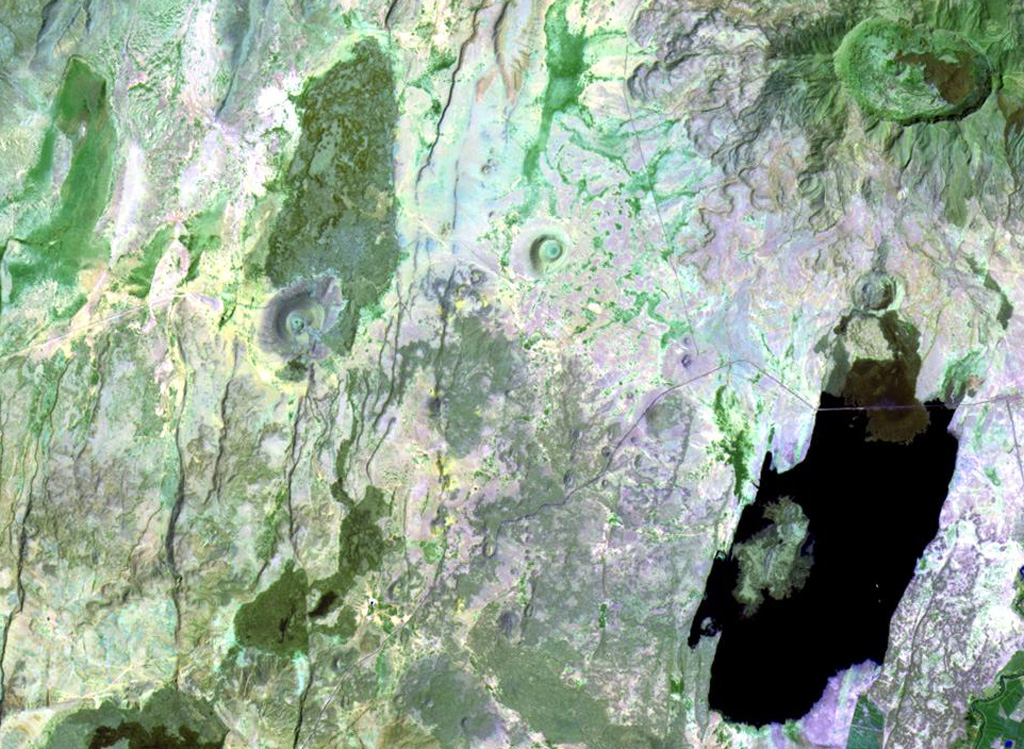
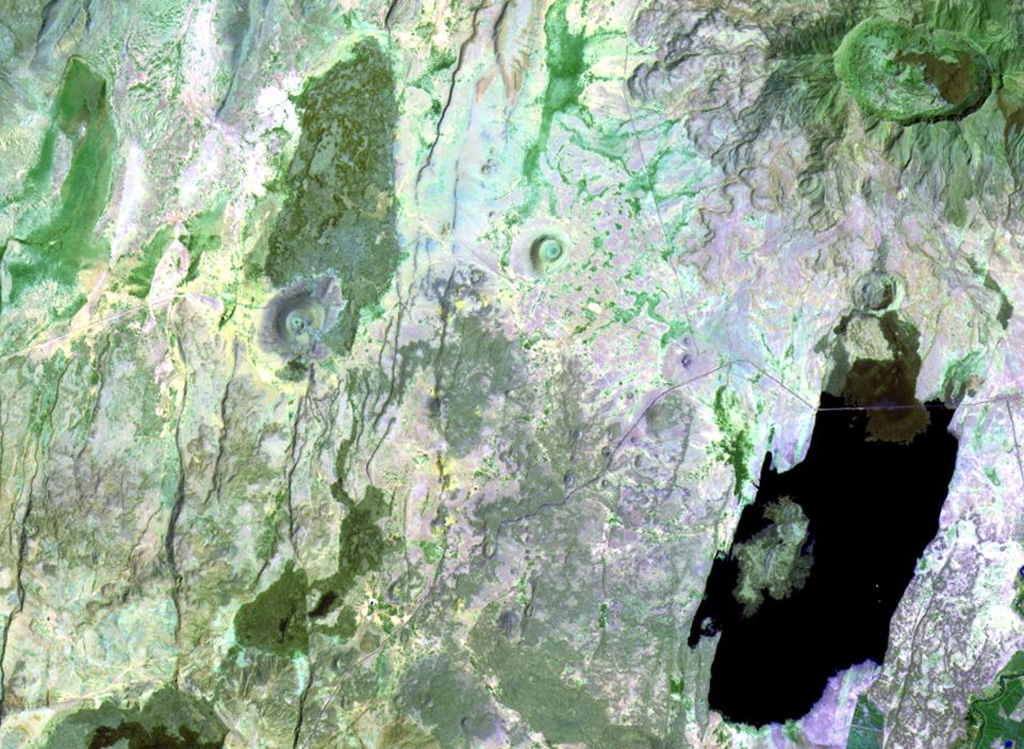
NASA Landsat view of the Main Ethiopian Rift between Fentale and Kone volcanoes. Fentale is toward the upper right. Credit: NASA Landsat / Hawaii Synergy Project / Smithsonian Global Volcanism Program. Public domain.
The finding documents a type of gas release that had not previously been detected from a volcanic system by satellite. Modern volcanoes generally emit little methane, and before Fentale the closest modern examples of methane released through interactions between magma and sedimentary rocks came mainly from geothermal systems. The observations provide a modern example of how an intrusion can interact with a buried carbon reservoir even when the magma itself remains underground.
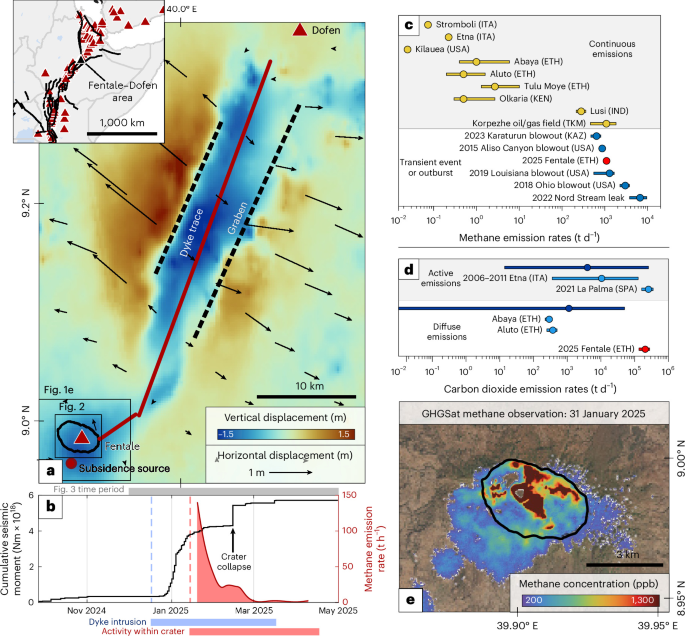
The episode developed from a major intrusion that began near Fentale on December 17, 2024. A dyke—a sheet of magma forced through fractures in the crust—propagated about 50 km (31 miles) north by December 29 and continued opening until mid-March 2025. The study estimates that about 1.4 km³ (0.34 mi³) of magma remained underground rather than erupting at the surface.
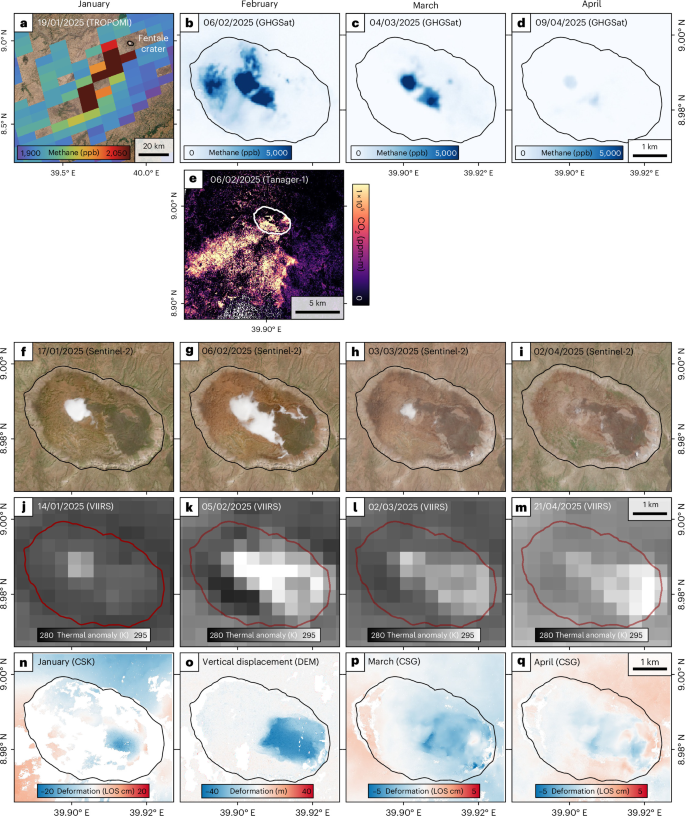
The first activity observed inside Fentale’s caldera was a thermal anomaly at 22:48 UTC on January 14, 2025. Methane was first detected on January 19, when the TROPOMI instrument aboard Sentinel-5P recorded a strong plume southwest of the volcano. The initial estimated emission rate reached 157 ± 41 t/h (about 173 ± 45 short tons/h).
Dualeh et al. (2026) estimate that Fentale released at least 38.2 ± 3.9 kt of methane (CH₄), equivalent to about 42 100 ± 4 300 short tons, between January 19 and April 9, 2025. About 90% of that amount—33.8 ± 3.5 kt (about 37 300 ± 3 900 short tons)—was released during the first 31 days. The peak rate was approximately four orders of magnitude above methane-emission rates measured at most other volcanic systems.
| Observed or derived quantity | Reported value | Physical meaning |
|---|---|---|
| Total methane release | 38.2 ± 3.9 kt CH₄ (about 42 100 ± 4 300 short tons) | Minimum methane released over roughly three months |
| Methane released in first 31 days | 33.8 ± 3.5 kt (about 37 300 ± 3 900 short tons) | About 90% of the measured methane total |
| Peak methane rate | 157 ± 41 t/h (about 173 ± 45 short tons/h) | Initial TROPOMI-estimated outburst rate |
| Total carbon dioxide | At least 2.9 ± 1.0 Mt CO₂ (about 3.20 ± 1.10 million short tons) | Estimated CO₂ released during the main episode |
| Intruded magma volume | 1.4 km³ (0.34 mi³) | Magma that remained underground during the intrusion |
At least 2.9 ± 1.0 Mt of carbon dioxide (CO₂), about 3.20 ± 1.10 million short tons, was also released. The methane and CO₂ coincided with thermal changes and localized deformation inside the caldera, but the researchers concluded that the two gases did not have the same dominant source. Much of the CO₂ was interpreted as magmatic, while the unusually large methane release, regional isotope measurements and geological setting support a thermogenic origin in sedimentary rocks.
Thermogenic methane forms when buried organic material is heated sufficiently for hydrocarbons to break down and generate gas. Beneath parts of the Main Ethiopian Rift, Mesozoic sedimentary rocks contain organic-rich material and hydrocarbon systems. The authors propose that prolonged heating associated with repeated magmatic intrusion during rifting generated methane within these sediments over time.
The 2025 intrusion is proposed to have provided the trigger for rapid release. According to the study’s model, the dyke fractured a shallow impermeable seal—a rock layer that had prevented accumulated gas from migrating upward. Fracturing created pathways through which methane and other gases escaped. The subsequent decline in methane emissions is consistent with depressurization of the reservoir, although the reservoir geometry and gas pathways were inferred rather than directly observed.
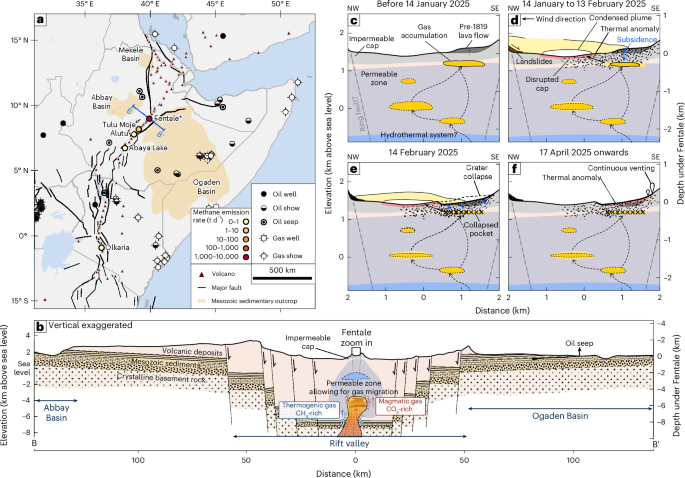
What was observed, and what was inferred?
Directly observed or instrumentally measured: methane and CO₂ plumes, thermal anomalies, surface deformation, the dyke intrusion, gas-emission timing and the February caldera collapse.
Derived or estimated: methane and CO₂ emission rates, intrusive magma volume, deformation-source properties and atmospheric transport of the gas plumes.
Researcher interpretation: a thermogenic sedimentary origin for most of the methane, accumulation beneath an impermeable seal, and fracturing of that seal during the 2025 intrusion.
The study combined several independent satellite systems to reconstruct the episode. TROPOMI aboard Sentinel-5P supplied daily global methane measurements at a nominal footprint of 5.5 × 7 km², equivalent to roughly 3.4 × 4.3 miles. GHGSat later obtained a much finer 25 × 25 m (82 × 82 feet) observation on January 31, confirming that the methane source was inside Fentale’s caldera. Thermal imagery, optical observations, synthetic aperture radar and additional greenhouse-gas measurements were combined with atmospheric transport modeling.
Keep reading
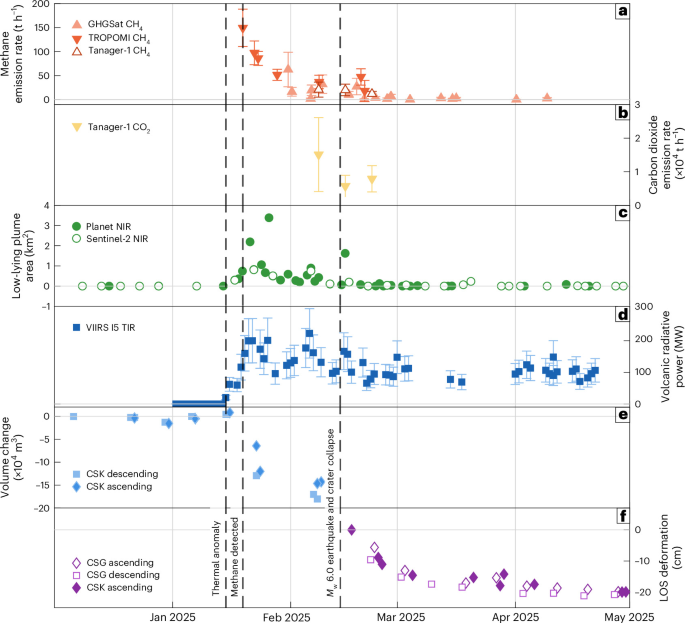
The combined record shows how rapidly conditions changed. Gas emissions, thermal activity and localized deformation reached their strongest levels in late January before declining. On February 14, a large collapse occurred inside the caldera, after which methane emissions showed a smaller resurgence. By March and April, methane rates were much lower, although elevated temperatures and localized deformation continued after the principal outburst.
The researchers report that no methane outburst from a volcanic system had previously been detected by satellite. Comparable short-lived events before TROPOMI began global operations in 2018 may therefore have gone undetected. Fentale’s relatively dry, cloud-free and low-aerosol conditions were unusually favorable for satellite observations, so the lack of comparable detections elsewhere does not establish that the process is unique to Fentale.
The observations do not establish a major present-day climate forcing from the Fentale episode. The study reports that the methane outburst was less than 0.1% of annual oil-and-gas-sector methane emissions and small compared with annual natural and anthropogenic sources. Its scientific value lies in documenting a modern process through which magmatic activity can rapidly mobilize carbon stored in sedimentary systems.
The process has broader geological relevance because interactions between magma and organic-rich sediments have been proposed as sources of greenhouse gases during the formation of large igneous provinces in Earth’s past. Fentale operated on a far smaller scale, but it provides a modern setting in which researchers can examine parts of the proposed sequence directly: long-term magmatic heating, thermogenic methane generation, gas accumulation, disruption of a seal and rapid release.

Important uncertainties remain underground. No methane isotope measurements were obtained directly at Fentale. The proposed methane reservoir, impermeable seal and subsurface gas pathways are inferred from emission magnitudes, regional isotope measurements, geological context, deformation and the timing of the outburst. Ground-based observations remain limited.
Further observations along the East African Rift are needed to determine how thermogenic methane accumulates beneath volcanic systems, how frequently sealed reservoirs fail during intrusions and whether comparable short-lived outbursts occur elsewhere. Continued satellite monitoring should improve detection, but the Fentale study also shows that favorable atmospheric conditions and access to high-resolution observations strongly affect whether such events can be identified and quantified.
References:
1 Dualeh, E. W., Biggs, J., Sharma, S., Stix, J., Hutchison, W., Etiope, G., Jervis, D., Way, L., Dogniaux, M., Maasakkers, J. D., Aveni, S., Cusworth, D., Ireland, B., Grandin, R., Girard, M., Ramier, A., Zheng, W., Davis, T., Howell, K., Coppola, D., Hauck, A., Pancost, R. D., Nettles, M., & Lewi, E. (2026). Methane outburst driven by magma–sediment interactions at Fentale Volcano detected by satellite. Nature Geoscience. DOI: 10.1038/s41561-026-02137-4
2 Scientists uncover secret of mysterious methane outburst from Ethiopian volcano – University of Bristol – November 19, 2026
3 VOLCANOES | Massive methane emission detected from space at Fentale, Ethiopia – Istituto Nazionale di Geofisica e Vulcanologia (INGV) – November 24, 2026
4 Fentale – Smithsonian Institution Global Volcanism Program – accessed November 26, 2026

I’m a science journalist and researcher at The Watchers, contributing to the Epicenter edition, where I cover peer-reviewed scientific research and emerging discoveries across Earth and space sciences. With a background in astronomy and a passion for environmental science, I’ve worked in shark and coral conservation in Fiji, conducting reef and shark-behavior research, contributing to mangrove restoration, and earning PADI Open Water and Coral Reef Certifications. I bring a blend of scientific rigor and storytelling to illuminate the discoveries shaping our planet and beyond.
More reporting
- Tibetan Plateau landslide susceptibility expands beyond July–August peak under warming scenarios
- Higher summer temperatures linked to increased mortality among people with cardiovascular disease in UK study
- Fault calcite reveals a missing phase in Türkiye’s Central Taurides fault history
- Data-center power demand pushes air-quality health burdens far beyond U.S. computing hubs
