
Astronomers trace seven-year stellar inspiral inside a giant star in Andromeda
Astronomers have reconstructed a seven-year inspiral in the Andromeda Galaxy, tracing a roughly 0.7-solar-mass star as it moved through the convective envelope of an approximately 7-solar-mass giant before a 2025 eruption. AT 2025abao provides rare direct evidence of how orbital energy is dissipated inside a shared stellar envelope and places an empirical constraint on one of the least directly observed phases of binary-star evolution.
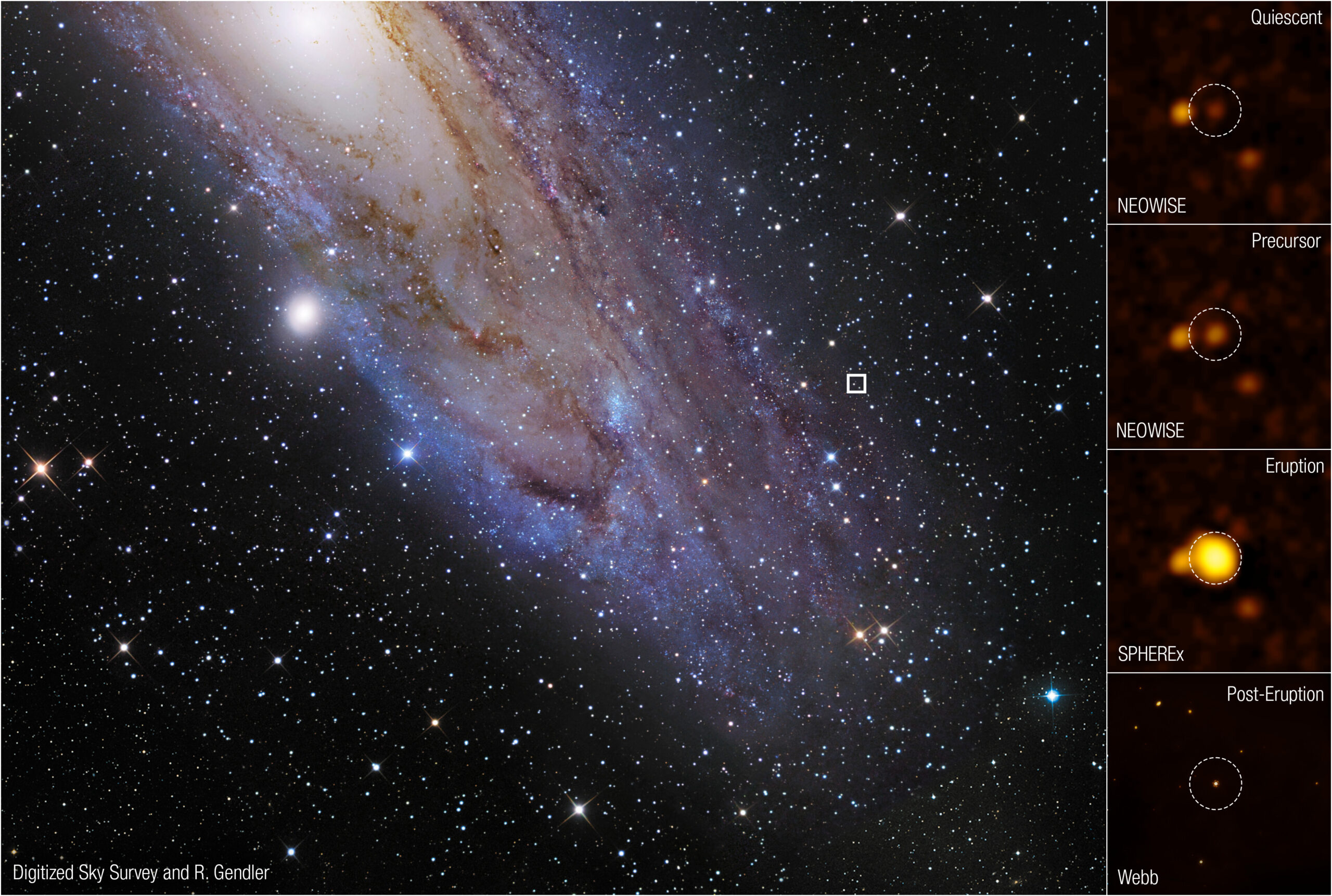
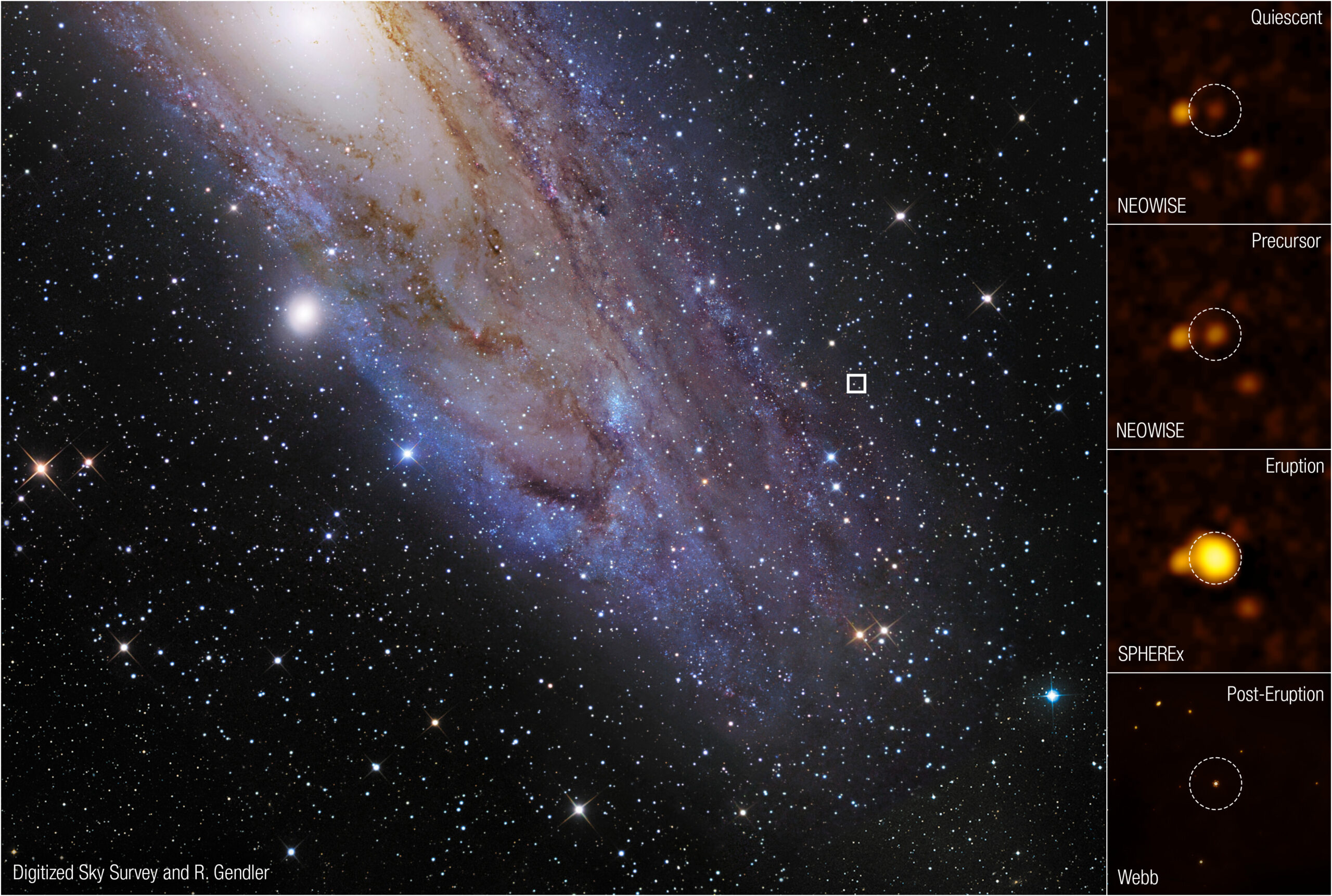
AT 2025abao in the Andromeda Galaxy shown across the quiescent, precursor, eruption and post-eruption phases using NEOWISE, SPHEREx and Webb observations. Credit: Image: NASA, ESA, CSA, STScI, V. Karambelkar (Columbia), K. De (Columbia). Image Processing: A. Pagan (STScI). Acknowledgment: R. Gendler, DSS
For decades before 2018, observations of the source now known as AT 2025abao showed no comparable long-term brightening. The system then began a gradual rise in luminosity that continued for approximately seven years. Researchers noticed unusual variability in infrared observations in 2023, WINTER recorded increasing near-infrared brightness and dust production in September 2024, and SPHEREx detected rapid changes in July 2025. The visible-light eruption was detected on October 17, 2025.
The unusually long precursor gives astronomers access to a stage of stellar evolution that has been central to binary-star models but difficult to observe while it is occurring. During common-envelope evolution, an expanding giant engulfs its companion so that both stars orbit inside the giant’s extended gaseous envelope. Frictional drag removes orbital energy and angular momentum, forcing the separation between the stars to shrink.
Karambelkar et al. (2026) reconstruct AT 2025abao as an approximately 7-solar-mass asymptotic giant branch star interacting with a companion of about 0.7 solar masses. Their spectroscopy and long-term photometry are best explained by the smaller star spiraling through the giant’s convective envelope while frictional drag supplied energy that emerged as radiation during the prolonged brightening. The study describes the observations as among the first direct evidence of frictional-drag energy dissipation during common-envelope evolution.
What does the common-envelope efficiency parameter α measure?
The parameter α describes the fraction of orbital energy dissipated during inspiral that is available to unbind the surrounding stellar envelope. For AT 2025abao, the study derives an empirical constraint of approximately 0.01 ≲ α ≲ 0.4. It does not represent the fraction of the envelope that was lost; it represents how efficiently orbital energy can contribute to removing envelope material.
| Stage | Date / period | Observed change |
|---|---|---|
| Quiescent | 1989–2018 | Approximately stable luminosity in the archival record |
| Precursor | 2018–2025 | Gradual brightening associated with the reconstructed common-envelope inspiral |
| Dust increase | September 2024 | WINTER observations recorded stronger infrared emission and dust production |
| Pre-eruption change | July 2025 | SPHEREx recorded rising infrared emission while visible light declined |
| Eruption | October 17, 2025 | Rapid brightening associated with the luminous red nova |
| Webb follow-up | December 24, 2025 | Three-hour mid-infrared observation 47 days after eruption peak |
| Research publication | November 18, 2026 | Peer-reviewed reconstruction published in Nature |
The convective structure of the giant is important to the interpretation. Energy deposited by the orbiting companion does not necessarily remain trapped around the inspiral. Convection can move some of that energy outward through the stellar envelope, allowing it to emerge as radiation. The approximately seven-year brightening is consistent with theoretical expectations for a radiatively efficient phase of common-envelope evolution in a strongly convective giant.
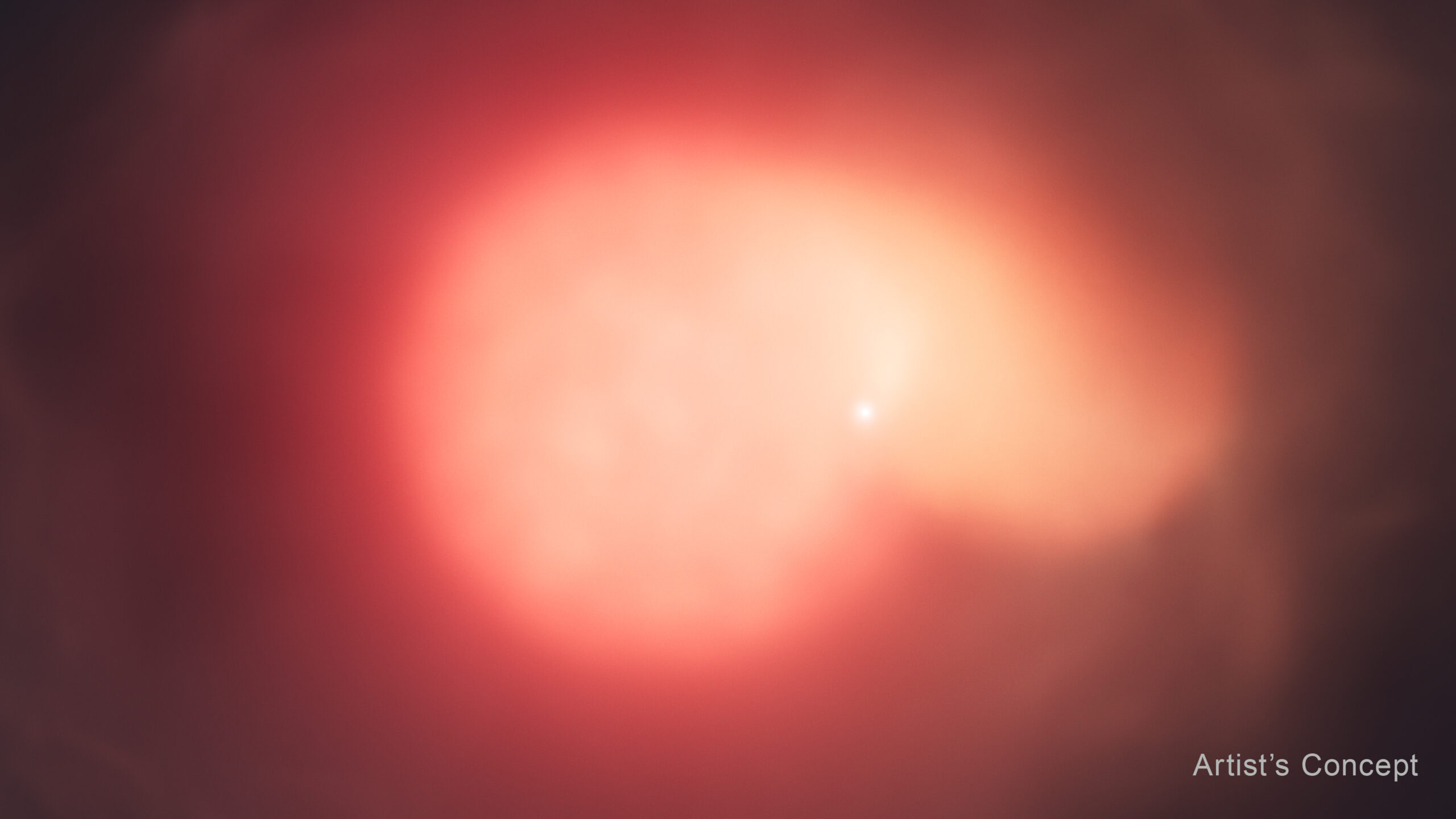
The late-2025 eruption marks the most energetic stage in the reconstruction. The researchers interpret it as the smaller companion reaching the central region of the giant, with the interaction ejecting approximately 0.1–0.2 solar masses from the primary star. That represents roughly the outermost 10% of the stellar envelope.
Spectroscopic observations tracked the speed of the expelled material as the eruption developed. The ejecta initially moved at approximately 800 km/s (497 miles/s). As it expanded into surrounding circumstellar gas, its speed fell to about 150 km/s (93 miles/s). The researchers interpret that interaction between fast ejecta and previously expelled material as an important source of energy for the observed eruption.
The observations also constrain how efficiently orbital energy can remove the envelope. The study derives 0.01 ≲ α ≲ 0.4 for AT 2025abao. Common-envelope efficiency is one of the quantities used in models of how initially wide binary systems can shrink dramatically, sometimes leaving compact binaries and in other cases ending in a merger.
The reconstruction does not depend on a single telescope or wavelength. Researchers combined ultraviolet, visible, near-infrared and mid-infrared observations from facilities including NEOWISE, WINTER, SPHEREx, ZTF, the Himalayan Chandra Telescope, NASA’s Swift observatory, Gemini North, the NASA Infrared Telescope Facility, Gran Telescopio CANARIAS and the James Webb Space Telescope.
Keep reading
The interactive timeline assembled by the Zwicky Transient Facility places the observations in chronological order and shows how multiple ground- and space-based facilities contributed to the reconstruction. It is useful because the scientific result depends on the system’s evolution across several years rather than on the eruption alone.
Webb observed AT 2025abao on December 24, 2025, during three hours of Director’s Discretionary Time. The observation came 47 days after the eruption peak and supplied mid-infrared measurements of dust surrounding the system. Researchers compared the Webb measurements with models of the stellar system, adding post-eruption constraints to observations collected before and during the eruption.
The study combined light curves, optical and near-infrared spectroscopy and spectral-energy-distribution modeling. A spectral-energy distribution describes how an object’s emitted energy is distributed across wavelength. Modeling that distribution allowed the researchers to infer properties that are not observed directly, including characteristics of the progenitor system, surrounding dust and companion mass. The observational products, derived bolometric parameters and analysis code were made available for independent examination.
The distinction between direct observation and reconstruction is important. The long-term brightening, eruption, spectra and infrared emission were measured instrumentally. The companion mass, detailed inspiral geometry, energy-transfer history and final stellar configuration depend on interpretation and modeling of those measurements. The peer-reviewed paper concludes that interaction between the companion and primary core powered the eruption, while NASA and ESA/Webb describe the combined data as establishing a stellar merger.
AT 2025abao is therefore valuable less because stellar mergers themselves are unknown than because the system was followed through an unusually complete sequence leading into and away from the eruption. The paper states that an inspiral inside this type of shared convective envelope had not previously been directly observed, allowing the researchers to connect a prolonged precursor, frictional energy loss, envelope ejection and post-eruption dust into one physical reconstruction.
The longer-term state of the remnant remains a target for follow-up observations. Continued monitoring can test how the post-eruption object evolves and whether the structure inferred from the 2025–2026 observations persists. Future wide-field optical and infrared surveys should also increase the number of stellar systems detected before eruption, giving astronomers more opportunities to test whether the behavior reconstructed for AT 2025abao is common or represents a narrower evolutionary pathway.
References:
1 Karambelkar, V., De, K., Temmink, K. D., et al. (2026). An inspiral of a star inside a common envelope with its giant companion. Nature, 659(8141), 628–633. DOI: 10.1038/s41586-026-11221-z
2 NASA Data Clinches First-of-Its-Kind Stellar Merger – NASA Science – November 18, 2026
3 For the first time, astronomers witness a stellar crash from beginning to end – Zwicky Transient Facility / Caltech – November 18, 2026

I’m a science journalist and researcher at The Watchers, contributing to the Epicenter edition, where I cover peer-reviewed scientific research and emerging discoveries across Earth and space sciences. With a background in astronomy and a passion for environmental science, I’ve worked in shark and coral conservation in Fiji, conducting reef and shark-behavior research, contributing to mangrove restoration, and earning PADI Open Water and Coral Reef Certifications. I bring a blend of scientific rigor and storytelling to illuminate the discoveries shaping our planet and beyond.
More reporting
- Civilian satellite observations reveal 18% velocity gap in South Atlantic fireball reconstruction
- JWST infrared pulses from magnetar 4U 0142+61 strengthen case for magnetospheric origin
- Tibetan Plateau landslide susceptibility expands beyond July–August peak under warming scenarios
- Higher summer temperatures linked to increased mortality among people with cardiovascular disease in UK study
