
JWST infrared pulses from magnetar 4U 0142+61 strengthen case for magnetospheric origin
JWST has detected infrared pulses from magnetar 4U 0142+61 that repeat with its approximately 8.7-second rotation and overlap, within current timing uncertainty, with its hard X-ray pulse. The measurement gives researchers a new way to test where the magnetar’s infrared radiation is produced and strengthens evidence that it originates in the magnetosphere rather than as thermal emission from a fallback disk.
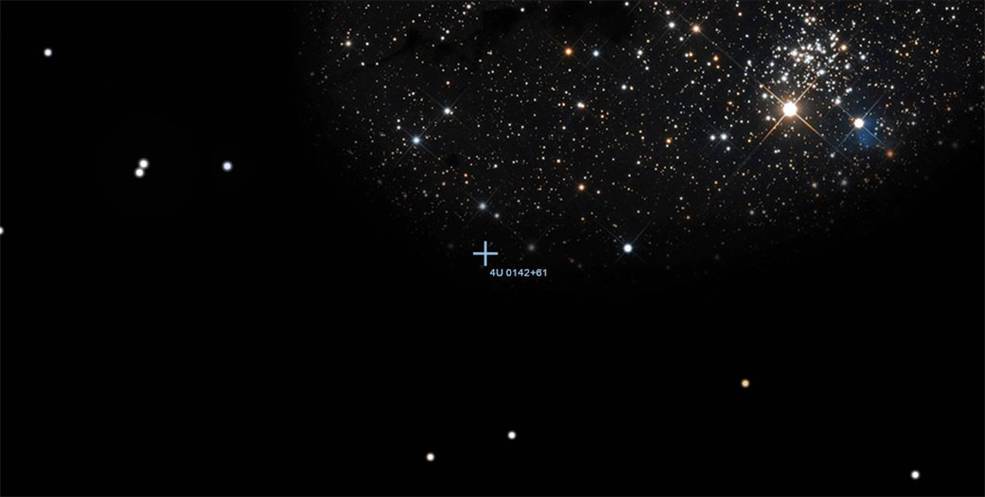
Location of magnetar 4U 0142+61. Credit: NASA
Infrared radiation from 4U 0142+61 was known before the new timing observation, but its physical origin remained uncertain. One explanation placed much of the emission in material surrounding the neutron star, including a fallback disk formed from debris left by the supernova. Another placed it in the magnetosphere, where charged particles move through the neutron star’s exceptionally strong magnetic field.
Earlier JWST spectroscopy had already weakened the specific passive thermal fallback-disk interpretation. Observations spanning 1.4–11 μm (1 400–11 000 nm) produced a smooth power-law spectrum rather than the spectral form expected from that disk model. The new study approaches the same question from a different direction: instead of asking how the infrared brightness changes with wavelength, it asks how that light changes with time as the neutron star rotates.
What JWST measured
Jeremy Hare and colleagues used the James Webb Space Telescope’s Near-Infrared Camera (NIRCam) to observe 4U 0142+61 for 2 008.88 seconds, or about 33.5 minutes, on August 18, 2024. The observation used the F410M filter at a pivot wavelength of 4.08 μm (4 080 nm) and recorded the source in 800 consecutive 2.5111-second timing intervals.
| Measurement | Result | Physical meaning |
|---|---|---|
| Infrared wavelength | 4.08 μm (4 080 nm) | Mid-near-infrared light recorded through NIRCam F410M |
| Total flux density | 22.9 ± 0.6 μJy (2.29 ± 0.06 × 10⁻³¹ W m⁻² Hz⁻¹) | Time-averaged infrared brightness of the source in the observation |
| Pulse frequency | 115.059 ± 0.035 mHz (0.115059 ± 0.000035 Hz) | Matches the neutron star’s known rotational frequency |
| Rotation period | Approximately 8.7 seconds | One rotation of the magnetar |
| Observed peak-to-trough pulsed fraction | 8 ± 1% | Measured brightness modulation across one rotational cycle |
| Observed rms pulsed fraction | 6 ± 1% | Alternative measure of the strength of periodic variability |
| NIRCam timing interval | 2.5111 seconds | About 29% of a full rotation, limiting the detail resolved within each pulse |
A magnetar is a neutron star whose activity is associated with an exceptionally strong magnetic field. 4U 0142+61 rotates approximately once every 8.7 seconds. Radiation tied to particular regions of the rotating system can therefore brighten and fade as those regions move through the observer’s line of sight.
The strongest periodic signal in the background-subtracted NIRCam data occurred at 115.059 ± 0.035 mHz. The timing model derived independently from X-ray observations gives a rotational frequency of about 115.077 mHz at the midpoint of the JWST observation. The difference between the infrared signal and the predicted spin frequency was 0.018 ± 0.035 mHz, consistent with zero within the statistical uncertainty.
That agreement is the central observational result. The infrared brightness is not merely changing during the observation; it is changing at the same rate as the neutron star rotates. This directly ties the infrared variability to the rotating magnetar system.
The infrared pulse is real, but its shape is blurred
When the NIRCam measurements are folded over the magnetar’s rotation period, the infrared light curve shows one broad maximum during each cycle. The measured peak-to-trough pulsed fraction is 8 ± 1%, while the rms pulsed fraction is 6 ± 1%.
Those numbers do not represent the full intrinsic modulation. Each NIRCam timing sample lasted 2.5111 seconds, almost 29% of an approximately 8.7-second rotation. The telescope therefore averaged the incoming light over a substantial fraction of each cycle, smoothing faster changes in brightness.
The researchers calculated that this sampling preserves about 87% of the amplitude of the first harmonic but only about 54% of the second harmonic. Harmonics encode progressively finer structure within a periodic signal, so the stronger suppression of the second harmonic means the measured profile can look simpler and broader than the true pulse.
The authors therefore do not interpret the single broad maximum as proof that the intrinsic infrared pulse has only one peak. Finer time sampling could reveal additional structure, including more than one maximum per rotation. They estimate that the intrinsic peak-to-trough pulsed fraction should exceed approximately 10%.
Keep reading
Infrared and hard X-ray pulses line up
The next test was whether the infrared pulse occurred at the same rotational phase as the magnetar’s X-ray emission. For that comparison, the researchers used a phase-connected timing solution derived from six years of Neutron Star Interior Composition Explorer (NICER) monitoring. Such a solution continuously tracks the neutron star’s rotational phase across time, allowing measurements made by different observatories to be placed on a common rotational clock.
The team compared the JWST pulse with NICER and Nuclear Spectroscopic Telescope Array (NuSTAR) X-ray profiles. The measured infrared maximum falls slightly before the hard X-ray maxima, with phase offsets of about −0.063, −0.125 and −0.075 relative to the selected NICER 0.5–10 keV, NuSTAR 8–20 keV and NuSTAR 20–78 keV profiles.
Those apparent offsets are not statistically established as real physical delays. The infrared peak position has an estimated phase precision of about 0.064, and the authors note that the true uncertainty may be larger because coarse sampling can distort a pulse that is not intrinsically sinusoidal. Within approximately 1–2σ, the infrared and hard X-ray maxima are consistent with overlapping.
The present data establish a rotational infrared pulse and a close phase relationship with the hard X-ray peak, but they do not establish that the infrared peak physically leads the X-ray peak.
Why that timing matters
The timing comparison provides information that a spectrum alone cannot. Infrared radiation produced by particles within the magnetosphere is directly linked to the rotating magnetic environment surrounding the neutron star. Thermal infrared radiation produced when X-rays illuminate and heat material farther from the star represents a physically different process.
The observed infrared pulsation at the magnetar’s rotational frequency, combined with its overlap with the hard X-ray maximum within the available timing precision, adds evidence in favor of nonthermal magnetospheric emission. It does not determine the exact radiation mechanism or prove that the infrared and hard X-rays originate from the same region.
If future measurements establish that the infrared peak genuinely arrives before the hard X-ray peak, the authors say that would point toward the two signals being produced at different emission sites even if the underlying processes are physically connected.
Earlier JWST spectrum already challenged the passive-disk model
The timing evidence follows an earlier JWST study of the same magnetar. Observations obtained on September 20–21, 2022 with NIRCam and the Mid-Infrared Instrument (MIRI) covered wavelengths from 1.4 to 11 μm (1 400 to 11 000 nm).
Those measurements were satisfactorily described by an absorbed power law with spectral slope α = 0.96 ± 0.02. A power law describes a smooth scaling of brightness with frequency. The observed shape did not support the specific passive fallback-disk model previously proposed from Spitzer observations, although the researchers did not exclude every possible form of circumstellar disk.
The 2024 study instead favored a nonthermal interpretation and noted that the hard X-ray spectrum measured by NuSTAR was substantially harder than the infrared spectrum. That spectral mismatch also leaves open the possibility that the infrared and hard X-ray radiation originate in different parts of the magnetosphere.
Possible infrared variability
The 2024 timing observation also found a lower F410M flux than expected from the earlier JWST spectrum. The measured value was approximately 20% below the F410M flux predicted by the best-fitting 2022 spectrum. F410M itself was not used during that earlier observing campaign, so the comparison is between a direct 2024 F410M measurement and a value calculated from the earlier spectral model.
The researchers describe the difference as evidence of possible infrared variability. They also found that the available X-ray-to-infrared flux ratios were approximately consistent between the observing epochs, but the small number of measurements prevents a firm correlation from being established. Higher-cadence observations are needed to determine whether the infrared and X-ray brightness change together.
What remains unknown
The study narrows the possible origin of the infrared emission without identifying a unique mechanism. Magnetospheric models can produce infrared and optical radiation through several particle-radiation processes, and the available JWST timing data do not distinguish among them.
Better infrared time resolution is the main observational requirement for the next step. Finer sampling would reveal the intrinsic pulse shape, provide a more precise phase comparison with the X-ray emission and test whether the apparent infrared lead is real. Near-simultaneous optical and infrared observations would also help determine whether those parts of the spectrum share the same physical origin.
The present observation establishes that the 4.08 μm infrared emission pulses at the magnetar’s rotation frequency. Its timing relative to the hard X-rays strengthens the magnetospheric interpretation, while the detailed pulse morphology, exact emission site and radiation mechanism remain unresolved.
References
1 Hare, J., Pavlov, G. G., Posselt, B., Younes, G., Kargaltsev, O., & van Kooten, A. (2026). Pulsed infrared emission from magnetar 4U 0142+61 detected by JWST. The Astrophysical Journal, 1008(2), Article 262. DOI: 10.3847/1538-4357/ae9745
2 Hare, J., Pavlov, G. G., Posselt, B., Kargaltsev, O., Temim, T., & Chen, S. (2024). Probing the spectrum of the magnetar 4U 0142+61 with JWST. The Astrophysical Journal, 972(2), Article 176. DOI: 10.3847/1538-4357/ad5ce5

I’m a science journalist and researcher at The Watchers, contributing to the Epicenter edition, where I cover peer-reviewed scientific research and emerging discoveries across Earth and space sciences. With a background in astronomy and a passion for environmental science, I’ve worked in shark and coral conservation in Fiji, conducting reef and shark-behavior research, contributing to mangrove restoration, and earning PADI Open Water and Coral Reef Certifications. I bring a blend of scientific rigor and storytelling to illuminate the discoveries shaping our planet and beyond.
More reporting
- A rock picked up in Antarctica in 1984 turned out to be from Mars and got a US president talking about alien life, until scientists showed its carbon was made by water and rock, not life
- Europa’s vast sodium cloud stays unexpectedly stable across decades
- Thermal study weakens buried-ice explanation for asteroid 1998 KY26’s unusual motion
- Antarctica’s blue ice has yielded more than 45 000 meteorites, but about 5 000 a year are becoming inaccessible
