
Roman bath at Stratonikeia reveals centuries of earthquake damage, repair and final collapse
Researchers have reconstructed how a Roman bath at ancient Stratonikeia in southwestern Türkiye survived major earthquake-related damage, underwent extensive repairs and later lost its monumental function after another destructive seismic episode. Luminescence dating, archaeological evidence and coins minted in 613 CE place the major repair phase within 365–499 CE and narrow the final collapse to 613–850 CE, providing a building-scale chronology of repeated seismic disruption and recovery.
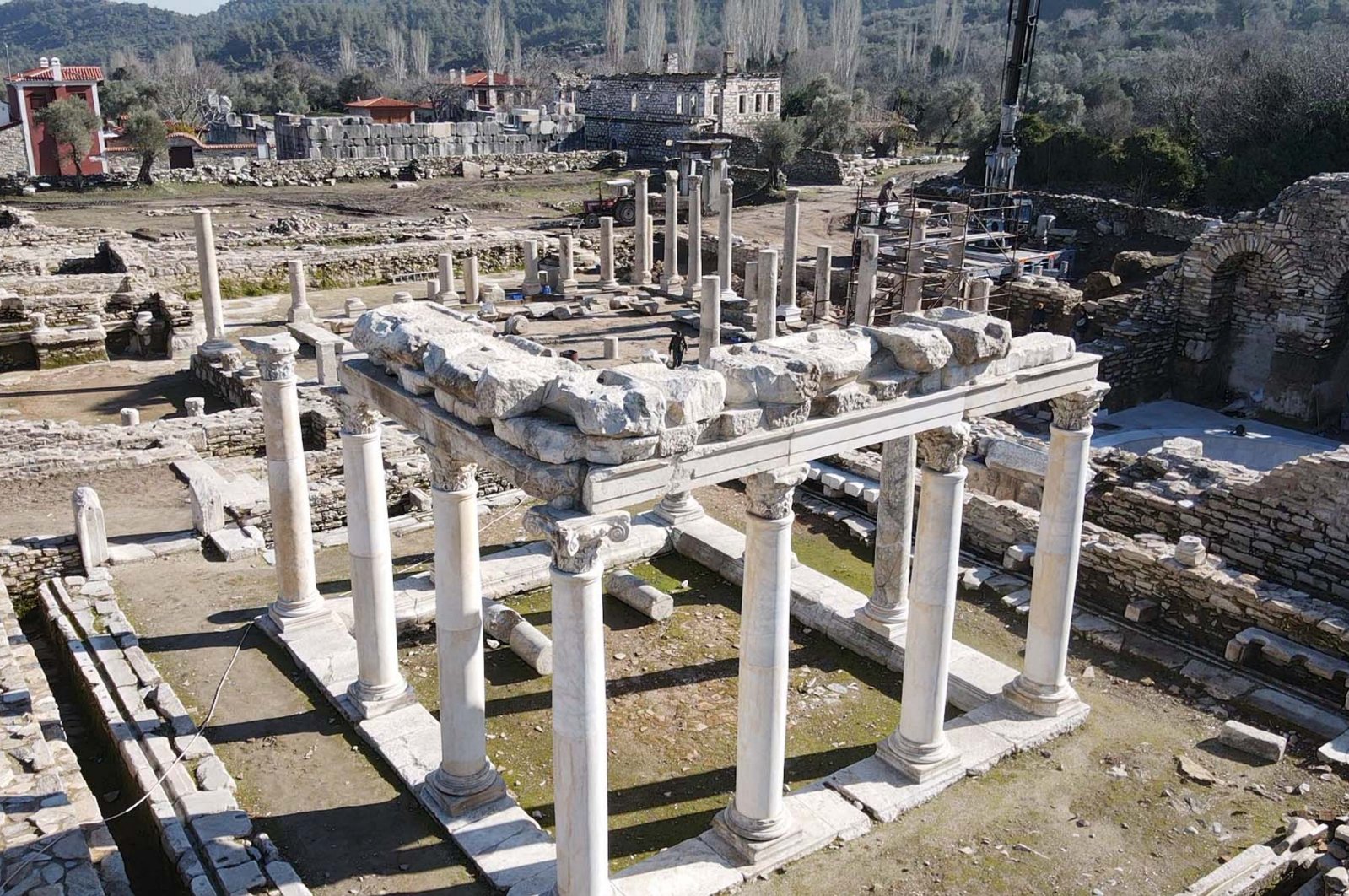
Columns in the courtyard of the Roman bath at Stratonikeia after excavation and restoration work in February 2025. Excavations in the Palaestra exposed 36 columns and associated architectural material. Credit: AA Photo
The significance of the Stratonikeia chronology lies in separating several stages of the building’s history that had previously been difficult to distinguish archaeologically. Reused architectural material, repairs, later alterations and overlapping destruction deposits complicated attempts to determine when the Frigidarium was first built, when it underwent major reconstruction and when its monumental use finally ended.
Şahiner et al. (2026) combined optically stimulated luminescence (OSL) dating with archaeological stratigraphy, structural evidence, historical earthquake records and coins recovered during excavation. Rather than assigning damaged architecture directly to known earthquakes, the researchers constructed probabilistic age ranges and then compared those results with regional seismic windows.
| Phase | Mode | Median | 95.4% modeled interval | Interpretation |
|---|---|---|---|---|
| Construction | 95 CE | 162 CE | 60–323 CE | Primary Roman Imperial construction, most plausibly late first to early second century CE |
| Major repair | 375 CE | 403 CE | 365–499 CE | Consistent with reconstruction after the 365 CE eastern Mediterranean earthquake |
| Destruction, Model A | 545 CE | 579 CE | 405–802 CE | OSL evidence alone cannot distinguish among several late seismic windows |
| Destruction, Model B | 633 CE | 687 CE | 613–850 CE | After the 613 CE coin constraint, the early seventh-century seismic window becomes dominant |
The construction phase has a modeled mode of 95 CE, a median of 162 CE and a 95.4% highest-posterior-density interval of 60–323 CE. The researchers interpret the main construction most plausibly as a late first- to early second-century CE development within the Roman Imperial monumentalization of Stratonikeia.
A fired structural brick labeled STR-3 provides one of the strongest constraints on that phase. Its OSL age was 1.94 ± 0.25 ka, corresponding to approximately 83 CE in the raw age estimate. Heating during brick manufacture resets the relevant luminescence signal in mineral grains, allowing the later accumulation of trapped energy to act as a clock for the time elapsed since firing.
How optically stimulated luminescence dating works
Mineral grains such as quartz accumulate trapped electrical charge while exposed to natural background radiation. Strong heating or sufficient exposure to light can empty that stored signal. In the laboratory, researchers stimulate the grains and measure the released luminescence. When the environmental radiation dose rate is also known, the stored energy can be converted into an estimate of the time since the signal was last reset.
The method does not simply produce a calendar date. Sample history, incomplete resetting of the signal and uncertainty in the surrounding radiation field all affect the result. The Stratonikeia study therefore combined OSL measurements with stratigraphy, material context and Bayesian statistical constraints.
Five archaeological specimens were dated during the luminescence program, but not all five were allowed to drive the final chronology. The phase model relies primarily on three well-bleached specimens: the structural brick STR-3, the pool-edge mortar STR-HMH and the sub-column sediment STR-HPGS.
Two other specimens displayed strong incomplete-bleaching signatures. Mineral grains that were not adequately reset before burial can retain an inherited luminescence signal and yield an apparent age older than the event being investigated. The researchers excluded those two specimens from the primary phase likelihood rather than using them to force a narrower chronology.
The next major phase falls several centuries later. The repair posterior has a mode of 375 CE, a median of 403 CE and a 95.4% highest-posterior-density interval of 365–499 CE. The authors describe that result as consistent with reconstruction after the major 365 CE Crete earthquake and its wider effects across the eastern Mediterranean.
The statistical agreement does not prove that every repair in the bath was caused by that earthquake. The 365 CE event is the strongest historical anchor for the modeled repair phase, but the relationship remains an archaeoseismic interpretation built from independent dating evidence, archaeological reconstruction and the historical earthquake record.
The crucial distinction is between a modeled chronology and an exact earthquake date. The study constrains when construction, repair and destruction most plausibly occurred; it does not convert the statistical modes of 375 CE or 633 CE into directly observed event dates.
The terminal destruction was substantially harder to date from luminescence evidence alone. Under Model A, before the decisive numismatic boundary is added, the collapse distribution has a mode of 545 CE, median of 579 CE and 95.4% interval of 405–802 CE.
That broad range overlaps several historical seismic anchors, including events around 494 CE, 554–558 CE and approximately 610–630 CE. At a ±25-year comparison window, the reported overlap probabilities are 0.16, 0.19 and 0.21 respectively, leaving those possibilities statistically difficult to separate with the OSL model alone.
Coins minted in 613 CE changed the chronological picture. The coin assemblage was stratigraphically sealed with the collapse sequence and supplies an independent terminus post quem, meaning the relevant destruction cannot precede that chronological boundary.
Why 633 CE is not the earthquake date
After the 613 CE numismatic constraint is applied, the destruction model has a mode of 633 CE, a median of 687 CE and a 95.4% interval of 613–850 CE. The mode is simply the highest point of the modeled probability distribution. It is not a historical observation that an earthquake struck Stratonikeia in 633 CE.
The appropriate interpretation is that the independent archaeological constraints make the approximately 610–630 CE regional seismic window the strongest of the earthquake windows tested by the researchers.
With the 613 CE boundary applied in Model B, the destruction posterior narrows to 613–850 CE and peaks at 633 CE. The approximately 610–630 CE seismic window then becomes the dominant historical anchor, with an overlap probability of 0.31 at a ±25-year tolerance and 0.46 at ±50 years.
Keep reading
| Evidence | What it establishes | What it does not establish |
|---|---|---|
| OSL ages | Probabilistic age constraints for construction, repair and destruction-related materials | An exact calendar year for an earthquake |
| 613 CE coins | A chronological boundary that removes earlier destruction possibilities | Proof that the collapse occurred immediately after 613 CE |
| Directional column collapse | A kinematic pattern compatible with strong ground motion | Earthquake causation by itself |
| Historical earthquake catalog | Candidate regional seismic windows for comparison | A one-to-one identification without archaeological support |
| Bayesian modeling | A combined probability distribution constrained by the available evidence | Certainty that the highest-probability year was the true event year |
The physical remains provide another independent line of evidence. Columns along the southern portico of the adjoining Palaestra collapsed in a unified northward direction, while architectural debris and a preserved destruction horizon were documented around the bath complex. The authors treat the directional toppling as a kinematic signature compatible with strong ground motion rather than gradual structural decay.
The researchers also examined alternative explanations. The relevant destruction horizon lacked fire or ash, reducing support for a fire-driven collapse, and the archaeoseismic assessment considered gradual decay, wind and flooding alongside seismic failure. The chronological, stratigraphic and structural evidence together led the authors to favor an earthquake as the trigger for the terminal destruction.
The destruction chronology nevertheless carries an important limitation. It relies heavily on one accepted event-related luminescence specimen, STR-HPGS, together with the independent numismatic boundary and structural evidence. The broad 613–850 CE posterior interval therefore remains scientifically important even though the probability distribution is concentrated toward the early seventh century.
The dose-rate calculations add another layer of uncertainty. OSL ages depend not only on the luminescence stored in the grains but also on the amount of environmental radiation they received over time. Compound masonry can place quartz close to materials with different radioactive properties, producing a heterogeneous gamma field.
The Stratonikeia model treats part of that gamma-field geometry as a Bayesian nuisance parameter rather than fixing the environmental radiation field at a single assumed value. The protocol also incorporates grain-size-dependent attenuation and a carbonate water-equivalence correction for lime-bound mortar.
The Bayesian synthesis used 2 million primary draws. Model A retained 53 465 posterior samples, an acceptance ratio of 2.67%, while Model B retained 20 689 samples, or 1.03%, after the additional numismatic and chronological constraints were applied. Those percentages describe how many sampled combinations satisfied the model constraints; they are not probabilities that the earthquake interpretation is correct.

The chronology records two markedly different outcomes after seismic disruption. The fourth-century phase was followed by substantial repair and continued monumental use. The later destruction was not followed by restoration of the same civic function, allowing the archaeological record to capture both recovery and eventual permanent change within the same public complex.
That contrast is the study’s broader archaeoseismic value. A damaged ancient structure does not preserve only the moment of destruction; it can also retain evidence of rebuilding decisions, continued investment and later abandonment. By placing those episodes within absolute chronological ranges, the Stratonikeia study turns a sequence of architectural changes into a testable history of urban response to repeated seismic disruption.
The work does not show that modern earthquake probabilities, seismic hazard maps, building codes or official risk assessments in southwestern Türkiye should be revised. Its direct contribution is historical and methodological: it improves the chronology against which ancient earthquake evidence and long-term urban responses can be compared.
The largest remaining uncertainty concerns the terminal event. The archaeological and statistical evidence favors an early seventh-century seismic trigger, but it does not identify a uniquely dated earthquake. Further independently dated destruction contexts from Stratonikeia and nearby sites would be needed to determine whether the same regional event can be traced across multiple structures with comparable chronological precision.
References:
1 Şahiner, E., Koralay, T., Söğüt, B., Sezgin, T., & Kadıoğlu, Y. K. (2026). Bayesian archaeoseismic chronology of the Stratonikeia Frigidarium from construction to seismic collapse. Archaeological and Anthropological Sciences, 18(10), Article 203. DOI: 10.1007/s12520-026-02564-9
2 Ancient Roman bath in Türkiye reveals centuries of earthquake damage, reconstruction – Anadolu Agency – November 18, 2026
3 “Gladyatörler kenti” Stratonikeia’nın Roma hamamında 1900 yıl sonra su aktı – Anadolu Agency – August 10, 2025

I’m a science journalist and researcher at The Watchers, contributing to the Epicenter edition, where I cover peer-reviewed scientific research and emerging discoveries across Earth and space sciences. With a background in astronomy and a passion for environmental science, I’ve worked in shark and coral conservation in Fiji, conducting reef and shark-behavior research, contributing to mangrove restoration, and earning PADI Open Water and Coral Reef Certifications. I bring a blend of scientific rigor and storytelling to illuminate the discoveries shaping our planet and beyond.
More reporting
- Recurrent flooding linked to higher odds of depression, anxiety and stress among farmers in southern Thailand
- New mapping finds widespread landslide susceptibility along Amarnath pilgrimage corridor, India
- Sudden heat shock linked to poorest honey bee survival in laboratory study
- A piece of Mars fell on Egypt in 1911, and a farmer said one fragment hit a dog and left it "like ashes in a moment"
