
Ancient Martian lavas were more fluid than younger basalts, Perseverance study finds
Ancient olivine-rich lavas preserved in the Séítah formation at Jezero Crater had a greater modeled ability to flow than younger Martian basalts, according to a new analysis of geochemical measurements from NASA’s Perseverance rover. The finding gives researchers a quantitative way to compare volcanic behavior across different periods of Martian history and supports a scenario in which low-viscosity lava ponded and crystallized to form the unusual rocks now exposed on the crater floor.
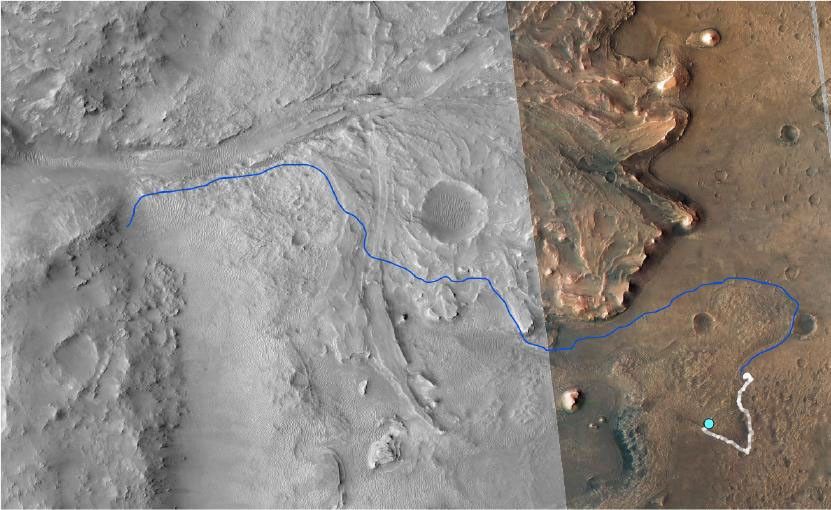
An orbital map showing Perseverance's route across the Jezero crater floor and through South Séítah during its first science campaign. The underlying imagery was obtained by the Mars Reconnaissance Orbiter's HiRISE camera. Credit: NASA/JPL-Caltech
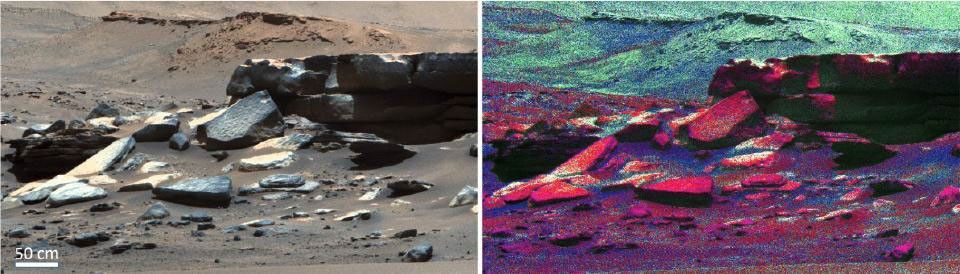
Perseverance entered the Séítah formation during its first exploration of the Jezero crater floor in 2021. The rocks immediately stood apart from much of the surrounding terrain because they contain abundant millimeter-scale olivine grains and preserve an igneous structure previously interpreted as an olivine cumulate — rock formed through the concentration of olivine crystals within cooling magma.
The physical behavior of the molten material that produced Séítah was harder to establish. Brown et al. (2026) addressed that problem by converting rover-measured chemical compositions into estimates of lava viscosity, then using those values to compare how different Martian lavas would behave under the same numerical flow conditions.1

Viscosity describes how strongly a fluid resists deformation and flow. Lower-viscosity lava moves more readily than higher-viscosity lava when other conditions are comparable. In volcanic systems, that difference affects how efficiently molten rock can move away from its source, how quickly it loses heat and how crystals become distributed as the lava cools.
| Evidence type | What the study uses | What it can establish |
|---|---|---|
| Direct observation | Perseverance geochemistry, mineralogy, rock textures and rover imagery | Composition and physical characteristics of the exposed Séítah rocks |
| Calculated quantity | Viscosity derived from measured chemical compositions | How resistant the corresponding melt would be to flow at specified temperatures |
| Model output | PyFLOWGO relative runout calculations | Comparative flow capacity under standardized assumptions |
| Research interpretation | Viscosity, olivine distribution and crystallization modeling considered together | A physically plausible ponded-lava origin for the Séítah olivine cumulate |
The researchers calculated viscosities using the empirical Giordano melt-viscosity model. For comparison at 1 400 K, approximately 1 127°C (2 060°F), the Séítah composition measured by SuperCam produced a viscosity of 1.16 log Pa·s in the study’s formulation, equivalent to about 14.5 Pa·s. That value is calculated from composition and temperature; Perseverance did not measure molten lava directly.
The calculated properties were then entered into PyFLOWGO, a numerical lava-flow model that follows changes in velocity, temperature and viscosity as a flow cools. Brown et al. ran each composition repeatedly with initial temperatures ranging from 1 000 to 2 000 K in 100 K increments and used the maximum result as a measure of relative flow capacity.
Model assumptions used for the flow comparison
The simulations used Martian gravity of 3.71 m/s², a 6 mbar atmosphere, a constant 7° slope, a volumetric lava-flow rate of 4 984 m³/s (about 176 000 ft³/s), and a channel width and depth of 12.8 m (42 feet). These parameters were deliberately held constant so differences between modeled compositions could be compared.1
FLOWGO assumes channelized, purely viscous, non-turbulent flow through a channel of uniform width. Real lava travels across three-dimensional terrain and may stop because magma supply ends rather than because cooling alone makes the lava immobile. The authors therefore state that the resulting distances are relative model values, not reconstructed Martian lava paths.1
| Study value | Meaning |
|---|---|
| 1 400 K / 1 127°C (2 060°F) | Reference temperature used for comparing calculated viscosities |
| 1.16 log Pa·s | Calculated Séítah SuperCam viscosity at 1 400 K |
| 198.6 km (123.4 miles) | Maximum relative PyFLOWGO runout for the Séítah SuperCam composition, not an observed flow length |
| 40 ± 10% | Modeled fraction of a lava lake that could crystallize as the cumulate floor layer |
| At least about 15 m (49 feet) | Depth to which RIMFAX identified subsurface reflectors near Séítah |
| 10 m (33 feet) | Illustrative lava-lake depth used by the authors for a thickness example |
| 4 ± 1 m (13 ± 3 feet) | Resulting illustrative cumulate thickness for that 10 m example |
The Séítah SuperCam composition produced a maximum relative runout of 198.6 km (123.4 miles) in the standardized simulations. That figure does not mean researchers identified a volcanic vent and traced a lava flow for nearly 200 km across Mars. It describes how long the modeled flow remained mobile under the numerical conditions imposed on every composition in the comparison.
What the 198.6 km result does — and does not — mean
The value is useful because every modeled composition was tested under the same imposed flow conditions. A longer modeled runout therefore identifies a composition with greater relative flow capacity in that experiment.
It cannot reconstruct an actual route across Jezero Crater. The authors explicitly state that FLOWGO was used to approximate relative flow length and that the calculated value cannot be used as a realistic actual distance. They also note that cooling-limited model results can exceed real flow lengths when a natural eruption stops because magma supply is cut off.1
The low modeled viscosity also helps address why Séítah contains a concentration of coarse olivine crystals. Liu et al. (2022) previously interpreted the formation as an olivine cumulate created through settling and enrichment of olivine during multistage cooling of a thick magma body.
Brown et al. tested a more specific physical scenario in which low-viscosity lava accumulated in a ponded body or lava lake. As the lava cooled, convection could keep molten material circulating while crystals formed and accumulated toward the bottom, gradually producing an olivine-rich floor layer.
The convective cooling model indicates that the crystal-rich cumulate could account for up to about 40 ± 10% of the lava-lake volume under the assumptions used. The calculation depends on an analogy with a low-viscosity diopside-anorthite system and on uncertainty over how efficiently the bottom of the ancient Martian lava body lost heat.
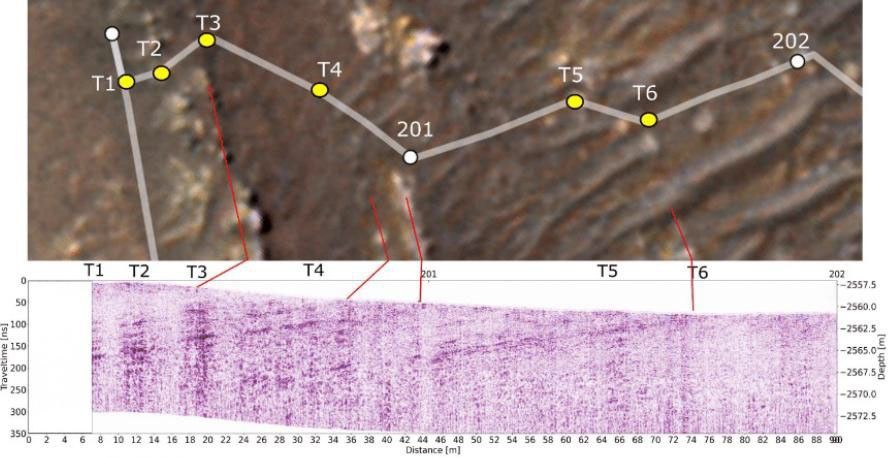
The original depth of the ponded lava remains uncertain. RIMFAX ground-penetrating radar detected sub-horizontal reflectors to at least about 15 m (49 feet) below the surface near Séítah, including structures interpreted as possible cross-sections through igneous flow lobes, but the base of the unit has not been clearly identified.
To illustrate the crystallization result, Brown et al. considered a hypothetical lava body approximately 10 m (33 feet) deep. In that example, the lower approximately 4 ± 1 m (13 ± 3 feet) would form the olivine-rich cumulate layer. The 10 m starting value is an illustrative assumption rather than a direct measurement of the original lava-lake depth.
Keep reading
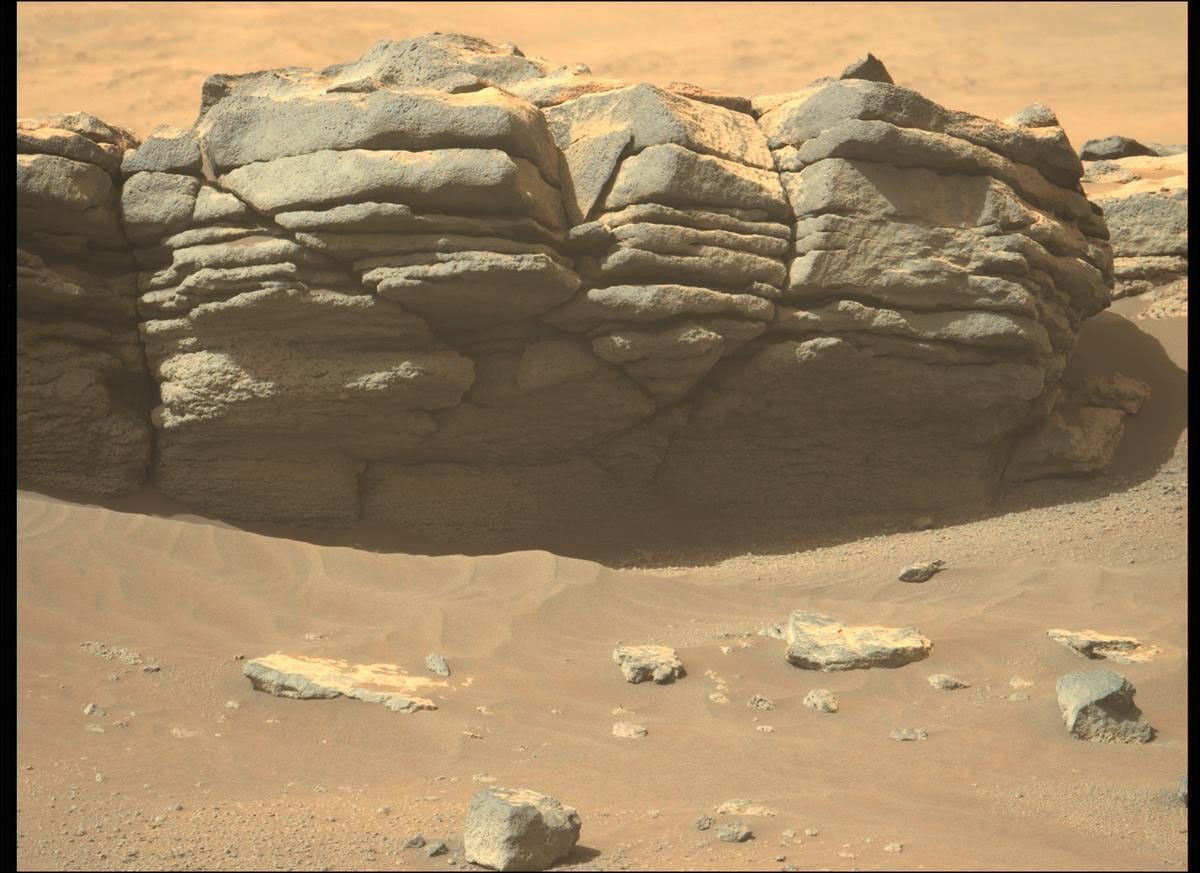
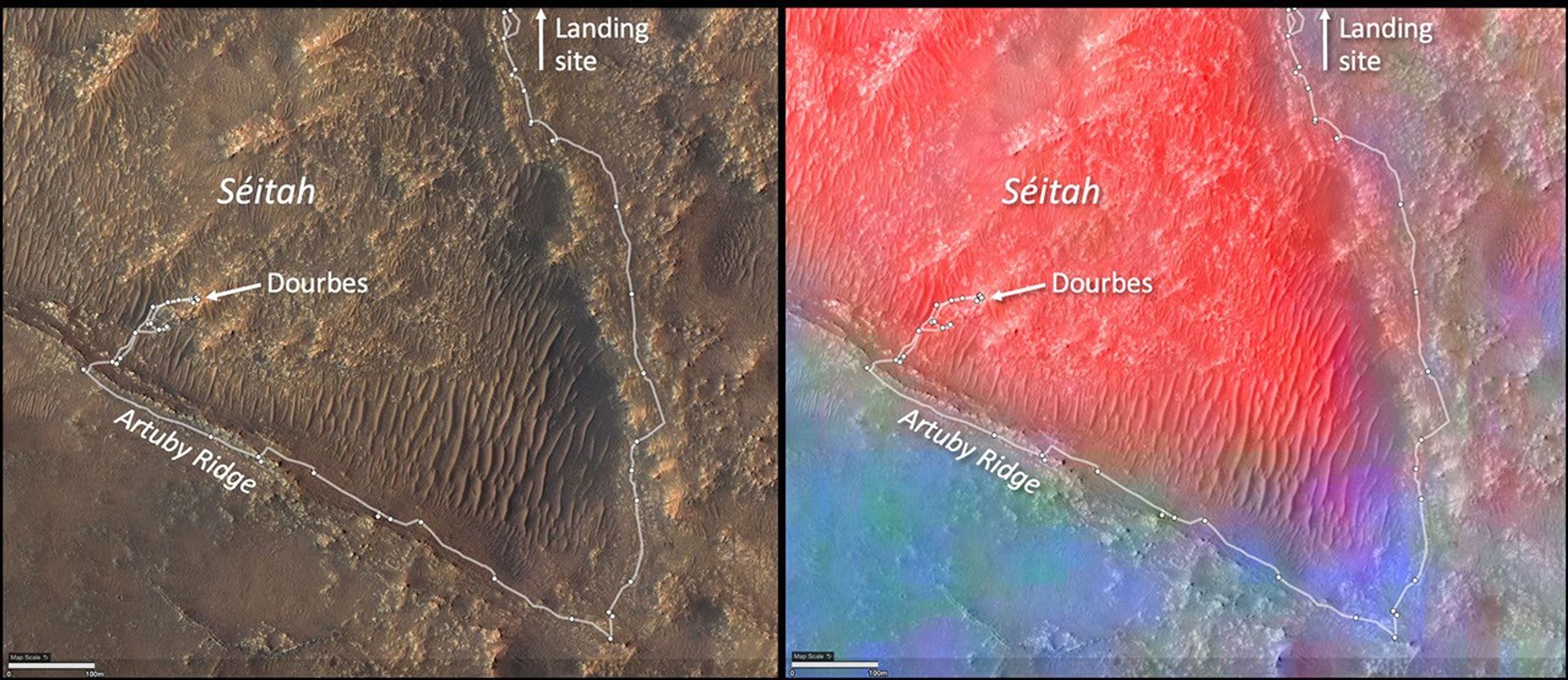
Rover observations independently show that Séítah is not uniform. Beyssac et al. (2023) analyzed an approximately 140 m (459 feet) traverse through the formation with SuperCam and documented changes in grain size, chemistry and mineralogy with stratigraphic position. Séítah rocks are dominated by millimeter-scale olivine grains and also contain pyroxenes and other primary igneous minerals.
The approximately 140 m section corresponds to an estimated stratigraphic thickness of about 15–20 m (49–66 feet) in southeastern Séítah. Rocks nearer the boundary with the overlying Máaz formation generally show smaller grains, lower olivine abundance and more alteration products than material deeper in the formation.
The 2026 study extends those petrological observations into a physical comparison of Martian lava behavior. Brown et al. compared the Noachian olivine-rich compositions at Jezero with younger Hesperian basalt compositions previously measured by NASA’s Spirit rover. Under the common modeling framework, the older Jezero examples had a greater propensity to flow.
The distinction provides a way to examine volcanic evolution using more than mineral composition alone. Viscosity connects chemistry and temperature with the physical behavior of a melt, allowing lavas from different periods and locations on Mars to be compared through the same rheological quantity.
The result does not establish a complete thermal history of the Martian mantle. Lava viscosity depends on composition, temperature, crystal content, volatile content and pressure, while actual surface flows are also controlled by eruption rate, terrain and the duration of magma supply. Brown et al. describe the work as placing new constraints on the evolution of Martian viscosity and as an initial step toward understanding what Séítah can reveal about ancient magma sources.

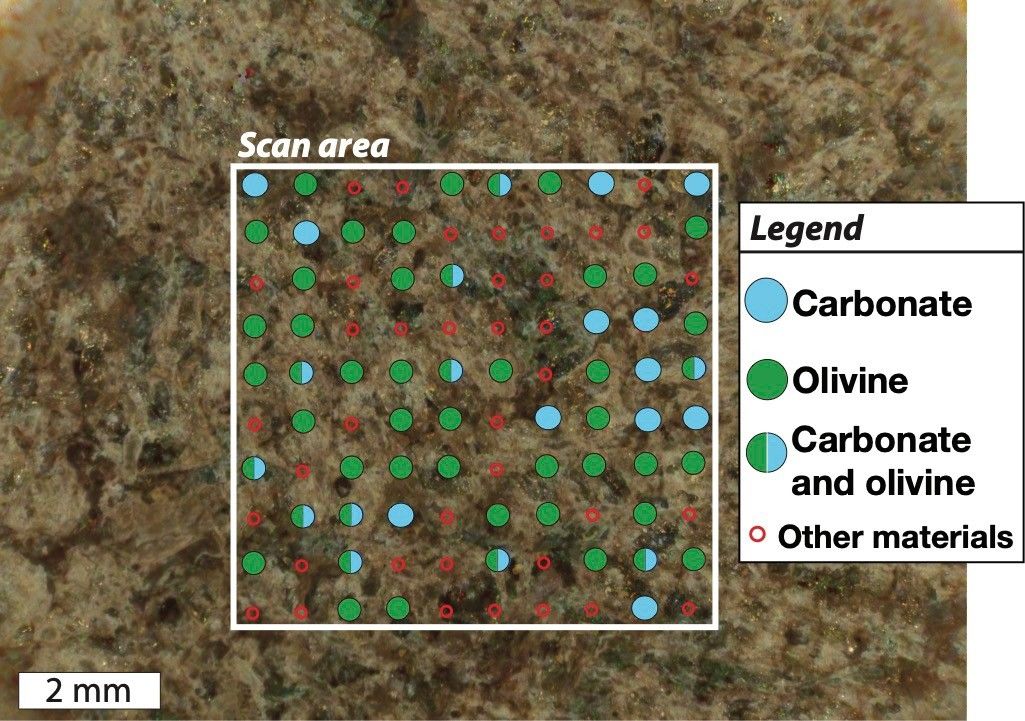
Séítah also preserves evidence of processes that occurred after the igneous rocks formed. Earlier Perseverance investigations identified carbonate and other alteration products associated with the olivine-rich material, showing that some of the volcanic rocks later interacted with liquid water.
That later aqueous history is separate from the new viscosity reconstruction, but together the observations show why Séítah is unusually information-rich. The same rocks preserve evidence about magma crystallization, lava emplacement and subsequent water-rock reactions on the ancient crater floor.

Future analysis of samples collected by Perseverance could test the crystallization history at scales unavailable to rover instruments. Brown et al. identify laboratory study of the Mars 2020 samples, together with further observations of the olivine-rich unit, as a way to constrain the dynamics and evolution of Martian lava flows more tightly.
The principal uncertainty is therefore no longer whether Séítah is an unusual olivine-rich igneous unit. Rover measurements have established that. The unresolved problem is how the ancient magma was emplaced, how thick the original molten body was, and how much of the structure now exposed at Jezero survived erosion and burial by later volcanic material.
References:
1 Brown, A. J., Kah, L., Wiens, R. C., Pinet, P., Gasda, P. J., Royer, C., Hickman-Lewis, K., Cousin, A., Simon, J. I., Comellas, J., Cloutis, E., Fouchet, T., Fairén, A. G., Connell, S., Flannery, D., Núñez, J. I., Wogland, B., Amundsen, H. E. F., Hand, K. P., … Forni, O. (2026). High flow capacity and low viscosity of the Séítah formation, at Jezero Crater, Mars. Communications Earth & Environment. DOI: 10.1038/s43247-026-04171-x
2 Liu, Y., Tice, M. M., Schmidt, M. E., Treiman, A. H., Kizovski, T. V., Hurowitz, J. A., Allwood, A. C., Henneke, J., Pedersen, D. A. K., VanBommel, S. J., Jones, M. W. M., Knight, A. L., Orenstein, B. J., Clark, B. C., Elam, W. T., Heirwegh, C. M., Barber, T., Beegle, L. W., Benzerara, K., … Zorzano, M.-P. (2022). An olivine cumulate outcrop on the floor of Jezero crater, Mars. Science, 377(6614), 1513–1519. DOI: 10.1126/science.abo2756
3 Beyssac, O., Forni, O., Cousin, A., Udry, A., Kah, L. C., Mandon, L., et al. (2023). Petrological traverse of the olivine cumulate Séítah formation at Jezero Crater, Mars: A perspective from SuperCam onboard Perseverance. Journal of Geophysical Research: Planets, 128(7), e2022JE007638. DOI: 10.1029/2022JE007638

I’m a science journalist and researcher at The Watchers, contributing to the Epicenter edition, where I cover peer-reviewed scientific research and emerging discoveries across Earth and space sciences. With a background in astronomy and a passion for environmental science, I’ve worked in shark and coral conservation in Fiji, conducting reef and shark-behavior research, contributing to mangrove restoration, and earning PADI Open Water and Coral Reef Certifications. I bring a blend of scientific rigor and storytelling to illuminate the discoveries shaping our planet and beyond.
More reporting
- Howard Carter found an iron dagger on Tutankhamun's right thigh in 1925; modern XRF analysis supports a meteoritic origin of the iron
- ALMA reveals a dying star's 6 500-year-old gas shell and emerging hourglass nebula
- Venus’ extreme atmosphere could preserve mineral traces of its wetter past
- Astronomers uncover hidden space debris in the Earth's geosynchronous region
