
Venus’ extreme atmosphere could preserve mineral traces of its wetter past
Laboratory experiments have revealed how Venus’ extreme atmosphere could preserve mineral evidence of an earlier water-rich period rather than erase it. Researchers found that hydrogen fluoride can transform water-bearing minerals into more heat-resistant forms, while reactions with carbon dioxide produce additional mineral signatures that could help reconstruct the planet’s water history.
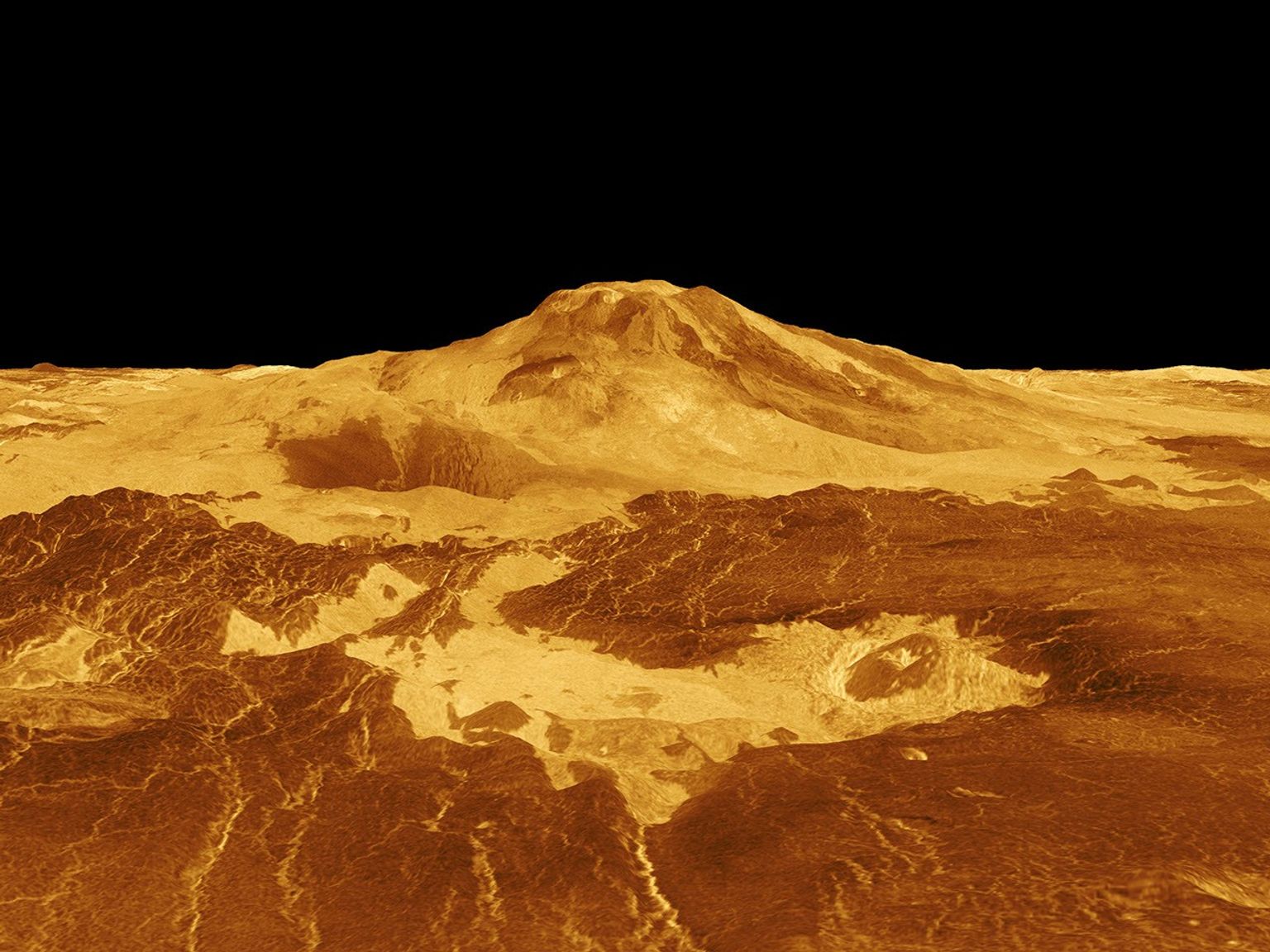
Maat Mons and surrounding volcanic plains on Venus in a computer-generated perspective derived from Magellan radar observations. Volcanic degassing and the exposure of fresh volcanic material represent possible mechanisms for replenishing atmospheric gases consumed through surface mineral reactions. Credit: NASA/JPL
Venus’ present surface environment presents a fundamental problem for researchers attempting to reconstruct its geological history. Minerals formed during a possible earlier period of greater water abundance would have been exposed to intense heat, atmospheric pressure and chemically reactive gases. Whether those minerals could survive, or leave recognizable alteration products, remains important to determining how much evidence of the planet’s earlier environment might still exist.
Sara Taeko Port and colleagues investigated that question by exposing six minerals to simulated Venus surface conditions for 60 consecutive days. Their study, published in The Planetary Science Journal on October 30, 2026, identified chemical reactions through which minerals containing hydroxyl groups can transform into fluorine-bearing micas and magnesium carbonate. Both products offer potential clues to Venus’ geological and atmospheric evolution.
The experiments took place in the Glenn Extreme Environments Rig (GEER) at NASA’s Glenn Research Center in Cleveland, Ohio. The 811 L (214 US gallons) pressure vessel reproduces Venus-like atmospheric chemistry, with the mineral samples exposed to temperatures of 460°C (860°F) and pressures of 93 ± 1 bar (approximately 1 350 ± 15 psi).
The researchers selected three carbonate minerals, calcite, siderite and magnesite, alongside phlogopite, muscovite and brucite. Studying these minerals together allowed the team to investigate how compounds associated with water and carbon dioxide respond to the present Venus atmosphere.
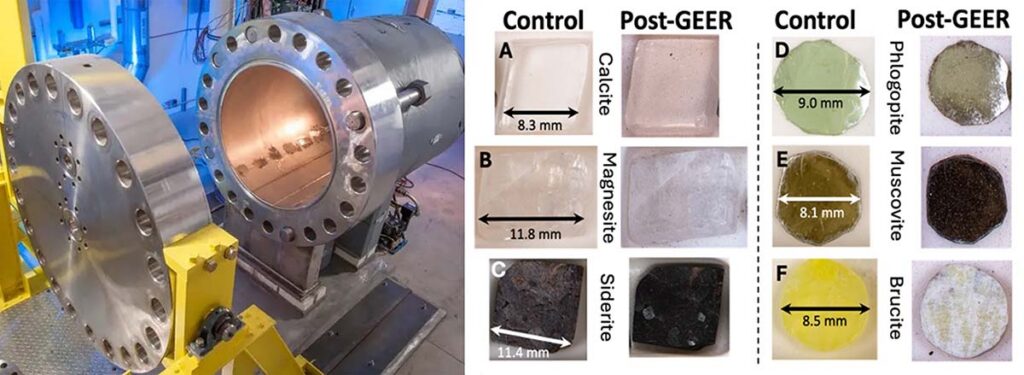
Phlogopite and muscovite supplied one of the most important results. Both belong to the mica group, whose minerals have layered crystal structures that can contain hydroxyl (OH), a chemical group composed of oxygen and hydrogen. Under the experimental conditions, hydrogen fluoride (HF) reacted with the micas, replacing hydroxyl with fluorine and producing fluorophlogopite and fluoromuscovite.
Replacing hydroxyl with fluorine can increase the temperature at which mica remains stable. The reaction offers a possible preservation pathway for Venus: if hydroxyl-bearing micas formed when water was more abundant, subsequent exposure to the modern atmosphere could transform them into more thermally stable minerals.
Port, a postdoctoral researcher at UT San Antonio, interprets the fluorine-bearing minerals as potential targets for investigating past water on Venus. Their discovery on the planet would warrant investigation of whether they originated through alteration of earlier water-bearing minerals. The laboratory experiment establishes that such a transformation is possible, but it does not establish that the precursor minerals existed on ancient Venus or that liquid water was present at its surface.
Brucite, a magnesium hydroxide mineral with the chemical formula Mg(OH)₂, experienced the greatest alteration among the six minerals. The solid slab lost 0.9% of its mass, while the powdered sample gained 15.2%. The different mass changes accompanied a combination of dehydration and chemical reactions with the simulated atmosphere.
| Starting mineral | Principal reaction product | Scientific relevance |
|---|---|---|
| Phlogopite | Fluorophlogopite | Fluorine substitution can increase thermal stability |
| Muscovite | Fluoromuscovite | Potential preservation of evidence inherited from hydroxyl-bearing minerals |
| Brucite | Periclase and magnesite | Mineral reactions linking hydroxyl loss with carbon dioxide uptake |
X-ray diffraction, a technique that identifies crystalline minerals from the way they scatter X-rays, revealed periclase (MgO) and magnesite (MgCO₃) in the exposed brucite samples. Some of the original brucite remained, establishing that the transformation was incomplete at the end of the experiment.
The authors propose that heating first caused brucite to decompose into periclase and water. Periclase subsequently reacted with atmospheric carbon dioxide to form magnesite. Thermodynamic calculations supported the proposed sequence by evaluating which minerals were energetically favored at the experimental temperature and in the presence of the simulated atmosphere.
The proposed reactions can be expressed as:
Mg(OH)₂ → MgO + H₂O
MgO + CO₂ → MgCO₃
Magnesite is therefore another potential source of information about Venus’ water history. Its formation through this particular pathway connects an initially hydroxyl-bearing mineral with the carbon dioxide-rich modern atmosphere. Magnesite alone would not establish a former ocean, however, because magnesium carbonate can form through other chemical pathways.
The experiments also revealed how Venus’ present atmosphere interacts with exposed mineral surfaces. Surface analyses identified sulfates on phlogopite, muscovite, calcite and brucite, while sulfides were detected on siderite, muscovite and phlogopite. Both groups contain sulfur, but they represent chemically different forms of the element.
Mineral reactions involving sulfur dioxide (SO₂) and hydrogen fluoride can remove these gases from the atmosphere. If comparable reactions occur on Venus, maintaining the atmospheric supply over geological time would require processes capable of replacing the gases consumed by surface chemistry.
Keep reading
Port et al. (2026) examined atmospheric replenishment under assumptions that included volcanic outgassing rates comparable to those on Earth and an interval of approximately 500 million years since a major resurfacing episode. Their interpretation connects the removal of atmospheric sulfur and fluorine compounds with sustained volcanic degassing and the availability of fresh reactive surface material.
The volcanic interpretation depends on the assumptions used to extend the experimental findings to the planet as a whole. The six mineral samples establish that reactions occur under simulated Venus conditions, but they cannot determine the global abundance of the minerals, the total amount of gas consumed by the surface or the rate at which Venusian volcanism supplies replacement gases.
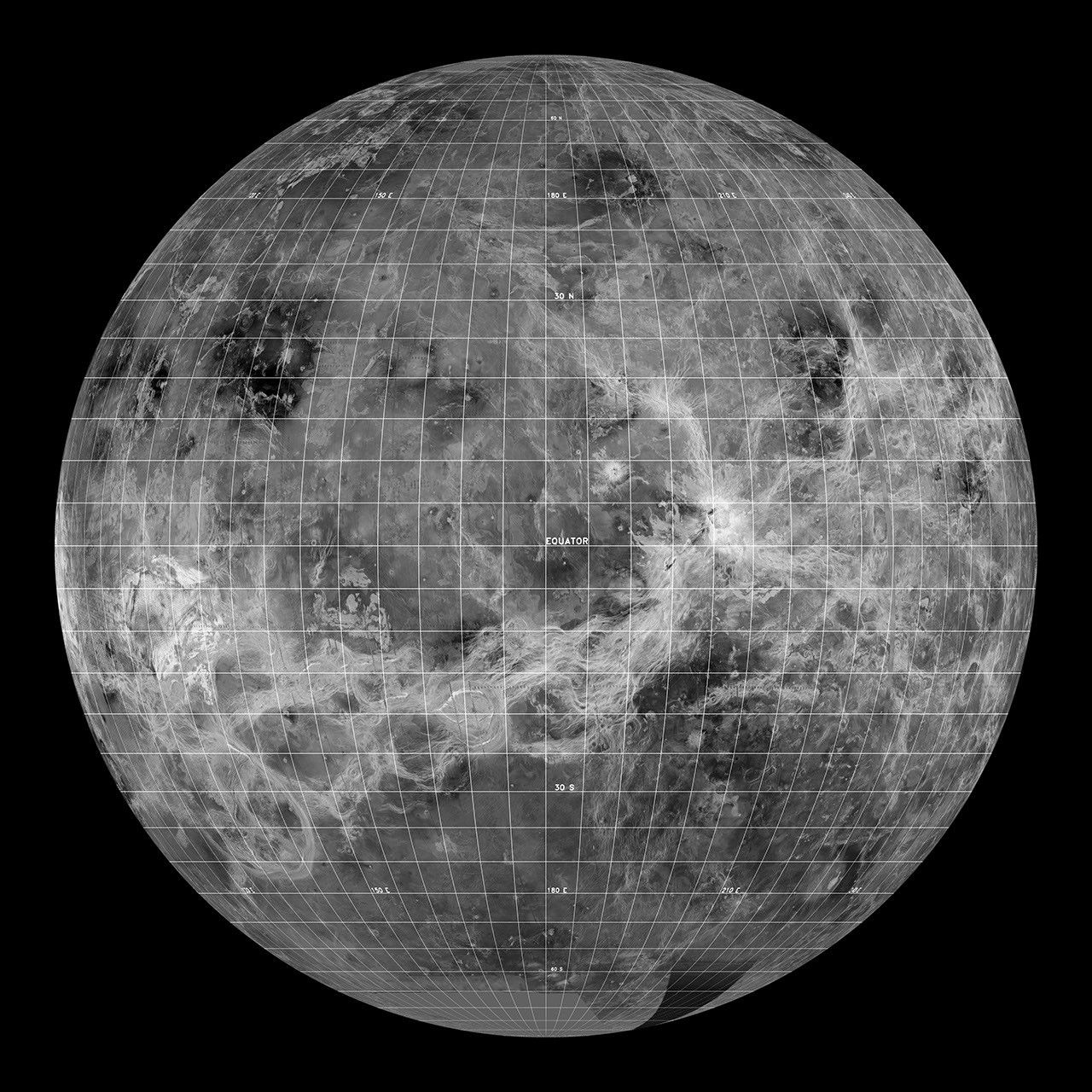
Determining the composition of Venus’ surface remains difficult because its persistent clouds obscure conventional visible-light observations from orbit. NASA’s Magellan mission used radar to map the terrain, revealing extensive geological structures, but establishing the mineral composition of individual rock units requires additional types of observations.

Future investigations of Venus include NASA’s DAVINCI and VERITAS missions and the European Space Agency’s EnVision mission. Their scientific objectives include investigating the planet’s atmosphere, geology and evolution, with different instruments and observing methods designed to provide complementary information.
DAVINCI is intended to release a probe that will measure atmospheric chemistry, temperature, pressure and winds during its descent. Below the clouds, its instruments will obtain images of Alpha Regio, a mountainous region that NASA identifies as potentially containing some of the planet’s oldest exposed terrain. Investigating the composition and geological structure of such terrain could help scientists evaluate whether Venus once supported conditions more favorable to surface water.


The laboratory findings provide a basis for interpreting future mineralogical observations, although the study does not establish that the planned spacecraft will directly identify the specific fluorine-bearing micas or magnesite produced in GEER. Establishing the mineral phases present on Venus and the conditions under which they formed would require sufficient compositional measurements and geological context.
Additional constraints will come from laboratory experiments testing how the alteration products evolve over longer periods and under different atmospheric compositions. The 60-day experiment establishes that particular chemical transformations occur, but it cannot directly demonstrate that their products remain preserved over hundreds of millions of years.
The unresolved question is whether Venus contains minerals that retain evidence of an earlier water-bearing environment despite prolonged exposure to its modern atmosphere. Identifying the fluorine-bearing micas and determining their formation history would help test that possibility, while magnesium carbonates could provide separate constraints on the planet’s carbon dioxide and water cycles. Neither mineral group has been established by this experiment as evidence of an ancient Venusian ocean.
References:
1 Port, S. T., Bose, M., Harvey, J.-P., Lukco, D., Kremic, T., & Hunter, G. W. (2026). New insights into Venus’s volatile cycles revealed by the formation of magnesite and fluoro–micas. The Planetary Science Journal, 7(10), 247. DOI: 10.3847/PSJ/aea909
2 UT San Antonio research offers new clues to Venus’ past and future exploration – UT San Antonio – November 9, 2026
3 DAVINCI – NASA

I’m a science journalist and researcher at The Watchers, contributing to the Epicenter edition, where I cover peer-reviewed scientific research and emerging discoveries across Earth and space sciences. With a background in astronomy and a passion for environmental science, I’ve worked in shark and coral conservation in Fiji, conducting reef and shark-behavior research, contributing to mangrove restoration, and earning PADI Open Water and Coral Reef Certifications. I bring a blend of scientific rigor and storytelling to illuminate the discoveries shaping our planet and beyond.
More reporting
- A fireball exploded over Murchison in Victoria on September 28, 1969, scattering meteorite fragments across about 35 km2, and 40 silicon carbide grains extracted from the meteorite include some older than 5.5 billion years, the Field Museum says
- Asteroid orientation can alter stand-off X-ray deflection by up to fivefold
- Auckland’s 2023 floods exposed a hidden cost of rebuilding after natural disasters
- An 11-year snow experiment reveals how desert biocrusts respond to changing winters
