
Vesuvius, the volcano that buried Pompeii, wrecked dozens of American bombers parked at its foot when it last erupted in 1944
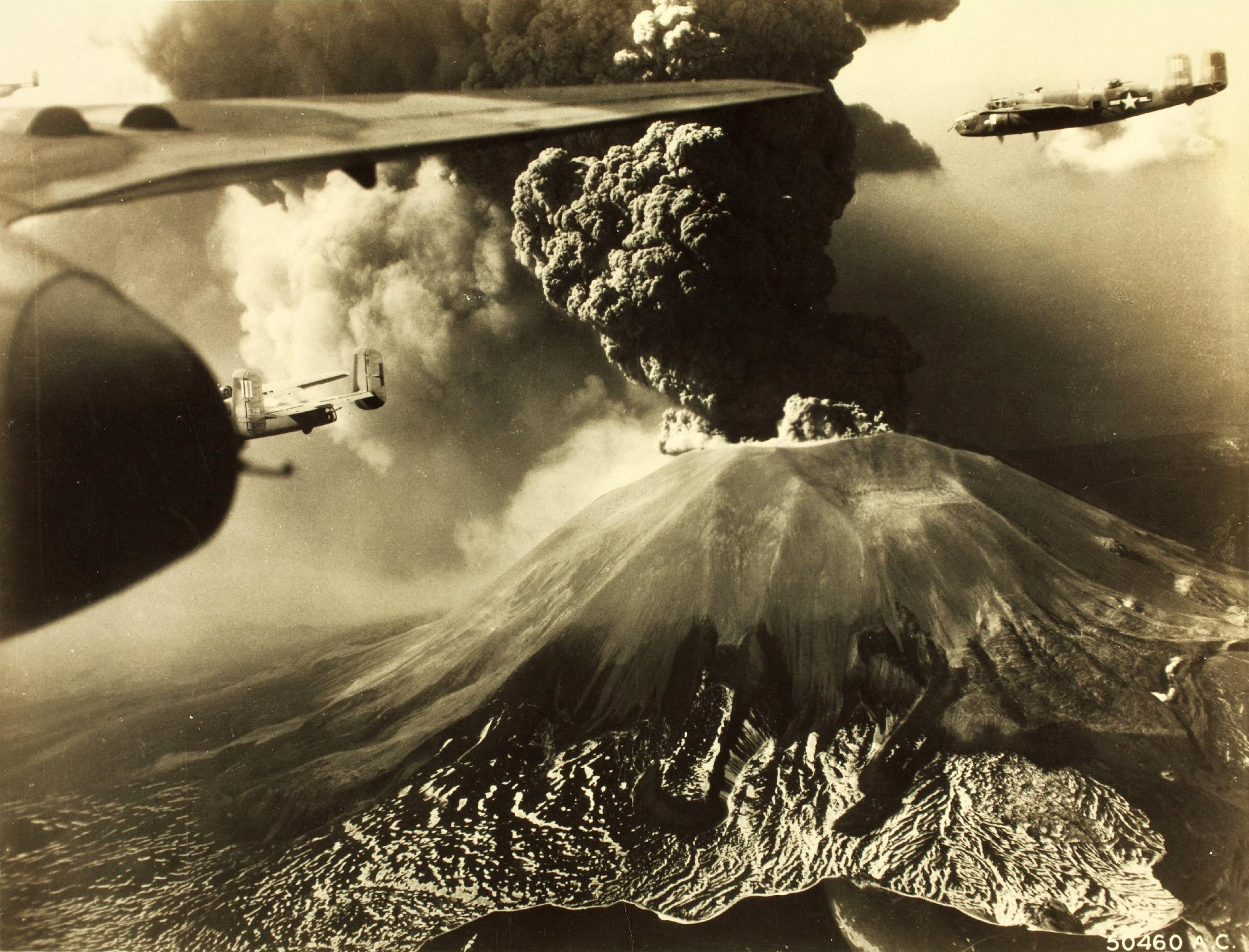
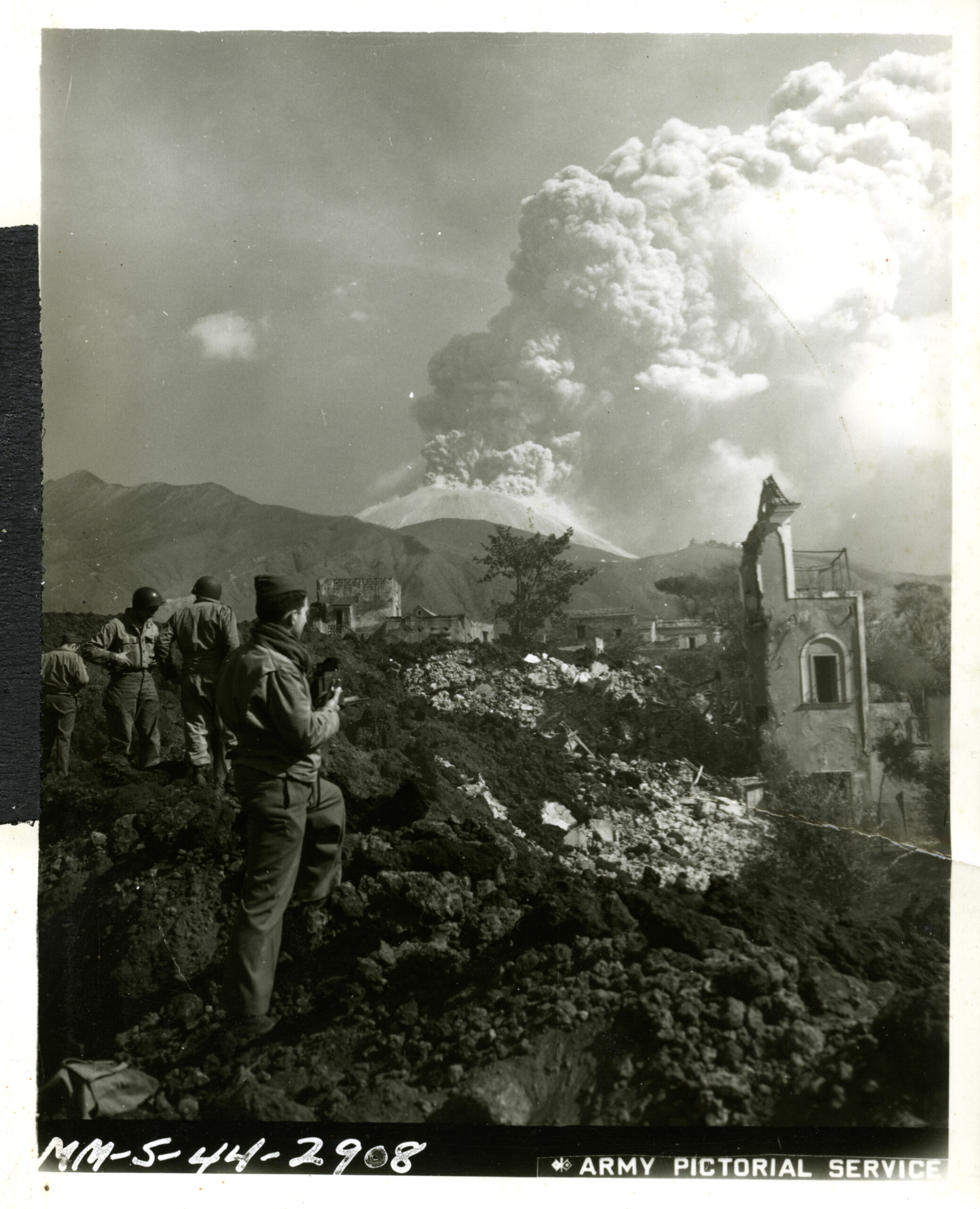
Mount Vesuvius began its last eruption on March 18, 1944, and four days later wind-driven tephra struck the U.S. Army Air Forces’ 340th Bombardment Group at Poggiomarino airfield, badly damaging 88 B-25 Mitchells. The same eruption sent lava through nearby settlements, collapsed ash-loaded roofs and forced about 14 000 people to evacuate; Italy’s Civil Protection records 21 deaths, while historical research preserves a higher 26-death reconstruction.
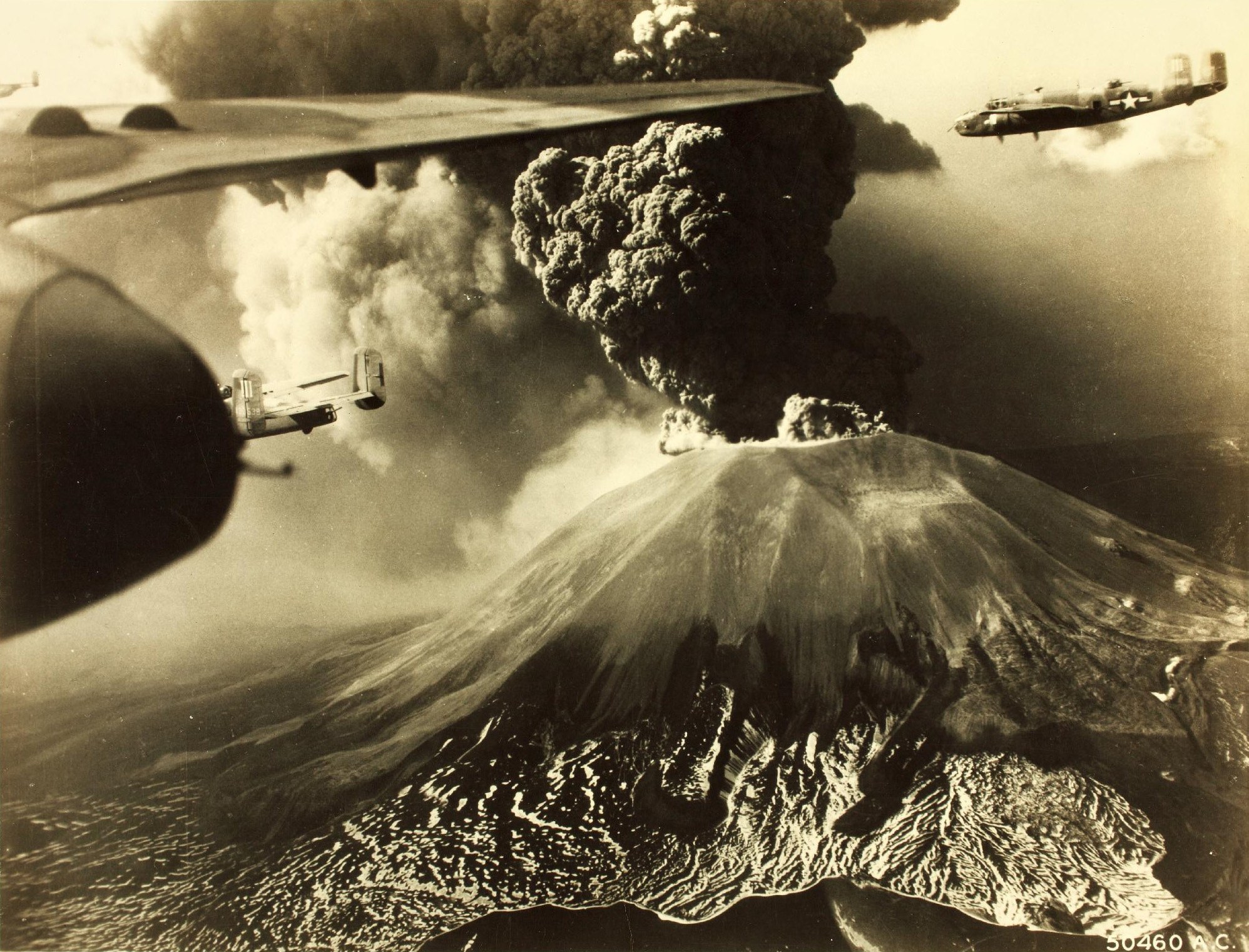
Mt Vesuvius Erupting. Credit: unknown member of 12th USAAF, 340th bomb group (public domain), via Wikimedia Commons.
The eruption began with lava effusion and changed character over the following days. Paul D. Cole and Claudio Scarpati’s volcanological reconstruction divides the event into four phases: effusive activity, eight successive lava-fountain episodes, mixed explosive activity and a final seismic-explosive phase. The sequence explains why different parts of the volcano experienced very different hazards within the same eruption.
The aircraft at Poggiomarino were not overrun by lava. They were damaged after Vesuvius entered its more explosive phase and wind carried tephra across the eastern and southeastern flanks. Tephra is the collective term for fragmented volcanic material thrown into the atmosphere, ranging from fine ash to larger lapilli and blocks.
March 22 produced the most serious military losses. Chester and Duncan’s reconstruction of Allied records states that 88 B-25 Mitchell medium bombers were badly damaged at Poggiomarino airfield, which wartime material also identifies as Terzigno, Pompeii or Vesuvius airfield. The researchers found considerable doubt in the surviving records over whether 14 of those aircraft were eventually repaired.
That uncertainty makes the frequently repeated claim that Vesuvius simply “destroyed 88 bombers” too definite. Sgt. Robert F. McRae of the 489th Bombardment Squadron recorded all 88 as a total loss when he inspected the field, but his diary captured the unit’s immediate wartime assessment rather than the final disposition of every aircraft.
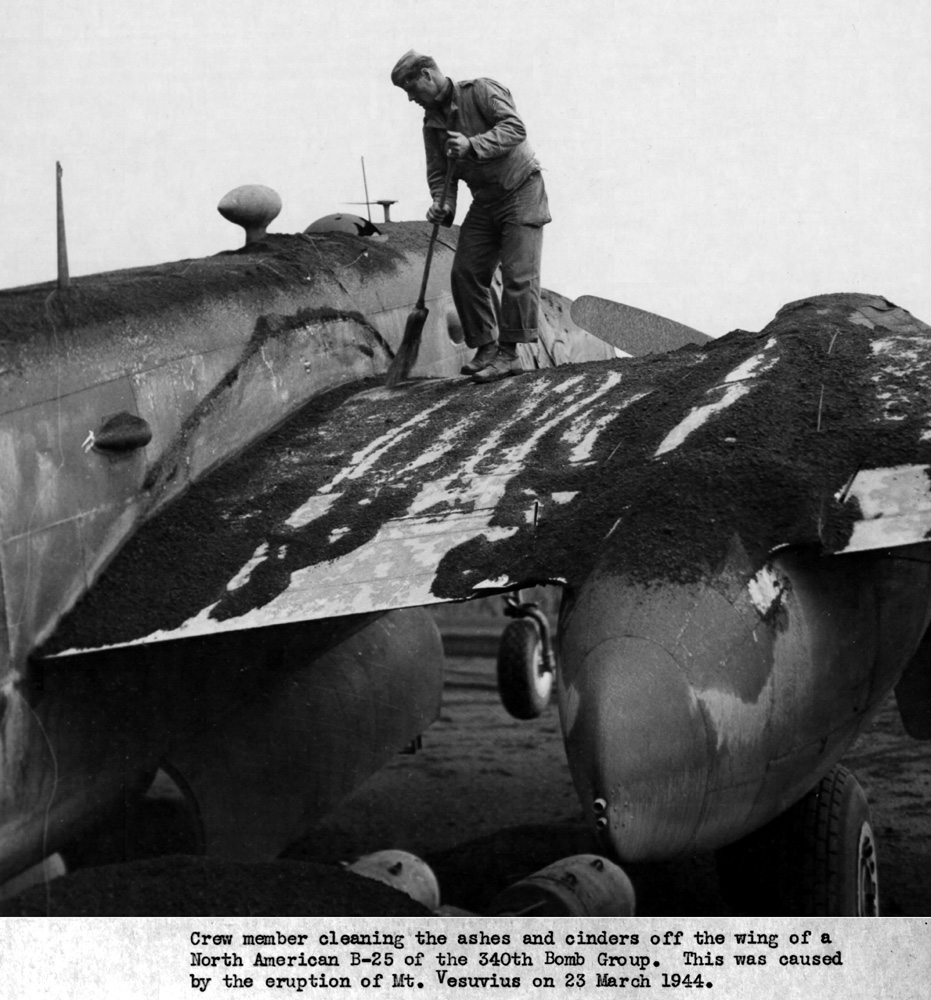
McRae had considered the base apparently safe on March 20, when the eruption was already underway. Conditions changed rapidly. His diary describes fine black material beginning to fall before progressively larger fragments struck the camp, broke tree branches, tore through tents and penetrated aircraft metal, fabric and Plexiglas.
The mechanism matters because volcanic fallout can disable exposed aircraft without a lava flow ever reaching them. Abrasive ash can contaminate engines and mechanical systems, while larger falling fragments can puncture surfaces, glazing and fabric-covered control structures. At Poggiomarino, the concentration of aircraft on an exposed wartime field turned the tephra fall into a major operational loss.
Chester and Duncan place the estimated aircraft loss at USD 25 million. The group evacuated the camp on March 22, while personnel later returned to salvage usable equipment. McRae recorded a sprained wrist and several minor cuts among the group’s casualties, but no U.S. airmen were killed in the eruption.
The aircraft losses developed during an increasingly energetic eruptive sequence. Cole and Scarpati reconstructed four days of initial effusive activity before eight successive lava fountains developed. They calculated about 8.2 million m3 of dense-rock-equivalent material for the lava-fountain phase, equal to about 0.0082 km3 (0.0020 mi3).
Dense-rock equivalent converts loose volcanic deposits into the volume they would occupy as solid rock, removing the effect of empty space between fragments. The measure allows different eruptive deposits to be compared more directly. Cole and Scarpati estimated about 40.2 million m3 of dense-rock-equivalent material for the subsequent mixed explosive phase, with substantially more material represented by distal ash deposits.
On March 22, wind-driven explosive plumes in the 2–4 km (1.2–2.5 miles) range sent tephra over the east and southeast flanks. During the evening, the eruption intensified further and the main column exceeded about 8–10 km (5–6 miles) above the crater. Lapilli and ash fell across Terzigno, Pompeii and Poggiomarino, while fine ash was documented as far away as Albania, about 500 km (310 miles) from Vesuvius.
About 15 cm (5.9 inches) of tephra accumulated on parts of the Naples–Pompeii motorway between Torre del Greco and Salerno. In some areas east and southeast of the volcano, deposits exceeded 1.2 m (3.9 feet). Allied authorities deployed bulldozers and 30 trucks to clear roads as Poggiomarino, San Giuseppe and Terzigno became increasingly difficult to reach.
Lava produced a different pattern of destruction on other parts of Vesuvius. Reconnaissance teams measured one southern flow advancing at about 300 m/h (980 feet/h) on March 19. A northern flow threatening populated areas was later measured at about 150 m (490 feet) wide and 4–5 m (13–16 feet) thick after slowing to around 6 m/h (20 feet/h).
San Sebastiano al Vesuvio suffered particularly severe losses. Chester and Duncan’s archival reconstruction states that about two-thirds of the town was destroyed. Lava also affected Massa di Somma and threatened Cercola, while emergency personnel worked to move residents away from advancing flows.
The Allied records examined by Chester and Duncan document evacuations of about 7 000 people from Cercola, between 1 500 and 1 800 from San Sebastiano, slightly fewer than 2 000 from Massa di Somma and more than 750 people threatened by the southern flow. A further 250 people were evacuated to Castellammare di Stabia when the southern flow advanced again on March 22.
Italy’s Civil Protection gives a broader official figure of about 14 000 evacuees for the eruption. The difference between that total and the individual Allied evacuation counts reflects different source compilations and coverage, so the figures should not be combined into a new total.
Keep reading
- A man locked in a jail cell lived through the 1902 volcanic blast that killed about 28,000 people in the Caribbean city of Saint-Pierre
- The small Utah town of Milford has been rocked by more than 200 earthquakes in two weeks, the largest magnitude 3.1; seismologists now tie the swarm to geothermal work at the Utah FORGE field lab.
The death toll also differs among authoritative sources. Italy’s Civil Protection records 21 deaths, primarily associated with roofs collapsing under accumulated volcanic material. Chester and Duncan’s historical reconstruction cites 24 deaths from ash-induced roof collapses in the Terzigno, Pagani and Nocera areas, plus two children killed when a tanker came into contact with active lava.
The difference remains unresolved in the sources used for this article. The 21-death figure is the current official Italian Civil Protection total, while the 26-death figure belongs to the historical reconstruction and should remain attributed as such rather than being presented as an uncontested count.
Roof collapse was one of the most dangerous consequences of heavy ashfall. Fine ash and lapilli accumulate rapidly on broad roof surfaces, adding a growing static load; moisture can increase that load further. Buildings unable to carry the weight can fail even when they are well beyond the reach of lava.

The emergency unfolded during the Allied campaign in Italy. Lt. Col. James Leslie Kincaid of the Allied Control Commission coordinated the civilian response in Naples Province, while Professor Giuseppe Imbò of the Reale Osservatorio Vesuviano supplied volcanological information. Military transport, engineers, police, medical personnel and Red Cross resources were brought into the operation as conditions deteriorated.
Field teams worked with difficult communications and roads increasingly obstructed by tephra. Reconnaissance personnel at times abandoned vehicles and continued on foot. Command responsibilities were distributed around the volcano so evacuations, road clearance and relief work could continue even when individual routes became inaccessible.
The March 22 paroxysm did not mark an immediate end to the eruption. Activity weakened after March 23, but intermittent explosive and seismic activity continued as the system waned. INGV describes the eruption that began on March 18 as lasting about 10 days, while the detailed historical chronology carries intermittent final activity into the closing days of March.
The 340th Bombardment Group survived the loss of its aircraft and equipment at Poggiomarino. Replacement aircraft allowed the unit to resume combat operations, separating the destruction at the airfield from the operational survival of the group itself. The abandoned Poggiomarino field was not returned to service.
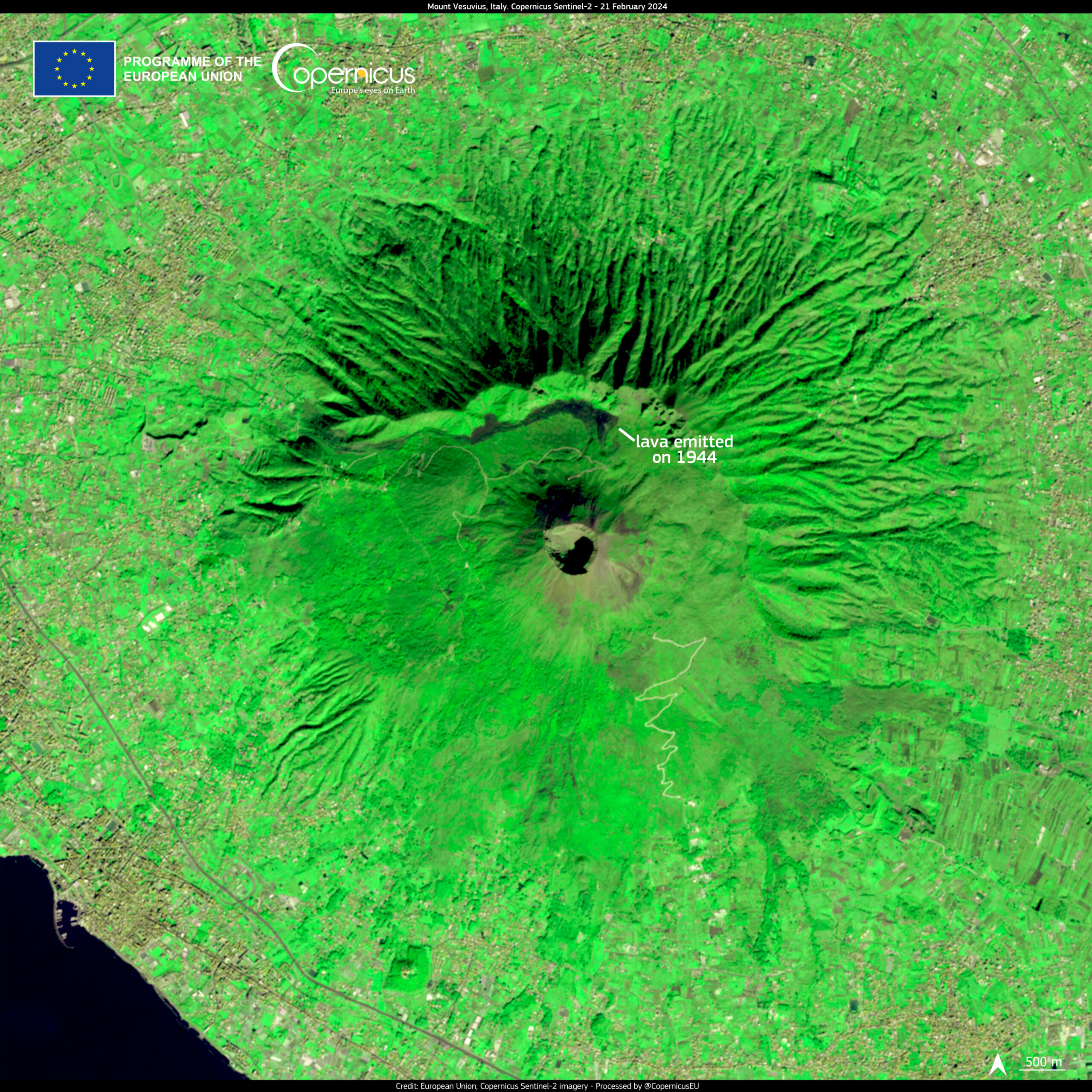
Vesuvius has not erupted since 1944. INGV classifies the volcano as quiescent and describes the post-1944 period as an obstructed-conduit phase characterized by very moderate seismicity and low-temperature degassing in the crater area rather than eruptive activity.
The 1944 record shows why the consequences of an eruption cannot be reduced to a single measure of volcanic size. Lava destroyed buildings on one flank, wind-driven tephra damaged aircraft and blocked transport routes on another, and roof-loading became lethal farther downwind. Exposure and wind direction determined where each physical process became most damaging.
The eruption is therefore valuable as the most recent direct record of Vesuvius in an eruptive state, but it is not a template for the volcano’s next eruption. Vesuvius has produced eruptions of markedly different styles and energies during its history, and modern hazard assessment draws on the wider geological record rather than assuming that a future event would reproduce the sequence observed in March 1944.
References:
1 Cole, P. D., & Scarpati, C. (2010). The 1944 eruption of Vesuvius, Italy: combining contemporary accounts and field studies for a new volcanological reconstruction. Geological Magazine, 147(3), 391–415. DOI: 10.1017/S0016756809990495
2 Chester, D. K., & Duncan, A. M. (2022). Lieutenant-Colonel James Leslie Kincaid and the emergency response to the 1944 eruption of Mount Vesuvius, southern Italy. British Journal for Military History, 8(1), 106–128. DOI: 10.25602/GOLD.bjmh.v8i1.1608
3 Eruptive history – Italian Civil Protection Department
4 Somma-Vesuvius – Istituto Nazionale di Geofisica e Vulcanologia
5 McRae, R. F. (1944). Vesuvius and the 340th – 57th Bomb Wing Association / Air Force Historical Research Agency material

I’m a science journalist and researcher at The Watchers, contributing to the Epicenter edition, where I cover peer-reviewed scientific research and emerging discoveries across Earth and space sciences. With a background in astronomy and a passion for environmental science, I’ve worked in shark and coral conservation in Fiji, conducting reef and shark-behavior research, contributing to mangrove restoration, and earning PADI Open Water and Coral Reef Certifications. I bring a blend of scientific rigor and storytelling to illuminate the discoveries shaping our planet and beyond.
More reporting
- Niagara Falls shrank to a trickle for more than a day in March 1848 when ice jammed the river, and people walked the dry riverbed picking up weapons from the War of 1812
- Tornadoes killed 42 people in one Florida night during the record El Niño winter of 1997–98, most of them asleep in mobile homes
- A fire tornado with winds over 143 mph spun into Redding, California, in 2018 and killed a fire inspector in its path
- Rain fell on the very top of Greenland's ice sheet, more than 2 miles up, for the first time on record in August 2021
