
Luxor sits inside the 258 km wide path of the total solar eclipse of 2 August 2027, and totality will last up to 6 minutes 23 seconds near the city, with the Sun 82 degrees overhead at greatest eclipse.
Luxor, Egypt, will spend more than six minutes inside the Moon’s shadow during the total solar eclipse of August 2, 2027, with NASA calculations placing the central path about 258 km (160 miles) wide as it crosses southern Egypt. Maximum totality reaches 6 minutes 23.2 seconds along the eclipse track, while Egypt’s National Research Institute of Astronomy and Geophysics gives about 6 minutes 20 seconds for Luxor and 6 minutes 22 seconds at its designated Luxor Library observing site.
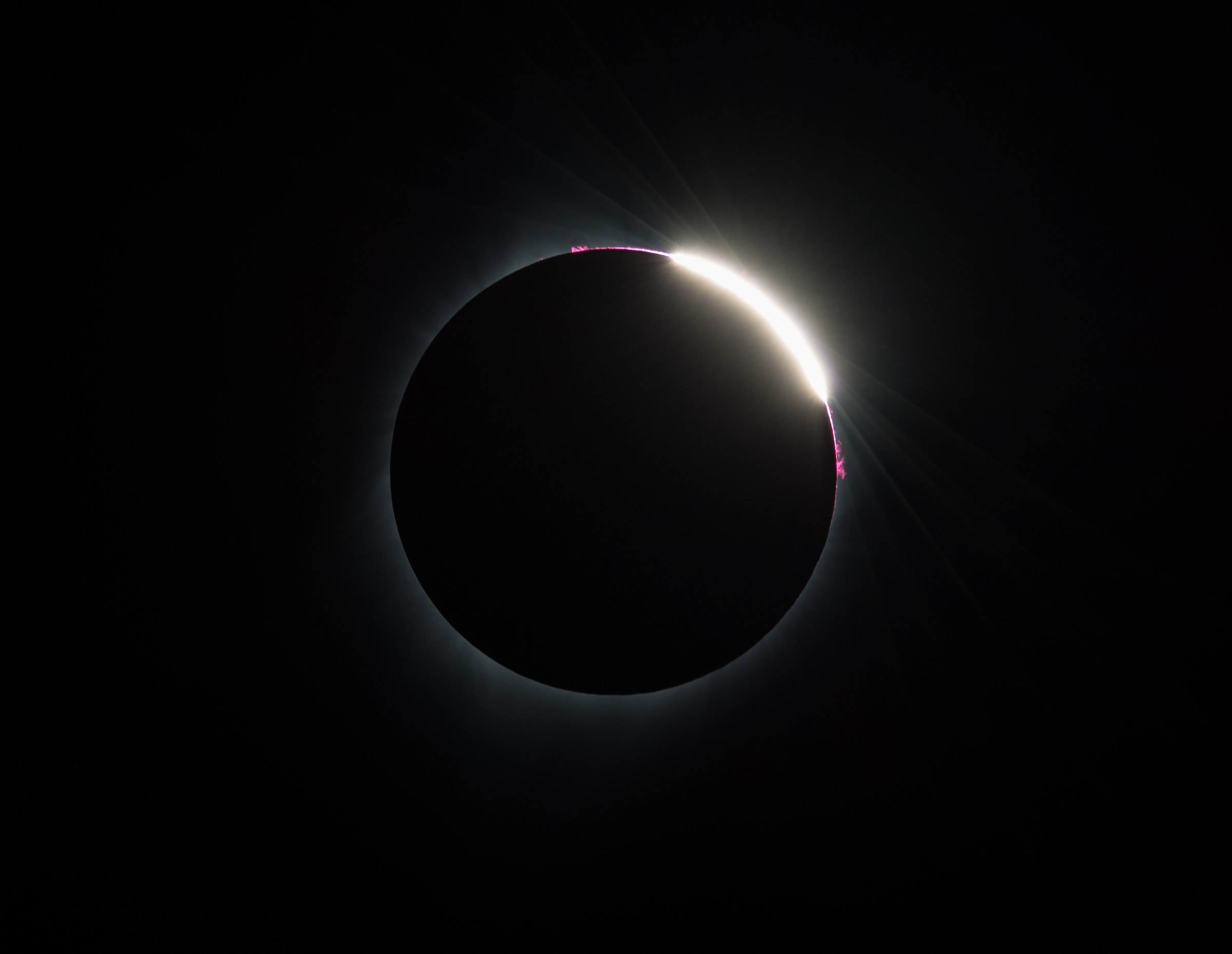
2017 Total Solar Eclipse. Credit: NASA/Aubrey Gemignani (public domain), via Wikimedia Commons.
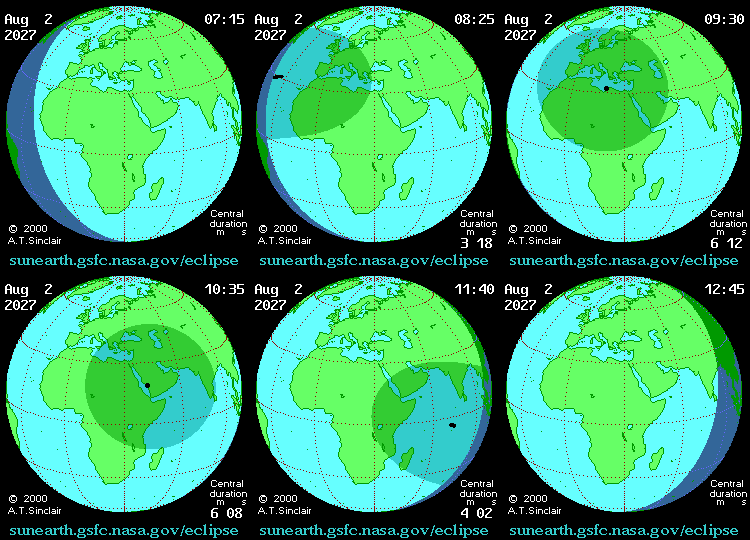
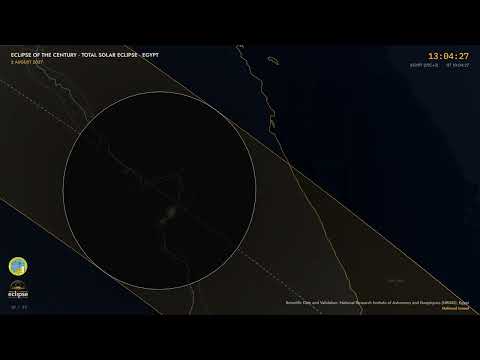
The August 2, 2027 eclipse will carry the Moon’s umbral shadow across southern Egypt, placing Luxor well inside the path of totality. NASA’s central-line calculations put the path at approximately 258 km (160 miles) wide through the region, while totality remains above six minutes across a broad section of Upper Egypt.
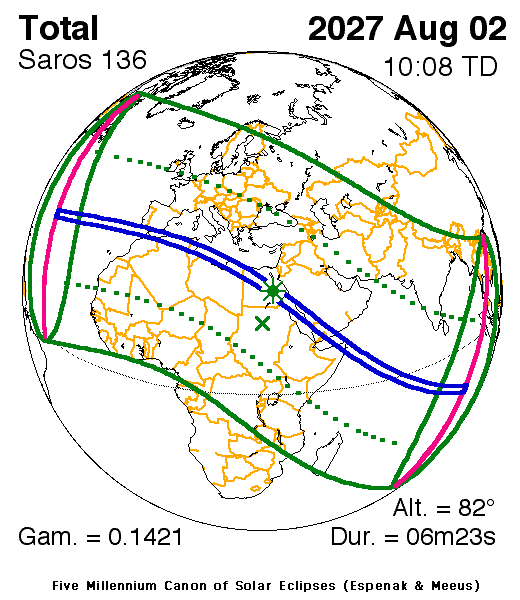
NASA’s path table places the central line at 26°03.7′N, 32°20.0′E at 10:04 UTC, where the totality path is 258 km (160 miles) wide and the central phase lasts 6 minutes 23.0 seconds. At 10:06 UTC, the central line reaches 25°38.3′N, 32°58.8′E, with the same rounded path width and 6 minutes 22.7 seconds of totality.
NRIAG’s current eclipse material distinguishes between the city-scale map and specific observing sites. Its general Upper Egypt map gives about 6 minutes 20 seconds for Luxor, while the institute’s designated Luxor Library observing site is listed at 6 minutes 22 seconds. The difference illustrates why eclipse duration should be tied to a specific location rather than treated as one fixed value for an entire city.
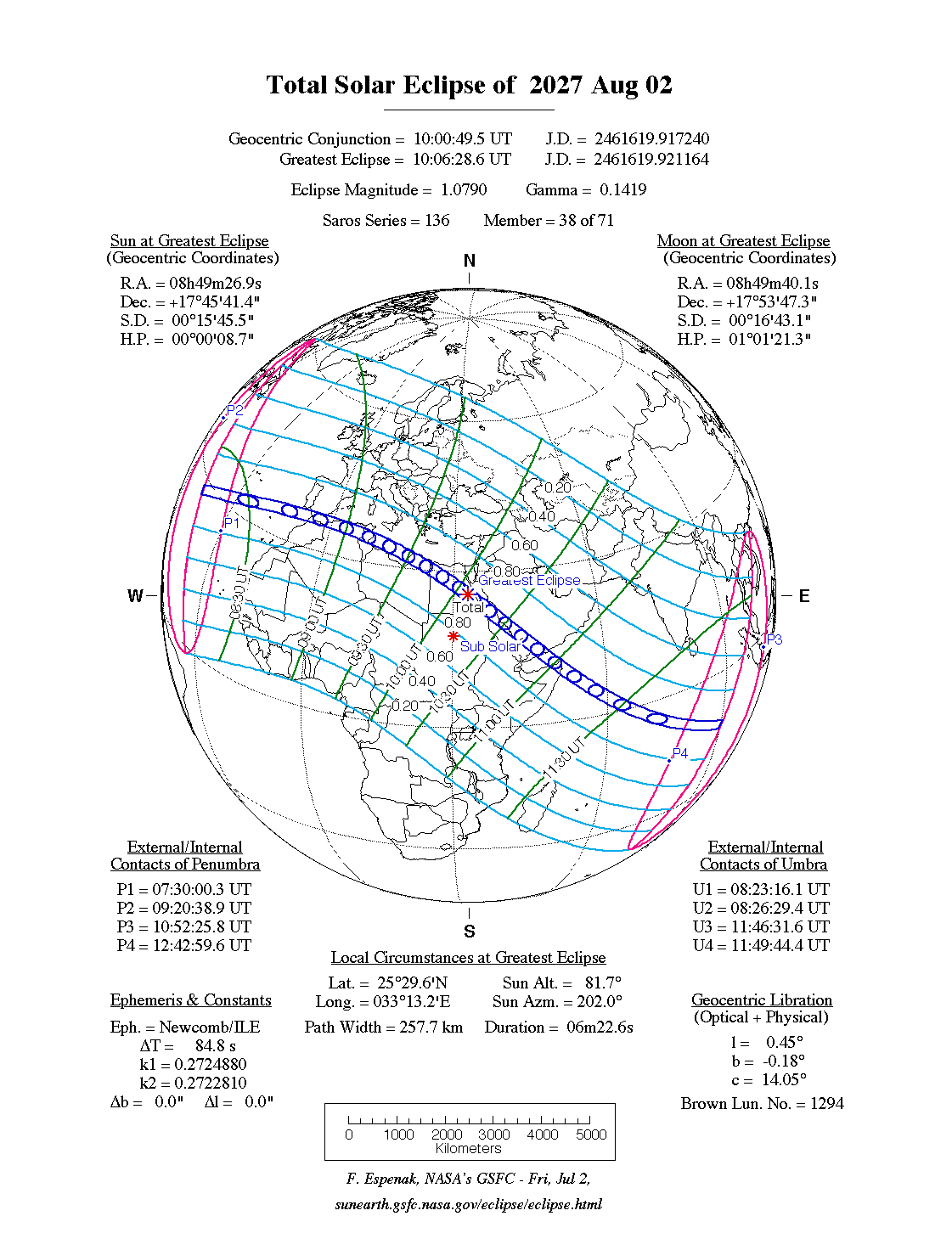
NRIAG lists 6 minutes 8 seconds of totality at Qena University, 6 minutes 23 seconds at Nag Hammadi, 6 minutes at Marsa Alam and 5 minutes 29 seconds at Siwa Oasis. Cairo and Kottamia remain outside the path of totality, where the eclipse will be partial rather than total.
The point of greatest duration is not identical to the point of greatest eclipse. NASA’s detailed calculations place greatest duration near 26°49′N, 31°08′E at about 10:00 UT, where totality reaches 6 minutes 23.2 seconds, the path is about 257.2 km (159.8 miles) wide and the Sun stands 80.9° above the horizon.
Greatest eclipse occurs several minutes later, near 25.5°N, 33.2°E. NASA gives a solar altitude of 81.7°, a path width of about 257.7 km (160.1 miles) and a central duration of approximately 6 minutes 23 seconds at that location.
The eclipse belongs to Saros series 136 and has a magnitude of 1.0790. Eclipse magnitude describes the relative apparent geometry of the Sun and Moon at the central eclipse. A value greater than 1 during a total eclipse means the apparent lunar disk is large enough to cover the visible solar photosphere completely along the central path.
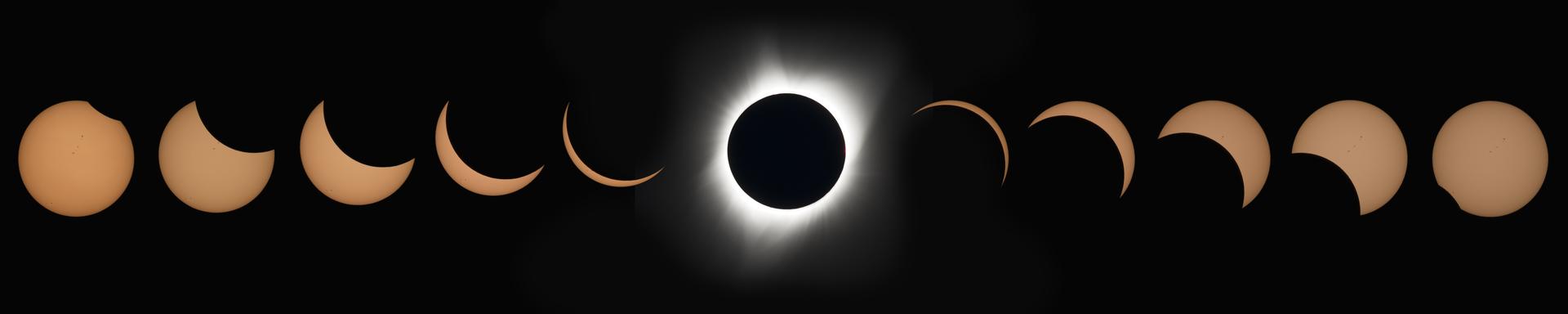
For observers in southern Egypt, the Sun will also be unusually high in the sky during totality. NASA gives an altitude of 81.7° at greatest eclipse, meaning the Sun is 81.7° above the horizon and about 8.3° from the zenith. The value should not be described as “82° overhead,” because a point directly overhead has an altitude of 90°.
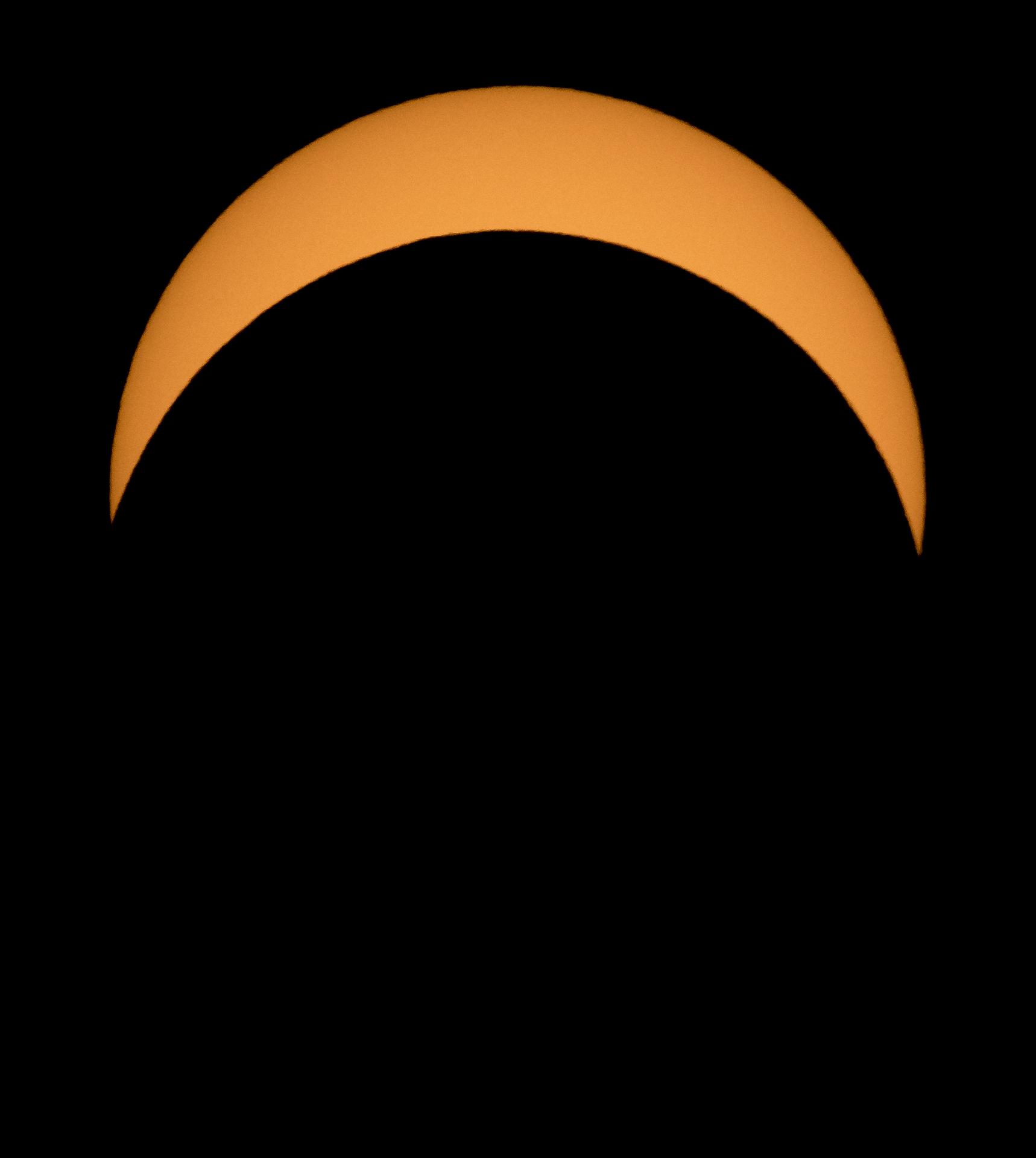
Totality begins only after the Moon has completely covered the bright solar photosphere. The photosphere dominates the Sun’s visible light under ordinary conditions, while the much fainter corona extends far beyond it. Blocking the photosphere allows coronal structures that are normally lost in scattered sunlight to become visible from the ground.
Tian et al. (2017) examined scientific observations made during the August 21, 2017 total solar eclipse and described why natural eclipses remain useful even with modern space-based solar observatories. The greatly reduced level of scattered light during totality allows ground-based instruments to examine coronal structures extending several solar radii from the Sun, complementing observations made closer to the solar limb at extreme-ultraviolet and X-ray wavelengths.
The researchers used several telescopes to examine coronal magnetic structure, electron density and high-frequency waves during the 2017 eclipse. Their work illustrates how a total eclipse temporarily opens an observing regime that is difficult to reproduce from the ground under ordinary daylight conditions.
That scientific opportunity is part of NRIAG’s planning for 2027. The institute is preparing eclipse observing sites in Egypt and an International Conference on Solar Physics and Space Weather scheduled for August 3–5, immediately after the eclipse. The program includes a scientific track devoted to results from observations of the solar corona during totality.

The eclipse also creates a sharp distinction between safe and unsafe direct viewing. During all partial phases, direct observation of the Sun requires certified eclipse glasses or another proper solar viewer. Cameras, binoculars and telescopes require a suitable solar filter attached to the Sun-facing end of the instrument.

Solar filters can be removed only during the total phase, when the Moon completely covers the bright solar disk. Eye protection must be restored as soon as direct photospheric light begins to reappear.
The calculated path boundaries and durations also have small physical uncertainties. NASA’s standard predictions use an idealized lunar limb and do not fully reproduce the mountains and valleys around the edge of the Moon. The agency’s eclipse material notes that lunar-limb topography can shift calculated path limits by roughly 1–3 km (0.6–1.9 miles) and alter totality durations by roughly 1–3 seconds.
For that reason, a duration should always be associated with a defined observing position. NRIAG’s current material gives about 6 minutes 20 seconds for Luxor on its general regional map and 6 minutes 22 seconds at Luxor Library, while NASA’s central-line calculations reach about 6 minutes 23 seconds nearby. The final local circumstances experienced on August 2, 2027 will depend on the observer’s exact position within the path.
References:
1 Besselian Elements and path data for the total solar eclipse of 2027 Aug 02 – NASA Goddard Space Flight Center – accessed November 22, 2026
2 Total Solar Eclipse 2027 in Luxor, Egypt and Eclipse Observation Registration – National Research Institute of Astronomy and Geophysics – accessed November 22, 2026
3 Tian, H., Qu, Z., Chen, Y., Deng, L., Huang, Z., Li, H., Zhong, Y., Liang, Y., Zhang, J., Zhang, Y., Lun, B., Cheng, X., Yan, X., Xue, Z., Xin, Y., Song, Z., Zhu, Y., & Samanta, T. (2017). Observations of the solar corona during the total solar eclipse on 21 August 2017. Earth and Planetary Physics, 1(1), 68–71. DOI: 10.26464/epp2017010

I’m a science journalist and researcher at The Watchers, contributing to the Epicenter edition, where I cover peer-reviewed scientific research and emerging discoveries across Earth and space sciences. With a background in astronomy and a passion for environmental science, I’ve worked in shark and coral conservation in Fiji, conducting reef and shark-behavior research, contributing to mangrove restoration, and earning PADI Open Water and Coral Reef Certifications. I bring a blend of scientific rigor and storytelling to illuminate the discoveries shaping our planet and beyond.
Published in the last 24 hours
- On 13 April 2029 the 340 m asteroid Apophis will pass about 32,000 km above Earth's surface, inside the ring of geosynchronous satellites, and NASA says observers across the Eastern Hemisphere will see it without a telescope or binoculars. Epicenter
- Dust shed by Halley's Comet gives Earth the Eta Aquarids every May and the Orionids every October, and the comet itself, which passed 4.94 million km away on 10 April 837 at about magnitude -3.5, is due to reach perihelion on 28 July 2061. Epicenter
- Detonations from Krakatoa on 26 and 27 August 1883 were heard over nearly one thirteenth of the globe, as far as Rodrigues about 4,800 km away, where the chief of police logged roars like heavy guns until 3 p.m., the Royal Society reported in 1888. Epicenter
- One dead, 15 injured and 152 homes left uninhabitable across five regions of Peru after the M6.7 Junín earthquake of 20 November, COEN-INDECI reports.
