
Detonations from Krakatoa on 26 and 27 August 1883 were heard over nearly one thirteenth of the globe, as far as Rodrigues about 4,800 km away, where the chief of police logged roars like heavy guns until 3 p.m., the Royal Society reported in 1888.
Explosions from Krakatoa on August 26 and 27, 1883, were heard on Rodrigues in the Indian Ocean about 4 800 km (2 968 miles) from the volcano, according to the 1888 report of the Krakatoa Committee of the Royal Society. James Wallis, the island’s chief of police, recorded repeated reports “like the distant roars of heavy guns” through 15:00 local time on August 27.
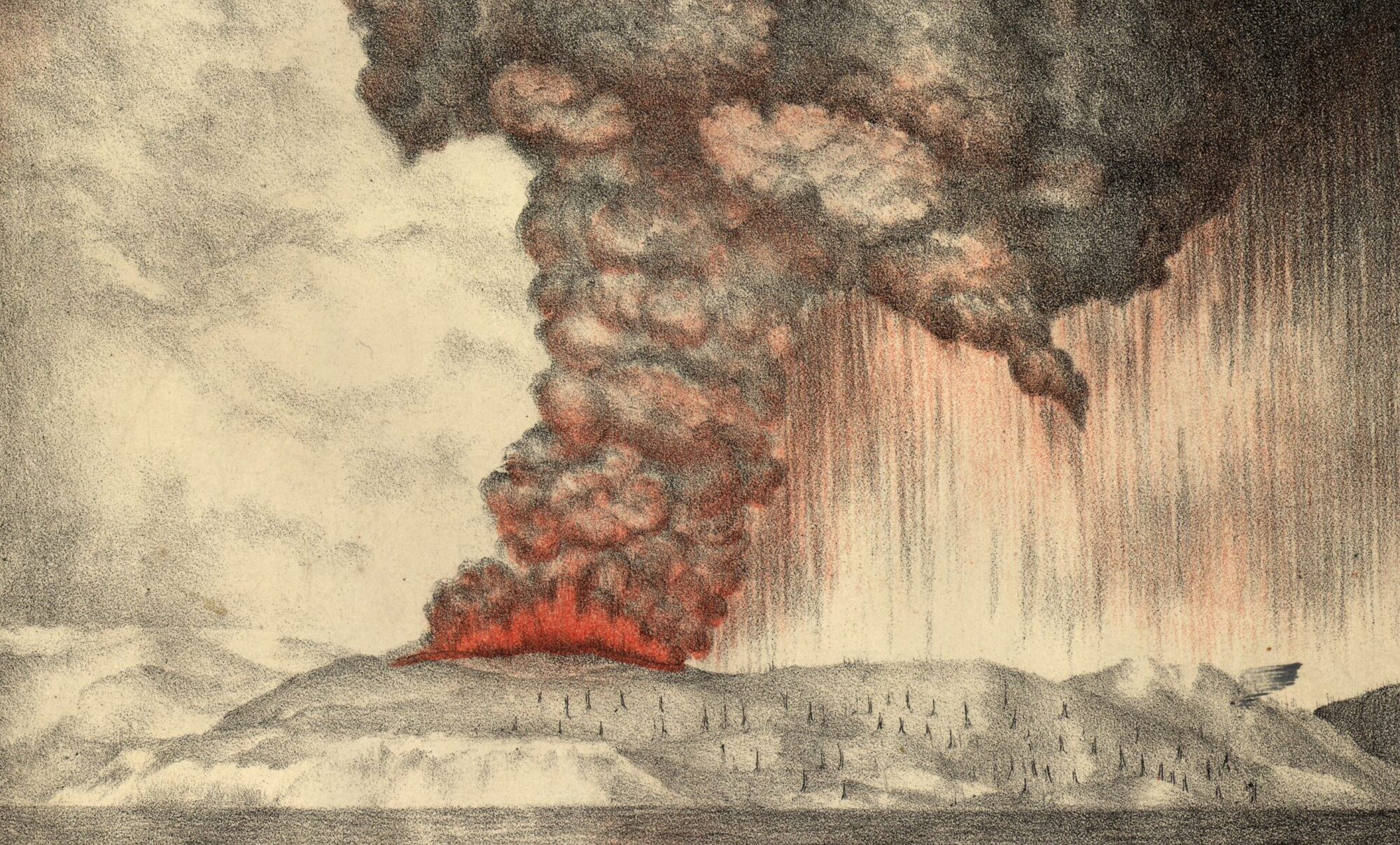
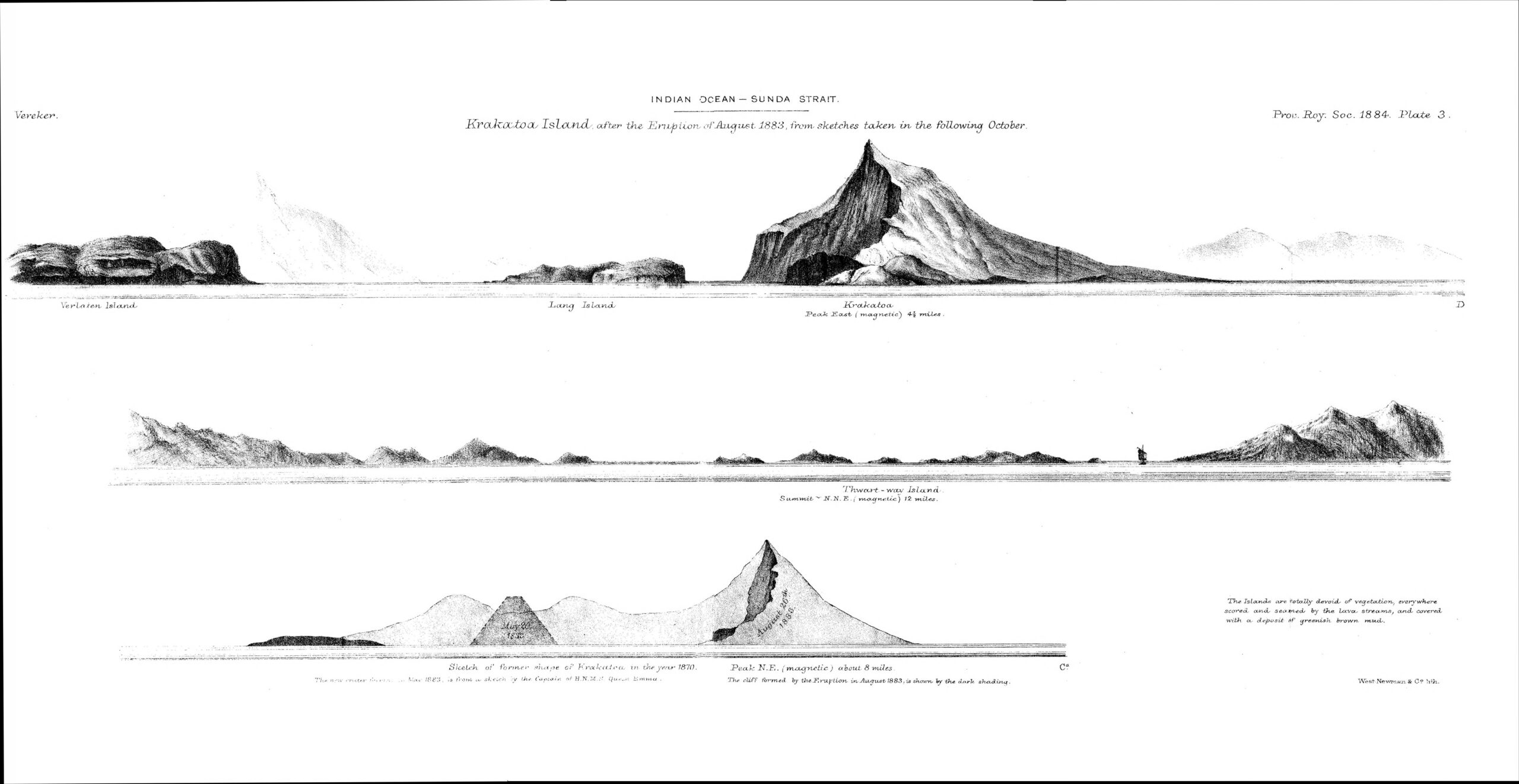
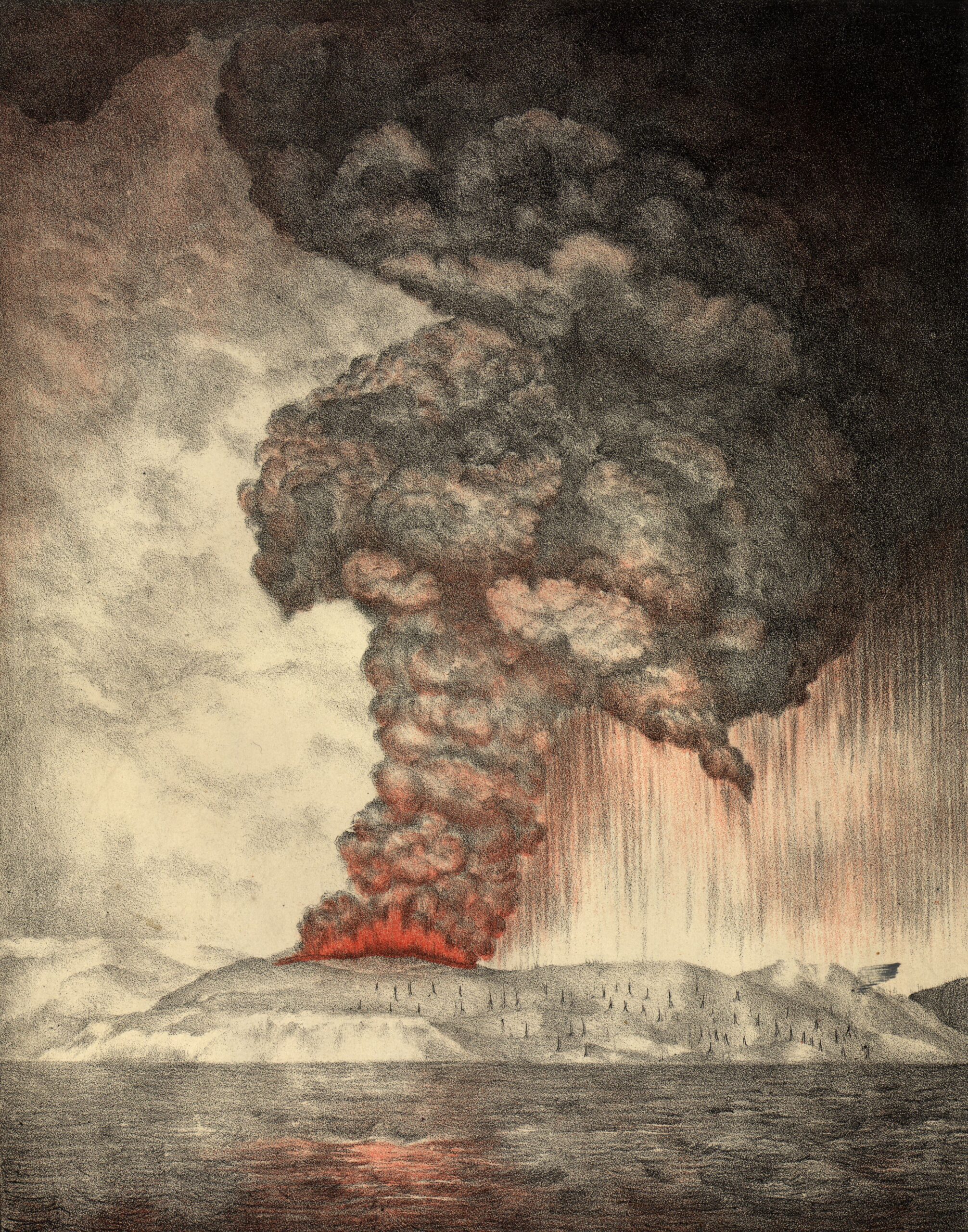
An 1888 lithograph depicting Krakatoa during the 1883 eruptive period, published as Plate 1 in the Royal Society's report. Credit: Parker & Coward, Britain / Krakatoa Committee of the Royal Society, 1888, public domain
The Royal Society report identified Rodrigues, written as “Rodriguez” in the 1888 volume, as the most remote location from which the explosions were reported. Table IX placed the island 4 777 km (2 968 miles) from Krakatoa, a distance the report summarized elsewhere as very nearly 3 000 English miles.
The distance made the Rodrigues observations exceptional within the material assembled by the committee. The report described them as the only instance then on record of sounds having been heard at anything approaching so great a distance from their source.
Wallis recorded several reports during the night of August 26–27 coming from the east. He compared them with the distant roars of heavy guns. The reports returned at intervals of between three and four hours until 15:00 local time on August 27, and the final two were heard in the directions of Oyster Bay and Port Mathurie.
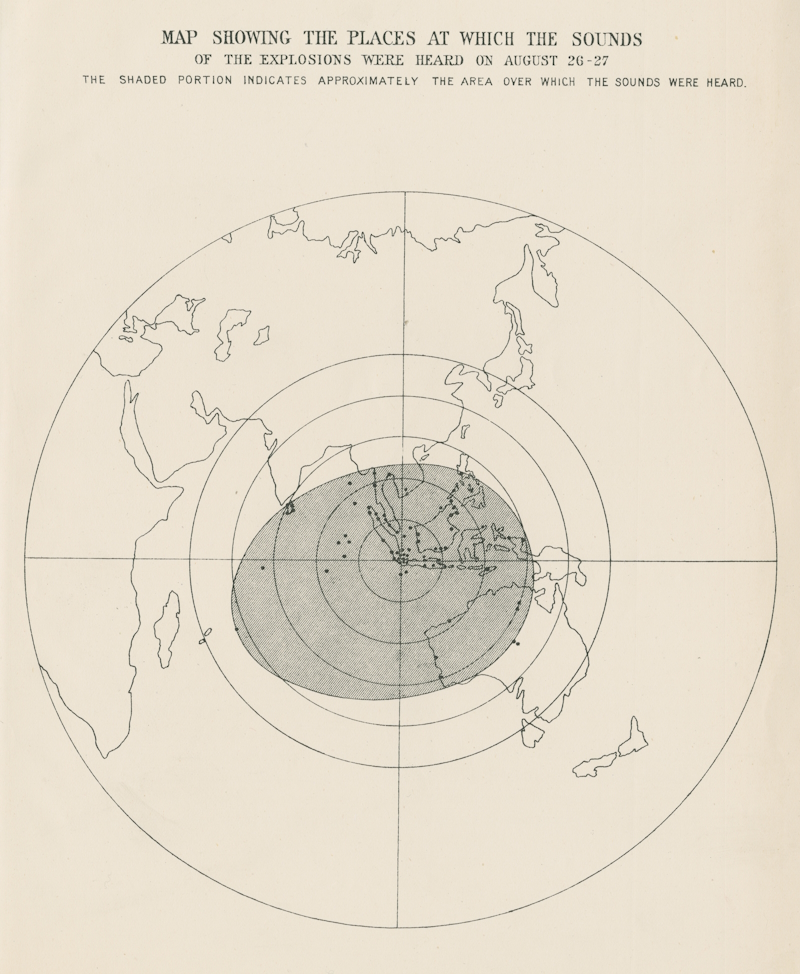
The Rodrigues reports formed the farthest end of a much larger documented acoustic field. The Royal Society described the mapped area over which the explosions were heard as roughly equal to rather less than one-thirteenth of the entire surface of the globe. The contents of the same report summarized the finding as detonations heard over nearly one-thirteenth of Earth’s surface.
Other distant observations show that many listeners did not know what had produced the reports. At Diego Garcia in the Chagos Islands, which Table IX placed about 3 648 km (2 267 miles) from Krakatoa, the sounds were heard distinctly and were taken for guns fired by a vessel in distress. The report said the same belief prevailed at Port Blair in the Andaman Islands.
At Dorey in New Guinea, the sounds were recorded before their cause was known. Those accounts are important because the Royal Society’s compilation was not based on observers identifying Krakatoa in real time. It assembled geographically separated reports and later compared their timing and location with the eruption.

The audible reports were distinct from another major atmospheric signal generated by the eruption. The Royal Society collected barometric records showing the larger air wave passing monitoring stations around the world repeatedly. Those instrumental pressure measurements should not be treated as evidence that the explosions themselves were heard everywhere the pressure disturbance was recorded.
Matoza and Roman (2022), reviewing a century of volcano seismology and acoustics, likewise separate the two forms of evidence. Their review discusses the long-period atmospheric pressure disturbance recorded by barometers around the world while separately noting reports of cannon-like sounds at distances of about 4 800 km from Krakatoa.
Closer to Krakatoa, the 1888 report documented much stronger effects from the atmospheric disturbance. At Batavia and Buitenzorg, about 160 km (100 miles) away in the report’s account, air waves forced windows inward and cracked walls. A gasometer at Batavia was displaced from its well.
The historical distance record itself contains a discrepancy that matters when quoting it precisely. Table IX gives Rodrigues as 2 968 English miles from Krakatoa, equivalent to about 4 777 km, while another passage in the same volume gives 3 080 miles, equivalent to about 4 957 km.
The Table IX figure provides the clearest station-by-station value and is therefore used here as about 4 800 km (2 968 miles). Describing Rodrigues as nearly 3 000 miles away also follows the language used by the committee without treating the conflicting 3 080-mile figure as identical.
The surviving record therefore supports two different measures of the eruption’s atmospheric reach. Human observers reported explosive sounds across an enormous region, with Rodrigues forming the most distant location identified by the Royal Society, while instruments recorded the associated pressure disturbance much farther around the planet. Keeping those records separate preserves what the historical observations actually establish without turning global barometric detection into a claim of globally audible sound.
References:
1 Royal Society (Great Britain), Krakatoa Committee. (1888). The eruption of Krakatoa, and subsequent phenomena: Report of the Krakatoa Committee of the Royal Society. G. J. Symons (Ed.). London: Trübner & Co. Internet Archive full text
2 Matoza, R. S., & Roman, D. C. (2022). One hundred years of advances in volcano seismology and acoustics. Bulletin of Volcanology, 84, 86. DOI: 10.1007/s00445-022-01586-0

I’m a science journalist and researcher at The Watchers, contributing to the Epicenter edition, where I cover peer-reviewed scientific research and emerging discoveries across Earth and space sciences. With a background in astronomy and a passion for environmental science, I’ve worked in shark and coral conservation in Fiji, conducting reef and shark-behavior research, contributing to mangrove restoration, and earning PADI Open Water and Coral Reef Certifications. I bring a blend of scientific rigor and storytelling to illuminate the discoveries shaping our planet and beyond.
Published in the last 24 hours
- Lava fountains reached 1,900 feet (580 m) at Kīlauea Iki in 1959, the highest ever recorded at Kīlauea, as USGS forecasts episode 57 fountaining at Halemaʻumaʻu for November 22-26. Epicenter
- Odisha evacuated 983,642 people before Phailin crossed near Gopalpur on 12 October 2013 with winds of 200-210 km/h gusting to 220, and 44 died, against 9,885 in the 1999 super cyclone. Cyclone Akvan crossed the same coast on 20 November 2026. Epicenter
- Novarupta in Alaska erupted about 3 cubic miles of magma in roughly 60 hours from 6 June 1912, 30 times Mount St. Helens in 1980, and strong northwesterly winds lifted that same loose ash on 16 November 2026, prompting an NWS SIGMET. Epicenter
- One dead, 15 injured and 152 homes left uninhabitable across five regions of Peru after the M6.7 Junín earthquake of 20 November, COEN-INDECI reports.
