
A fog linked to about 12 000 excess deaths in London in 1952 puzzled scientists for decades, until researchers reconstructed how coal smoke formed acidic haze
London’s Great Smog of December 5–9, 1952 is associated with an estimated 12 000 excess deaths, but one part of the disaster remained unresolved for decades: how sulfur dioxide from coal smoke could be converted rapidly enough into sulfate and sulfuric acid under the conditions over the city. A 2016 study combining laboratory experiments with measurements from polluted air in China identified aqueous oxidation of sulfur dioxide by nitrogen dioxide as a pathway capable of explaining that missing chemistry.
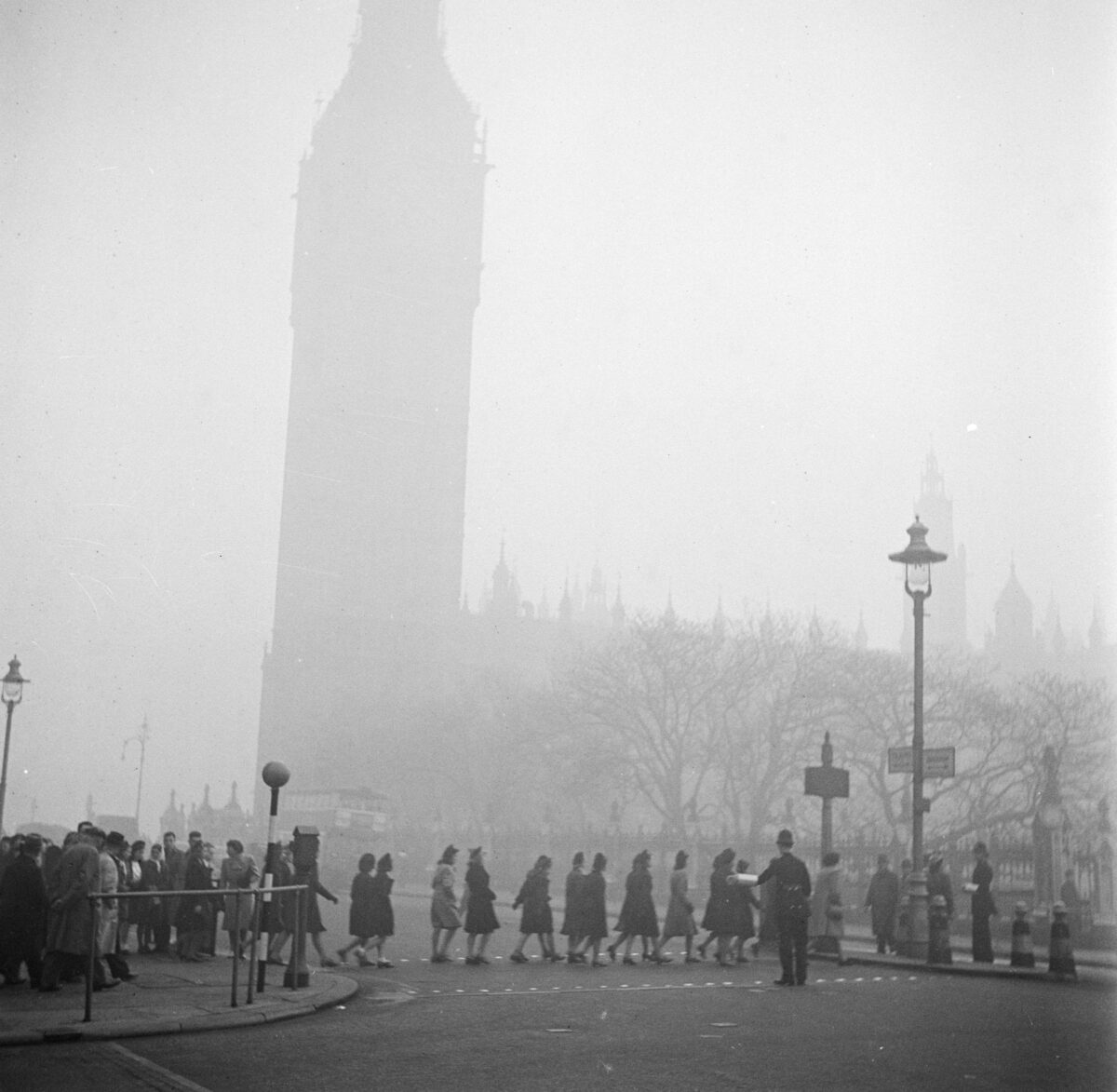
Een agent helpt mensen met oversteken Op de achtergrond is Big Ben te zien, Bestanddeelnr 254-1954. Credit: Willem van de Poll (CC0), via Wikimedia Commons.
Scientists already knew that sulfur compounds were central to the Great Smog, but the detailed chemistry converting gaseous sulfur dioxide (SO₂) into particulate sulfate remained uncertain. Wang et al. (2016) investigated that gap using atmospheric measurements from Xi’an and Beijing together with controlled laboratory experiments designed to test how SO₂ behaves in aqueous environments containing nitrogen dioxide (NO₂).
The experiments established an overall aqueous reaction in which NO₂ oxidizes dissolved sulfur dioxide to sulfate. The reaction also generates hydrogen ions, increasing acidity, and nitrous acid (HONO). The finding supplied a chemical pathway capable of explaining why sulfate could accumulate rapidly under the highly polluted conditions associated with the 1952 London fog.

The reaction depends strongly on acidity. As sulfate forms, hydrogen ions accumulate and lower the pH of the water. Wang et al. reported that reducing pH from 6 to 4 lowers the effective Henry’s law constant for sulfur dioxide by more than two orders of magnitude, corresponding to an approximately two-order-of-magnitude reduction in the oxidation rate reported by earlier experimental studies.
In physical terms, the reaction begins to suppress itself. Increasing acidity makes it more difficult for enough sulfur dioxide to remain dissolved in the water for rapid oxidation to continue. The amount of water surrounding the pollutants therefore becomes critical.
Natural cloud and fog droplets can exceed several tens of micrometers in diameter and contain far more water than fine aerosol particles. In London, those large droplets could dilute the acid as it formed, allowing SO₂ oxidation by NO₂ to continue even as sulfate accumulated.
Evaporation then changed the chemistry again. When water disappeared from the fog droplets, sulfate and hydrogen ions remained in the residual particles. Their concentrations increased as the droplets contracted, leaving smaller and much more acidic haze particles.

Wang et al. applied the mechanism to London because both SO₂ and NO₂ were present at elevated concentrations as products associated with coal combustion, while the episode combined high relative humidity, low temperatures and large natural fog droplets. The authors concluded that these conditions were compatible with in-cloud oxidation of SO₂ by NO₂ followed by evaporation and concentration of the acidic material.
The physical setting for the disaster developed on December 5, 1952. According to the Met Office, an anticyclone covered the London area while winds remained light and air close to the ground was moist. Cooling at the surface produced radiation fog beneath a temperature inversion, with warmer air above preventing the colder polluted air near the ground from rising and dispersing.

The Met Office describes the fog layer as approximately 100–200 m (330–660 feet) deep. Smoke from domestic chimneys and factories accumulated beneath the inversion, together with pollution transported into the London area from industrial regions to the east. The smog persisted until December 9, when changing weather finally allowed it to disperse.
The quantity of pollution released during those five days was substantial. The Met Office reports that about 1 000 tonnes (1 102 short tons) of smoke particles, 2 000 tonnes (2 205 short tons) of carbon dioxide, 140 tonnes (154 short tons) of hydrochloric acid and 14 tonnes (15 short tons) of fluorine compounds were emitted each day during the foggy period.
The agency also reports that approximately 370 tonnes (408 short tons) of sulfur dioxide were converted into about 800 tonnes (882 short tons) of sulfuric acid. Those historical estimates provide the scale of the sulfur chemistry that later researchers sought to explain.

The 2016 study did not chemically analyze a preserved sample of London air from December 1952. Its interpretation of the Great Smog is a historical reconstruction built from laboratory chemistry, atmospheric measurements during modern pollution episodes in China and documented conditions over London.
That distinction limits the conclusion appropriately. The experiments demonstrate that aqueous SO₂ oxidation by NO₂ can operate efficiently under the relevant physical conditions and provide a mechanism consistent with the Great Smog. They do not constitute a direct measurement of that reaction occurring over London in 1952.
The study also does not establish that sulfuric acid, sulfur dioxide or nitrogen dioxide acting alone caused the deaths. Londoners were exposed to a complex mixture of gases and particles under stagnant atmospheric conditions. Wang et al. addressed the chemical pathway responsible for rapid sulfate production, not the individual medical cause of each fatality.
The widely cited estimate of about 12 000 deaths comes from separate epidemiological work. Bell and Davis (2001) examined mortality records, hospital admissions for cardiac and respiratory disease, pneumonia cases, influenza reports, temperature and air-pollution measurements for December 1952 through February 1953 and compared them with preceding years.
They estimated that approximately 12 000 excess deaths occurred from December 1952 through February 1953 because of the acute and persisting effects of the smog. Mortality during the period was 50–300% higher than during the previous year, depending on the interval examined.

The estimate expanded the health impact far beyond the roughly 4 000 deaths recognized during and immediately after the five-day event. It is therefore important to distinguish the contemporary toll from the later estimate: 12 000 is a retrospective excess-mortality figure covering the smog and its aftermath, not a count of people documented as dying during the five days of fog.

Wang et al. also examined sulfate production during severe haze in China, where the same SO₂–NO₂ aqueous reaction operates under a different physical regime. Fine aerosol particles contain far less liquid water than natural fog droplets, so rising acidity can suppress sulfate formation much sooner.
In experiments representing fine particulate matter, efficient sulfate production required high relative humidity together with ammonia neutralization. The study found the reaction was favored when relative humidity exceeded about 60–70% and the particles were sufficiently neutralized near pH 7. Large cloud and fog droplets, by contrast, could sustain the reaction without the same degree of neutralization because their greater water volume diluted the acid.
The comparison does not mean that the 1952 London fog and every modern Chinese haze episode are chemically identical. The study identified the same underlying aqueous oxidation route under two different atmospheric regimes: large natural droplets in the London reconstruction and much smaller, ammonia-neutralized particles in the Chinese measurements and laboratory experiments.

The atmospheric-chemistry and mortality studies therefore answer different questions. Bell and Davis reassessed how many deaths were associated with the episode and its aftermath. Wang and colleagues investigated how coal-derived sulfur dioxide could be converted rapidly into sulfate under conditions comparable with those documented during the Great Smog.
The episode also changed British air-pollution policy. The Clean Air Act 1956 introduced controls on black smoke and promoted conversion toward smokeless fuels, followed by additional legislation in 1968. The Met Office notes that polluted fogs continued for some time after the first Act, but changes in fuel use, heating and pollution regulation progressively eliminated the coal-smoke conditions responsible for London’s historic smogs.
The scientific boundary remains important more than seven decades after the event. The laboratory work provides experimental support for a pathway capable of producing the sulfate and acidity associated with London’s 1952 atmosphere, while the historical application remains a reconstruction. No preserved sample allows researchers to replay the chemistry of the Great Smog directly, making the mechanism a strongly supported explanation of the available evidence rather than a firsthand measurement of the event.
References:
1 Wang, G., Zhang, R., Gomez, M. E., Yang, L., Levy Zamora, M., Hu, M., Lin, Y., Peng, J., Guo, S., Meng, J., Li, J., Cheng, C., Hu, T., Ren, Y., Wang, Y., Gao, J., Cao, J., An, Z., Zhou, W., Li, G., Wang, J., Tian, P., Marrero-Ortiz, W., Secrest, J., Du, Z., Zheng, J., Shang, D., Zeng, L., Shao, M., Wang, W., Huang, Y., Wang, Y., Zhu, Y., Li, Y., Hu, J., Pan, B., Cai, L., Cheng, Y., Ji, Y., Zhang, F., Rosenfeld, D., Liss, P. S., Duce, R. A., Kolb, C. E., & Molina, M. J. (2016). Persistent sulfate formation from London Fog to Chinese haze. Proceedings of the National Academy of Sciences of the United States of America, 113(48), 13630–13635. DOI: 10.1073/pnas.1616540113
2 Bell, M. L., & Davis, D. L. (2001). Reassessment of the lethal London fog of 1952: Novel indicators of acute and chronic consequences of acute exposure to air pollution. Environmental Health Perspectives, 109(Suppl. 3), 389–394. DOI: 10.1289/ehp.01109s3389
3 The Great Smog of 1952 – Met Office – historical case study

Rishav Kothari is Editor-in-Chief of The Watchers, where he runs the newsroom and covers earthquakes, volcanoes, severe weather and space weather.
Published in the last 24 hours
- In 2012, cameras filming a thunderstorm in western China caught ball lightning by accident, and its 1.64-second glow carried iron, silicon, and calcium from the soil it rose out of Epicenter
- Strong El Niño reinforces above-normal winter precipitation outlook across southern and eastern U.S.
- Strong M6.8 earthquake hits Kepulauan Barat Daya, Indonesia, near Timor-Leste
