
In 2012, cameras filming a thunderstorm in western China caught ball lightning by accident, and its 1.64-second glow carried iron, silicon, and calcium from the soil it rose out of
Researchers studying ordinary cloud-to-ground lightning on China’s Qinghai Plateau accidentally recorded a natural ball-lightning event lasting 1.64 seconds in July 2012, obtaining what was reported as the first optical emission spectrum of the phenomenon. The spectrum contained persistent emission from silicon, iron and calcium, providing rare field evidence consistent with a proposed soil-strike formation mechanism without establishing that mechanism as the general explanation for ball lightning.
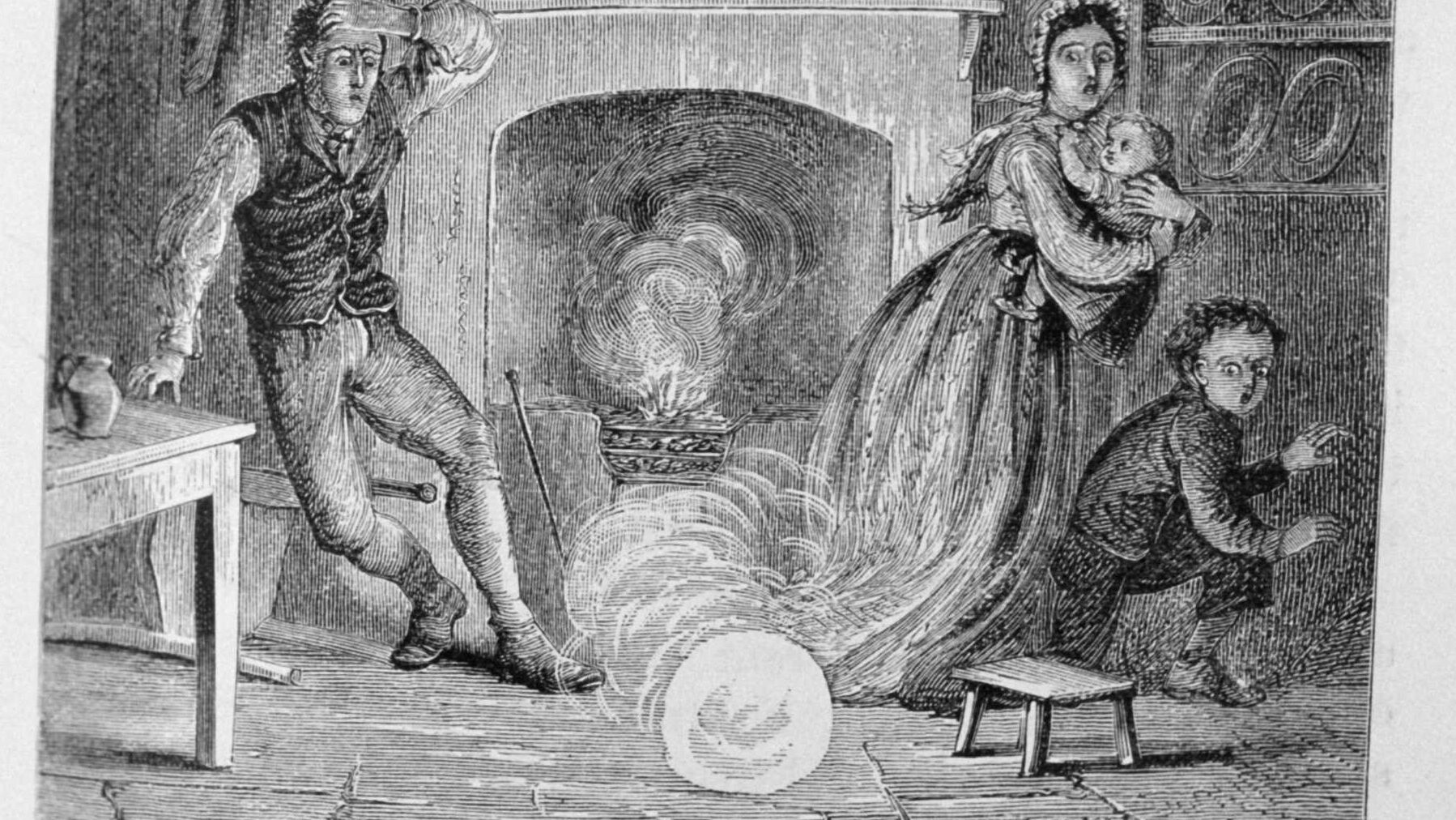
Ball lightning. Credit: The original uploader was Srbauer at German Wikipedia. (public domain), via Wikimedia Commons.
Jianyong Cen, Ping Yuan and Simin Xue of Northwest Normal University recorded the event while conducting field experiments on natural cloud-to-ground lightning on the Qinghai Plateau. Two slitless spectrographs were operating at the observation site when the luminous object appeared accidentally during a thunderstorm, turning an experiment designed for ordinary lightning into a rare instrumented observation of ball lightning.
The importance of the observation was not simply that a luminous ball had been photographed. Reports of ball lightning extend far back in history, but its rarity, unpredictable appearance, and short lifetime have left researchers with little direct physical data. By dispersing the emitted light into a spectrum, the Qinghai instruments recorded identifiable atomic emission that could be compared with proposed formation mechanisms.
The event occurred at 21:54:59 local time (13:54:59 UTC) on July 23, 2012. The digital video camera recorded its entire luminous evolution as video and sound, together with 82 still images. The glow persisted for 1.64 seconds.
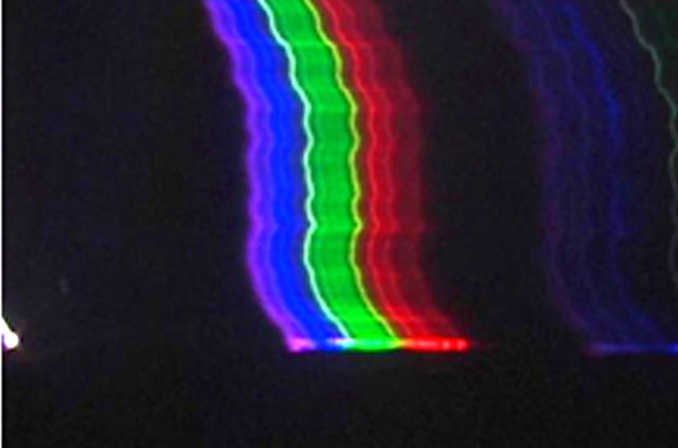
The observation site was at an elevation of about 2 530 m (8 301 feet). One spectrograph used a high-speed black-and-white camera operating at 3 000 frames per second, while the second used a digital color video camera operating at 50 frames per second. Both cameras were synchronized by GPS timing.
The high-speed camera recorded only the later part of the event because its recording window was limited to 1.11 seconds. It captured about 2 360 images during 0.78 seconds of the ball lightning’s later evolution.

The researchers estimated that the luminous event occurred about 0.9 km (0.6 miles) from the instruments. Mapping placed the center of the estimated location area 0.902 km (0.56 miles) away, with an uncertainty of ±7.7 m (±25 feet).
A separate calculation provided an independent check. Air temperatures along the sound path were about 14–15°C (57–59°F), giving a sound speed of 340.51–341.15 m/s. The recorded delay of 2.64 seconds between the lightning flash and its sound placed the event about 0.898–0.900 km (0.558–0.559 miles) from the instruments, consistent with the mapped location.
The first digital-camera frame showed the luminous ball together with the lower part of a cloud-to-ground lightning channel. Twenty milliseconds later, the channel had disappeared while the ball remained visible. That sequence tied the phenomenon closely in time and location to the ground strike, although temporal proximity alone could not establish the mechanism that produced it.

Tracking the point of maximum brightness from 20 to 1 160 milliseconds showed nine pixels of horizontal displacement. Using the estimated image scale, the researchers calculated an average two-dimensional horizontal speed of about 8.6 m/s (31 km/h; 19 mph).
The measured value represents motion across the camera image rather than the full three-dimensional velocity. Any simultaneous movement toward or away from the instruments would not appear in that calculation, so the actual speed could have been higher.
The object’s color evolved rapidly. The paper describes a strong purple-white appearance at the beginning, orange at about 80 milliseconds, approximately white from 160 to 1 100 milliseconds and red after about 1 120 milliseconds as the light dissipated.
Its apparent size also changed. During much of the stable period, the full width at half maximum of the measured brightness profile corresponded to an apparent diameter of about 5 m (16 feet). Cen et al. explicitly warned that this was not the physical diameter of the ball. It represented the width of the luminous region recorded by the camera.
The optical evolution divided into three stages. During approximately the first 160 milliseconds, apparent diameter, peak intensity and total intensity decreased strongly, apart from a small increase between 20 and 60 milliseconds. From about 160 to 1 080 milliseconds, the peak and total intensity remained comparatively stable. Both then declined through the final 560 milliseconds until the luminous object disappeared.
The spectrum provided the most important physical evidence. Strong continuous radiation was accompanied by emission lines from silicon, iron and calcium. In the visible portion of the high-speed spectrum, most identified lines were emitted by neutral silicon, iron and calcium atoms, represented as Si I, Fe I and Ca I.
Those signals persisted rather than appearing only during the initial flash. Si I, Fe I, and Ca I lines were present through most of the recorded lifetime, and the Si I line at 594.8 nm remained visible during the final period. Near-infrared lines from neutral nitrogen and oxygen behaved differently, appearing periodically as brightness increased and disappearing again as it decreased.
An emission spectrum functions as a physical fingerprint of radiating atoms and ions. When electrons within an atom move between allowed energy states, radiation is emitted at characteristic wavelengths. Detecting Si, Fe and Ca lines therefore established that radiation from those atomic species was present in the luminous phenomenon; spectroscopy alone did not establish exactly where every emitting atom originated.

The elemental composition connected the observation with a model published by John Abrahamson and James Dinniss in 2000. Their proposed mechanism begins when ordinary lightning strikes soil and chemically transforms silicon-containing minerals, producing energetic nanoparticles of Si, SiO or SiC that can be expelled into the air as a filamentary network.
As those particles slowly oxidize in the surrounding air, the model proposes that stored chemical energy is released as heat and light. Abrahamson and Dinniss supported the underlying process experimentally by exposing soil samples to a lightning-like discharge and producing chain aggregates of nanoparticles that oxidized on a timescale relevant to reported ball-lightning lifetimes.
The Qinghai spectrum was compatible with part of that prediction. Silicon, iron, and calcium are common major constituents of soil, and Cen et al. argued that the elemental emission, combined with the ball and cloud-to-ground channel appearing together in the first frame, provided reasons to associate the observed event with lightning striking the ground.
The experiment did not directly sample material from the ball or chemically compare it with soil recovered from the strike location. The strongest direct conclusion is narrower: Si, Fe, and Ca emissions were detected through most or all of the observed event. Interpreting those elements as soil-derived material belongs to the researchers’ explanation of how the ball formed.

Aluminum, another major component of many soils, was not identified in the recorded spectrum. The absence does not establish that aluminum was absent from the material. The digital camera covered 400–690 nm and the high-speed camera 400–1 000 nm, and the authors reported that no strong neutral-aluminum lines occur across the broader 400–1 000 nm interval.
Strong lines from singly ionized aluminum do occur within that wavelength range, but their excitation energies are about 15.0–18.2 eV. The researchers inferred that the persistent spectral lines in the ball lightning had excitation energies below 11.7 eV, providing an explanation for why strong Al II emission was not recorded.
The instruments also limited what could be concluded about temperature. Wavelength calibration allowed the researchers to identify spectral lines, but spectral intensity was not calibrated. The team therefore could not derive a quantitative temperature from line intensities.
The color evolution was instead used qualitatively. The change from purple toward orange at about 80 milliseconds was interpreted as cooling, the approximately white appearance during the stable stage as comparatively stable temperature, and the later red appearance as a lower-temperature stage. The paper also compared the spectrum with ordinary lightning, whose stepped leaders can reach temperatures of roughly 15 000–30 000 K.
A separate feature appeared in the high-speed brightness measurements. During the stable stage, light intensity varied with a mean period of about 10.06 milliseconds, equivalent to an observed frequency of 99.4 Hz.
The researchers noted that 35 kV transmission lines crossed the area near the estimated location, with the nearest line approximately 20 m (66 feet) away. Because the regional power frequency was 50 Hz, they proposed that the 99.4 Hz oscillation could have resulted from a second-harmonic interaction with the nearby power lines.
That explanation remained an inference. The measurements did not demonstrate that the transmission lines created the ball lightning, supplied its main energy source or caused the observed ground strike.

The observation also did not establish a universal model of ball lightning. Cen et al. explicitly cautioned that more than one type of ball lightning and more than one physical mechanism may exist, and that their single event might not represent all reported cases.
An accompanying American Physical Society article described the Qinghai observation as what appeared to be the first measurement of an emission spectrum from natural ball lightning. Lightning specialist Martin Uman considered the observation credible but cautioned that the spectral evidence did not identify which of the competing ball-lightning theories was correct.
The distinction separates the Qinghai event from the much larger historical record of visual descriptions. During 1.64 seconds, the instruments measured motion, brightness, changing color and identifiable atomic emission rather than relying on an observer’s memory of a transient phenomenon.
Further instrumented natural events would be required to determine whether persistent silicon, iron and calcium emission is characteristic of a broader class of ball lightning or specific to events produced through one particular pathway. The 2012 observation therefore did not solve the origin of ball lightning, but it established a rare set of measurements against which competing physical models can be tested.
References:
1 Cen, J., Yuan, P., & Xue, S. (2014). Observation of the optical and spectral characteristics of ball lightning. Physical Review Letters, 112(3), 035001. DOI: 10.1103/PhysRevLett.112.035001
2 Abrahamson, J., & Dinniss, J. (2000). Ball lightning caused by oxidation of nanoparticle networks from normal lightning strikes on soil. Nature, 403(6769), 519–521. DOI: 10.1038/35000525
3 First Spectrum of Ball Lightning – American Physical Society, Physics – January 17, 2014

Rishav Kothari is Editor-in-Chief of The Watchers, where he runs the newsroom and covers earthquakes, volcanoes, severe weather and space weather.
