
Asteroid 2026 WJ to pass Earth at 1.7 lunar distances at 04:20 UTC on November 22, with 2026 WD following at 4.4 lunar distances on November 23
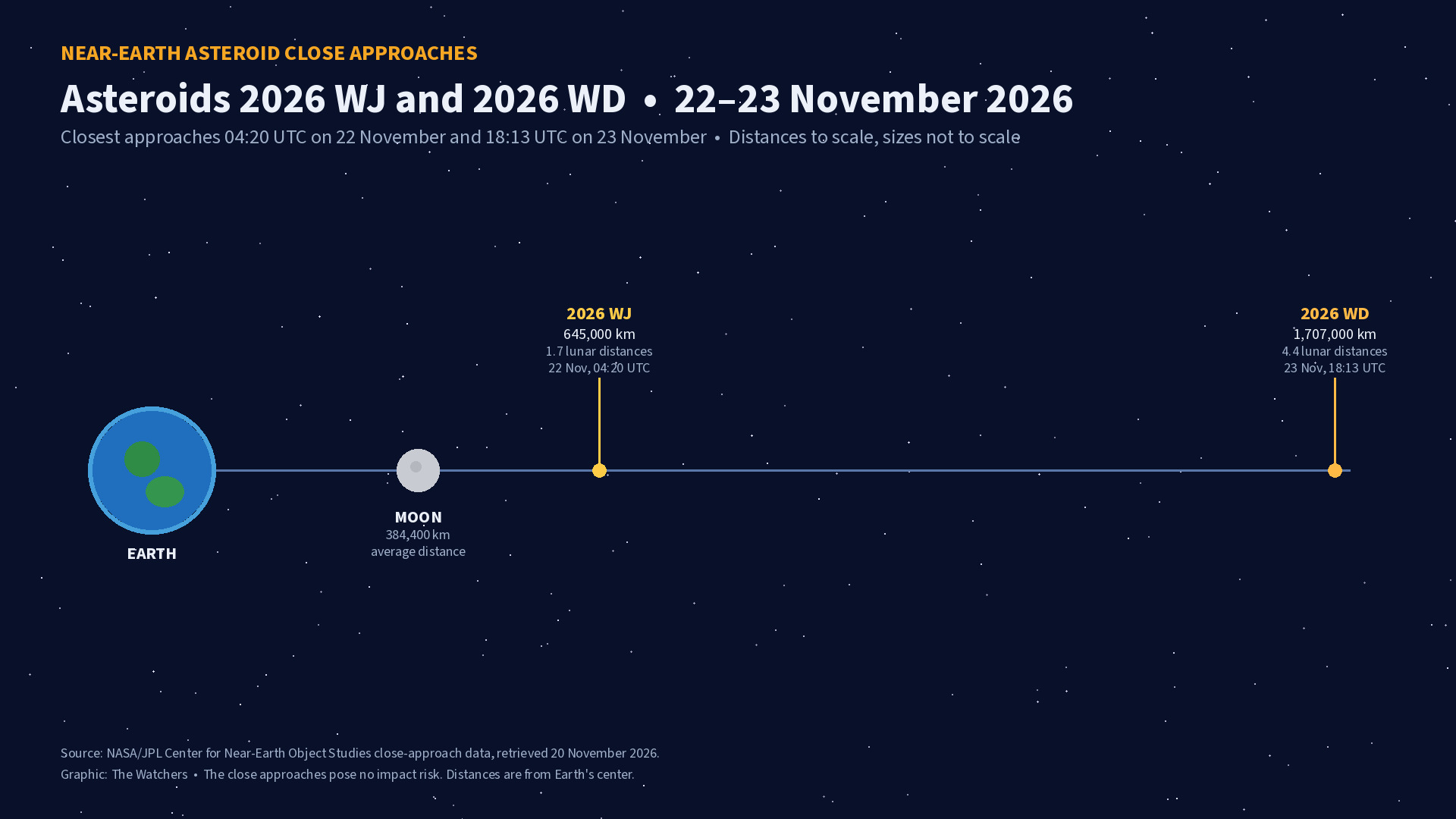
Asteroid 2026 WJ will pass Earth at 04:20 UTC (12:20 SGT) on Sunday, November 22, 2026, at a distance of 0.00431 astronomical units, or about 645,000 km (401,000 miles) from the planet’s center, according to close-approach data from NASA’s Jet Propulsion Laboratory Center for Near-Earth Object Studies (CNEOS). That is about 1.7 times the average distance to the Moon. A second small near-Earth asteroid, 2026 WD, will pass at 18:13 UTC on Monday, November 23 (02:13 SGT on November 24), at 0.01141 astronomical units, or about 1,707,000 km (1,060,000 miles), about 4.4 lunar distances. Neither close approach poses an impact risk.
JPL lists a timing uncertainty of about six minutes for both encounters. The nominal distance for 2026 WJ sits in a narrow window of 0.00430 to 0.00433 au, a spread of about 4,200 km (2,600 miles). For 2026 WD the window is 0.01137 to 0.01145 au, a spread of about 12,500 km (7,800 miles). The relative velocity at closest approach is 9.2 km/s (33,000 km/h, or 21,000 mph) for 2026 WJ and 13.9 km/s (50,000 km/h, or 31,000 mph) for 2026 WD.
JPL classifies both objects as Apollo-class near-Earth asteroids and not as potentially hazardous asteroids. It gives 2026 WJ an absolute magnitude of 27.1, based on 12 observations from November 16 to 18, and 2026 WD a magnitude of 26.9, based on 19 observations from November 16 to 19. Using the CNEOS size estimator, those magnitudes correspond to diameters of about 10 to 23 m (33 to 75 feet) for 2026 WJ and about 11 to 25 m (36 to 82 feet) for 2026 WD, if the objects have geometric albedos between 0.25 and 0.05. The sizes are estimates, not measurements, because the reflectivity of each asteroid is not known.
The same CNEOS close-approach list also shows two smaller Apollo-class objects passing Earth on Saturday, November 21. Asteroid 2026 WA1 is listed at 22:28 UTC at about 0.00317 au, or 1.2 lunar distances, with a larger timing uncertainty of about 36 minutes and an absolute magnitude of 29.5, implying a diameter of roughly 3 to 8 m (10 to 26 feet) on the same albedo assumptions. Asteroid 2026 WB1 is listed at 19:54 UTC at about 0.00489 au, or 1.9 lunar distances, with a magnitude of 27.8, implying a diameter of roughly 7 to 17 m (23 to 56 feet). JPL does not classify either as a potentially hazardous asteroid, and neither pass is an impact risk.
Featured image: Distance comparison for the close approaches of asteroids 2026 WJ and 2026 WD on November 22 and 23, 2026, with distances to scale and sizes not to scale. Credit: The Watchers, based on NASA/JPL CNEOS close-approach data
Sources: NASA/JPL CNEOS close-approach table, JPL CAD API, JPL Small-Body Database, 2026 WJ, JPL Small-Body Database, 2026 WD, CNEOS Asteroid Size Estimator

The Watchers Staff covers earthquakes, volcanoes, severe weather, space weather and other natural events. Published since 2011, The Watchers reports on a changing planet and the science behind it.
Published in the last 24 hours
- High Risk of excessive rainfall covers Florida’s Space Coast as St. Johns River near Cocoa reaches 5.67 m
- Cyclone Akvan crossed the north Andhra Pradesh and south Odisha coasts close to Gopalpur on November 20 with 70-80 km/h winds gusting to 90, and has weakened into a deep depression
- A broad low over southeastern Florida and the northwestern Bahamas has a 30 percent chance of subtropical or tropical development within 48 hours and a 50 percent chance within 7 days, the National Hurricane Center says
- A Virginia park ranger was struck by lightning seven times and lived, even though three of the strikes set his hair on fire Epicenter
