
On 13 April 2029 the 340 m asteroid Apophis will pass about 32,000 km above Earth’s surface, inside the ring of geosynchronous satellites, and NASA says observers across the Eastern Hemisphere will see it without a telescope or binoculars.
Simulations suggest that Earth’s gravity could expose important clues about the internal structure of asteroid Apophis when the roughly 340 m (1 115 feet) body passes about 32 000 km (20 000 miles) above the planet on April 13, 2029. Researchers found that weakly packed asteroid interiors can deform four times as much as more compact ones during the encounter, offering a rare opportunity to test how a large near-Earth asteroid responds to planetary tides. NASA says the flyby is safe and that Apophis poses no impact risk for at least 100 years.
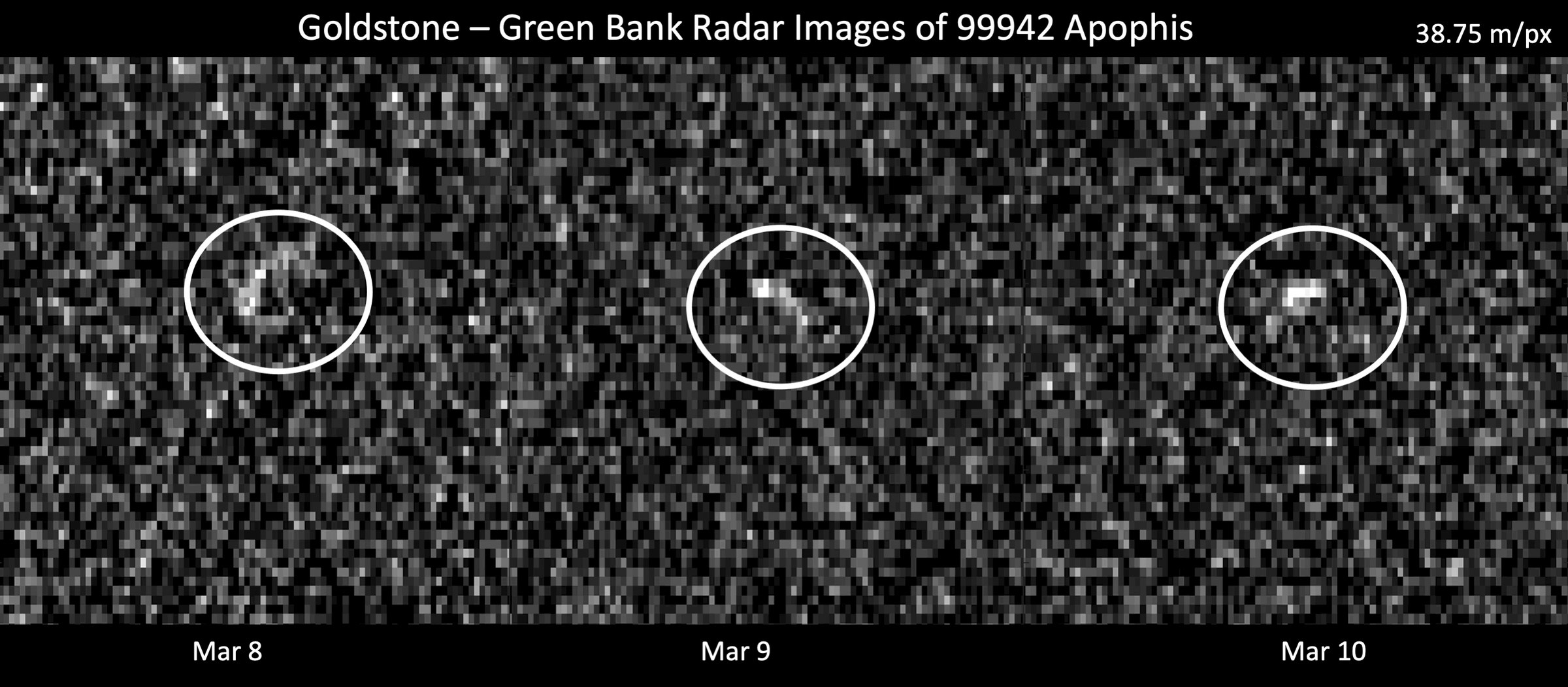
Radar observations of asteroid 99942 Apophis (PIA24168). Credit: NASA/JPL-Caltech and NSF/AUI/GBO (public domain), via Wikimedia Commons.
Apophis presents an unusual scientific problem because astronomers can measure its trajectory, rotational state and approximate shape from Earth, but cannot directly observe how its interior is assembled. Radar observations suggest an elongated body that may have two lobes, while the distribution of rocks, smaller particles and empty spaces beneath its surface remains uncertain. The 2029 flyby will expose that structure to a gravitational disturbance that scientists can calculate in advance, allowing them to compare the asteroid’s behavior with models of different possible interiors.
DeMartini et al. (2025) investigated that opportunity using numerical simulations of Apophis during its close encounter with Earth. Their models found that the weakest packing configuration deformed four times more than the most compact configuration. They also predicted short-period seismic activity in shallow layers following closest approach. Those differences suggest that measurements of deformation, rotation and surface motion could help constrain the asteroid’s internal structure, rather than leaving researchers dependent on its outward appearance alone.

The gravitational interaction is expected to alter Apophis’ orbit around the Sun and its tumbling rotation. Earth will pull more strongly on the side of the asteroid nearest the planet than on the far side, producing tidal forces that can stretch and redistribute stress within the body. Whether those stresses produce measurable deformation, shallow movement or seismic vibrations depends on how the material inside Apophis is arranged and how strongly its constituent particles resist movement.
The models used by DeMartini and colleagues represent Apophis as a self-gravitating collection of particles rather than a single solid rock. The researchers varied particle sizes, shapes, packing arrangements and the presence of larger embedded cores. They then calculated how each simulated interior would respond as Earth exerted changing gravitational forces throughout the encounter.

A more tightly packed aggregate generally resists deformation more effectively than a weaker arrangement of material. In the study, the least resistant packing configuration underwent four times more deformation than the most compact configuration. Introducing larger coherent cores also affected how stress was distributed through the simulated asteroid, showing that a body with a similar outward shape can behave differently depending on its hidden structure.
The encounter itself will occur at 21:46 UTC on April 13, 2029, according to JPL’s current Goldstone radar-observation planning data. Apophis will pass approximately 38 000 km (23 600 miles) from Earth’s center, corresponding to about 32 000 km (20 000 miles) above the surface. Its relative speed at closest approach will be about 7.42 km/s (4.61 miles/s), or approximately 26 700 km/h (16 600 mph).

Apophis will therefore pass closer to Earth’s surface than the altitude of many satellites in geosynchronous orbit, approximately 36 000 km (22 236 miles). That comparison describes distance from Earth rather than a passage through the densely populated equatorial geosynchronous satellite belt. NASA states that the encounter presents no danger to the planet, astronauts or satellites.
The asteroid’s mean diameter is approximately 340 m (1 115 feet), while its longest axis extends at least 450 m (1 480 feet). NASA identifies it as a stony near-Earth asteroid containing silicate material together with metallic nickel and iron. Objects of this size rarely make such close approaches, making the 2029 encounter an opportunity for measurements that cannot ordinarily be obtained during a distant asteroid passage.

Earth’s gravity will also change the asteroid’s heliocentric orbit. JPL’s planning solution gives Apophis a pre-encounter orbital period of about 324 days and a post-encounter period of approximately 423 days. That change will move it from the Aten group of near-Earth asteroids, whose orbital periods are shorter than one year, into the Apollo group, whose members have orbital periods longer than one year and cross Earth’s orbital region.
Its rotation adds another layer of complexity. Apophis is a non-principal-axis rotator, meaning that it tumbles rather than spinning steadily around a single fixed axis. JPL lists rotational components of approximately 30.56 hours and 11 days. The asteroid’s orientation as it approaches Earth will influence how gravitational torque changes its motion, and observing that change will help researchers evaluate models of its mass distribution.

The 2025 simulations also predict seismic motion within the asteroid. Rather than treating every change in particle velocity as an independent quake, the researchers identified short-duration events in which modeled particles experienced sharp, localized changes in motion. The events were concentrated in shallow regions and generally occurred after closest approach, when the simulated asteroid was responding to the changed stresses and rotational state.
Half of the modeled short-period seismic events in one high-resolution simulation originated within approximately 30 m (98 feet) of the surface. This shallow concentration matters because movement near the surface could modify loose material, redistribute small particles or influence the appearance of local terrain. The results do not establish that visible landslides will occur. They identify physical responses that may be detectable if the actual asteroid behaves similarly to the simulated structures.
The modeled signals included frequencies of approximately 0.1 to 1 Hz, corresponding to oscillation periods from about 10 seconds to 1 second. Their estimated acceleration amplitudes were on the order of 10-4 m/s2/Hz1/2. The authors compared these values with the sensitivity of recent small-body seismometer designs and concluded that some of the predicted signals could be detectable by suitable instruments operating directly on the asteroid.
These are predicted responses rather than observed seismic measurements. No seismic instrument has yet recorded the 2029 encounter, and Apophis’ actual internal arrangement is not known. The calculations are valuable because they specify how different interiors might behave under the same external forcing, creating results against which later measurements can be compared.
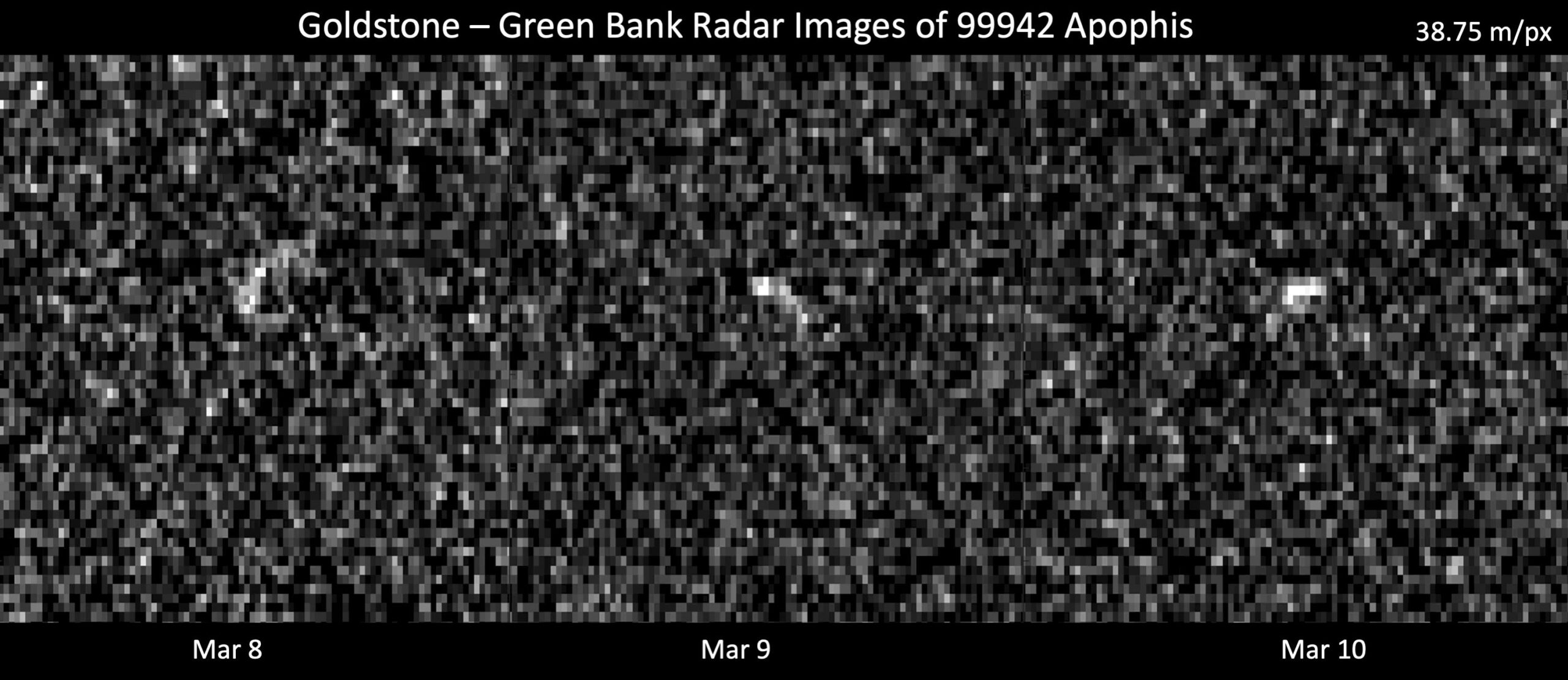
Radar observations have already transformed scientists’ understanding of Apophis’ trajectory. During its March 2021 approach, NASA’s 70 m (230 feet) Goldstone antenna transmitted radar signals that were received by the 100 m (328 feet) Green Bank Telescope. Those measurements improved the asteroid’s orbital solution enough to remove the remaining potential Earth impact in 2068 from consideration.
Earlier measurements had already ruled out the historical 2029 and 2036 impact possibilities. NASA now states that Apophis poses no impact risk for at least 100 years. Its designation as a potentially hazardous asteroid is based on characteristics including size and orbital proximity, not on a current prediction that it will strike Earth.
Apophis was discovered on June 19, 2004, by Roy Tucker, David Tholen and Fabrizio Bernardi at Kitt Peak National Observatory in Arizona. It was initially designated 2004 MN4 before receiving its permanent numbered designation, 99942 Apophis. Early observations briefly left open the possibility of an Earth impact, but successive optical and radar measurements reduced the orbit uncertainty and eliminated the threat.

The April 2029 encounter will also be unusual for observers on the ground. NASA says Apophis will become visible without a telescope or binoculars from parts of the Eastern Hemisphere, weather and local viewing conditions permitting. JPL expects favorable observers in portions of Europe and Africa to see the asteroid brighten to approximately third or fourth magnitude during the encounter.
Ground-based radar observations will supply much more precise measurements than visual viewing alone. JPL is preparing a radar campaign extending from March into May 2029, with several planned transmitter and receiver configurations. Some configurations are designed to achieve range resolutions as fine as 1.875 m (6.15 feet), potentially allowing researchers to study much finer surface-scale structure than was accessible during the 2021 observations.
The radar campaign should also constrain the asteroid’s rotational state and shape after the flyby. Those measurements will be important for separating genuine physical changes from changes in viewing geometry. A difference in the asteroid’s apparent silhouette, for example, could arise from a change in its orientation rather than from deformation of the body itself.
NASA’s OSIRIS-APEX spacecraft will provide another observational perspective. Formerly known as OSIRIS-REx, the spacecraft completed its original mission when it returned samples from asteroid Bennu to Earth in September 2023. NASA subsequently redirected it toward Apophis, with rendezvous planned for mid-2029, after the asteroid’s encounter with Earth.

OSIRIS-APEX is scheduled to study Apophis after the strongest tidal forcing has ended. That makes observations obtained before and during the encounter especially important. Comparing pre-encounter measurements with the spacecraft’s later observations could show whether the asteroid’s rotation, orientation, surface or overall shape changed in ways consistent with the predicted gravitational response.
The planned observations will not provide a direct photograph of Apophis’ interior. Real asteroid interiors may contain complex combinations of void spaces, loose grains, larger coherent blocks and material contacts that are not represented by any one simulation. Researchers will instead compare the measured changes with a range of models, using the observed response to eliminate or constrain physical structures that are inconsistent with the data.
The outcome could also improve interpretation of other near-Earth asteroids. Internal structure influences how an asteroid responds to planetary tides, collisions and efforts to alter its trajectory. Apophis offers an unusually well-constrained opportunity to investigate those properties because scientists can calculate the gravitational forcing in advance and obtain observations on both sides of the encounter. The remaining question is whether its actual response will be measurable enough to distinguish between competing models of what lies beneath its surface.
References:
1 DeMartini, J. V., Richardson, D. C., Murdoch, N., Garcia, R. F., Schmerr, N. C., Scheirich, P., Ballouz, R.-L., & Daca, A. (2025). The influence of internal structure on physical outcomes of the 2029 Apophis close approach with Earth. The Planetary Science Journal, 6(11), 263. DOI: 10.3847/PSJ/ae147e
2 Apophis Facts – National Aeronautics and Space Administration – Updated September 23, 2026
3 Goldstone Radar Observations Planning: 99942 Apophis in 2029 – NASA Jet Propulsion Laboratory – Updated April 29, 2026
4 Radar Observations of Asteroid 99942 Apophis – NASA Jet Propulsion Laboratory – March 26, 2021
5 Asteroid Apophis 2029 Earth Flyby – Orbit Visualizations – NASA’s Goddard Space Flight Center – September 23, 2026
6 NASA’s OSIRIS-APEX Mission Will Explore Asteroid Apophis – NASA’s Goddard Space Flight Center – September 23, 2026

I’m a science journalist and researcher at The Watchers, contributing to the Epicenter edition, where I cover peer-reviewed scientific research and emerging discoveries across Earth and space sciences. With a background in astronomy and a passion for environmental science, I’ve worked in shark and coral conservation in Fiji, conducting reef and shark-behavior research, contributing to mangrove restoration, and earning PADI Open Water and Coral Reef Certifications. I bring a blend of scientific rigor and storytelling to illuminate the discoveries shaping our planet and beyond.
Published in the last 24 hours
- Dust shed by Halley's Comet gives Earth the Eta Aquarids every May and the Orionids every October, and the comet itself, which passed 4.94 million km away on 10 April 837 at about magnitude -3.5, is due to reach perihelion on 28 July 2061. Epicenter
- Detonations from Krakatoa on 26 and 27 August 1883 were heard over nearly one thirteenth of the globe, as far as Rodrigues about 4,800 km away, where the chief of police logged roars like heavy guns until 3 p.m., the Royal Society reported in 1888. Epicenter
- One dead, 15 injured and 152 homes left uninhabitable across five regions of Peru after the M6.7 Junín earthquake of 20 November, COEN-INDECI reports.
- WPC flags a Slight Risk of excessive rainfall for the coastal Carolinas on Wednesday as a low forms off Florida and tracks up the East Coast on Thanksgiving Day.
