
Dust shed by Halley’s Comet gives Earth the Eta Aquarids every May and the Orionids every October, and the comet itself, which passed 4.94 million km away on 10 April 837 at about magnitude -3.5, is due to reach perihelion on 28 July 2061.
Halley’s Comet came within 4.94 million km (3.07 million miles) of Earth on April 10, 837, its closest recorded approach, when it reached a total apparent magnitude of about -3.5. Nearly 1 200 years later, material released from the comet still produces the Eta Aquariids each May and the Orionids each October, while Halley itself is due to reach perihelion again on July 28, 2061.
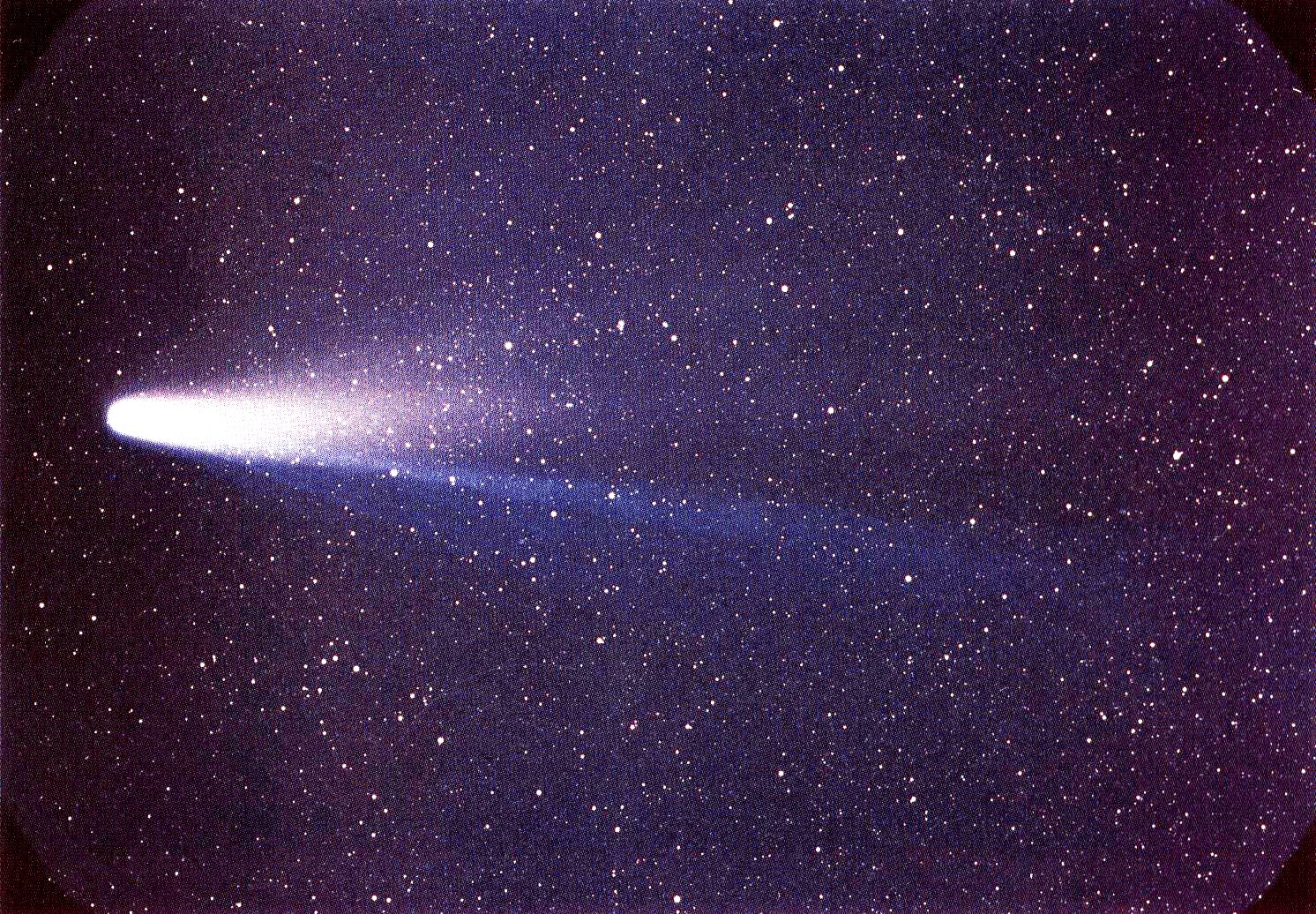
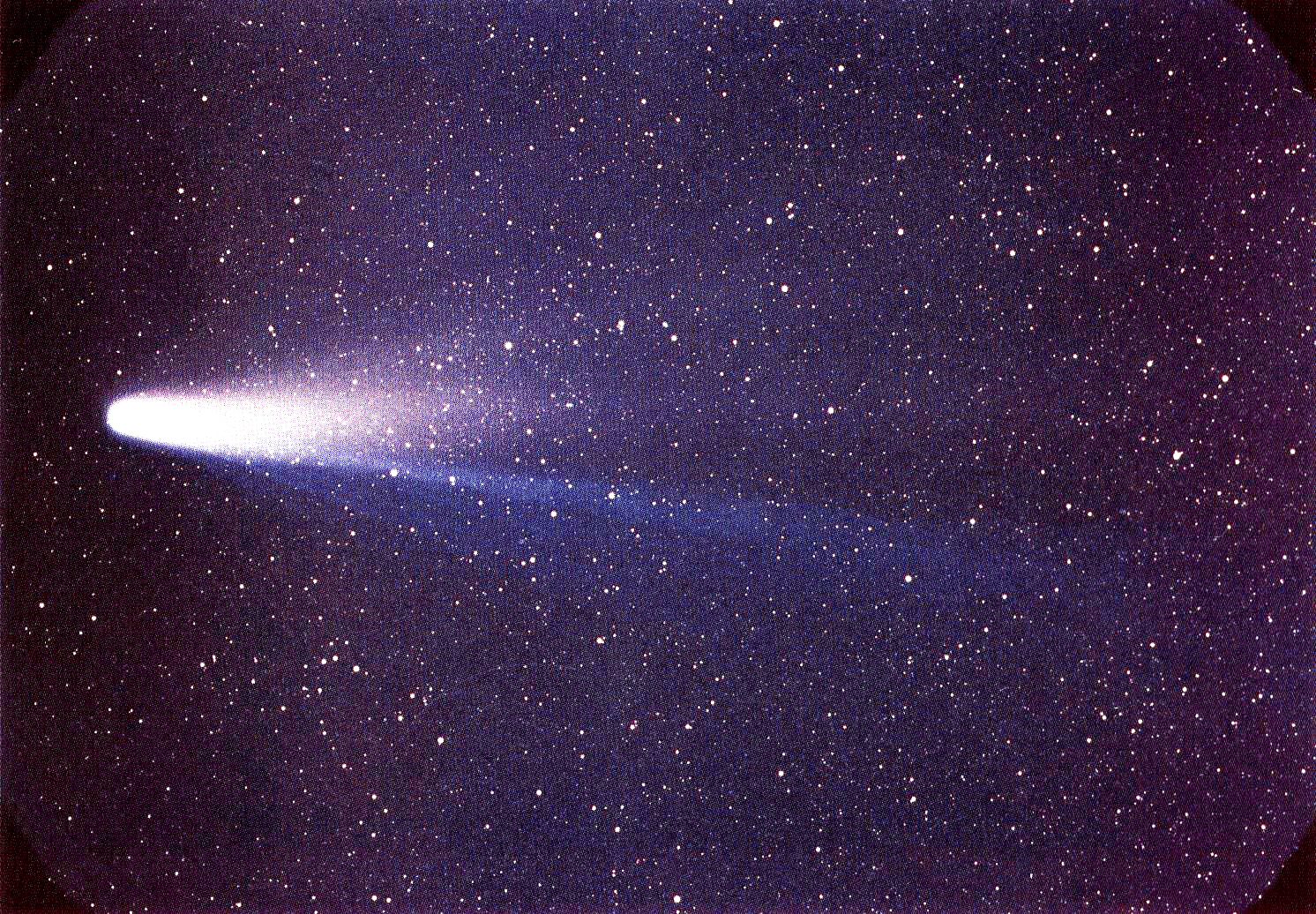
Lspn comet halley. Credit: NASA/W. Liller (public domain), via Wikimedia Commons.
The annual meteor showers preserve a direct physical connection with Halley during the decades when the comet itself is far from the inner Solar System. Each return toward the Sun releases ice, rock and dust from the nucleus, and some of that material spreads along the comet’s orbit.
Earth passes through parts of this debris stream twice during its yearly orbit around the Sun. The resulting Eta Aquariids occur in May and the Orionids in October, so material lost by Halley can produce visible meteors even while the comet’s nucleus is billions of kilometres away.

Meteor showers do not originate from the constellation whose name they carry. Their radiant is an effect of perspective showing the direction from which the meteors appear to emerge, while the particles themselves are remnants of the comet’s repeated passages through the inner Solar System.
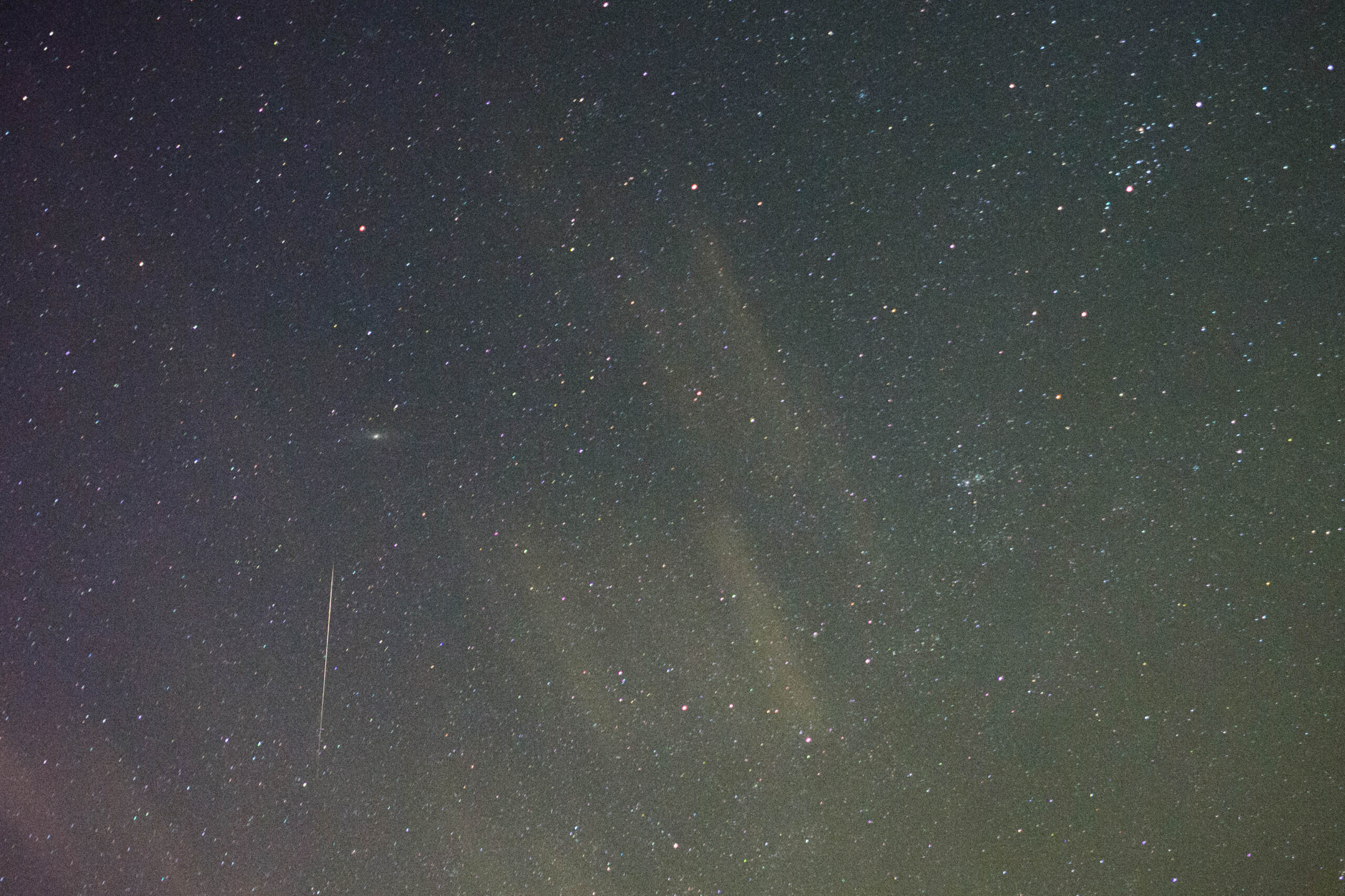
Halley’s closest recorded passage to Earth occurred on April 10, 837. NASA gives the minimum distance as 0.033 AU, equivalent to 4.94 million km (3.07 million miles), and its total apparent brightness at the time as about magnitude -3.5.
The brightness value describes the comet’s integrated light rather than the brightness of a point-like object. NASA notes that Halley’s light was spread across an extended area, so its surface brightness was lower than that of a star or planet with a comparable total apparent magnitude.
The 837 apparition also became important to attempts to reconstruct Halley’s earlier orbit. Yeomans and Kiang (1981) numerically integrated the comet’s motion back to 1404 BC using planetary perturbations together with non-gravitational forces associated with outgassing from the nucleus.
The researchers used unusually accurate observations associated with the apparitions of 837, 374 and 141 to constrain the computed motion. Their calculations show how historical astronomical records and modern orbital dynamics can be combined to trace a periodic comet across nearly two millennia of observations.
Halley travels around the Sun in a retrograde orbit, moving opposite to Earth’s orbital direction, with its orbital plane tilted about 18° relative to Earth’s. Its period averages about 76 years, but gravitational interactions with the planets alter the interval from one perihelion passage to the next.
NASA gives the shortest measured interval as 74.42 years between the 1835 and 1910 perihelia and the longest as 79.25 years between the returns of 451 and 530. Halley’s widely quoted 76-year period is therefore an average rather than a fixed interval.
Halley’s most recent perihelion occurred on February 9, 1986. At that point it was 0.5871 AU, about 87.8 million km (54.6 million miles), from the Sun and was moving at 54.55 km/s (33.90 miles/s).
The comet’s nearest approach to Earth during the 1986 apparition occurred later on the outbound leg of its orbit at 0.42 AU, approximately 63 million km (39 million miles). That distance was about 12.8 times greater than the 4.94 million km (3.07 million miles) recorded during the 837 passage.
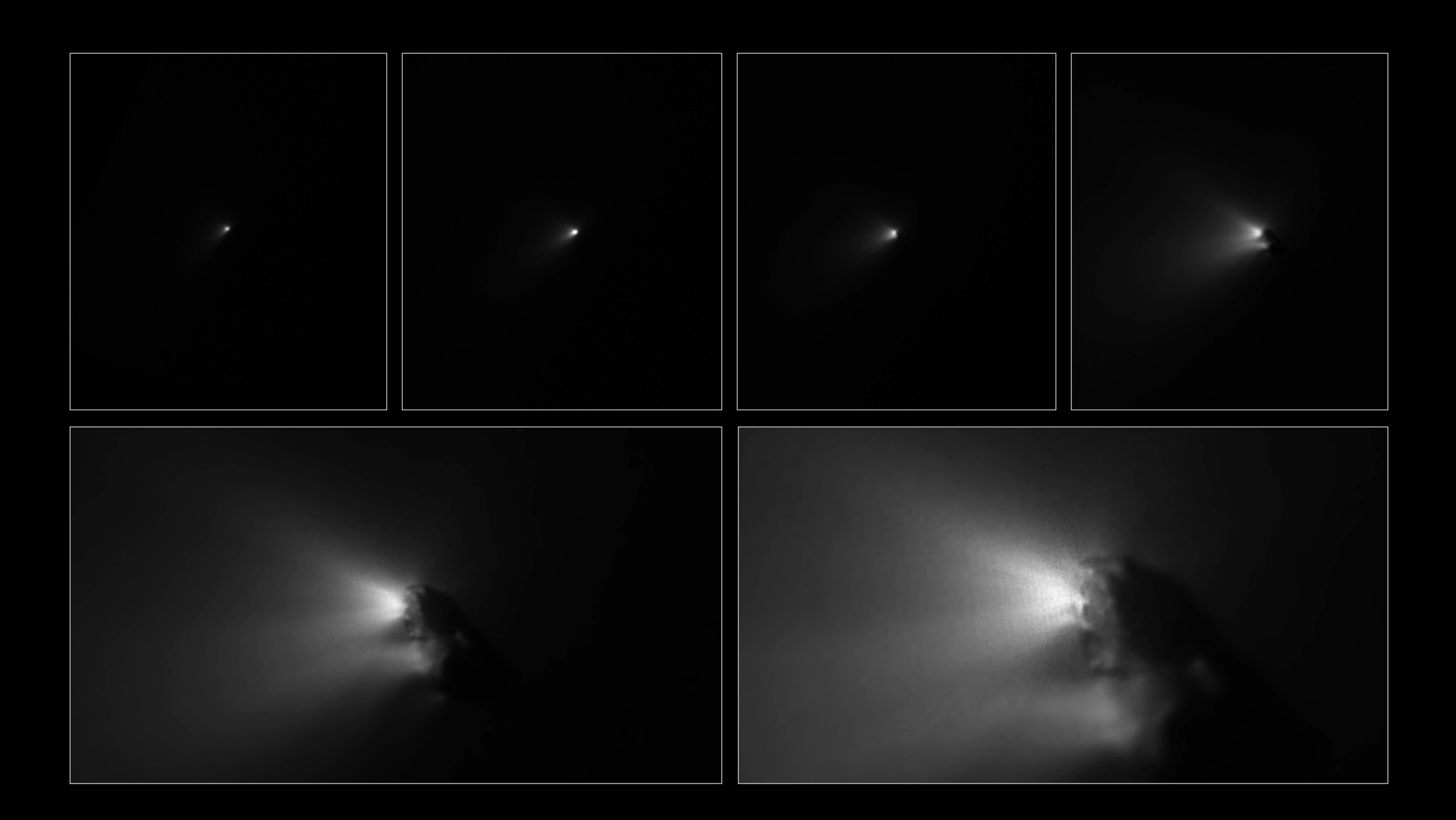
The 1986 return gave spacecraft the first opportunity to examine a cometary nucleus at close range. ESA’s Giotto spacecraft flew to within 596 km (370 miles) of Halley and returned images showing an extremely dark, irregular body surrounded by bright jets of gas and dust.
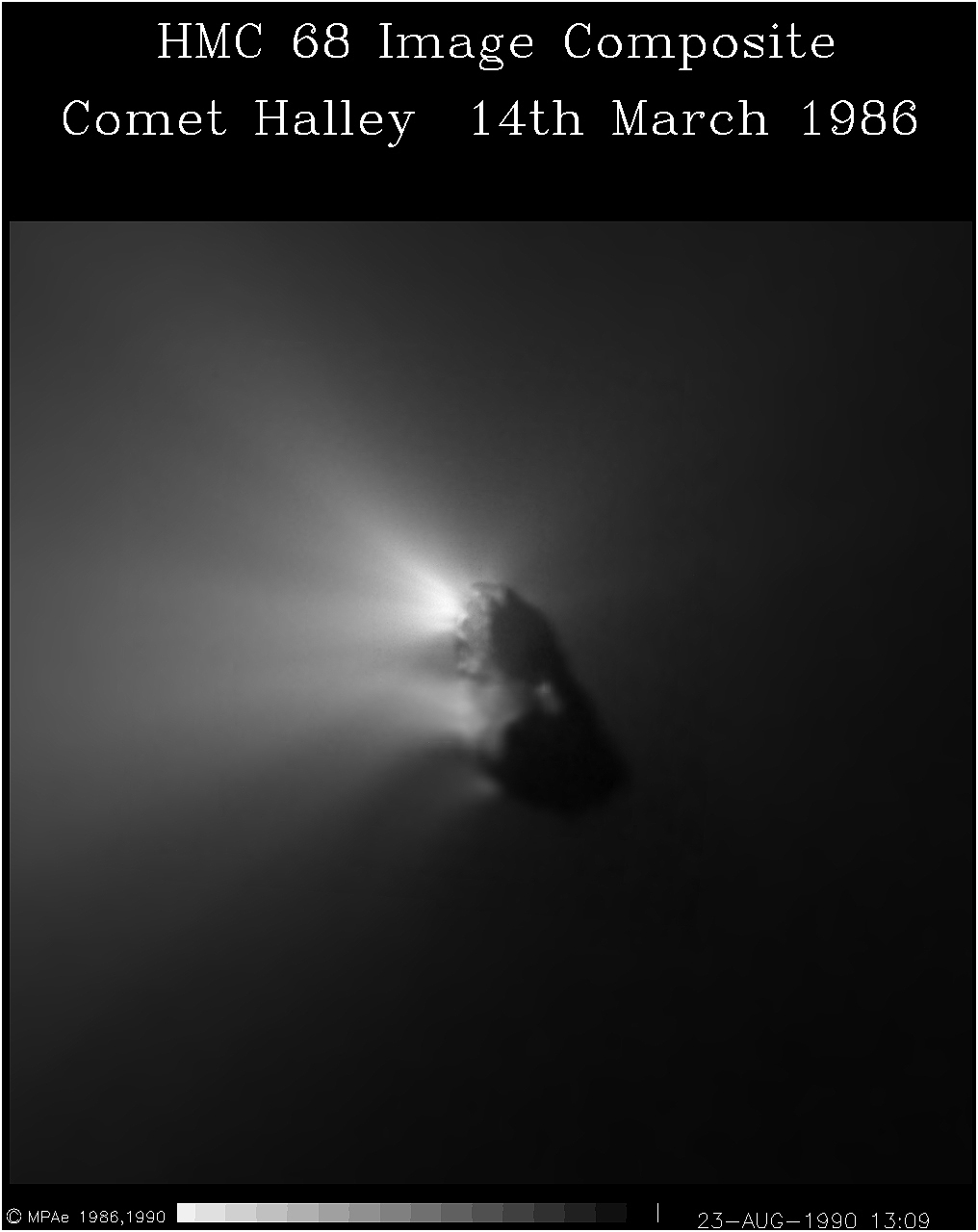
NASA gives the nucleus dimensions as about 15 × 8 km (9.3 × 5 miles). Its albedo is 0.03, meaning the surface reflects only about 3% of the light falling on it.
The darkness of the nucleus contrasts sharply with the bright coma and jets that develop around an active comet. Solar heating causes volatile material near the surface to escape, carrying dust with it and supplying some of the material that later becomes distributed along Halley’s orbit.
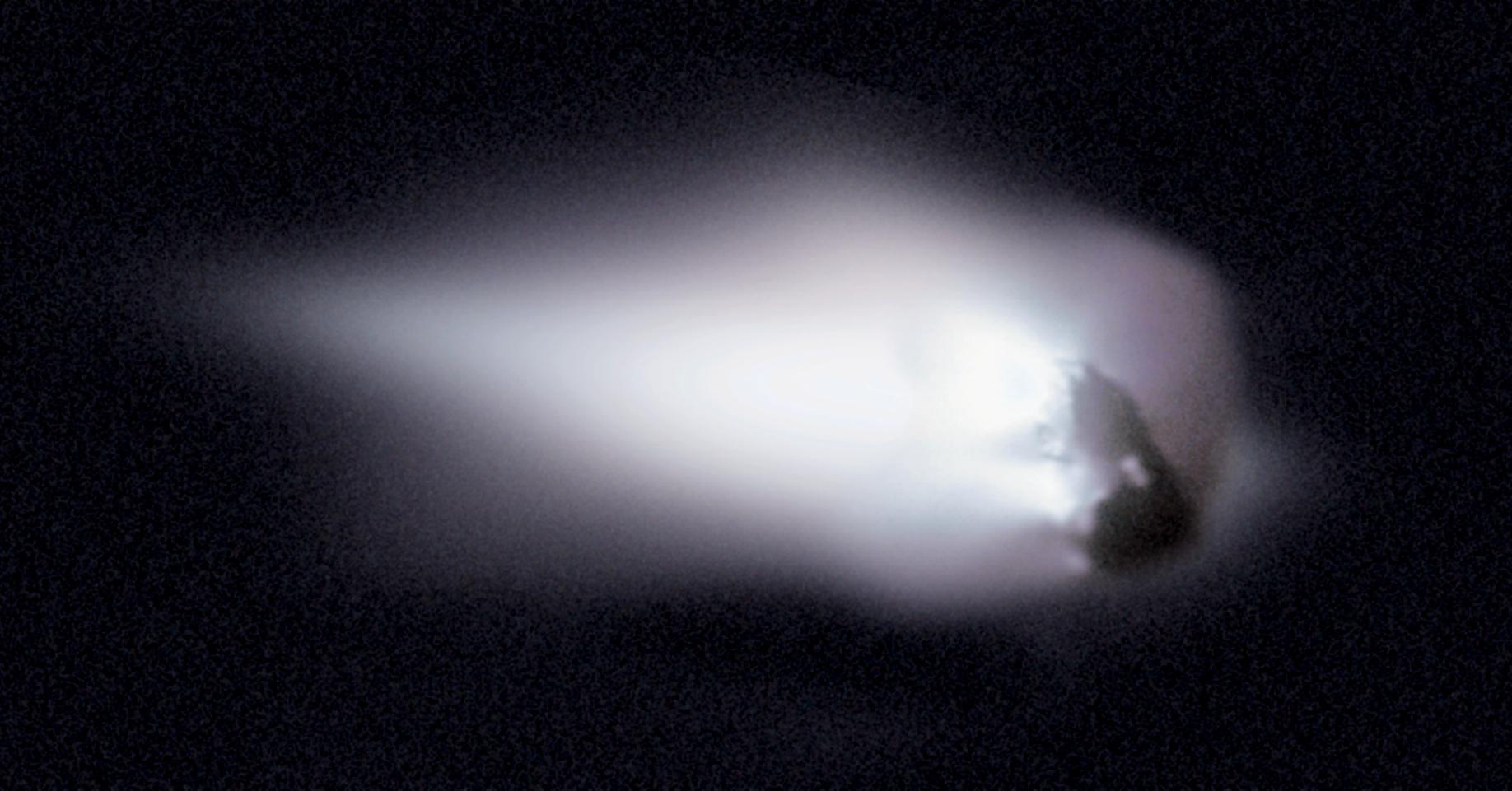
Repeated solar passages gradually erode the nucleus. NASA estimates that a comet the size of Halley loses about 1 to 3 m (3 to 10 feet) of material from its surface during each orbit.
The comet spends most of its orbit far from the Sun. At aphelion in 1948, Halley was 35.25 AU, about 5.27 billion km (3.28 billion miles), from the Sun and was moving at 0.91 km/s (0.57 miles/s).
Near perihelion, its much greater speed reflects the conversion of gravitational potential energy as the comet falls inward toward the Sun. Its orbit carries it from beyond Neptune into the inner Solar System and back again.

The Astronomical Society of the Pacific’s 1985 special issue on Halley’s Comet lists July 28, 2061 as the calculated date of the next perihelion, attributing the calculation to Donald K. Yeomans of the Jet Propulsion Laboratory.
Perihelion is the point in the orbit at which the comet is closest to the Sun. The July 28, 2061 date therefore does not by itself describe Halley’s closest distance from Earth during that apparition, and no Earth-distance or brightness claim for the 2061 return is inferred here.

Halley’s continuing connection with Earth is therefore visible on two very different time scales. Its nucleus returns to the inner Solar System only once in roughly a human lifetime, while material released during earlier passages continues to reach Earth’s atmosphere every year as the Eta Aquariids and Orionids.
The same object also links modern spacecraft measurements with observations made more than a thousand years ago. Historical records from apparitions such as 837 remain useful in dynamical reconstructions, while the 1986 spacecraft encounter supplied direct measurements of the nucleus that earlier observers could never obtain.
References:
1 Yeomans, D. K., & Kiang, T. (1981). The long-term motion of comet Halley. Monthly Notices of the Royal Astronomical Society, 197(3), 633-646. DOI: 10.1093/mnras/197.3.633
2 1P/Halley – NASA Science
3 A Special Issue on Halley’s Comet – Astronomical Society of the Pacific – 1985

I’m a science journalist and researcher at The Watchers, contributing to the Epicenter edition, where I cover peer-reviewed scientific research and emerging discoveries across Earth and space sciences. With a background in astronomy and a passion for environmental science, I’ve worked in shark and coral conservation in Fiji, conducting reef and shark-behavior research, contributing to mangrove restoration, and earning PADI Open Water and Coral Reef Certifications. I bring a blend of scientific rigor and storytelling to illuminate the discoveries shaping our planet and beyond.
Published in the last 24 hours
- Detonations from Krakatoa on 26 and 27 August 1883 were heard over nearly one thirteenth of the globe, as far as Rodrigues about 4,800 km away, where the chief of police logged roars like heavy guns until 3 p.m., the Royal Society reported in 1888. Epicenter
- One dead, 15 injured and 152 homes left uninhabitable across five regions of Peru after the M6.7 Junín earthquake of 20 November, COEN-INDECI reports.
- WPC flags a Slight Risk of excessive rainfall for the coastal Carolinas on Wednesday as a low forms off Florida and tracks up the East Coast on Thanksgiving Day.
- Scientists directly observe how submarine landslides unfold in western Canada Epicenter
