
Asteroid orientation can alter stand-off X-ray deflection by up to fivefold
The direction from which an asteroid receives a stand-off X-ray burst could change its calculated deflection velocity by as much as fivefold, according to simulations of three real asteroid shapes. Researchers at Sandia National Laboratories found that irregular topography and orientation strongly influence how vaporized surface material transfers momentum to an asteroid, exposing a major uncertainty in a potential last-resort planetary-defense technique.
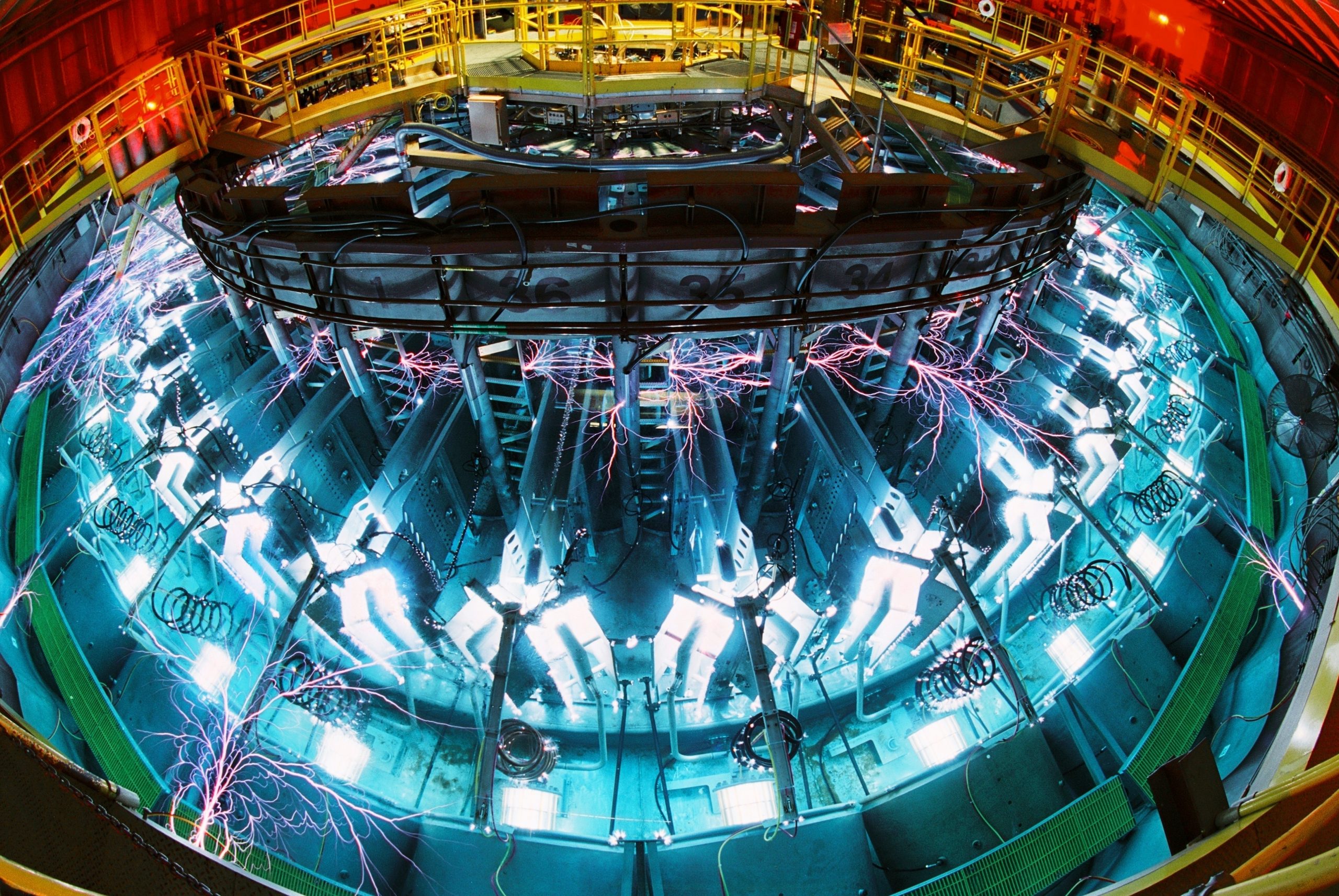
Sandia National Laboratories' Z pulsed-power facility, which produces intense X-rays for high-energy-density physics experiments. Earlier asteroid-deflection research used X-ray pulses from Z to test the response of small asteroid-analogue samples. Credit: Sandia National Laboratories
Earlier calculations of radiation-driven asteroid deflection faced a difficult tradeoff. Models capable of representing the intense heating, vaporization and expansion caused by X-rays were computationally expensive to apply across the irregular surface of an entire asteroid. Simpler calculations could handle larger geometries but could not represent all the relevant physics in comparable detail. Nathan W. Moore and colleagues at Sandia National Laboratories developed a method intended to overcome that limitation, allowing realistic asteroid shapes to be included without making the calculations prohibitively expensive.
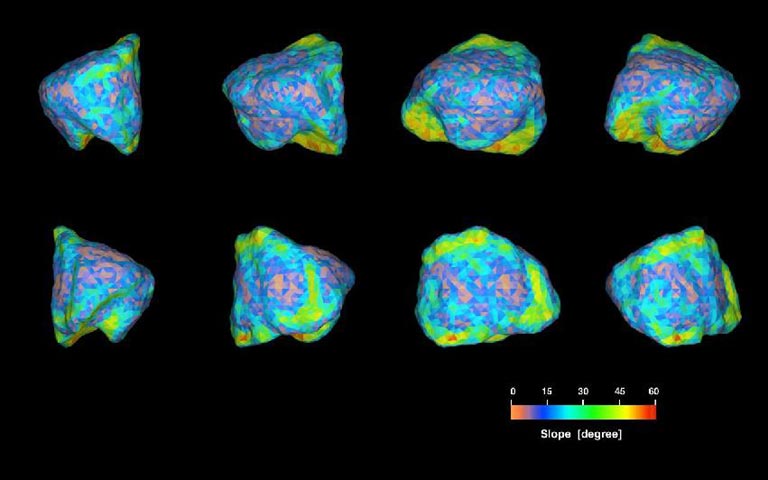
The distinction matters because a stand-off detonation would not push every part of an asteroid equally. Ridges, boulders, depressions and areas shielded from incoming radiation affect where surface material becomes heated and how the resulting vapor escapes. The combined forces determine the asteroid’s overall change in velocity and rotation. The research shows that knowing the incoming object’s approximate size and orbit would not be sufficient to predict its response accurately: its three-dimensional shape and orientation at the moment of interception could also be important.
Moore et al. (2027) investigated 168 interception scenarios involving three near-Earth asteroids: (101955) Bennu, (25143) Itokawa and (6489) Golevka. The simulations included different orientations and two irradiation distances. The calculated change in velocity varied by nearly a factor of two for Bennu, four for Itokawa and five for Golevka when the strongest and weakest responses for each asteroid were compared. These figures describe differences among modeled irradiation geometries, not changes measured in the trajectories of real asteroids.

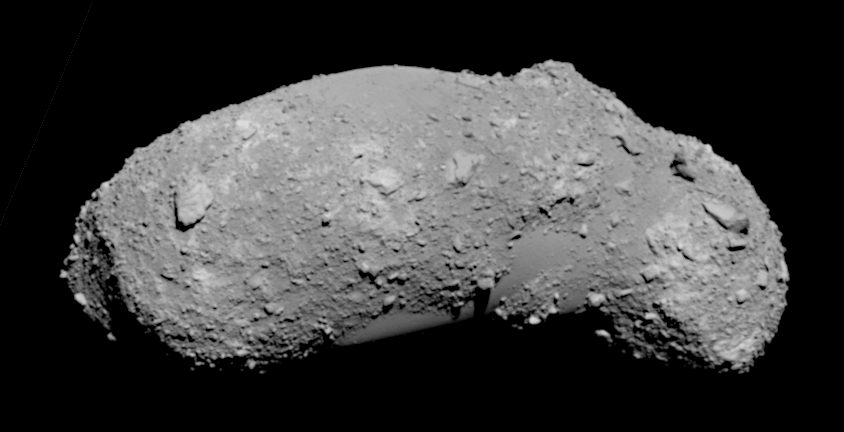
The three objects provided substantially different shapes for the calculations. Bennu is roughly spheroidal but has an uneven, boulder-covered surface and a prominent equatorial ridge. Itokawa is elongated and bilobed, while Golevka has a particularly angular and irregular radar-derived shape. These differences allowed the researchers to investigate how surface topography changes the distribution of pressure generated by escaping material.
The orientation-dependent results were not identical among the three bodies. Bennu produced the smallest relative variation, while Itokawa showed a larger spread and Golevka the greatest. The fivefold result therefore does not mean that every asteroid could receive five times more deflection from a particular direction. It represents the largest orientation-dependent ratio reported among the three modeled geometries.
Sandia described one calculated case in which the X-ray burst produced a velocity change of 3.9 mm/s (0.15 inches/s) when the asteroid was irradiated from one direction, compared with 0.8 mm/s (0.03 inches/s) from another. Although both velocity changes are small, they differ by nearly fivefold. For planetary defense, a change in velocity would need to be evaluated together with the remaining warning time and the asteroid’s predicted trajectory, because an early change can accumulate into a much larger positional difference over time.
The simulations also examined changes in rotational motion. In one modeled case, the predicted change in rotational speed varied by a factor of 17 depending on orientation. This is a separate result from the fivefold variation in linear deflection velocity. It indicates that uneven surface forces can produce different amounts of torque, potentially changing how rapidly the asteroid spins as well as how its center of mass moves.
The physical mechanism begins when a burst of X-rays strikes the asteroid’s exposed surface. Absorbed radiation rapidly heats the material, causing part of it to melt or vaporize. As hot material expands away from the surface, it carries momentum in one direction and produces a reaction force on the asteroid in the other. The process is a form of ablation-driven recoil, rather than the asteroid being pushed by direct contact with an explosive device.
In a stand-off nuclear-deflection scenario, the device would detonate some distance from the asteroid rather than strike it. Radiation from the detonation would supply the energy responsible for surface ablation. Such an approach has been discussed as a possible response to an object discovered too late for slower techniques, but the present study does not establish that nuclear deflection is preferable to other mitigation methods or demonstrate that an actual asteroid could be redirected successfully in this way.
To calculate the response, the researchers combined two numerical methods that handle different stages of the process. The radiation-hydrodynamics code ALEGRA modeled the initial interaction between X-rays and asteroid material, accounting for radiation transport, heating, changes of phase and the development of the vapor flow. The resulting conditions were then transferred to SPARTA, a Direct Simulation Monte Carlo code that calculates the behavior of lower-density gas as it expands around the three-dimensional body.
Direct Simulation Monte Carlo follows the statistical behavior of representative particles rather than treating every region of the expanding vapor as a continuous fluid. That makes it useful for modeling gas flow where the material becomes too dilute for conventional fluid descriptions to remain appropriate. SPARTA calculated the pressure exerted by the expanding vapor across the asteroid surface, from which the combined force and torque could be evaluated.
The hybrid method accelerated the relevant deflection calculations by at least 1 600 times, according to the paper. The speedup applies to the computational approach used for this class of vapor-flow and deflection calculation; it should not be interpreted as making every aspect of asteroid-interception modeling 1 600 times faster. The reduced cost made it practical to investigate many irradiation orientations while preserving detailed topography.

The study’s modeling approach addresses a problem that could become particularly important when warning time is short. Scientists might establish that an incoming object is on a hazardous trajectory without having a complete three-dimensional map of its surface. Its rotational state could introduce further uncertainty about which terrain would face an arriving spacecraft or a stand-off energy source at the intended moment of interception.
Moore and colleagues describe the case in which orientation is not controlled as “naïve targeting.” The calculations suggest that choosing an irradiation direction without sufficiently accounting for topography could produce substantially less deflection than another orientation of the same asteroid. How accurately an optimum direction could be determined in practice would depend on the quality of the available shape and rotation data, along with the constraints of the interception mission.
The researchers also extended their calculations beyond vapor recoil. Pressure fields generated by the simulations were applied to a loosely compacted, Itokawa-like collection of boulders. The resulting solid ejecta were strongly asymmetric, involving shock-induced fracturing and motion of loose material. This result further motivates accurate topographic mapping when evaluating both momentum transfer and material expelled from an irregular asteroid.
Important limitations remain. Sandia said the current model can represent fracturing and ejecta from rocks near the surface but cannot yet accurately predict the breakup of an entire asteroid. A deflection attempt that applies excessive or uneven energy might produce a more complicated structural response than surface-vapor calculations alone can describe. The motion and distribution of any resulting fragments would have to be evaluated separately in a complete mitigation assessment.
The new modeling work follows earlier experiments at Sandia’s Z machine that tested whether intense X-ray pulses could impart momentum to small asteroid-like samples. In those experiments, thin supporting material was vaporized to leave the test samples effectively free-floating during the brief irradiation period, reducing interference from mechanical supports. The laboratory measurements provided experimental evidence of X-ray-driven material motion, while the later numerical study examined the separate challenge of modeling an entire irregular asteroid.

Another planetary-defense method has already been tested in space. NASA’s Double Asteroid Redirection Test (DART) deliberately struck Dimorphos, a small moonlet orbiting asteroid Didymos, in September 2022. The kinetic impact changed Dimorphos’ orbital period around Didymos, demonstrating a different mechanism for altering an asteroid’s motion. Unlike DART’s direct collision, the Sandia study concerns modeled momentum transfer from X-ray-heated surface material.
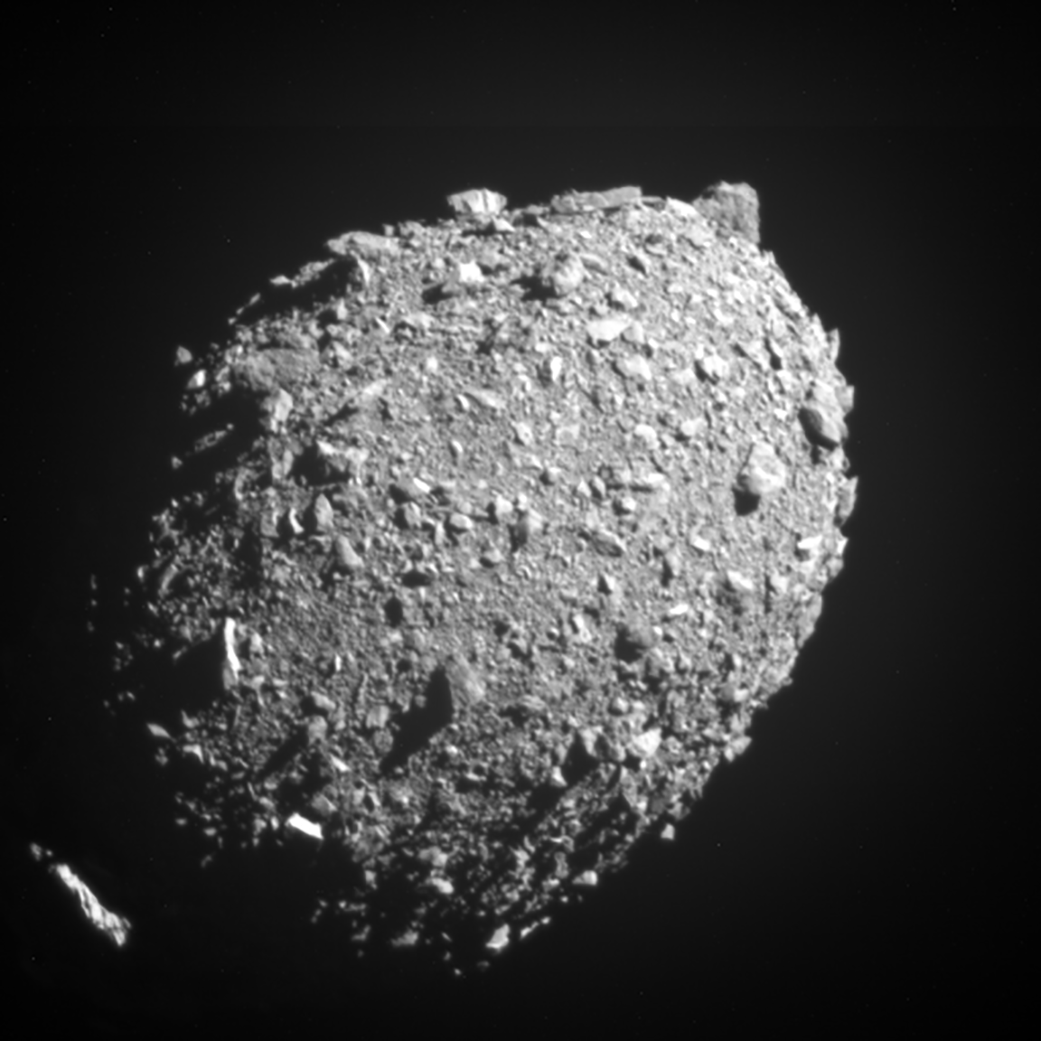
The distinction between techniques is important because the most appropriate response to a future asteroid threat would depend on the characteristics of the object and the available warning time. A kinetic impactor, a long-duration gravitational or other slow-push method, and high-energy interception do not rely on identical physical mechanisms. Moore et al. note that no general consensus establishes whether deflection, disruption or a combination of approaches would be preferable across all possible threat scenarios.
Asteroid 2024 YR4 is discussed in the study as part of the recent planetary-defense context, not as an object selected for the X-ray simulations. The asteroid briefly attracted attention because early orbit calculations indicated a possible impact with Earth in 2032. Subsequent observations eliminated any significant Earth-impact risk for that encounter or through the next century. NASA later used James Webb Space Telescope observations obtained in February 2026 to rule out the previously possible lunar impact on December 22, 2032.

The remaining challenge is to connect accurate calculations of surface recoil with a reliable prediction of the response of an actual asteroid. Better shape maps, rotational measurements and improved models of internal structure and fragmentation would help reduce uncertainties that the present simulations cannot resolve. The research establishes that irradiation direction can make a substantial difference to the calculated velocity change, but determining how to achieve a required deflection under the constraints of a real planetary-defense mission remains a separate problem.
References:
1 Moore, N. W., Gallis, M. A., Tipton, D. G., Eckert, Z. S., Koehler, T. P., Long, K. N., Clemmer, J. T., Cochrane, K. R., Franke, B. C., & Olguin, M. (2027). Efficient computation of vapor ejecta over asteroid geometries during pulsed energy deflection. Icarus, 463, 117364. DOI: 10.1016/j.icarus.2026.117364
2 Asteroid defense hits a lump in the road – Sandia National Laboratories – November 3, 2026
3 New NASA Asteroid Observations Eliminate Chance of 2032 Lunar Impact – NASA – March 5, 2026

I’m a science journalist and researcher at The Watchers, contributing to the Epicenter edition, where I cover peer-reviewed scientific research and emerging discoveries across Earth and space sciences. With a background in astronomy and a passion for environmental science, I’ve worked in shark and coral conservation in Fiji, conducting reef and shark-behavior research, contributing to mangrove restoration, and earning PADI Open Water and Coral Reef Certifications. I bring a blend of scientific rigor and storytelling to illuminate the discoveries shaping our planet and beyond.
Published in the last 24 hours
- Hera’s first thermal images of Didymos-Dimorphos reveal cooling hidden from visible cameras Epicenter
- On 13 April 2029 the 340 m asteroid Apophis will pass about 32,000 km above Earth's surface, inside the ring of geosynchronous satellites, and NASA says observers across the Eastern Hemisphere will see it without a telescope or binoculars. Epicenter
- Surface dust differences may explain why some Martian storms encircle the planet Epicenter
- Moonquake shaking travels much farther than Earth-based models predict Epicenter
