
Hera’s first thermal images of Didymos-Dimorphos reveal cooling hidden from visible cameras
ESA’s Hera spacecraft has detected temperature changes across the Didymos-Dimorphos asteroid system, including cooling as Dimorphos passes into the shadow of its larger companion. The observations, which Japan’s space agency describes as the first successful thermal imaging of a binary asteroid system, provide a new way to investigate the material properties of the objects targeted by NASA’s DART planetary-defense experiment in 2022. The measurements may help scientists understand how asteroid surfaces and internal structures affect their response to a deliberate impact.
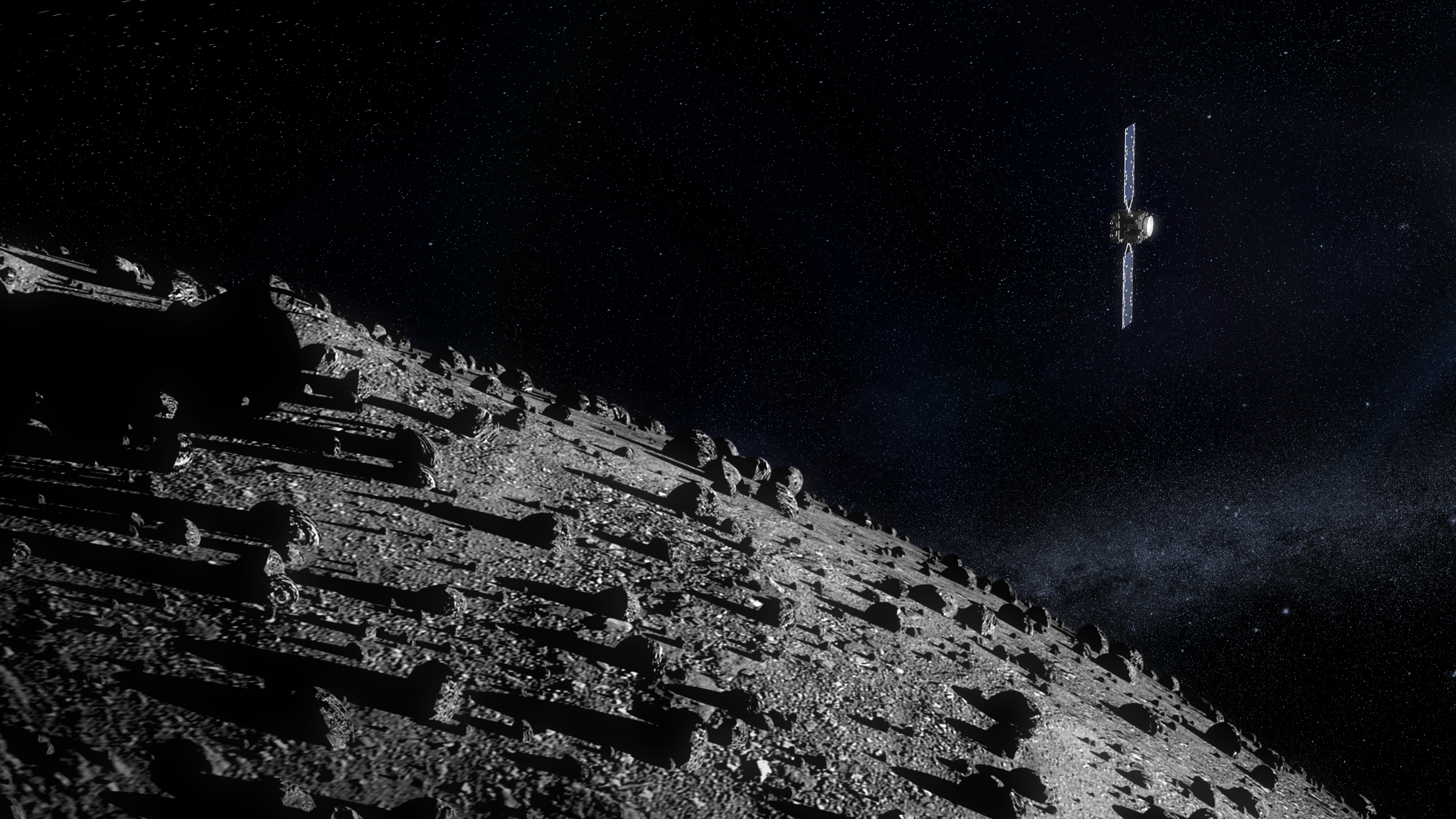
Artist’s illustration of ESA’s Hera spacecraft approaching the boulder-strewn surface of Dimorphos. The spacecraft is designed to examine the asteroid system after NASA’s DART collision. This is an illustration, not an image returned by Hera. Credit: ESA–Science Office
The new observations mark the beginning of Hera’s direct investigation of an asteroid system whose motion was deliberately altered by a spacecraft. NASA’s Double Asteroid Redirection Test (DART) demonstrated that a kinetic impact could shorten Dimorphos’ orbit around Didymos, but important questions remain about the moonlet’s physical structure, the amount of material displaced and the mechanisms responsible for the resulting orbital change. Hera’s thermal measurements add information about surface properties that visible-light images alone cannot provide.
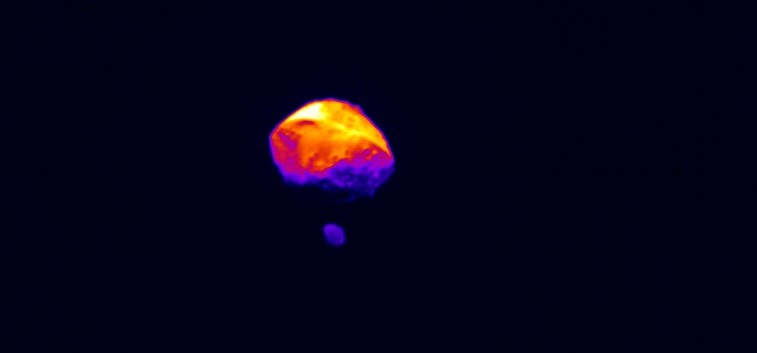
The Japan Aerospace Exploration Agency (JAXA) reported that Hera’s Thermal Infrared Imager (TIRI) recorded Didymos and Dimorphos from 57 km (35 miles) away at 11:19:52 UTC on October 31, 2026. JAXA described the result as the first successful thermal imaging of a binary asteroid system. The instrument recorded heat emitted by both bodies, including the smaller moonlet, which appeared relatively cool where it entered the shadow cast by Didymos.
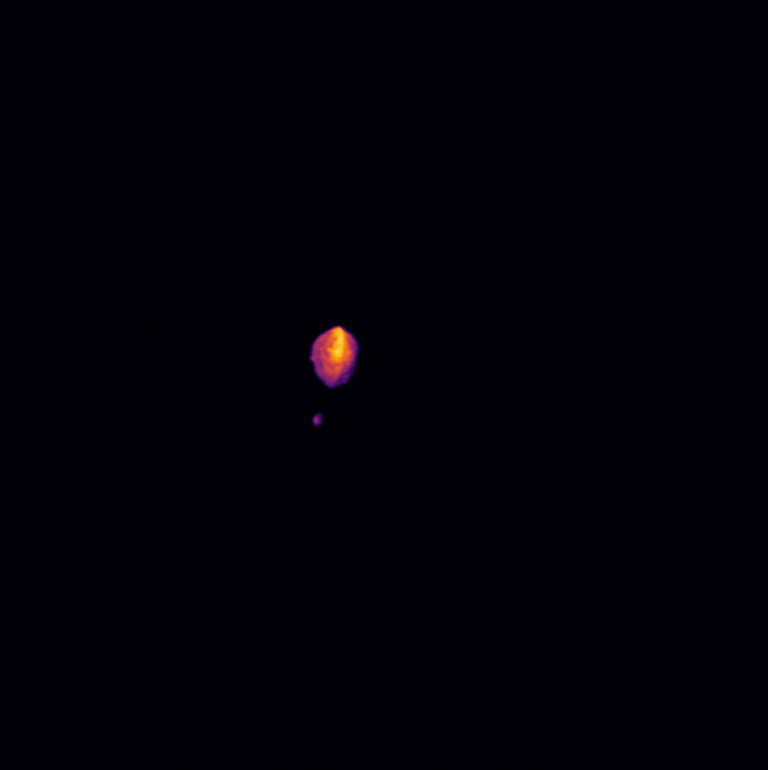
TIRI observes thermal radiation at wavelengths between 8 and 14 micrometers (0.00031–0.00055 inches). Its detector records digital brightness values that vary with the radiation emitted by the asteroid surfaces. Calibration equations established during ground testing allow those measurements to be converted into estimates of surface temperature. JAXA said detailed analysis of the temperatures recorded on Didymos was still underway.
Surface temperature is useful because loose dust, solid rock and highly porous material do not heat and cool in the same way. When sunlight reaches an asteroid, energy is absorbed at the surface and transferred into the material beneath it. As illumination changes, some of that stored heat is released back into space. The rate at which the surface responds depends on its physical properties, including how efficiently heat moves through the material.
Scientists describe this behavior using thermal inertia. Material with greater thermal inertia generally changes temperature more slowly, while material with lower thermal inertia responds more rapidly to changes in heating. Temperature measurements collected over time can therefore help researchers estimate whether an asteroid’s surface is dominated by fine-grained regolith, larger rocks or porous material. Thermal inertia is not a direct measurement of composition or internal structure, however, and different physical characteristics can produce similar thermal responses.
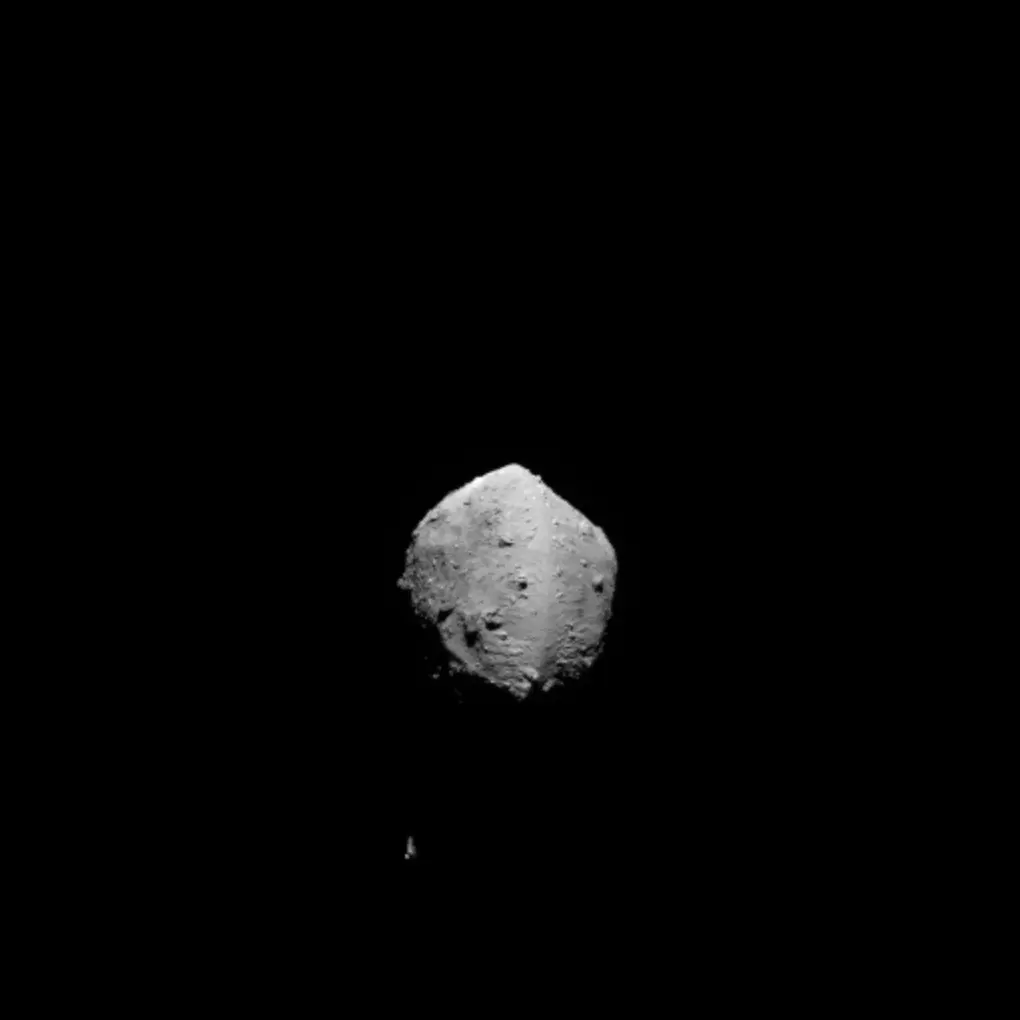
Hera’s observations provide a particularly useful test because Didymos and Dimorphos repeatedly change their orientation relative to the Sun and the spacecraft. In the October 31 observation, the solar phase angle was approximately 45°. A visible-light camera observing nearly the same geometry recorded Dimorphos as a narrow crescent, while TIRI continued detecting thermal emission from regions that were not directly illuminated.
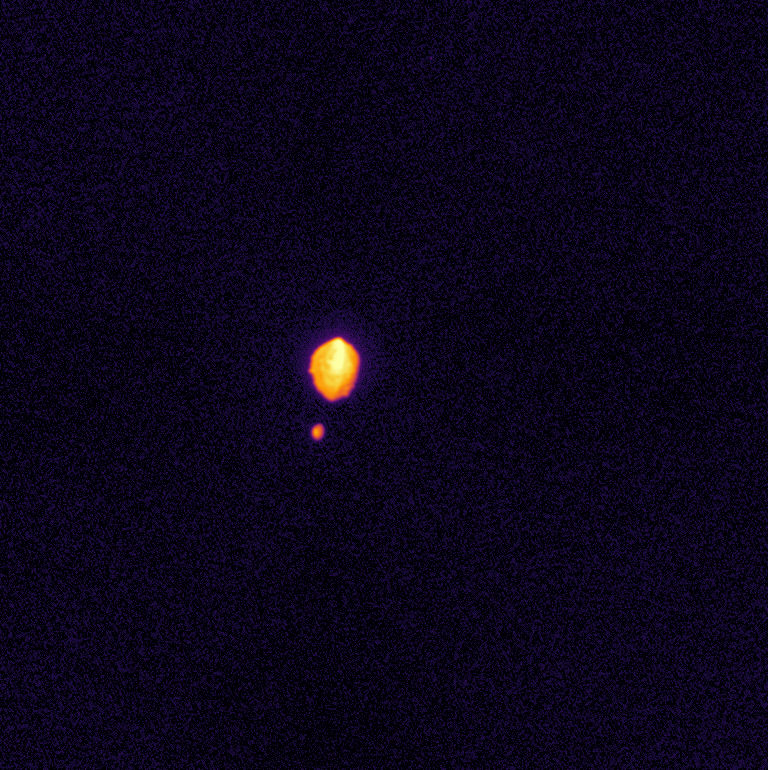
A separate TIRI sequence recorded between 10:20:27 and 15:29:01 UTC on October 28 followed Dimorphos as it passed into the shadow of Didymos. JAXA reported a decline in the moonlet’s thermal brightness during the passage. The team processed the sequence using 3 × 3 pixel binning, combining neighboring detector values to make the change easier to distinguish. The observations demonstrate that TIRI can track temperature-related variations over time, providing information needed for subsequent thermophysical analysis.
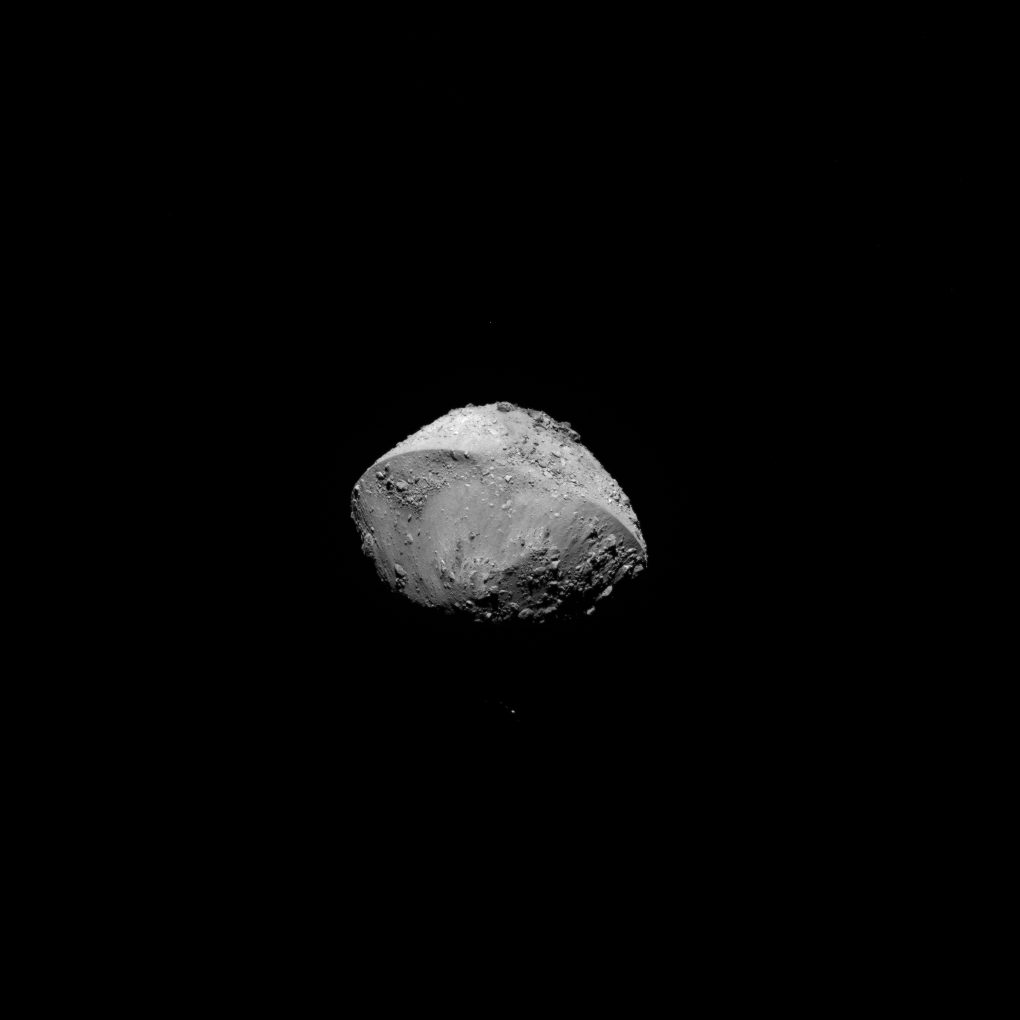
The thermal results form part of a wider observing campaign. ESA released a further set of Hera images on November 17, including data acquired on November 6 from a distance of 28.5 km (17.7 miles). The spacecraft’s Asteroid Framing Camera produced monochrome images at approximately 2.7 m (8.9 feet) per pixel. At that resolution, the larger asteroid’s equatorial ridge, boulders and variations in surface texture are visible.
The November 6 measurements also included thermal imaging of the same system. In the visible and multispectral observations, Dimorphos was almost entirely in shadow, with only a small sunlit portion detectable. In the TIRI image, however, thermal radiation made the moonlet visible as a more complete body. The comparison demonstrates how the different instruments contribute separate information about the same objects.
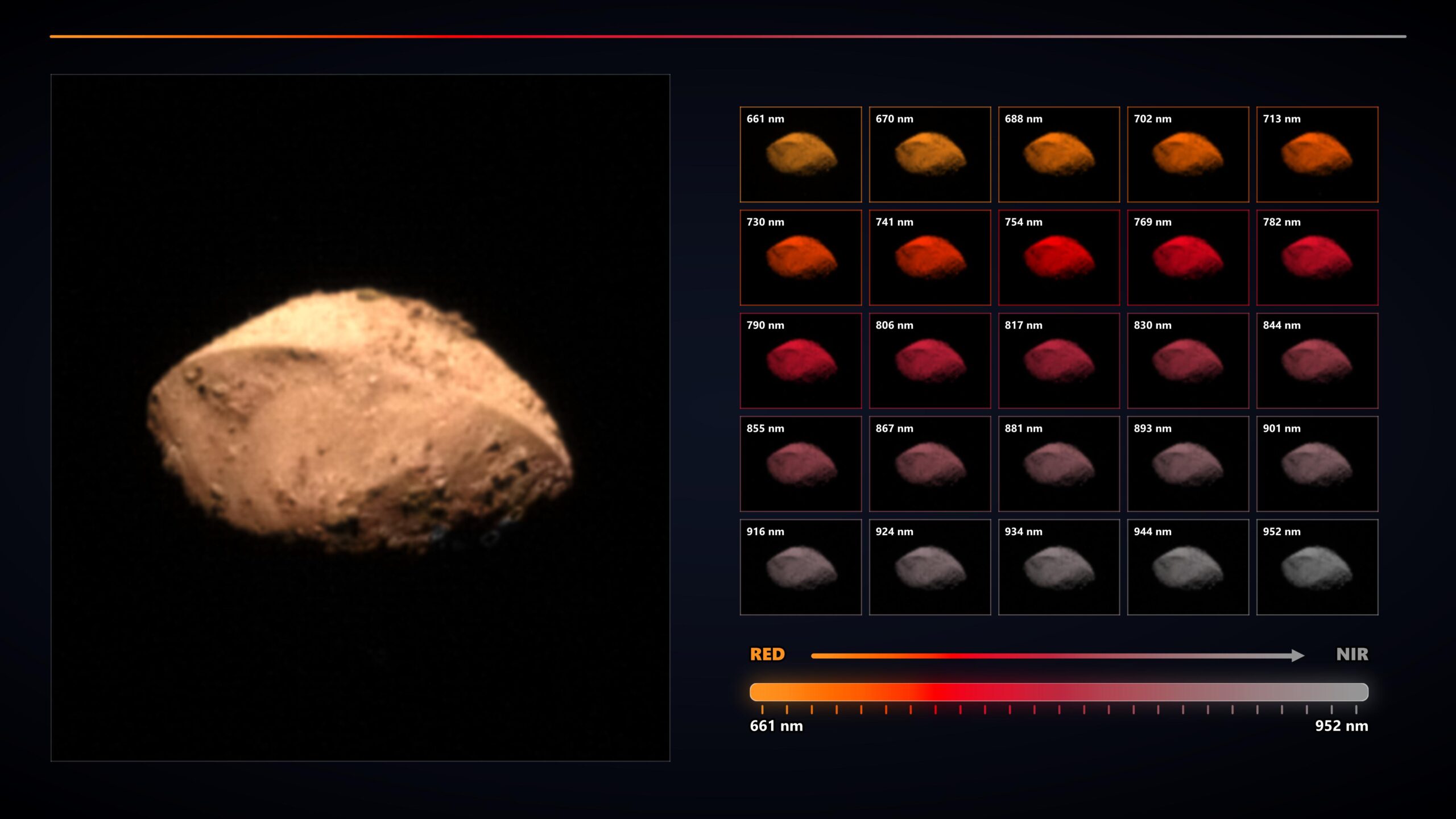
Hera’s HyperScout H instrument adds a third observational method. It measures sunlight reflected from the asteroid across 25 spectral bands extending from the visible red portion of the spectrum into the near-infrared. Differences in reflectance at individual wavelengths can be compared with laboratory spectra of minerals and meteorites to investigate surface composition. Thermal measurements, meanwhile, help determine how those materials behave as they gain and lose heat.
The visible images also raise questions about how Didymos developed its present shape. The larger asteroid measures approximately 780 m (2 560 feet) across and has a pronounced ridge around its equator. Hera principal investigator Patrick Michel identified boulder-rich and relatively clear areas, together with features that might represent landslides or movement of surface material toward the ridge. Didymos rotates approximately once every 2.2 hours, and ESA is examining whether that rapid rotation contributes to the redistribution of loose material. The proposed movement has not yet been established as the definitive explanation for the ridge.
Dimorphos, approximately 151 m (495 feet) across, is the central target of the planetary-defense investigation. On September 26, 2022, NASA’s DART spacecraft deliberately struck the moonlet at approximately 6.1 km/s (3.8 miles/s). The impact changed Dimorphos’ orbit around Didymos, demonstrating that a spacecraft collision could measurably alter the motion of a natural celestial object. The experiment was conducted on a system that poses no known impact threat to Earth.
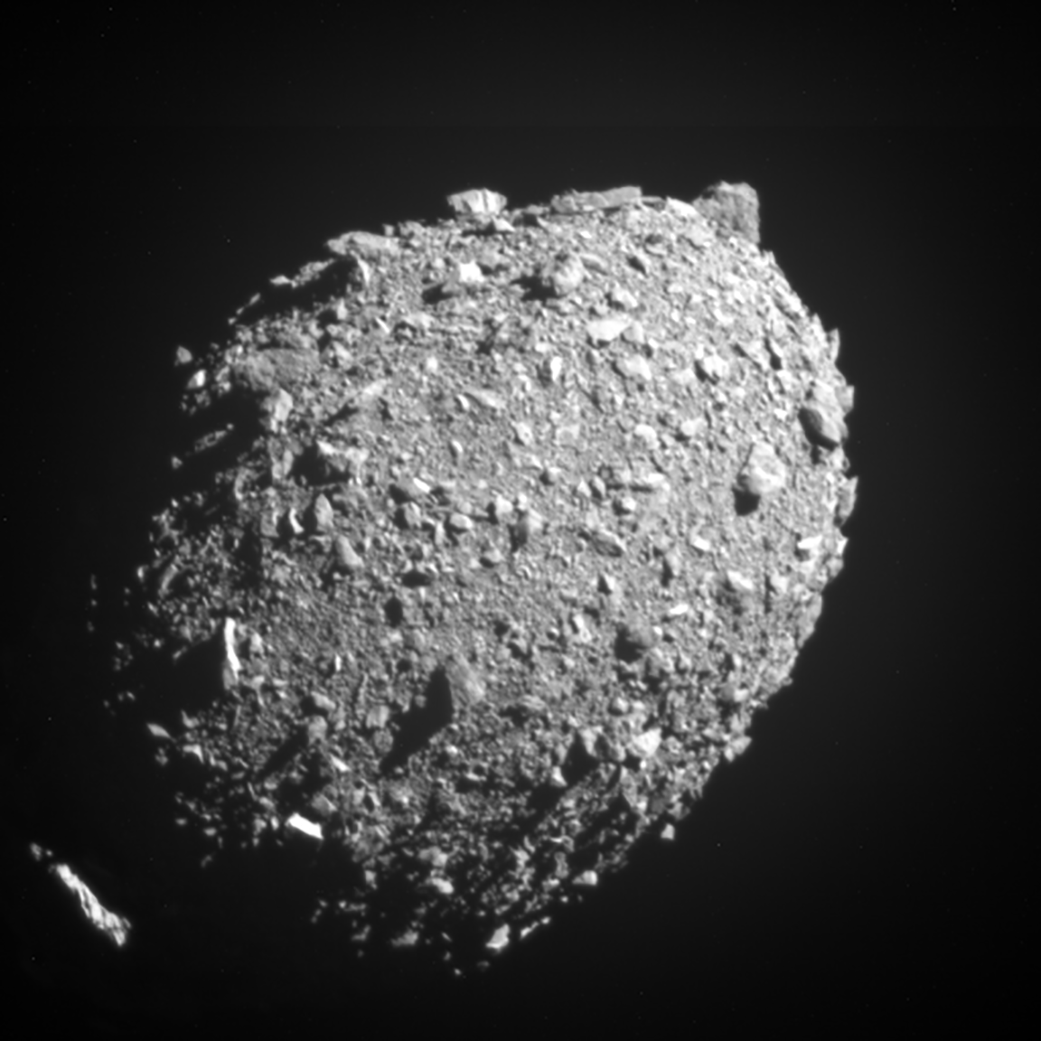
Before DART, Dimorphos completed an orbit around Didymos in approximately 11 hours and 55 minutes. NASA’s subsequent analysis found that the orbital period initially shortened by 32 minutes and 42 seconds, then continued decreasing as material escaped from the disturbed asteroid. The later orbital solution settled at 11 hours 22 minutes 3 seconds, a reduction of 33 minutes and 15 seconds relative to the pre-impact period.
The change was larger than the impulse from the incoming spacecraft alone would explain. When DART struck Dimorphos, debris was launched away from the moonlet. That escaping material carried momentum in one direction, while the remaining asteroid experienced recoil in the opposite direction. The combined effect changed the moonlet’s orbit more than a simple collision without substantial ejecta would have done. NASA-sponsored analyses estimated momentum enhancement factors of approximately 2.2–4.9, depending partly on the assumed mass of Dimorphos.
The uncertainty in the moonlet’s mass is one reason Hera’s measurements are needed. Orbital observations can reveal how much Dimorphos’ motion changed, but translating that change into the momentum transferred by DART requires knowledge of the asteroid’s mass. Its internal structure, porosity and mechanical properties also affect how the target responds to an impact and how material is excavated or displaced.
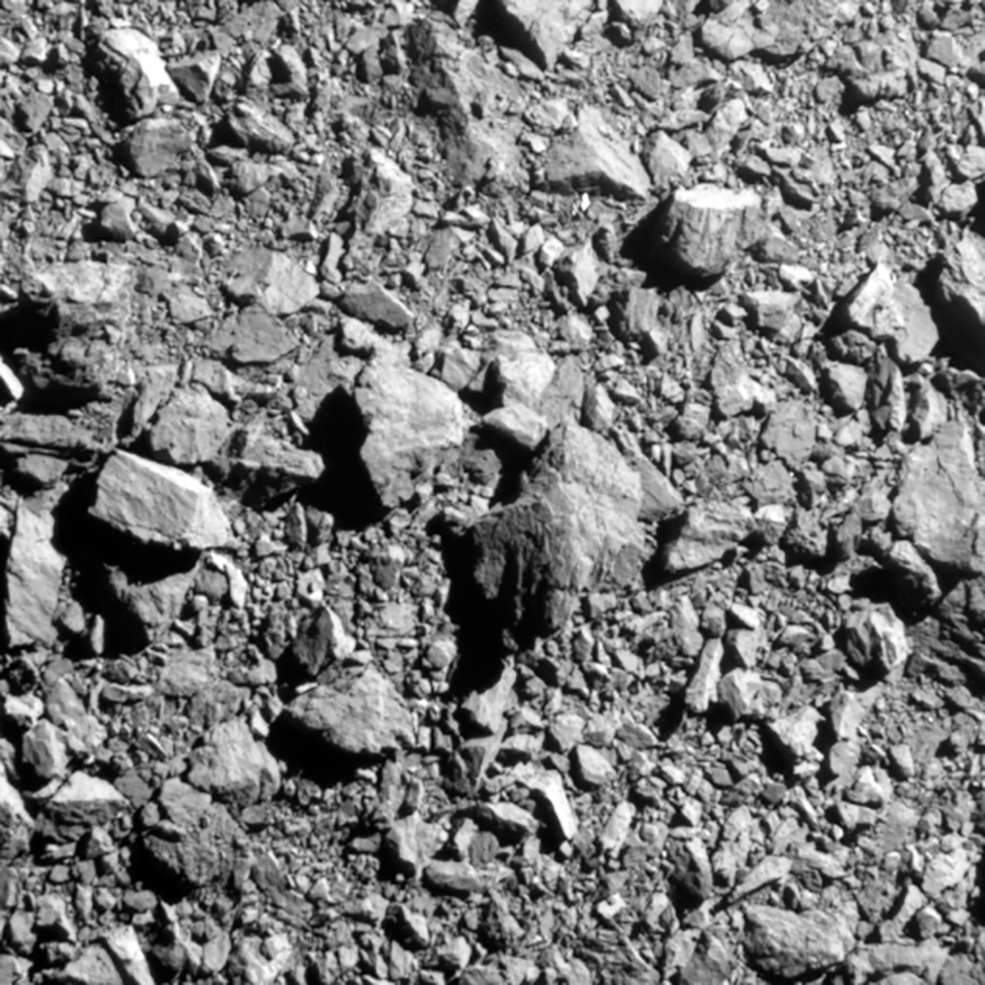
Thermal imaging cannot independently determine all these properties, but it adds constraints that can be combined with gravity, imaging, spectroscopy and radar measurements. JAXA’s earlier Hayabusa2 mission demonstrated the value of this method at asteroid Ryugu. Thermal observations revealed that numerous boulders had highly porous structures, helping researchers reassess expectations based on Earth-based measurements and the appearance of the asteroid’s surface.
The Hera observations extend that approach to a binary system that has already undergone a controlled impact. Researchers will be able to compare thermal behavior across Didymos and Dimorphos, examine differences between illuminated and shadowed terrain, and assess whether material properties vary between regions. JAXA emphasized on November 20 that the analysis is still in progress and that thermal imaging is expected to provide further information about regolith, boulders and surface structure.
Hera’s Early Characterization Phase began in early November, with observations from approximately 20–30 km (12–19 miles). During this campaign, the spacecraft follows a rectangular trajectory around the binary system, using its imaging instruments to investigate shape, rotation, orbital dynamics and surface properties. JAXA’s mission plan also calls for continuous thermal observations spanning an entire rotation of Didymos, allowing researchers to examine temperature changes over a complete day-night cycle on the asteroid.
The next phase is scheduled to begin on December 2, 2026, when Hera will move into a closer observation campaign at approximately 8–20 km (5–12 miles). The Juventas and Milani CubeSats are scheduled for deployment on January 16 and January 30, 2027, respectively. Juventas is designed to investigate Dimorphos’ interior using radar, while Milani will conduct compositional observations with visible and near-infrared instruments. The mission plan then calls for closer investigations of Dimorphos and the DART impact region beginning in February 2027.
ESA has scheduled the release of detailed images of the two asteroids for November 25, 2026, while JAXA expects early scientific results to be presented during the Hera Arrival Event. These observations should provide a more complete basis for comparing the visible appearance, thermal properties and dynamics of the binary system, although interpretation of the full dataset will require further analysis.
The central unresolved question is how the physical structure of Dimorphos controlled the response to DART. Thermal inertia can help characterize surface material, but it does not directly establish the moonlet’s mass, bulk cohesion or the amount of momentum transferred during the collision. Hera’s closer gravity, radar and imaging measurements will be needed to distinguish between different structural interpretations and determine how the impact changed the asteroid. Those constraints will be important for assessing how reliably results from the DART experiment can be applied to other potential asteroid-deflection scenarios.

References:
1 First Thermal Imaging of a Binary Asteroid System – Hera-JAPAN Project / JAXA – November 6, 2026
2 Hera surveying asteroids with superhuman vision – European Space Agency – November 17, 2026
3 NASA Study: Asteroid’s Orbit, Shape Changed After DART Impact – NASA Jet Propulsion Laboratory – March 19, 2024
4 NASA’s DART Data Validates Kinetic Impact as Planetary Defense Method – NASA – February 28, 2023
5 Upcoming Observation and Mission Operations Plan for the Hera Spacecraft in the Binary Asteroid Exploration Mission – Hera-JAPAN Project / JAXA – November 2, 2026
6 Advancing Thermal Infrared Observation Technology: A Legacy of Hayabusa2 – Hera-JAPAN Project / JAXA – November 20, 2026

I’m a science journalist and researcher at The Watchers, contributing to the Epicenter edition, where I cover peer-reviewed scientific research and emerging discoveries across Earth and space sciences. With a background in astronomy and a passion for environmental science, I’ve worked in shark and coral conservation in Fiji, conducting reef and shark-behavior research, contributing to mangrove restoration, and earning PADI Open Water and Coral Reef Certifications. I bring a blend of scientific rigor and storytelling to illuminate the discoveries shaping our planet and beyond.
Published in the last 24 hours
- Asteroid orientation can alter stand-off X-ray deflection by up to fivefold Epicenter
- On 13 April 2029 the 340 m asteroid Apophis will pass about 32,000 km above Earth's surface, inside the ring of geosynchronous satellites, and NASA says observers across the Eastern Hemisphere will see it without a telescope or binoculars. Epicenter
- Surface dust differences may explain why some Martian storms encircle the planet Epicenter
- Moonquake shaking travels much farther than Earth-based models predict Epicenter
