
ALMA reveals a dying star’s 6 500-year-old gas shell and emerging hourglass nebula
A giant shell of molecular gas surrounding the dying carbon-rich star IRAS 06530-0213 preserves evidence of a thermal pulse that occurred about 6 500 years before the evolutionary stage now visible from Earth. New observations from the Atacama Large Millimeter/submillimeter Array (ALMA) reveal a much younger hourglass-shaped nebula inside the shell, allowing astronomers to reconstruct thousands of years of changing stellar mass loss while uncovering unresolved questions about how planetary nebulae acquire their complex shapes.
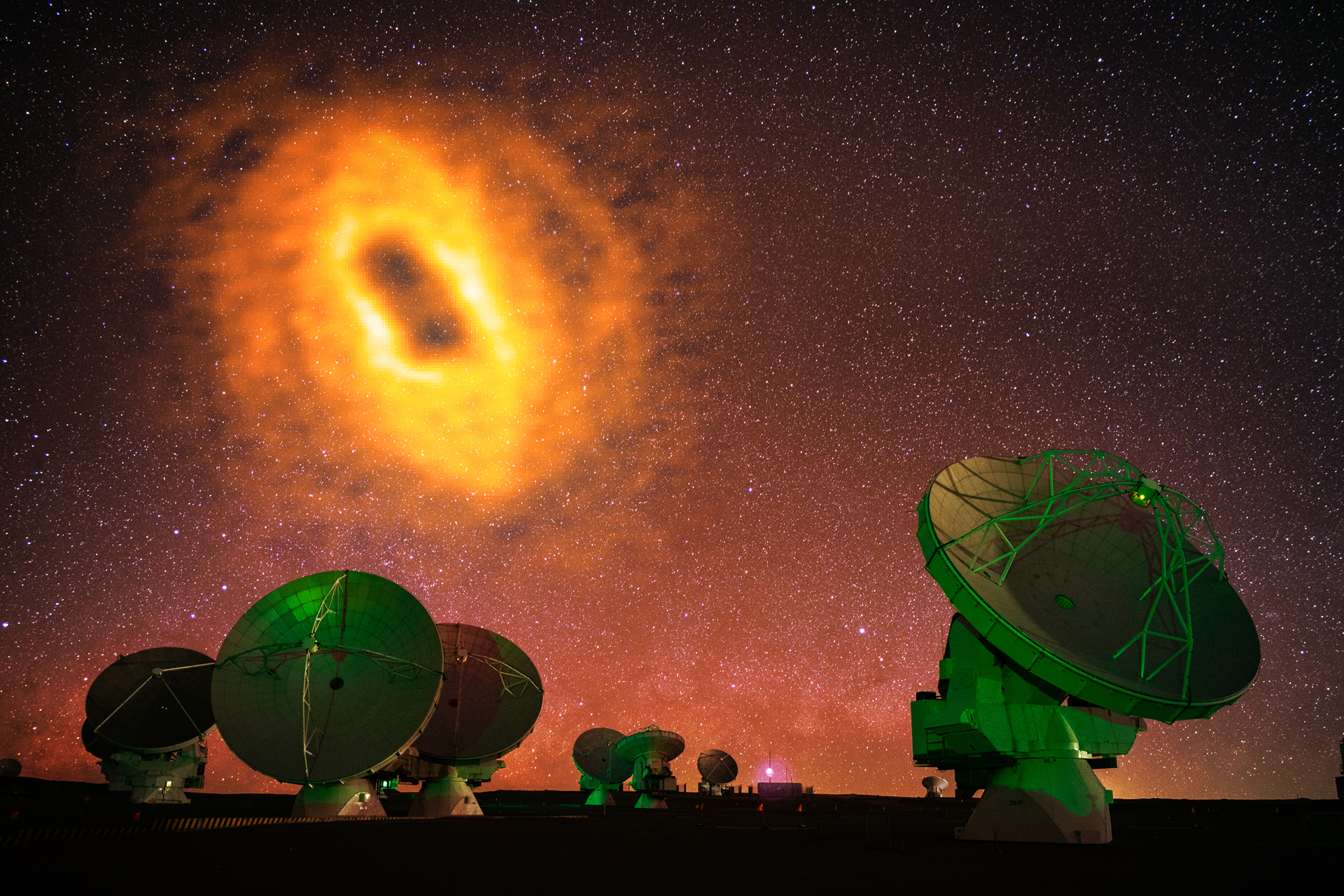
A composite combining ALMA radio observations of the central bipolar nebula and surrounding filamentary arcs of IRAS 06530-0213 with astrophotography of the ALMA observatory. The enlarged nebula is a composite element rather than an object visible at that scale above the telescopes. Credit: IRAS 06530-0213: ALMA (ESO/NAOJ/NRAO); Sahai et al. (2026). Astrophotography: NSF/AUI/NSF NRAO/B. Foott. Composite: NSF/AUI/NSF NRAO/M. Weiss
IRAS 06530-0213 lies approximately 12 000 light-years away in the constellation Monoceros and is passing through the preplanetary nebula stage, a brief evolutionary interval between an aging giant star and the formation of a planetary nebula. During this transition, material expelled by the star can develop complex structures that differ substantially from the approximately spherical winds produced during earlier stages of its evolution.
Research led by Raghvendra Sahai of NASA’s Jet Propulsion Laboratory, published in The Astrophysical Journal on November 20, 2026, resolves several generations of expelled material around the star. The observations distinguish an extensive spherical shell, intermediate filamentary structures, a dense equatorial torus and a younger bipolar nebula. Their different expansion ages allow researchers to investigate when the geometry and rate of stellar mass loss changed.
The outer shell has a mean radius of approximately 16 950 astronomical units (AU), equivalent to about 2.54 trillion km (1.58 trillion miles). One AU represents the mean Earth-Sun distance. The shell’s estimated diameter is approximately 0.54 light-years, making it substantially larger than the nebula forming near the central star.
ALMA measurements at wavelengths of approximately 0.44 and 0.88 mm allowed the team to map molecular gas and continuum emission at angular resolutions of approximately 0.1–0.5 arcseconds. Carbon monoxide emission reveals the distribution and motion of molecular material, including gas that cannot be adequately characterized using visible-light observations alone.
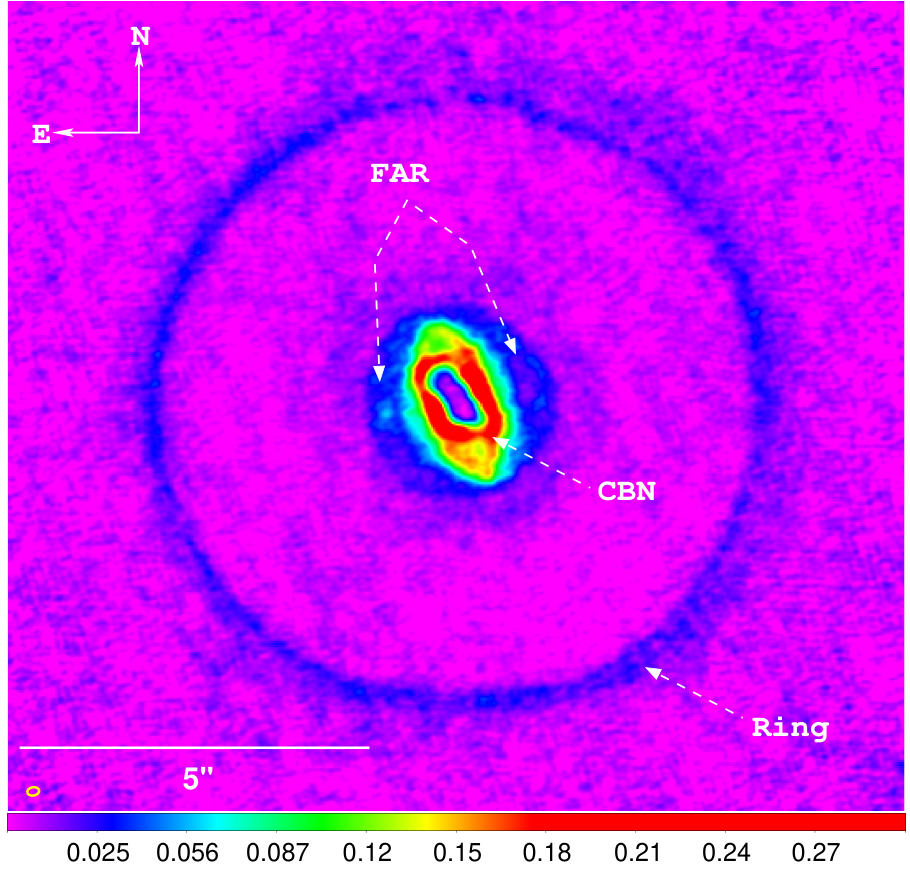
The circular ring seen in the radio images represents a spherical shell rather than a flat ring of material. Astronomers established its geometry by examining molecular emission at different Doppler velocities. Emission from different parts of an expanding shell appears in different velocity channels, allowing its spatial structure to be reconstructed.
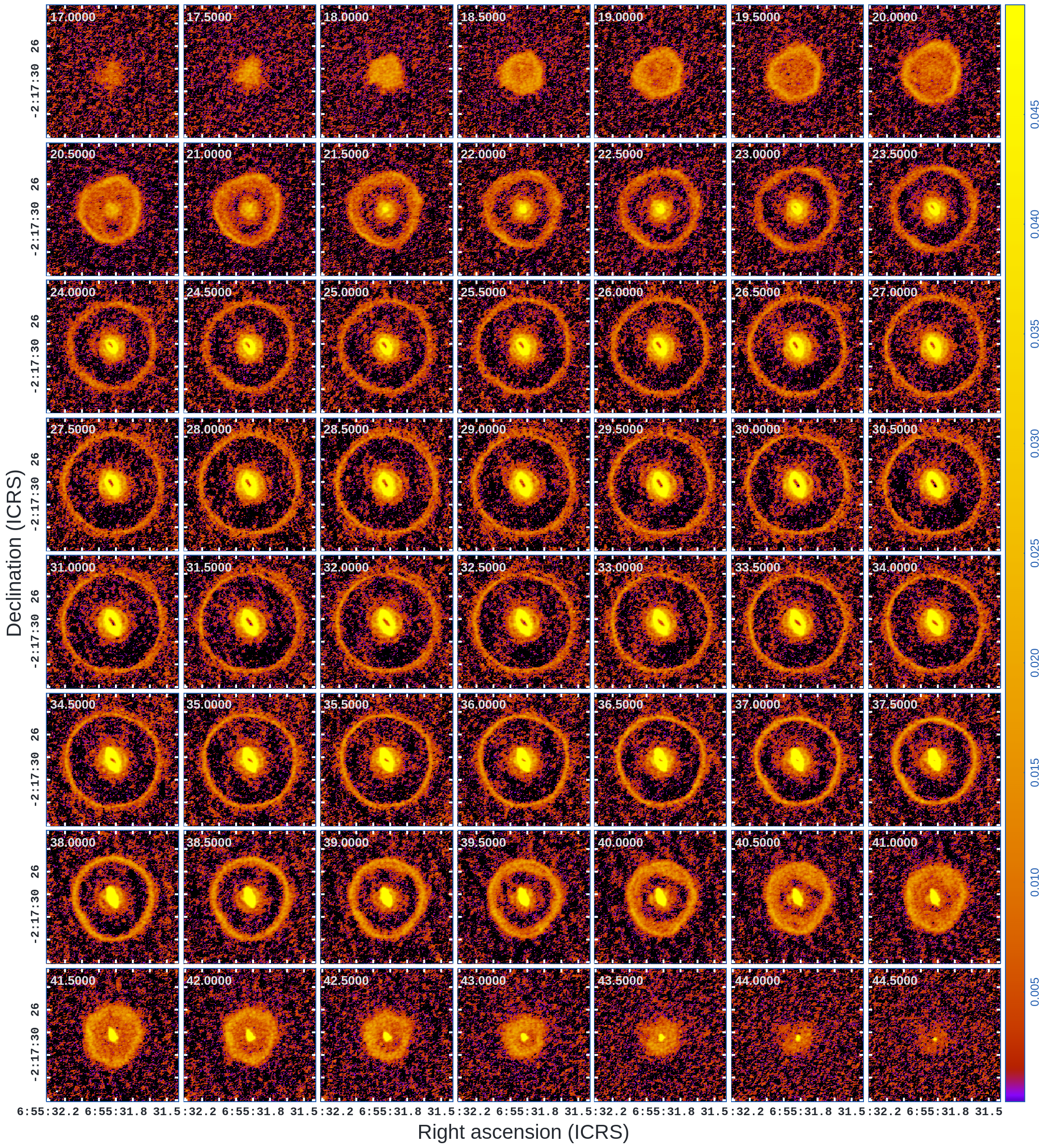
The researchers identified two components within the ring, with characteristic radii of 16 375 AU and 17 515 AU. Both have an estimated expansion velocity of 12.4 km/s (7.7 miles/s), equivalent to 44 640 km/h (27 738 mph). Combining their dimensions and expansion velocities gives estimated ages of 6 260 and 6 695 years, respectively, at the adopted distance to the star.
The team associates the shell with the final thermal pulse experienced by the star during its asymptotic giant branch (AGB) phase. During that phase, hydrogen and helium burn in separate layers surrounding the stellar core. A thermal pulse occurs when helium-shell burning becomes unstable and releases energy at a greatly increased rate, temporarily changing the star’s internal structure and the rate at which it loses material.
Detached molecular shells associated with thermal pulses have previously been identified around carbon-rich stars. Their importance comes from the fact that the expelled material can remain detectable long after the nuclear-burning episode has ended, preserving information about earlier stellar activity. ALMA did not directly observe the thermal pulse in IRAS 06530-0213. Its association with the detached shell is an interpretation based on the shell’s physical characteristics and the reconstructed evolutionary history.
The history reconstructed from the gas distribution shows that mass loss declined after the shell-producing episode and remained relatively weak for approximately 2 145 years. It subsequently increased, reaching another period of intense mass loss that lasted about 945 years. Material expelled during that later interval produced much of the filamentary gas surrounding the central nebula.
The filamentary arc region has an estimated expansion age of 2 270 years and contains approximately 0.12–0.25 solar masses of molecular hydrogen. One solar mass is approximately 1.99 × 1030 kg (4.38 × 1030 pounds). The filamentary material accounts for the largest share of the molecular mass identified in the circumstellar ejecta.
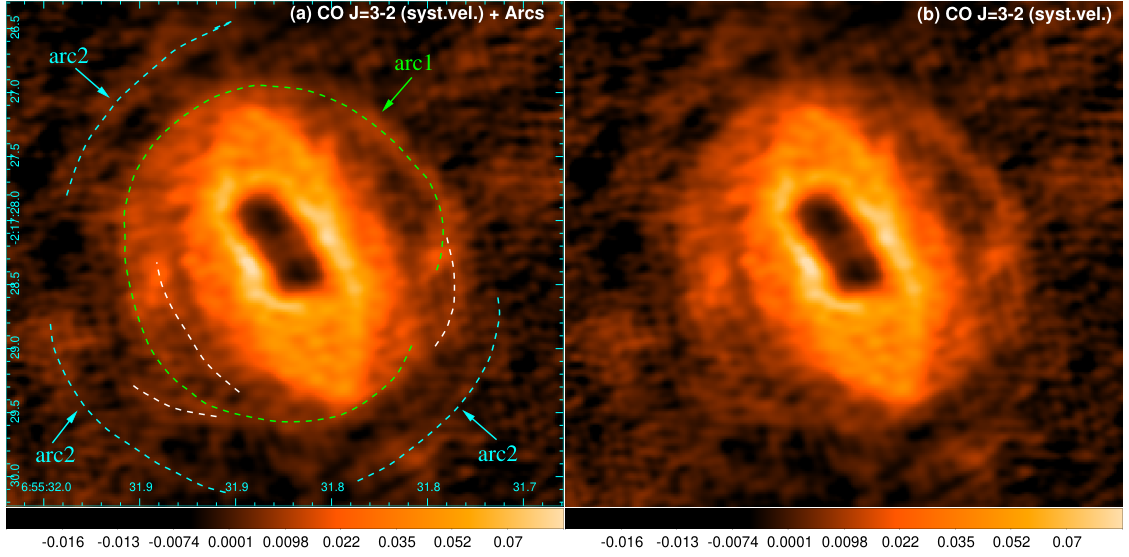
The curvature of the filaments provides evidence relevant to the possible presence of a companion star. The authors interpret their geometry as consistent with a three-dimensional Archimedean spiral, a structure in which successive turns are separated by approximately constant radial intervals. Orbital motion in binary systems can produce spiral patterns as material expelled by one star is redistributed through interactions with its companion.
ALMA previously resolved a detached shell and spiral-shaped circumstellar material around another carbon-rich red giant, R Sculptoris. That separate system provides an example of how molecular gas observations and three-dimensional models can be used to investigate the relationship between stellar mass loss and binary interaction.

Closer to IRAS 06530-0213, the geometry changes from the approximately spherical outer shell to a much younger bipolar nebula and dense torus. A bipolar nebula consists of opposing lobes extending away from the central star, while a torus is a ring-shaped concentration of material surrounding its equatorial region.
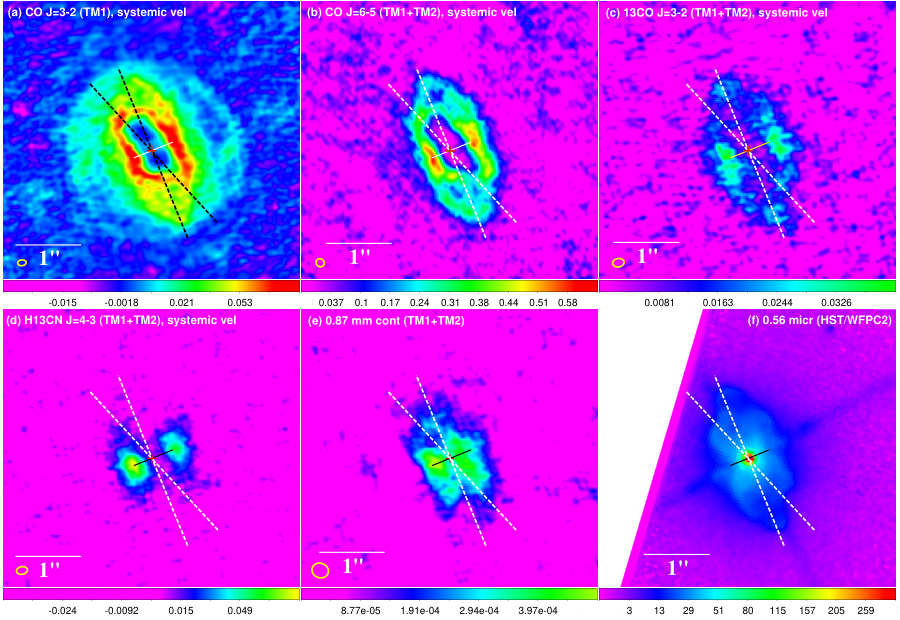
The estimated expansion age of the central bipolar nebula is no more than about 580 years, while the corresponding upper estimate for the torus is about 840 years. Assuming both structures formed near the end of the AGB phase, the researchers use their average as a rough upper estimate of 700 years for the onset of the post-AGB stage.
| Circumstellar structure | Estimated expansion age | Expansion velocity |
|---|---|---|
| Outer ring, broader component | 6 695 years | 12.4 km/s (7.7 miles/s) |
| Outer ring, sharper component | 6 260 years | 12.4 km/s (7.7 miles/s) |
| Filamentary arc region | 2 270 years | 9 km/s (5.6 miles/s) |
| Equatorial torus | Approximately 840 years or less | 9 km/s (5.6 miles/s) |
| Central bipolar nebula | Approximately 580 years or less | 16.5 km/s (10.3 miles/s) |
The age estimates depend on the assumed distance to IRAS 06530-0213 and on the expansion geometry of its ejecta. The study adopts a distance of 3.8 kiloparsecs (approximately 12 400 light-years), with a range of 2.9–5.0 kiloparsecs (approximately 9 500–16 300 light-years). A greater or smaller distance changes the inferred physical dimensions and corresponding expansion ages.
The latest reconstruction also differs from an earlier investigation published in The Astronomical Journal in 2025. Using observations from the Northern Extended Millimeter Array (NOEMA), Sun and colleagues identified a spherical halo and barrel-shaped torus around IRAS 06530-0213. Their modeling placed the final thermal pulse approximately 6 500 years before the observed evolutionary stage but estimated that the transition into the preplanetary nebula phase occurred approximately 4 500 years earlier.
Keep reading
The two investigations therefore derive similar ages for the final thermal-pulse episode but substantially different timescales for the subsequent evolutionary transition. Their estimates depend on the structures selected as chronological markers and the assumptions used to reconstruct the system. The approximately 700-year upper estimate from the new ALMA analysis should be understood within those methodological constraints.
Another unresolved problem concerns the mechanism responsible for the formation of the bipolar nebula. In some evolved binary systems, material transferred toward a companion accumulates in an accretion disk. Such disks can provide the conditions necessary to generate narrow, high-speed outflows that redistribute surrounding stellar material and produce elongated or bipolar nebulae.
Despite the spiral-like structures surrounding IRAS 06530-0213, ALMA did not detect a compact continuum source at the position of the central star comparable to the dusty disks found in several other post-AGB binary systems. The upper limit for compact-disk emission is lower by factors of 88 and 56, respectively, than emission from the disks of the Red Rectangle and IW Car after correcting for their different distances.
The observations do not exclude the presence of a companion or a disk with emission below the detection threshold. Sahai and colleagues propose that a short-lived accretion structure might have existed earlier, generated collimated outflows and subsequently dissipated. Such a scenario would also be consistent with the present absence of detected high-velocity material, but the proposed disk and earlier jet activity have not been directly observed.
Molecular emission from the dense equatorial torus reveals a separate problem involving the star’s chemical evolution. Isotopes are forms of the same chemical element that contain different numbers of neutrons. Their relative abundances provide information about nuclear reactions and the movement of material between different regions inside a star.
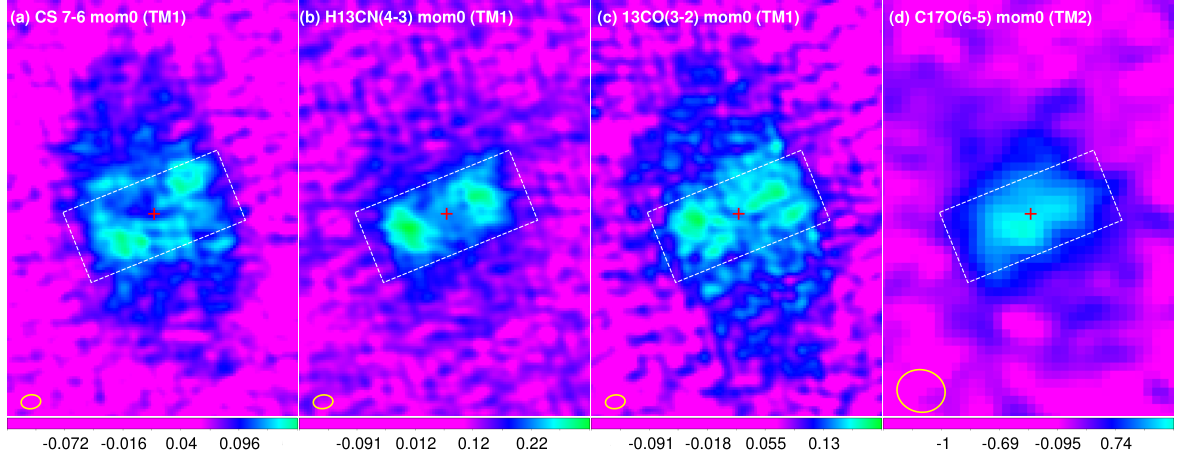
The derived carbon-12 to carbon-13 isotope ratio in the torus is 18 ± 3, substantially below the solar value of approximately 89.4 and below the range of 25–90 reported for circumstellar envelopes around carbon-rich stars in the comparison literature used by the researchers. A lower ratio corresponds to a greater relative abundance of carbon-13.
The modeled oxygen-16 to oxygen-17 ratio ranges from 15 to 54, compared with a solar value of approximately 2 632. The nitrogen-14 to nitrogen-15 ratio ranges from 254 to 377, compared with a solar reference value of approximately 435. The resulting pattern represents substantial relative enrichment in carbon-13 and oxygen-17 and more modest enrichment in nitrogen-15.
Standard models of stellar nucleosynthesis, the production of chemical elements through nuclear reactions, do not account for the complete isotope pattern reported in the torus. The unusually low carbon isotope ratio is also inconsistent with the increase generally expected during repeated episodes of thermal pulsing and the transport of newly produced carbon toward the stellar envelope.
Comparable isotope enrichments have been reported in other evolved stellar objects. Nonstandard nuclear-burning processes have been proposed to explain some of those chemical signatures, but the isotope measurements in IRAS 06530-0213 do not establish that an explosive nuclear-burning event occurred in this particular system.
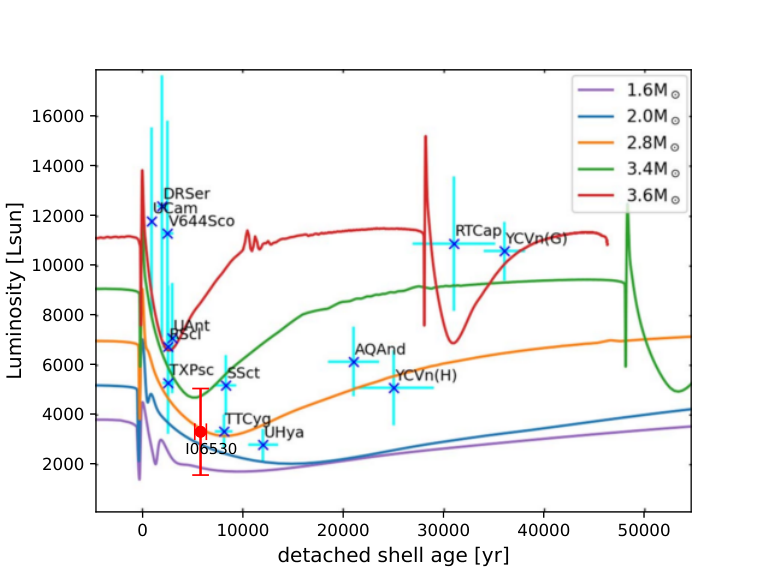
By comparing the luminosity of IRAS 06530-0213 and the expansion age of its detached shell with theoretical stellar evolution calculations, the team inferred an initial stellar mass of approximately 1.6–3.4 times the mass of the Sun. The estimate describes the progenitor star before substantial mass loss rather than the mass of the remaining central star.
The researchers estimate that the circumstellar molecular material detected around IRAS 06530-0213 contains approximately 0.18–0.34 solar masses. Accounting for the additional gas component gives an estimated total gas mass of 0.23–0.45 solar masses, representing a substantial quantity of material returned to the surrounding environment during late stellar evolution.
The observations form part of PANORAMA, an ALMA survey investigating the outflows and central structures of stars undergoing the transition toward planetary nebulae. Comparing IRAS 06530-0213 with additional systems will help establish whether its mass-loss sequence and lack of detectable compact-disk emission are representative of this evolutionary stage or reflect a less common configuration.
The remaining uncertainties concern both the physical shaping of the nebula and the nuclear processes responsible for its chemical composition. Establishing the presence and orbital properties of a possible stellar companion would help test the proposed shaping mechanism, while additional molecular measurements and stellar evolution calculations are needed to account for the unusual isotope ratios preserved in the torus.
References:
1 Sahai, R., Vlemmings, W., Quintana-Lacaci, G., Kim, H., Alcolea, J., Balick, B., Blackman, E. G., Castro-Carrizo, A., de Marco, O., Kastner, J. H., Lagadec, E., Lee, C.-F., Santander-García, M., Sánchez Contreras, C., Ueta, T., Zijlstra, A. A., Bujarrabal, V., Sabin, L., & Tafoya, D. (2026). The last gasps of a dying star: ALMA observations of the preplanetary nebula IRAS 06530–0213. The Astrophysical Journal. DOI: 10.3847/1538-4357/aeab9a
2 A Star’s Last Gasps: ALMA Reveals a Giant Gas Ring & Budding Hourglass Around a Star in Transition – National Radio Astronomy Observatory – November 20, 2026
3 Sun, H.-M., Zhang, Y., & Qin, S.-L. (2025). Cocoon-to-butterfly transformation in protoplanetary nebula: Detection of a spherical halo and a barrel-shaped torus in IRAS 06530–0213. The Astronomical Journal, 170, 231. Scientific publication record

I’m a science journalist and researcher at The Watchers, contributing to the Epicenter edition, where I cover peer-reviewed scientific research and emerging discoveries across Earth and space sciences. With a background in astronomy and a passion for environmental science, I’ve worked in shark and coral conservation in Fiji, conducting reef and shark-behavior research, contributing to mangrove restoration, and earning PADI Open Water and Coral Reef Certifications. I bring a blend of scientific rigor and storytelling to illuminate the discoveries shaping our planet and beyond.
More reporting
- Astronomers uncover hidden space debris in the Earth's geosynchronous region
- A fireball exploded over Murchison in Victoria on September 28, 1969, scattering meteorite fragments across about 35 km2, and 40 silicon carbide grains extracted from the meteorite include some older than 5.5 billion years, the Field Museum says
- Auckland’s 2023 floods exposed a hidden cost of rebuilding after natural disasters
- An 11-year snow experiment reveals how desert biocrusts respond to changing winters
