
Howard Carter found an iron dagger on Tutankhamun’s right thigh in 1925; modern XRF analysis supports a meteoritic origin of the iron
An iron dagger found among the wrappings of Tutankhamun’s mummy contains 10.8 ± 0.3 wt% nickel and 0.58 ± 0.04 wt% cobalt, a composition that strongly supports an extraterrestrial origin. Calibrated X-ray measurements published in 2016 resolved decades of conflicting analyses of the blade, while later research opened a separate and still disputed question over how the meteorite iron was worked and where the dagger was manufactured.
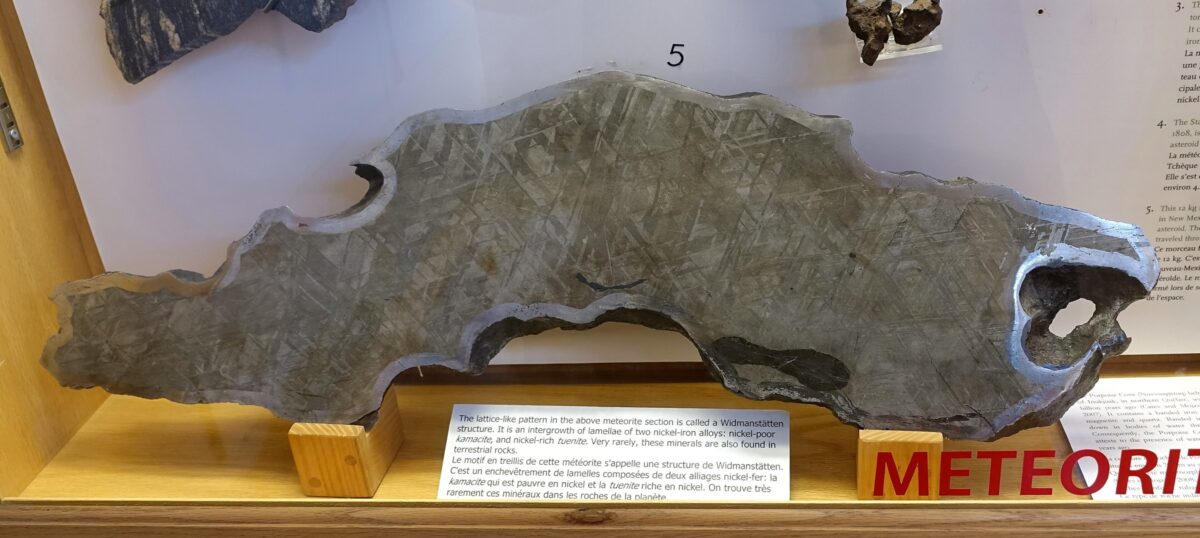
Meteorite slab with Widmanstätten pattern, found in New Mexico in 1896, 12 kg, iron-nickel alloy - Redpath Museum - McGill University - Montreal, Canada - DSC07886. Credit: Daderot (CC0), via Wikimedia Commons.
Howard Carter found two daggers in the wrappings of Tutankhamun’s mummy in 1925. The iron-bladed dagger, cataloged as Carter no. 256K and JE 61585, lay on the king’s right thigh, while a second dagger with a gold blade lay on the abdomen. The iron dagger is 34.2 cm (13.5 inches) long and has a finely worked gold handle and sheath.
The origin of the metal had remained unsettled because earlier analyses produced conflicting results. A 1994 X-ray fluorescence analysis, published the following year, measured only 2.8 wt% nickel and was considered inconsistent with meteoritic iron. A later team therefore returned to the blade with modern calibrated instrumentation designed to measure nickel and cobalt without removing material from the object.
Comelli et al. (2016) examined the dagger at the Egyptian Museum in Cairo using portable X-ray fluorescence, or XRF. The technique directs X-rays into a material and measures the characteristic secondary X-rays emitted by its atoms, allowing researchers to determine elemental composition while leaving the artifact intact.

The team calibrated the instrument against 11 certified steel standards and 11 iron meteorites with known compositions. Measurements from two areas of the blade produced 10.8 ± 0.3 wt% nickel and 0.58 ± 0.04 wt% cobalt at a 95 percent confidence interval. The nickel-to-cobalt ratio was approximately 20.
Those values provide the strongest evidence for the blade’s material origin. Most iron meteorites contain about 5 to 35 wt% nickel, according to the study, while nickel does not exceed 4 wt% in the historical terrestrial-ore iron artifacts used for comparison from before the 19th century. Tutankhamun’s blade falls well inside the meteoritic range, and its Ni/Co ratio is also consistent with iron meteorites.

The nickel-to-cobalt relationship provides another constraint. Iron meteorites have an average Ni/Co ratio close to 18 ± 2 in the comparison used by Comelli and colleagues, while the dagger’s ratio is about 20. A set of 76 iron meteorites containing 10 to 12 wt% nickel, close to the blade’s nickel concentration, had an average cobalt concentration of 0.57 ± 0.08 wt%, nearly matching the 0.58 wt% measured in the dagger.
The chemical evidence does not identify the individual meteorite from which the blade was made. Comelli et al. compared the dagger with 20 known iron meteorites inside an arbitrarily selected 2 000 km (1 240 mile) radius centered on the Red Sea. Only the Kharga meteorite had nickel and cobalt concentrations within 10 percent of the dagger’s measured composition.
Kharga cannot therefore be presented as the source of the dagger. The 2016 paper explicitly states that nickel and cobalt concentrations alone cannot classify the source meteorite into a specific chemical or structural group, and no known meteorite has been securely linked to the blade.

The workmanship makes the object scientifically important beyond its chemistry. Tutankhamun lived in the 14th century BCE, before the widespread use of smelted iron in Egypt. Comelli et al. described the blade’s manufacturing quality as high compared with simpler meteoritic-iron objects and concluded that it provides evidence of successful iron smithing during Tutankhamun’s period.
Meteorite iron was already being worked in Egypt much earlier. Nine small iron beads recovered from a cemetery at Gerzeh and dated to about 3200 BCE have been identified as meteoritic iron. The beads were hammered into thin sheets, showing that craftspeople were shaping iron from meteorites thousands of years before iron became a common utilitarian metal in Egypt.

A second research team examined the dagger in February 2020 using two-dimensional XRF mapping. Matsui et al. published those results in 2022, shifting the question from whether the iron was meteoritic toward how the metal may have been worked and where the finished object may have originated.
Their semiquantitative measurements of metallic areas produced an average of 11.8 ± 0.5 wt% nickel and 0.2 ± 0.1 wt% cobalt. Matsui and colleagues acknowledged that the calibrated 2016 values were more accurate, particularly for cobalt. Their main new argument instead came from patterns in maps of nickel, sulfur and chlorine across the blade.
The researchers reported discontinuous bands with apparent cubic symmetry and widths of about 1 mm (0.039 inches). They interpreted those bands as remnants of a Widmanstätten pattern, the interlocking crystalline structure that develops when iron-nickel metal cools extremely slowly inside the parent bodies of some meteorites.
Keep reading
- A fireball exploded over Murchison in Victoria on September 28, 1969, scattering meteorite fragments across about 35 km2, and 40 silicon carbide grains extracted from the meteorite include some older than 5.5 billion years, the Field Museum says
- ALMA reveals a dying star's 6 500-year-old gas shell and emerging hourglass nebula
A preserved Widmanstätten pattern would constrain how intensely the metal was heated because strong reheating can destroy the original meteorite texture. Matsui et al. also reported sulfur-rich dark areas that they interpreted as remnants of troilite, an iron sulfide mineral found in meteorites. From those observations, the team proposed that the dagger was shaped by low-temperature forging rather than melting and placed the heating temperature below about 950°C (1 742°F).

The 2022 study extended the analysis to the dagger’s gold hilt. XRF measurements detected calcium there, which the authors interpreted as evidence for lime plaster used as an adhesive. The researchers argued that the proposed adhesive technology was more consistent with manufacture outside Egypt.
Matsui and colleagues connected that interpretation with the Amarna letters, a collection of diplomatic correspondence from the Egyptian royal archives. One inventory of gifts sent by Tushratta, king of Mitanni, to Amenhotep III records iron-bladed daggers with gold components. The researchers proposed that Tutankhamun’s dagger could have arrived in Egypt through such an exchange.
The historical parallel does not establish that the dagger described in the Amarna correspondence was the object later buried with Tutankhamun. The proposed manufacturing history also became the subject of a peer-reviewed technical dispute.
Albert Jambon challenged the interpretation in a comment published online in 2022 and in the journal’s 2023 volume. He argued that the two-dimensional XRF mapping did not have sufficient spatial resolution to demonstrate a Widmanstätten pattern at the approximately 1 mm scale reported by Matsui et al.
The 2022 analysis used a measurement step of about 0.9 mm (0.035 inches), while the volume excited by the X-ray beam extended beyond the nominal spot size. Jambon argued that measurements at that scale could not securely resolve the proposed millimeter-scale crystalline bands and also questioned the reliability of the reported cobalt distribution.
Jambon separately challenged the calcium-based provenance argument. Calcium detected on the gold hilt does not establish where the iron blade itself was manufactured, and the hilt and blade do not necessarily share the same production history. His conclusion was that the geographical origin of the dagger remains open.
The dispute leaves the strongest finding intact while narrowing what can responsibly be claimed. The calibrated nickel and cobalt composition measured by Comelli et al. strongly supports meteoritic iron. The proposed Widmanstätten pattern, a specific low-temperature forging history, and a Mitanni manufacturing origin belong to a later interpretive layer that remains contested.
The remaining uncertainty is therefore not whether the 2016 chemistry supports a meteorite source, but how ancient metalworkers converted that material into the finished blade and where that work took place. Higher-resolution non-destructive measurements of the blade’s microstructure and trace-element distribution could test whether original meteorite textures survive and place tighter limits on the manufacturing process without damaging the artifact.
References:
1 Comelli, D., D’Orazio, M., Folco, L., El-Halwagy, M., Frizzi, T., Alberti, R., Capogrosso, V., Elnaggar, A., Hassan, H., Nevin, A., Porcelli, F., Rashed, M. G., & Valentini, G. (2016). The meteoritic origin of Tutankhamun’s iron dagger blade. Meteoritics & Planetary Science, 51(7), 1301–1309. DOI: 10.1111/maps.12664
2 Matsui, T., Moriwaki, R., Zidan, E., & Arai, T. (2022). The manufacture and origin of the Tutankhamen meteoritic iron dagger. Meteoritics & Planetary Science, 57(4), 747–758. DOI: 10.1111/maps.13787
3 Jambon, A. (2023). A comment to: “The manufacture and origin of the Tutankhamun meteoritic iron dagger” by Matsui et al. Meteoritics & Planetary Science, 58(1), 165–168. DOI: 10.1111/maps.13942

Rishav Kothari is Editor-in-Chief of The Watchers, where he runs the newsroom and covers earthquakes, volcanoes, severe weather and space weather.
More reporting
- Venus’ extreme atmosphere could preserve mineral traces of its wetter past
- Curiosity’s 49th drill hole on Mars targets clues to ancient mineral formation
- Astronomers uncover hidden space debris in the Earth's geosynchronous region
- Extreme weather exposes weak points in global oil and natural gas shipping, IEA finds
