
Chipmaking plasma releases oxygen-related gases from lunar-regolith simulants below 400°C
Researchers have adapted fluorinated plasma-processing methods used in semiconductor manufacturing to release oxygen and oxygen-containing gases from lunar-regolith simulants at temperatures below 400°C (752°F). The experiments establish a new dry processing route for lunar in-situ resource utilization, but they remain a laboratory proof-of-concept and have not demonstrated a complete, energy-optimized or economically scalable lunar oxygen-production system.
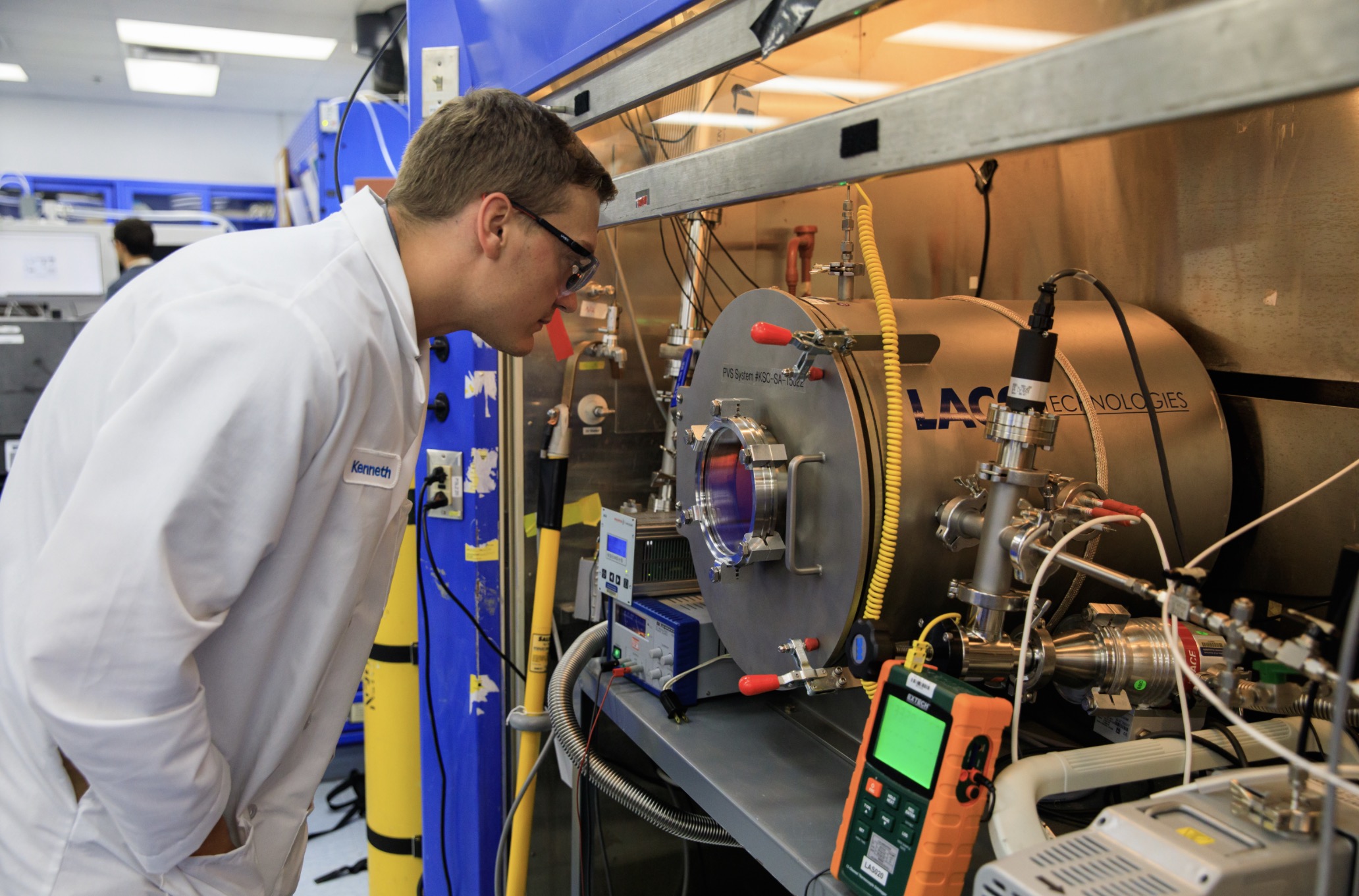
An engineer conducts molten regolith electrolysis testing at NASA's Kennedy Space Center in Florida on August 30, 2022, as part of research into extracting oxygen from simulated lunar soil. Credit: NASA/Kim Shiflett
Oxygen extraction from lunar material is already an established research goal, with electrochemical, carbothermal and other methods under development. The new work addresses a different question: whether fluorinated plasma chemistry refined over decades by the semiconductor industry can react effectively with the complex silicate minerals represented in lunar-regolith simulants.
The significance lies in the processing route rather than in the general idea of obtaining oxygen from lunar soil. The researchers demonstrated that semiconductor-style plasma systems can fluorinate lunar-type mineral mixtures and release oxygen-related gaseous products while operating below 400°C (752°F). The studies do not yet establish production efficiency, total energy demand, fluorine-recycling performance or economic viability at lunar scale.
Jaggernauth et al. (2026) examined the mechanisms behind measurable quantities of O2, CO and CO2 produced after lunar mare simulant was treated with plasma containing sulfur hexafluoride (SF6) or octafluorocyclobutane (C4F8). The team used energy-dispersive X-ray spectroscopy, X-ray diffraction and X-ray photoelectron spectroscopy to determine which mineral phases had reacted and how their surfaces changed during processing.
The SF6 plasma showed a strong preference for anorthosite, a plagioclase-rich component represented in the simulant. Energy-dispersive X-ray imaging showed the reaction occurring almost exclusively in that component, while the authors reported evidence consistent with the formation of a fluoride-rich surface layer.
The mineral response was also visible in diffraction measurements. Peaks associated with anorthosite broadened after SF6 treatment, which the researchers attributed to strain associated with the altered surface layer. Silicon and oxygen signals were absent from corresponding regions in the energy-dispersive X-ray maps after treatment.
C4F8 behaved differently. The researchers did not find equivalent loss of the silicon and oxygen signals or the same broadening of the anorthosite diffraction peaks, and the reaction was not confined to anorthosite. The two fluorinated plasmas therefore interacted differently with the same heterogeneous simulant.
What the experiments establish — and what they do not
Established: fluorinated plasmas used in semiconductor-style processing react with lunar-regolith simulants; oxygen-related gaseous products were detected; mineral phases responded differently; and the companion experiments operated below 400°C (752°F).
Not established: an operating lunar oxygen plant, a production rate suitable for a lunar base, lower total system energy consumption, closed-loop fluorine recovery, long-duration lunar hardware performance, or economic viability.
For both plasma chemistries, the authors found that the oxygen-extraction mechanisms were consistent with reaction pathways already known from fluorine-plasma etching of silicon dioxide in semiconductor manufacturing. That connection is central to the work: lunar regolith is dominated by silicate and oxide-bearing minerals, while the chip industry has developed highly controlled techniques for reacting fluorinated plasmas with chemically related materials.
A companion study by Cowley et al. (2026) tested EAC-1a lunar mare simulant and LHS-1 lunar highlands simulant inside a capacitively coupled plasma-etch system of the type used for semiconductor wafer processing. The samples were exposed separately to SF6 and C4F8 under low-pressure plasma conditions.
Optical emission spectroscopy detected atomic oxygen in the SF6 plasma and carbon monoxide in the C4F8 plasma. That distinction matters: the optical measurement identified atomic O in the SF6 experiment rather than directly measuring molecular O2 in that particular diagnostic. X-ray photoelectron spectroscopy also detected fluorine on processed surfaces, supporting a surface-mediated fluorination reaction.
Cowley et al. describe the experiment as the first qualitative empirical demonstration of this specific fluorine-plasma processing route applied to lunar-regolith simulants. The novelty is therefore narrow and technical: it concerns the application of semiconductor-style fluorinated plasma processing to lunar resource extraction, not the first production of oxygen from simulated lunar soil by any method.
How the plasma route compares with other lunar oxygen concepts
| Process | Feedstock / setup | Verified temperature | What has been demonstrated | Development status represented here |
|---|---|---|---|---|
| Fluorinated plasma | Lunar mare and highlands simulants exposed to SF6 or C4F8 plasma | Below 400°C (752°F) | Atomic O and CO detected in companion plasma experiments; O2, CO and CO2 extraction mechanisms studied in later material analysis | Qualitative laboratory proof-of-concept |
| Molten-salt electrolysis | Regolith simulant in molten calcium chloride electrolyte | 950°C (1 742°F) | Oxygen extraction with metal-alloy residue in an ESA laboratory system | Laboratory process development |
| Carbothermal reduction | Simulated lunar regolith heated with concentrated solar energy in a reactor | Not specified in the 2026 integrated-test source | Integrated prototype testing confirmed carbon monoxide production as part of an oxygen-production process | Integrated prototype development |
The fluorinated-plasma process operated below 400°C (752°F), substantially below the operating temperature of ESA’s molten-salt electrolysis system. That temperature difference makes the plasma route technically interesting, but it does not establish lower total energy consumption. A complete system would also require plasma generation, gas circulation, product separation, thermal control and fluorine recovery.

ESA’s molten-salt process places regolith simulant in calcium chloride electrolyte heated to 950°C (1 742°F). Passing electrical current through the system removes oxygen while leaving a mixture of metals. Earlier ESA testing reported extraction of 96% of the available oxygen after 50 hours, with 75% removed during the first 15 hours, demonstrating how differently oxygen-production technologies can trade temperature, processing time, hardware and chemistry.
Lunar regolith contains about 40–45% oxygen by weight when its mineral content is represented as oxides. That oxygen is chemically locked inside minerals and glass rather than present as freely available O2. Producing breathable oxygen or oxidizer therefore requires breaking chemical bonds, separating reaction products and collecting oxygen in a usable form.
Fluorine-based processing of lunar material has been considered previously, including concepts involving hydrofluoric acid and fluorine-gas chemistry. Those approaches face substantial handling and recycling requirements. The newer plasma route instead uses fluorine-containing gases familiar to semiconductor manufacturing, allowing the reaction to proceed as a dry process rather than through an aqueous reagent system.
The researchers identify that dry-processing architecture as a potential advantage, but the experiments do not establish a closed-loop fluorine-recovery system. Any lunar implementation would still have to store, contain, circulate and recover fluorinated process gases with minimal losses.
Keep reading
The mineral-specific response seen with SF6 creates another engineering question. Lunar regolith is a mixture of minerals and glass whose composition varies between geological terrains. A process that reacts strongly with one mineral phase but less efficiently with others could produce different yields as feedstock composition changes.

The companion plasma study places the process within lunar in-situ resource utilization (ISRU), the use of material already available at an exploration site instead of transporting every consumable from Earth. Oxygen is particularly valuable because it can support life-support systems and can serve as an oxidizer in chemical propulsion when paired with a suitable fuel.
Other lunar oxygen technologies are farther along in integrated-system development. NASA’s Carbothermal Reduction Demonstration has combined a reactor, solar concentrator, precision mirrors, avionics, software and gas-analysis hardware. During an integrated test reported in February 2026, NASA confirmed carbon monoxide production through the solar-driven reaction, an intermediate step in the carbothermal oxygen-production chain.
That hardware illustrates the engineering gap between proving a chemical reaction and operating a resource-processing system. A practical lunar plant must acquire feedstock, move it into a reactor, provide energy, separate products, manage waste streams, recycle consumables, withstand abrasive dust and function through lunar thermal and vacuum conditions.

The fluorinated-plasma studies remain at an earlier stage. Rajani K. Vijayaraghavan and Aidan Cowley wrote in November 2026 that oxygen yields must increase substantially and that further work is needed to determine whether the process can be scaled economically. The current experiments establish plasma-regolith chemistry rather than a production rate suitable for a lunar base.
Scaling would require measurements that the proof-of-concept studies were not designed to provide, including oxygen yield per unit mass of feedstock, fluorine losses, power consumption, gas-recycling efficiency, processing throughput and performance across regolith compositions representative of different lunar terrains.
The work was carried out by researchers associated with Dublin City University, Durham University and the European Space Agency. ESA funded the Scientific Reports work under its Fluorinated Plasma Based Oxygen Extraction from Lunar Regolith project, known as FLU-ORE.
The Scientific Reports paper was published on September 2, 2026. The companion Planetary and Space Science paper was formally published in Volume 282 on November 1, 2026. Renewed attention followed an article written by two members of the research team and republished by Phys.org from The Conversation on November 20.
The next scientific question is no longer whether fluorinated plasma can react with lunar-regolith simulants; the experiments establish that it can. What remains unresolved is whether those reactions can be converted into a high-yield, recyclable and energy-efficient production chain that continues to work when laboratory plasma hardware is transformed into equipment designed for the lunar surface.
References:
1 Jaggernauth, A., Kelly, S., Tanner, B. K., O’Connor, R., Cowley, A., & Vijayaraghavan, R. K. (2026). Impact of oxygen extraction from lunar regolith simulant using fluorinated plasma processes. Scientific Reports, 16, 35553. DOI: 10.1038/s41598-026-67891-2
2 Cowley, A., Vijayaraghavan, R. K., McGearalt, N., Kelly, S., McNally, P., Lomax, B., & Tanner, B. (2026). Fluorine plasma processing of lunar regolith simulant for lunar in-situ resource production. Planetary and Space Science, 282, 106337. DOI: 10.1016/j.pss.2026.106337
3 A new way to extract oxygen from lunar soil could support bases on the moon – Phys.org / The Conversation – November 20, 2026
4 Sunlight Extracts Oxygen From Regolith Using Solar Chemistry – NASA – February 13, 2026
5 ESA opens oxygen plant – making air out of moondust – European Space Agency – January 17, 2020
6 Oxygen and metal from lunar regolith – European Space Agency – October 9, 2019
7 Prospect – searching for water at the lunar poles – European Space Agency – August 29, 2024
8 Future Moon base – European Space Agency – November 21, 2018

I’m a science journalist and researcher at The Watchers, contributing to the Epicenter edition, where I cover peer-reviewed scientific research and emerging discoveries across Earth and space sciences. With a background in astronomy and a passion for environmental science, I’ve worked in shark and coral conservation in Fiji, conducting reef and shark-behavior research, contributing to mangrove restoration, and earning PADI Open Water and Coral Reef Certifications. I bring a blend of scientific rigor and storytelling to illuminate the discoveries shaping our planet and beyond.
More reporting
- Ancient Martian lavas were more fluid than younger basalts, Perseverance study finds
- Howard Carter found an iron dagger on Tutankhamun's right thigh in 1925; modern XRF analysis supports a meteoritic origin of the iron
- Sudden heat shock linked to poorest honey bee survival in laboratory study
- Extreme weather exposes weak points in global oil and natural gas shipping, IEA finds
