
Coastal storm forces first-ever postponement of Macy’s Thanksgiving Day Parade in New York, U.S.
Macy’s 100th Thanksgiving Day Parade in New York City, United States, was postponed for the first time in its history on November 25, 2026, due to a coastal storm forecast to bring damaging winds, heavy rainfall and widespread coastal flooding. The parade was rescheduled from November 26 to November 28.
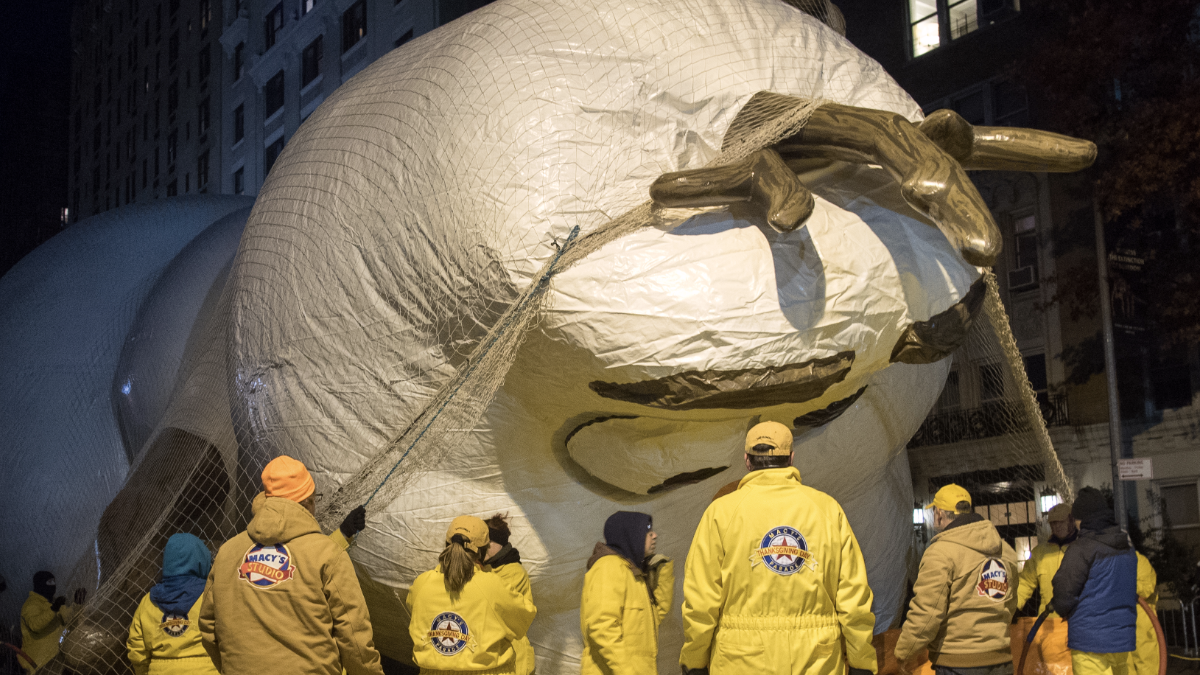
2018 Macy's Thanksgiving Day Parade balloon inflation, which takes place the day before the parade on 77th and 81st streets on either side of the American Museum of Natural History. Credit: Rhododendrites/Wikimedia Commons/CC BY-SA 4.0
Macy’s made the decision in coordination with New York City officials, the New York Police Department (NYPD), and other city agencies over safety concerns for participants and spectators. The rescheduled parade is due to begin at 13:30 UTC (08:30 EST) on Saturday, November 28.
Crews had already begun inflating the parade’s giant character balloons in Manhattan when the postponement was announced. Workers began deflating the balloons following the decision.
Footage published by CBS New York documents the deflation of the balloons following the postponement.

New York City Emergency Management (NYCEM) issued a Travel Advisory on November 25, warning of transportation disruptions, fallen trees, and power outages. Officials advised residents to avoid travel where possible during the afternoon and evening of November 26, when the storm is expected to be strongest.
The National Weather Service (NWS) issued a High Wind Warning for New York City, valid from 15:00 UTC on November 26 to 06:00 UTC on November 27. A Coastal Flood Warning is valid from 12:00 UTC on November 26 to 11:00 UTC on November 27.
According to NYCEM, wind gusts of 64–72 km/h (40–45 mph) are forecast by daybreak on November 26. Sustained winds of 48–64 km/h (30–40 mph) and gusts of 97–105 km/h (60–65 mph) are possible during the afternoon and evening, with the strongest winds expected along the coast and in exposed locations.
New York City’s balloon safety measures, introduced in 1998 following an accident during the previous year’s parade, prohibit the operation of large parade balloons when sustained winds exceed 37 km/h (23 mph) or gusts exceed 55 km/h (34 mph).
| Wind measurement | Balloon safety threshold | NYC forecast |
|---|---|---|
| Sustained winds | 37 km/h (23 mph) | 48–64 km/h (30–40 mph) |
| Wind gusts | 55 km/h (34 mph) | 97–105 km/h (60–65 mph) |
The parade’s giant character balloons were grounded due to adverse weather in 1971, although the procession itself went ahead.
The NWS forecasts rainfall totals of 38–51 mm (1.5–2 inches), with locally higher accumulations of up to 76 mm (3 inches). Rainfall rates could reach 13–19 mm/h (0.5–0.75 inches per hour) during the heaviest precipitation, according to NYCEM.
Heavy rainfall coinciding with the evening high tide could restrict drainage and worsen street flooding. Localized flash flooding is also possible, particularly where fallen leaves obstruct storm drains.
The NWS attributed the coastal flood threat to persistent east-northeasterly winds between an approaching low-pressure system and strong high pressure to the north, coinciding with elevated astronomical tides following the recent full moon.
Keep reading

NYCEM forecasts widespread moderate coastal flooding during the morning and evening high tides on November 26, with localized major flooding possible in Jamaica Bay. Inundation depths of 0.61–0.76 m (2–2.5 feet) are possible in the most vulnerable parts of Jamaica Bay and the coastal Bronx.
The NWS also warned of potential major coastal flooding along western Great South Bay on Long Island, with beach flooding and dune erosion expected along exposed shorelines during high tides. Minor to moderate coastal flooding could persist during the morning high tide on November 27.
New York City activated its Flash Flood Emergency Plan on November 23 and placed its Downed Tree Task Force on alert the following day. The city announced that it would activate its Emergency Operations Center protocol on November 26 to coordinate its response to the storm.
Macy’s Thanksgiving Day Parade was first held in 1924, with giant character balloons introduced in 1927. The parade was canceled in 1942, 1943, and 1944 during World War II.
References:
1 2026 Macy’s Thanksgiving Day Parade Moves to Saturday, November 28: Details – NBC – November 25, 2026
2 Bad weather postpones Macy’s Thanksgiving Day Parade for first time ever – Associated Press – November 25, 2026
3 Mayor Mamdani Issues Travel Advisory for Thanksgiving Day as Coastal Storm Approaches – New York City Emergency Management – November 25, 2026
4 Area Forecast Discussion (FXUS61 KOKX 260527) – National Weather Service New York – November 26, 2026, 05:27 UTC
5 Mayor Giuliani announces safety measures for the 1998 Macy’s Annual Thanksgiving Day Parade – New York City Mayor’s Office – November 20, 1998
6 Excitement Soars During the World-Renowned Macy’s Thanksgiving Day Parade® as the Holiday Season Officially Begins – Macy’s – November 2024

Rishav Kothari is Editor-in-Chief of The Watchers, where he runs the newsroom and covers earthquakes, volcanoes, severe weather and space weather.
More reporting
- KIC 4737720 changes its dominant pulsation as Kepler’s own cycle mimics stellar drift
- Global simulation reveals how successive solar eruptions overtake and magnetically merge
- Ancient Martian lavas were more fluid than younger basalts, Perseverance study finds
- Howard Carter found an iron dagger on Tutankhamun's right thigh in 1925; modern XRF analysis supports a meteoritic origin of the iron
