
A piece of Mars fell on Egypt in 1911, and a farmer said one fragment hit a dog and left it “like ashes in a moment”
A meteorite now known to have come from Mars fell near Alexandria, Egypt, on June 28, 1911, scattering about 40 recovered stones across an area roughly 4.5 km (2.8 miles) wide. One account collected after the fall said a fragment struck a dog and left it “like ashes in a moment,” but the claim was never substantiated; scientists did not establish the Martian origin of this rare family of meteorites until decades later.
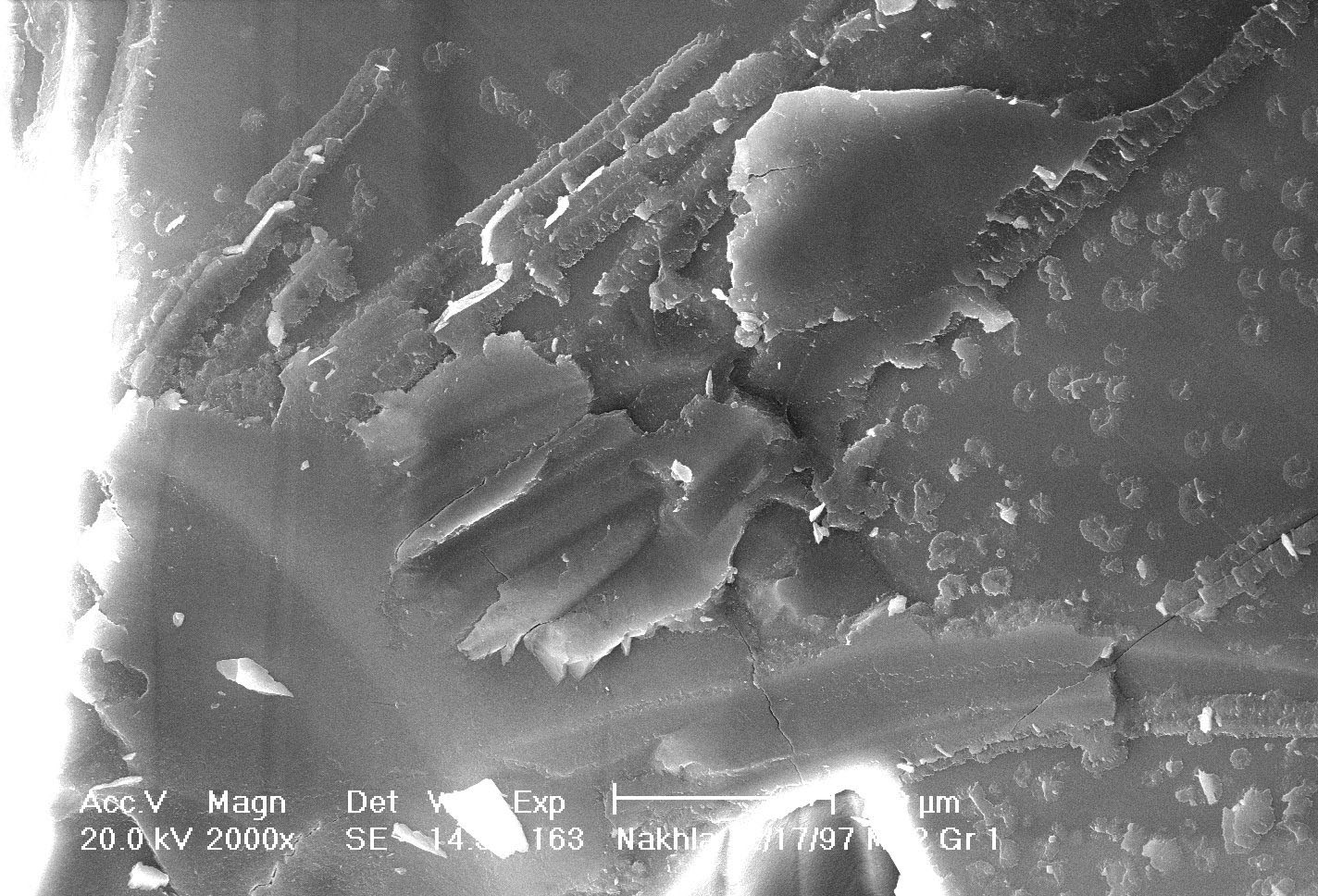
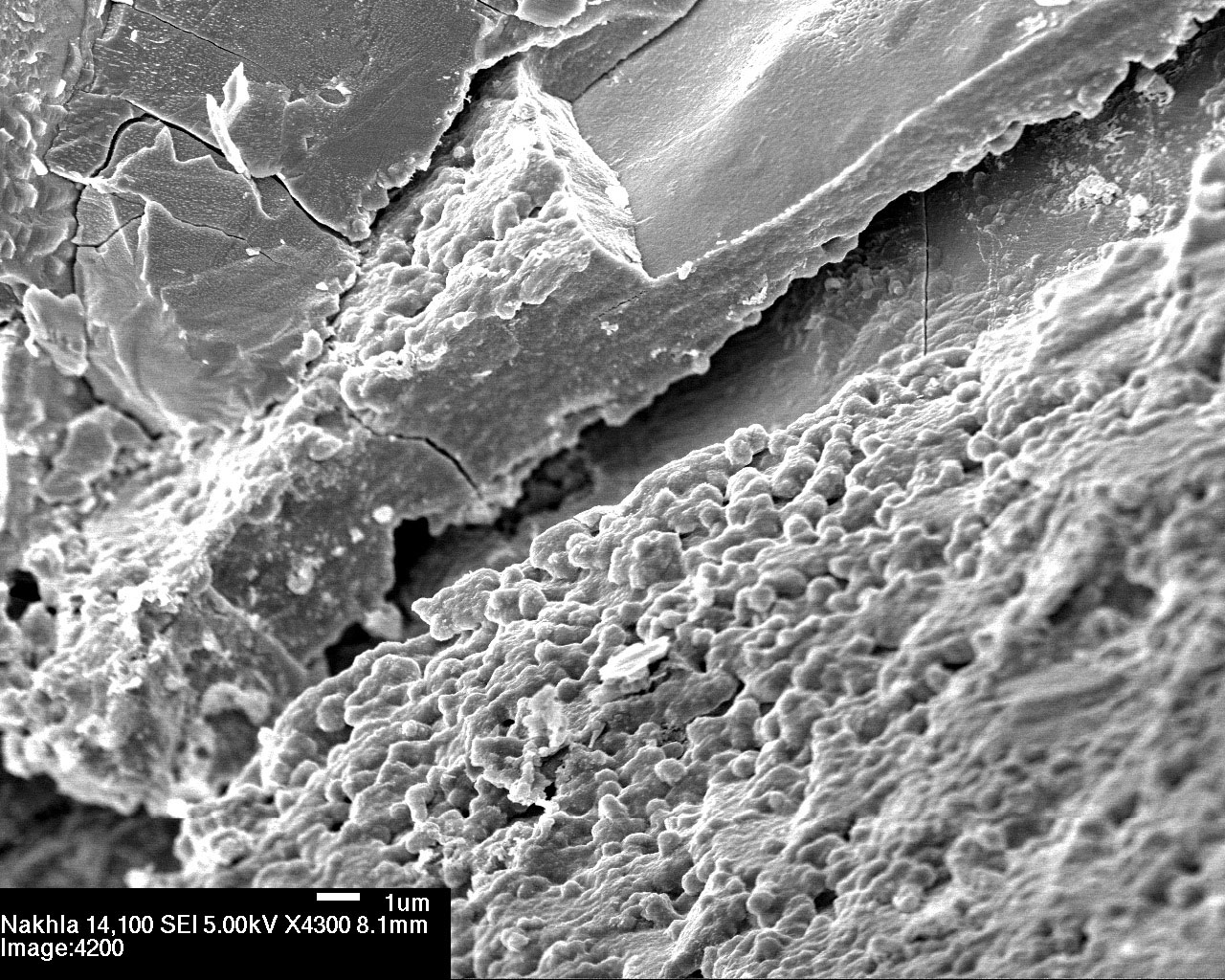
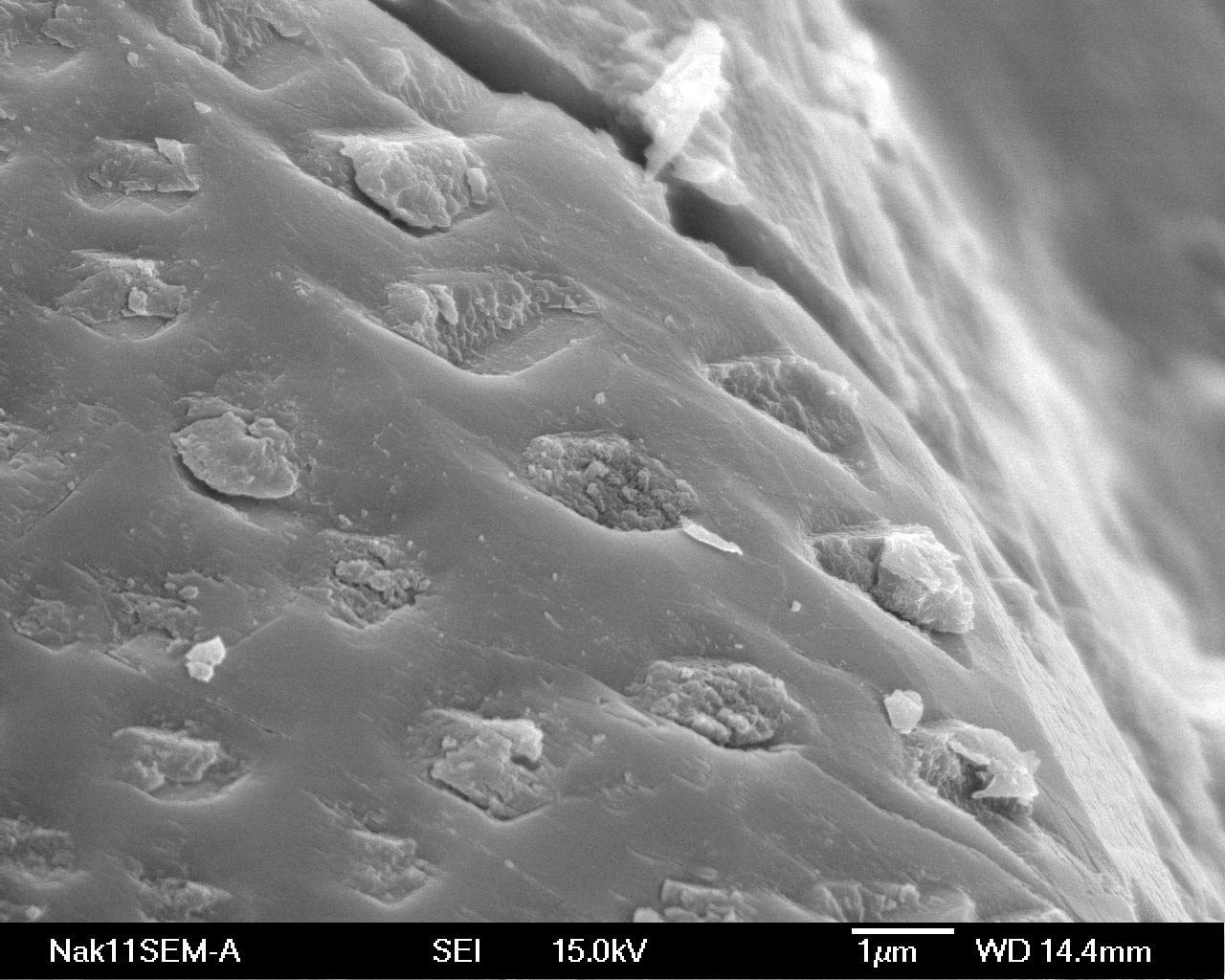
Scanning electron microscope view of microscopic structures on a chip of the Nakhla meteorite examined by NASA in 2009. The image spans features on the micrometre scale. Credit: NASA/David McKay — Public domain
| Event | Nakhla meteorite fall |
|---|---|
| Date | June 28, 1911 |
| Location | El Nakhla El Baharia, Abu Hommos district, northern Egypt |
| Recovered material | About 40 stones totaling nearly 10 kg (22 lb) |
| Strewn area | About 4.5 km (2.8 miles) in diameter |
| Scientific identity | Martian meteorite; namesake of the nakhlite group |
| Dog account | Recorded eyewitness claim; not substantiated |
A meteorite now known to have originated on Mars fell near El Nakhla El Baharia in northern Egypt at about 09:00 local time on June 28, 1911. G. T. Prior’s 1912 description in Mineralogical Magazine, drawing on reports published by members of the Egyptian Geological Survey, placed the fall in hamlets west and north of the village in the Abu Hommos district, at 31°19′ N, 30°21′ E, about 39 km (24 miles) east of Alexandria.
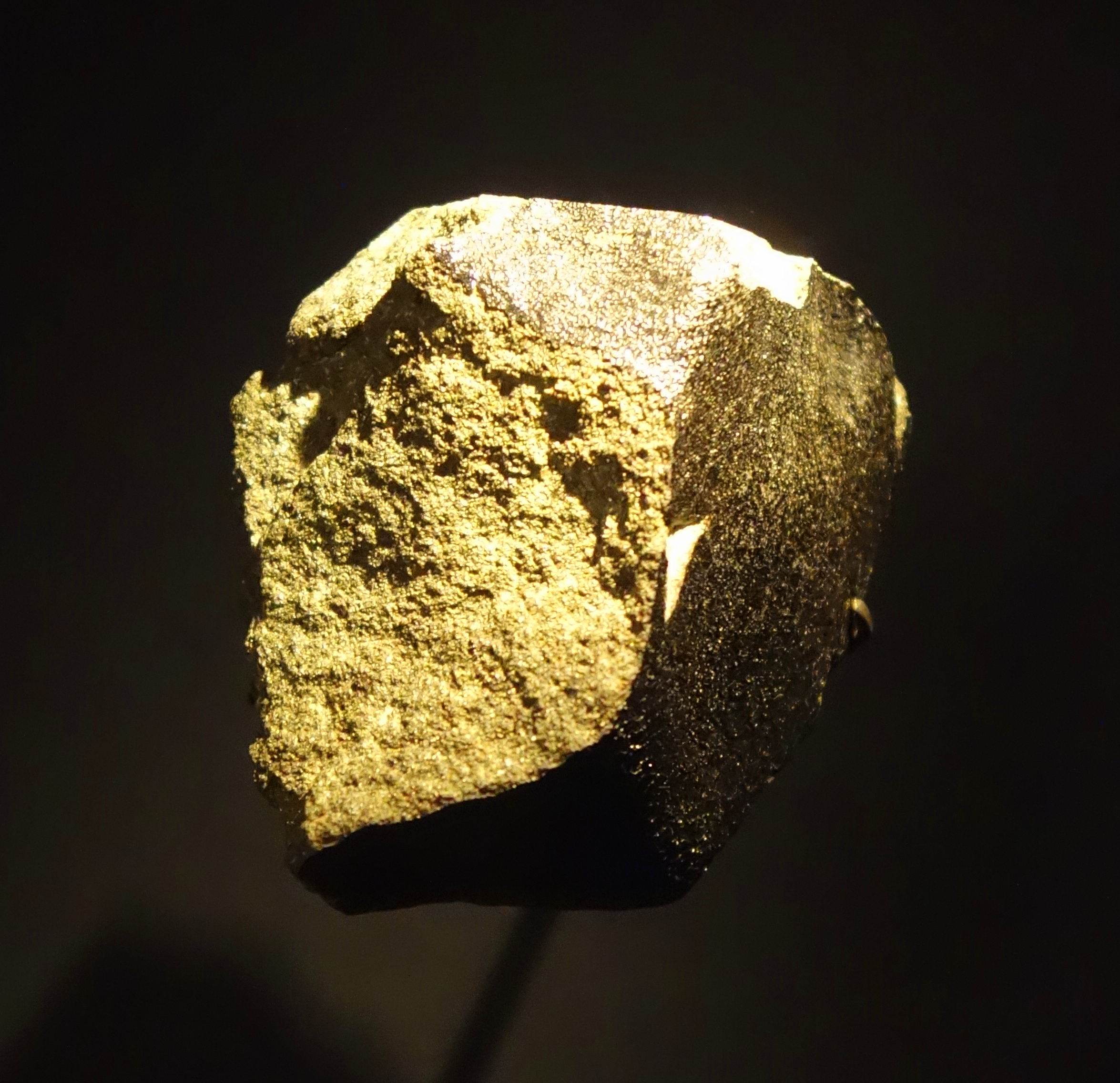
Prior reported that about 40 stones with a combined mass of nearly 10 kg (22 lb) were recovered across an area approximately 4.5 km (2.8 miles) in diameter. Individual stones ranged from about 20 g (0.7 oz) to 1 813 g (64.0 oz).
Eyewitnesses described the meteor approaching from the northwest along a path marked by a column of white smoke, inclined at about 30° to the horizontal. Several explosions were heard before the stones reached the ground.
“leaving it like ashes in a moment”
Eyewitness account recorded after the 1911 Nakhla fall
One statement became more famous than the rest. W. F. Hume of the Geological Survey of Egypt collected eyewitness accounts after the fall and published them in 1911 in The First Meteorite Record in Egypt. Smithsonian later reproduced a farmer’s account saying that one fragment fell on a dog, “leaving it like ashes in a moment.”
The quotation is part of the documented history of the fall, but the alleged fate of the dog is not established to the same standard. Smithsonian describes the claim as unsubstantiated. No authoritative source verified in this review establishes that a Nakhla fragment killed, incinerated or vaporized the animal, so the episode remains an eyewitness claim rather than a confirmed impact.
Why the dog story is treated separately from the meteorite science
The historical record establishes that an extraordinary statement about a dog was collected after the fall. It does not establish that the alleged impact and instantaneous destruction actually occurred. The article therefore treats the statement as testimony with traceable provenance, not as a verified casualty.
The rocks themselves produced a much stronger scientific record. Prior’s mineralogical work established that Nakhla was an unusual igneous meteorite, but researchers in 1911 had no direct measurements of the Martian atmosphere with which to identify Mars as its parent planet.
That changed after spacecraft reached Mars. NASA’s Viking landers arrived in 1976 and measured the composition and isotopic properties of the Martian atmosphere. Those measurements provided a chemical reference that scientists on Earth could compare with material trapped inside meteorites.
| Year | What changed |
|---|---|
| 1911 | Nakhla fell in Egypt and eyewitness accounts were collected. |
| 1912 | G. T. Prior published the foundational mineralogical description of the stones. |
| 1976 | Viking measured the Martian atmosphere, supplying a new planetary chemical reference. |
| 1983 | Bogard and Johnson reported Martian-like trapped noble gases in EETA 79001, strengthening the case that the rare SNC meteorites came from Mars. |
Bogard and Johnson (1983) examined shock-altered material from the Antarctic meteorite Elephant Moraine 79001, or EETA 79001. They measured trapped argon, krypton and xenon whose relative abundances and isotopic ratios more closely resembled Viking measurements of the Martian atmosphere than noble-gas components normally found in meteorites.
Keep reading
The 1983 study did not analyze Nakhla itself. Instead, the trapped gases strengthened earlier geochemical arguments that shergottites and related rare meteorites had originated on Mars. Smithsonian’s historical account places Nakhla’s recognition as a piece of Mars in the same 1983 scientific shift, 72 years after the stones fell in Egypt.
Nakhla became the namesake of the nakhlites, a group of Martian igneous meteorites. Smithsonian describes nakhlites as rocks that crystallized from basaltic magma about 1.3 billion years ago. Their minerals preserve information about volcanism on Mars, while secondary alteration products in Nakhla have also been studied for evidence that liquid water once interacted with the rock.
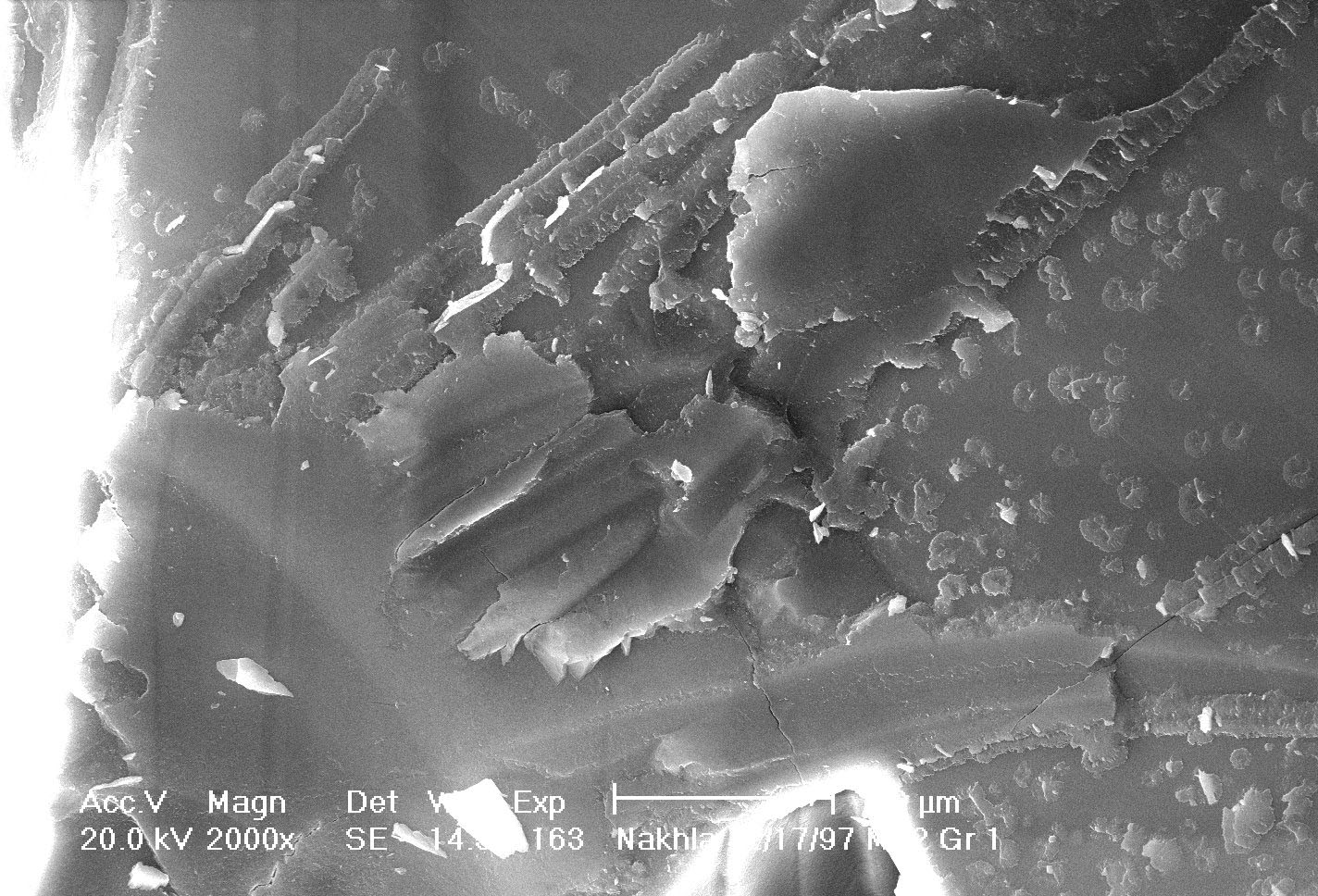
The microscopic structures in the NASA images generated interest because some shapes resemble features associated with microbial alteration on Earth. Morphology alone does not establish biology, however, and the images should not be read as evidence that Nakhla contains fossil Martian life.
What is a nakhlite?
A nakhlite is a Martian igneous meteorite belonging to the group named after Nakhla. The rocks are dominated by clinopyroxene and record crystallization from magma on Mars. Later alteration minerals preserved in some nakhlites provide evidence that water interacted with the rock after it formed.
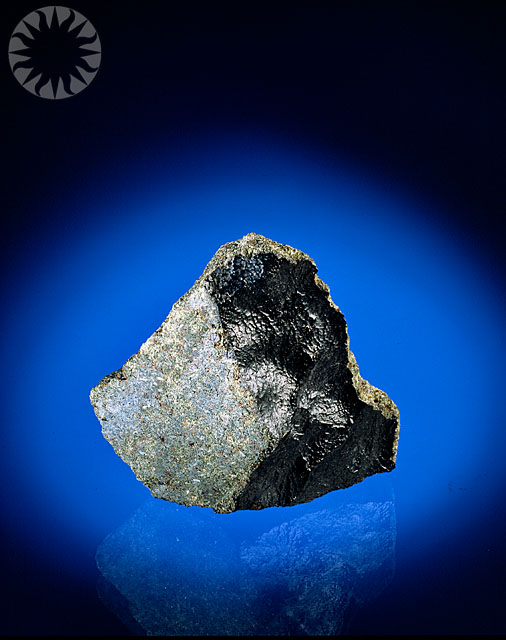
Material from the 1911 fall entered major museum collections soon afterward. Hume sent two stones weighing 117 g (4.13 oz) and 52 g (1.83 oz) to the Smithsonian, where they arrived in August 1911. Smithsonian later received another specimen of about 480 g (16.9 oz) in 1962 and reported holdings totaling roughly 650 g (22.9 oz).
One of the two original Smithsonian stones remained virtually untouched for a century, while material from other specimens was cut or broken for laboratory study. The surviving pieces therefore preserve both sides of Nakhla’s history: the physical evidence recovered from an observed meteorite fall and the samples that later became part of the laboratory evidence connecting rare meteorites on Earth with Mars.

References:
1 Prior, G. T. (1912). The meteoric stones of El Nakhla El Baharia (Egypt). Mineralogical Magazine and Journal of the Mineralogical Society, 16(76), 274–281. DOI: 10.1180/minmag.1912.016.76.04
2 Bogard, D. D., & Johnson, P. (1983). Martian gases in an Antarctic meteorite? Science, 221(4611), 651–654. DOI: 10.1126/science.221.4611.651
3 One Hundred Years Ago Today, A Mars Meteorite Fell in a Blaze – Smithsonian Magazine – June 28, 2011

I’m a science journalist and researcher at The Watchers, contributing to the Epicenter edition, where I cover peer-reviewed scientific research and emerging discoveries across Earth and space sciences. With a background in astronomy and a passion for environmental science, I’ve worked in shark and coral conservation in Fiji, conducting reef and shark-behavior research, contributing to mangrove restoration, and earning PADI Open Water and Coral Reef Certifications. I bring a blend of scientific rigor and storytelling to illuminate the discoveries shaping our planet and beyond.
More reporting
- Thermal study weakens buried-ice explanation for asteroid 1998 KY26’s unusual motion
- Antarctica’s blue ice has yielded more than 45 000 meteorites, but about 5 000 a year are becoming inaccessible
- Ancient Martian lavas were more fluid than younger basalts, Perseverance study finds
- BepiColombo's MIXS returns first astronomical X-ray images after eight years in space
