
Antarctica’s blue ice has yielded more than 45 000 meteorites, but about 5 000 a year are becoming inaccessible
Antarctica’s blue-ice fields have delivered more than 45 000 meteorites to science, but a 2024 Nature Climate Change study estimates that about 5 000 now disappear from the recoverable surface each year as warming allows dark meteorites to melt into the ice. That modeled loss rate is about five times the roughly 1 000 meteorites collected annually, putting part of the continent’s extraterrestrial archive out of reach faster than field teams recover it.
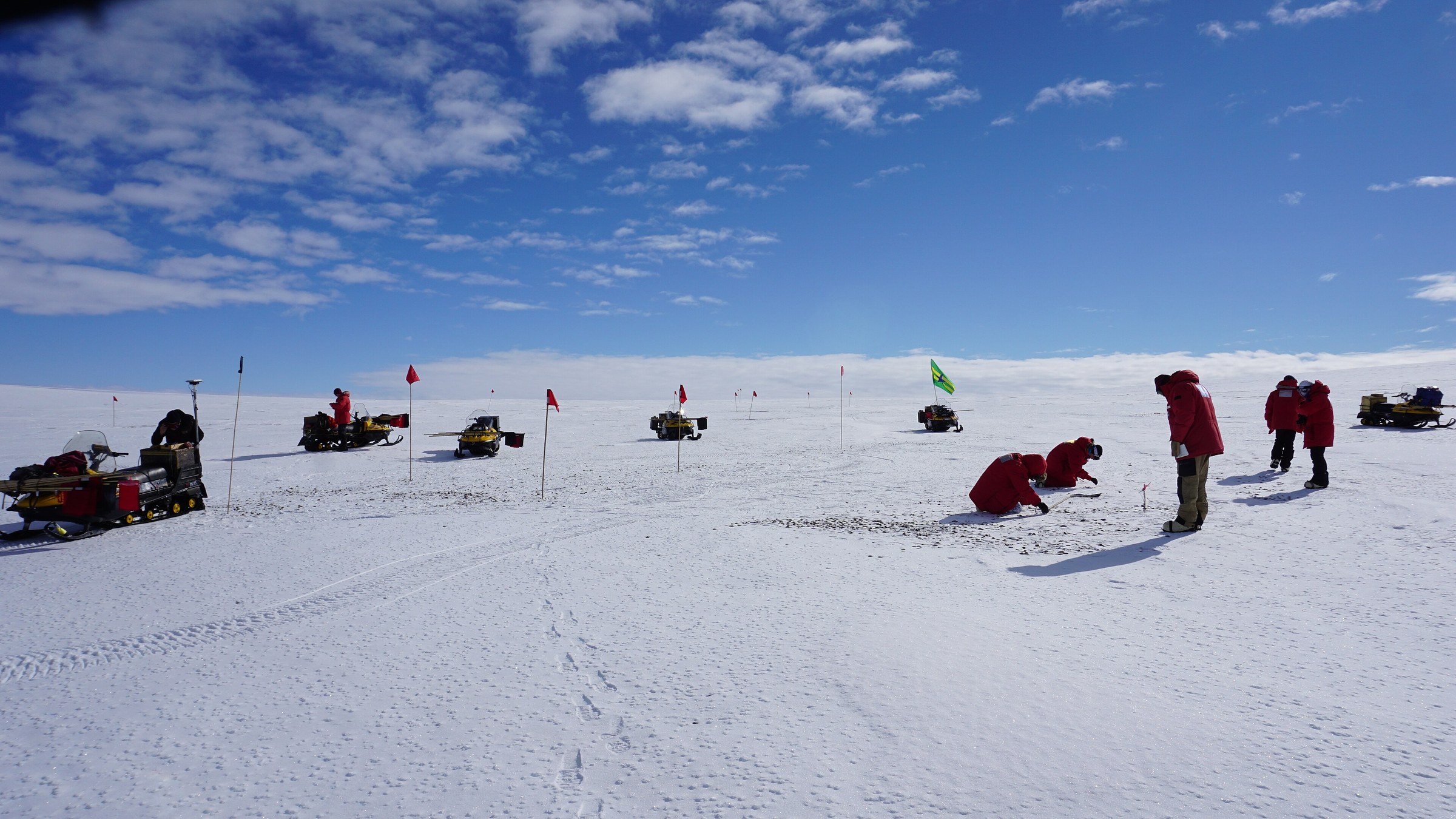
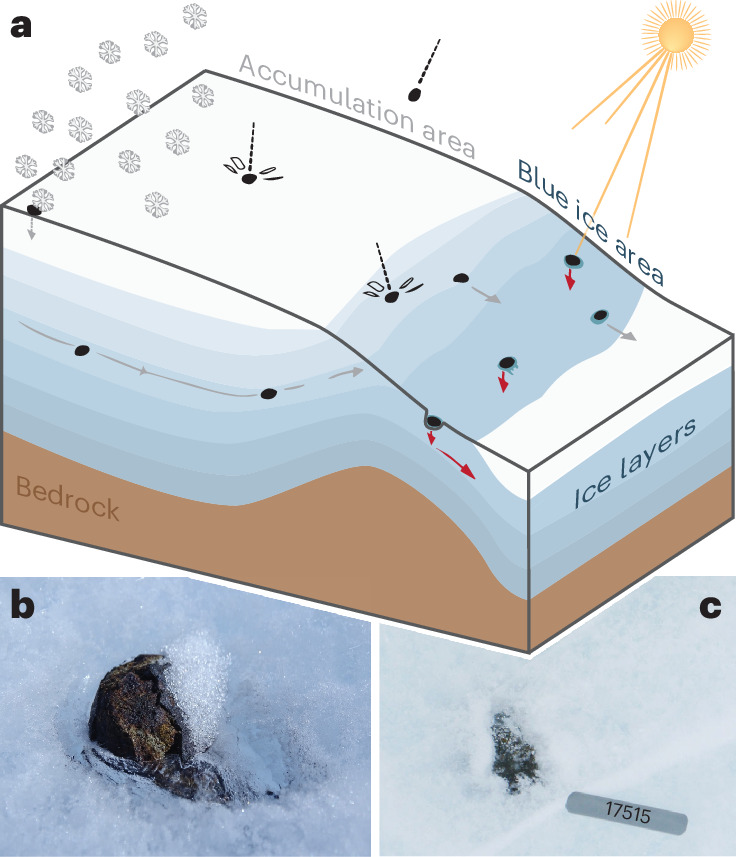
Antarctica is unusually productive for meteorite recovery because its ice acts as both a transport system and a concentrating mechanism. Meteorites that fall onto snow-covered accumulation areas can become buried and move with the ice for thousands to hundreds of thousands of years before returning toward the surface in some blue-ice areas, where ablation removes ice faster than new snow accumulates.
The result is a network of meteorite stranding zones where extraterrestrial rocks become concentrated at the surface and stand out against exposed blue ice. Tollenaar et al. (2022) reported that about 62% of all meteorites recovered on Earth originated from Antarctica and that more than 45 000 Antarctic meteorites had already been found.
The 2022 study used machine learning to identify Antarctic locations with combinations of ice flow, temperature, radar backscatter and surface slope associated with known meteorite-rich sites. The resulting dataset contains 613 meteorite stranding zones, summarized in the paper as approximately 600 areas, with estimated classification accuracy above 80%.
The analysis also showed how much of the Antarctic meteorite resource remains unexplored. Based on the classifier and known recovery densities, the researchers estimated that only about 5 to 13% of meteorites present at the ice-sheet surface had been recovered. Their original 2022 estimate placed the remaining surface population at roughly 340 000 to 900 000 meteorites.
The 2024 climate analysis used an updated estimate of approximately 300 000 to 850 000 meteorites remaining at the Antarctic surface. Those figures are model-based population estimates rather than direct counts, and their wide range reflects uncertainty in how efficiently the machine-learning classifier identifies true meteorite-bearing areas.
Blue ice is central to the concentration mechanism. In areas where ice flow encounters favorable topography and ablation conditions, old ice carrying buried meteorites can be brought toward the surface. Because little or no snow remains over the blue ice, exposed meteorites can accumulate instead of being buried again.
Antarctica’s cold and dry environment can then preserve exposed specimens for thousands of years. The process gives researchers access to material from asteroids and other planetary bodies without a spacecraft sample-return mission, while the contrast between dark meteorites and blue ice makes systematic field searches possible.
The same dark surface that helps search teams spot a meteorite also makes it vulnerable to solar heating. A meteorite absorbs more incoming radiation than the surrounding ice and can become warmer than its immediate environment. When enough heat reaches the ice beneath the rock, a small melt pocket forms.
The rock can then move downward as the underlying ice melts, while meltwater above it refreezes. Field teams have recovered meteorites enclosed in clear, refrozen ice, providing direct evidence that this sinking process occurs. A meteorite becomes inaccessible when its downward motion exceeds the rate at which ablation removes the surrounding ice surface.
The temperature sensitivity is visible in the geographic record of known finds. Fewer than 1% of Antarctic meteorites have been recovered from locations where the near-maximum ice-surface temperature exceeds about -9°C (16°F). The value is not a normal daily maximum. It represents the 99th percentile of 19 years of eight-day satellite surface-temperature averages.
Higher-frequency field measurements cited by the researchers show that air and ice temperatures at meteorite stranding surfaces rarely exceed about -5°C (23°F) for more than a few minutes. Thermodynamic modeling cited in the study indicates that meteorites can begin sinking when air temperatures rise above approximately -10°C (14°F), depending on local conditions.
Tollenaar et al. (2024) combined the meteorite-site classifier with regional climate simulations to estimate how warming changes the amount of Antarctic surface capable of keeping meteorites exposed. The regional atmospheric model operated at a horizontal resolution of 35 km (22 miles), while potential meteorite sites were evaluated on 450 m (1 480 feet) grid cells.
The classifier used observed ice-flow velocity, surface temperature, radar backscatter and surface slope. For future conditions, the researchers calculated annual near-maximum temperature values from regional climate-model output between 2020 and 2100 and applied the temperature changes to the meteorite-site model.
The estimated losses are therefore model outputs, not a direct annual census of meteorites sinking into the ice. Under present warming conditions, the study estimates that approximately 5 000 meteorites become inaccessible at the Antarctic surface each year. Field campaigns have recovered roughly 1 000 meteorites annually on average over recent decades, leaving the modeled loss rate about five times higher than the recovery rate.

The researchers estimate that approximately 24% of the meteorites accessible at the surface in 2020 will be lost by 2050. The low-emissions SSP1-2.6 and high-emissions SSP5-8.5 scenarios remain similar through the first half of the century, with their modeled loss rates separating more clearly after 2050.
Under SSP5-8.5, approximately 76% of Antarctic surface meteorites are projected to become inaccessible by 2100. Only about 150 meteorite stranding zones covering roughly 3 180 km2 (1 228 mi2) remain in that simulation, corresponding to reductions of 76% in the number of zones and 78% in their modeled surface area.
The relationship with global temperature is steep. The study estimates that an additional 5 100 to 12 200 meteorites, equivalent to about 1 to 2% of the current modeled surface population, are lost for every additional 0.1°C (0.18°F) of global air-temperature increase. The range reflects uncertainty in the precision and sensitivity of the meteorite-site classifier.
The losses are not distributed uniformly. Some established dense meteorite collection areas are projected to lose as much as half of their surface population before 2050. The Grove Mountains in East Antarctica, where more than 12 000 meteorites have already been recovered, are among the sensitive regions identified by the study.
Keep reading
Enderby Land in East Antarctica is another region where the modeled losses are large. The area remains comparatively unexplored, but the study projects that half of its accessible meteorites could disappear before 2054.
Elevation strongly affects the modeled outcome. The largest present-day concentrations occur mainly between 1 800 and 2 000 m (5 900 and 6 560 feet), where the study projects an 88% reduction in recoverable meteorites by the end of the century under SSP5-8.5. Above 2 500 m (8 200 feet), projected losses remain below 50%.

Recovering the remaining specimens is labor-intensive. Search teams often identify meteorites visually while moving across blue ice on foot or by snowmobile. Access to individual fields depends heavily on Antarctic logistics and the research priorities of national programs.
The authors proposed larger internationally coordinated searches over the following 10 to 15 years, particularly in vulnerable low-elevation areas and unexplored meteorite stranding zones. They also identified unoccupied aerial vehicles and higher-resolution mapping as possible ways to improve search efficiency, while acknowledging the difficulty of deploying such systems reliably in the Antarctic environment.
The projected loss figures do not include every process capable of hiding a meteorite. The climate simulations held the mapped extent of blue-ice areas fixed through time, and increased snow cover was not included in the calculated meteorite losses. Snow can temporarily or persistently conceal specimens even where the sinking mechanism itself has not removed them from the surface.
The remaining meteorite population is also uncertain because it is inferred statistically rather than counted. The 2024 analysis used classifier precision estimates ranging from 0.47 to 0.81 and sensitivity estimates ranging from 0.48 to 0.74 when deriving lower and upper bounds. The researchers propagated those uncertainties into the population and loss estimates rather than presenting a single exact inventory.
The 2022 analysis shows why the remaining resource is scientifically important. Its machine-learning map identified more than 600 potential meteorite-rich areas, many of which had not been fully explored. NASA Earth Observatory described the work as a continent-wide guide to places where combinations of blue ice, ice velocity, temperature and terrain make meteorite concentrations more probable.
One high-ranked unexplored area identified in that work lies in the Fimbulheimen mountain range, approximately 120 km (75 miles) from Novolazarevskaya Station. Allan Hills, by contrast, is an established collection region and has yielded large numbers of specimens.
Antarctica’s meteorite archive has been accumulating over geological timescales but can be depleted at the exposed surface much faster. The 2024 study describes that asymmetry explicitly: concentrating meteorites can take thousands of years, while individual specimens can disappear from the accessible surface over much shorter periods once local conditions favor melting beneath them.
Since the discovery of the Adelie Land meteorite in 1912, more than 45 000 meteorites have been recovered from Antarctic ice. The specimens preserve material from the early Solar System and include samples originating from asteroids, the Moon and Mars, making Antarctic collection fields a natural archive of planetary material.
The remaining uncertainty concerns the rate at which that archive will become inaccessible across individual blue-ice regions and how much can be recovered before local conditions cross the temperature range unfavorable for exposed meteorites. The model establishes a continent-wide sensitivity to warming, but the exact fate of any individual meteorite or stranding zone still depends on local ice flow, surface conditions, snow cover and the physical properties of the meteorites themselves.
References:
1 Tollenaar, V., Zekollari, H., Kittel, C., Farinotti, D., Lhermitte, S., Debaille, V., Goderis, S., Claeys, P., Joy, K. H., & Pattyn, F. (2024). Antarctic meteorites threatened by climate warming. Nature Climate Change, 14(4), 340–343. DOI: 10.1038/s41558-024-01954-y
2 Tollenaar, V., Zekollari, H., Lhermitte, S., Tax, D. M. J., Debaille, V., Goderis, S., Claeys, P., & Pattyn, F. (2022). Unexplored Antarctic meteorite collection sites revealed through machine learning. Science Advances, 8(4), eabj8138. DOI: 10.1126/sciadv.abj8138
3 Finding Meteorite Hotspots in Antarctica – NASA Earth Observatory – March 9, 2022
4 Antarctic Meteorite – NASA Science – January 25, 2019
5 Science from the Sky: NASA Renews Search for Antarctic Meteorites – NASA Science – November 15, 2016

Rishav Kothari is Editor-in-Chief of The Watchers, where he runs the newsroom and covers earthquakes, volcanoes, severe weather and space weather.
More reporting
- Chipmaking plasma releases oxygen-related gases from lunar-regolith simulants below 400°C
- KIC 4737720 changes its dominant pulsation as Kepler’s own cycle mimics stellar drift
- Global simulation reveals how successive solar eruptions overtake and magnetically merge
- Ancient Martian lavas were more fluid than younger basalts, Perseverance study finds
