
Thermal study weakens buried-ice explanation for asteroid 1998 KY26’s unusual motion
Thermal modeling of near-Earth asteroid 1998 KY26 found conditions too warm for buried water ice to survive over long periods, weakening sustained outgassing as an explanation for its nongravitational acceleration. The result adds an independent constraint to a 2025 orbital study that reproduced the asteroid’s measured motion using solar radiation pressure and heat re-emitted from its surface.
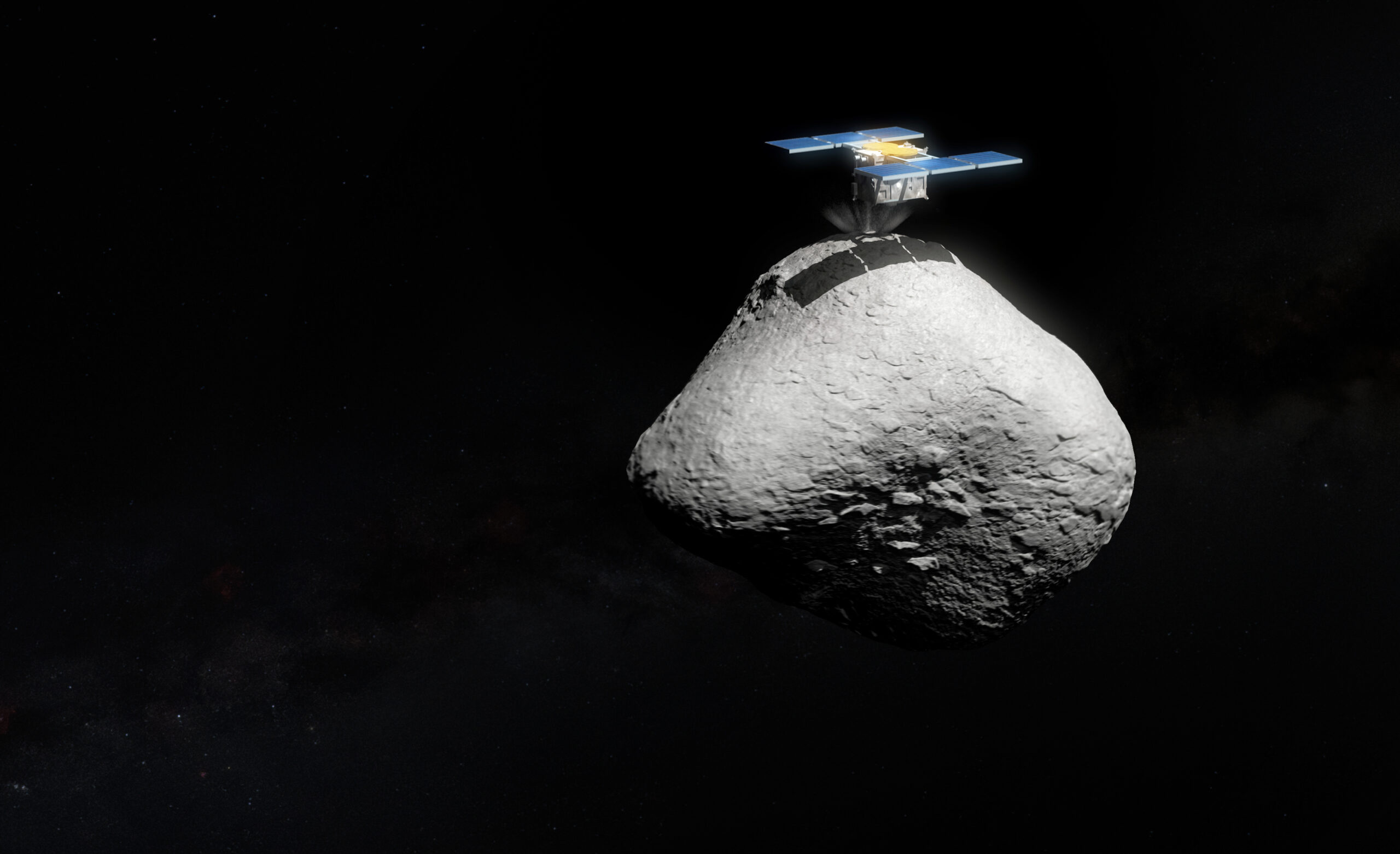
Artist's impression of Hayabusa2 at 1998 KY26, created while the asteroid was still the spacecraft's planned 2031 rendezvous target. JAXA cancelled that rendezvous in November 2026 after ion-engine problems and changed the extended mission to a flyby of asteroid 2015 BM510. Credit: ESO/M. Kornmesser. Asteroid: T. Santana-Ros et al. Hayabusa2 model: SuperTKG (CC BY-SA)
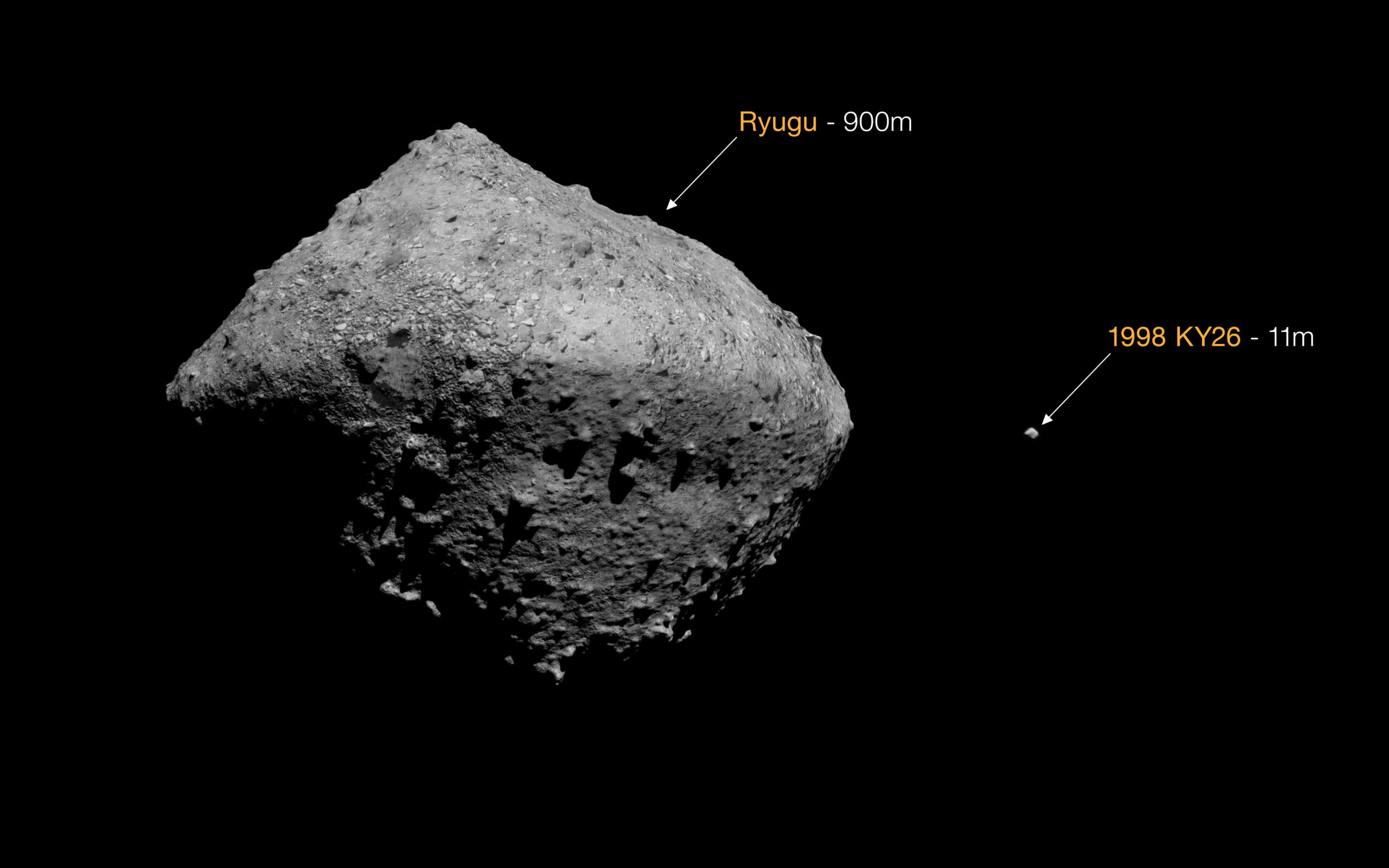
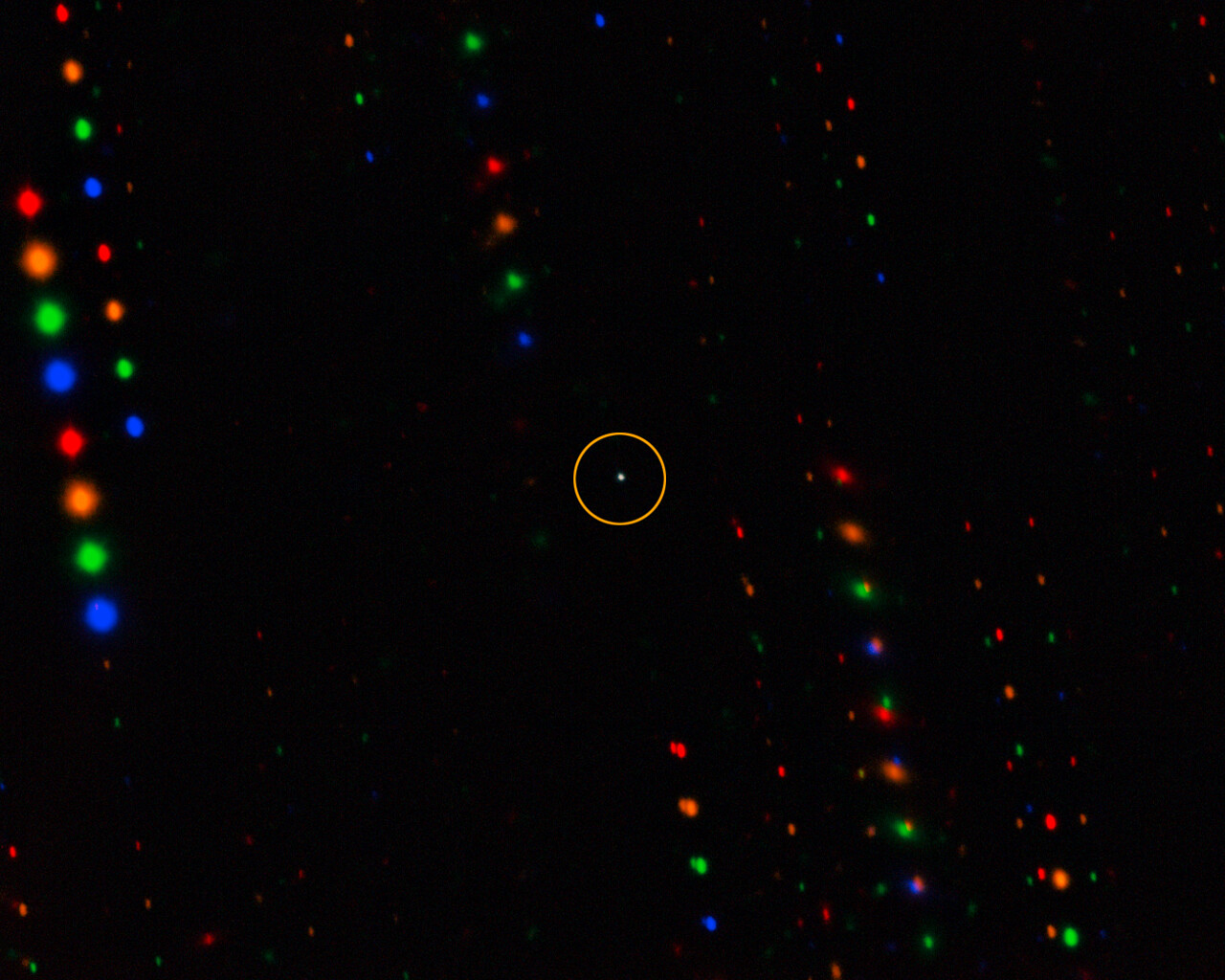
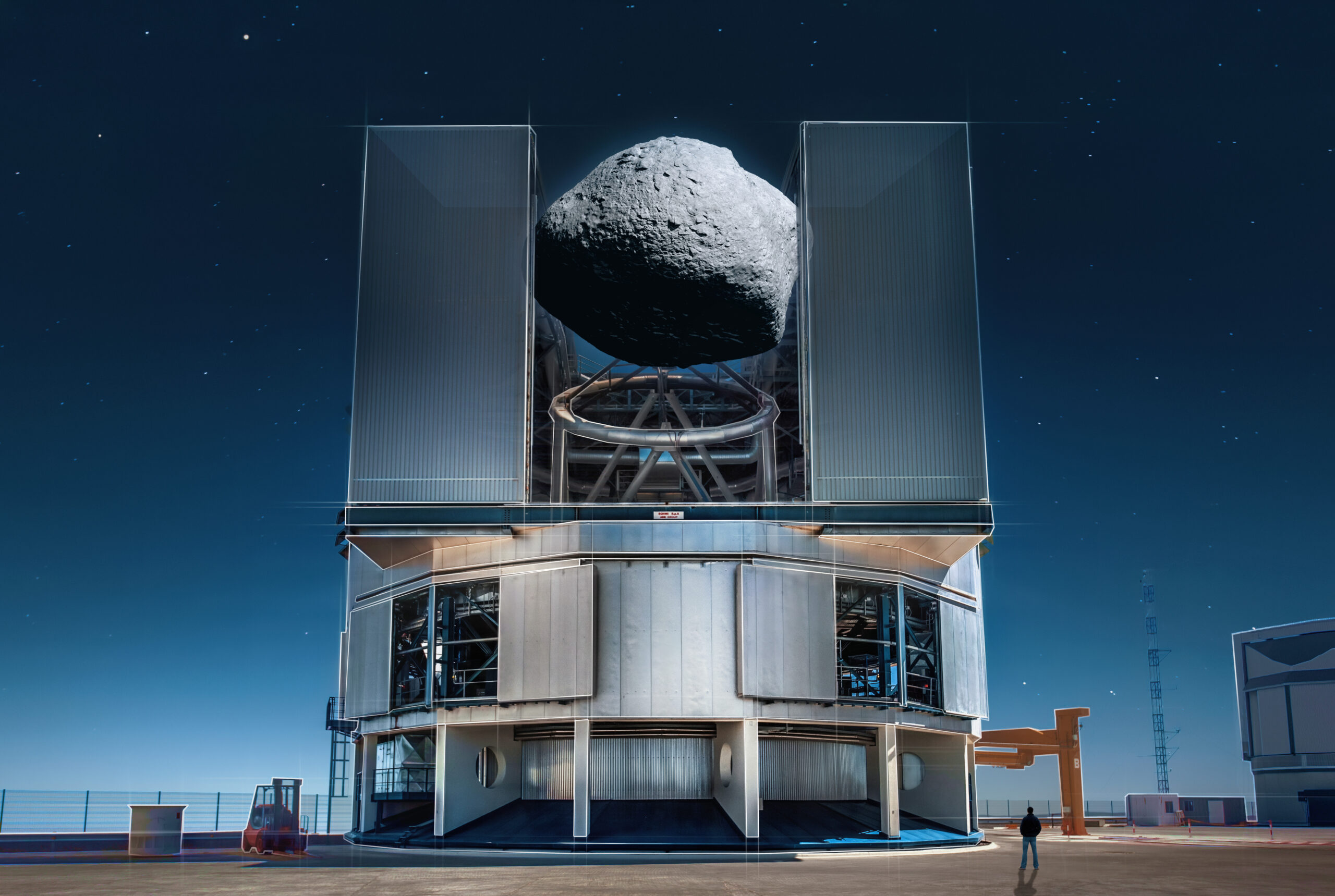
The explanation changed after astronomers obtained a much better physical description of 1998 KY26 during its favorable 2024 apparition. Observations from several large telescopes, combined with radar measurements collected in 1998, showed that the asteroid is only 11 ± 2 m (36 ± 7 feet) across and completes one rotation in 5.3516 ± 0.0001 minutes. Earlier estimates placed it near 30 ± 10 m (98 ± 33 feet) across with a rotation period of about 10.7 minutes.
Those revisions matter because nongravitational forces become increasingly important as an asteroid becomes smaller. Sunlight transfers momentum directly when photons strike the surface, while absorbed solar energy is later radiated back into space as heat. If that thermal emission is uneven, the recoil produces another small acceleration. For an object only about 11 m (36 feet) wide, those forces can produce measurable changes in its trajectory.
| Property | Earlier estimate | Current best estimate |
|---|---|---|
| Diameter | 30 ± 10 m (98 ± 33 feet) | 11 ± 2 m (36 ± 7 feet) |
| Rotation period | About 10.7 minutes | 5.3516 ± 0.0001 minutes |
| Visible activity | No established coma | No dust detected in 2024 observations |
| Proposed nongravitational mechanism | Outgassing considered | Radiation-force model reproduces the astrometry without requiring cometary activity |
1998 KY26 had already attracted attention because gravity alone did not fully reproduce its measured orbit. Astrometric observations from 1998, 2002, 2020 and 2024 show departures from a purely gravity-driven trajectory, including an unusual acceleration component perpendicular to the orbital plane.
One proposed explanation was outgassing. Ice or another volatile material buried inside an asteroid can absorb heat, sublimate directly from solid to gas and escape through the surface. The departing gas carries momentum and can act as a weak natural thruster, changing the object’s orbit even when the activity is too faint to produce a conventional bright comet.
What is a “dark comet”?
The term describes small bodies that show measurable nongravitational acceleration resembling the effects of cometary outgassing while displaying little or no obvious coma or dust tail. The classification describes an orbital and observational puzzle; it does not by itself prove that hidden gas release is occurring.
The 2024 observations made it possible to test the acceleration with a more realistic physical model. Santana-Ros et al. (2025) obtained photometry over a much wider range of observing geometries than was available after the asteroid’s discovery. Lightcurve inversion favored a rotation period of 5.3516 ± 0.0001 minutes, half the earlier value, and produced new estimates of the spin axis and shape.
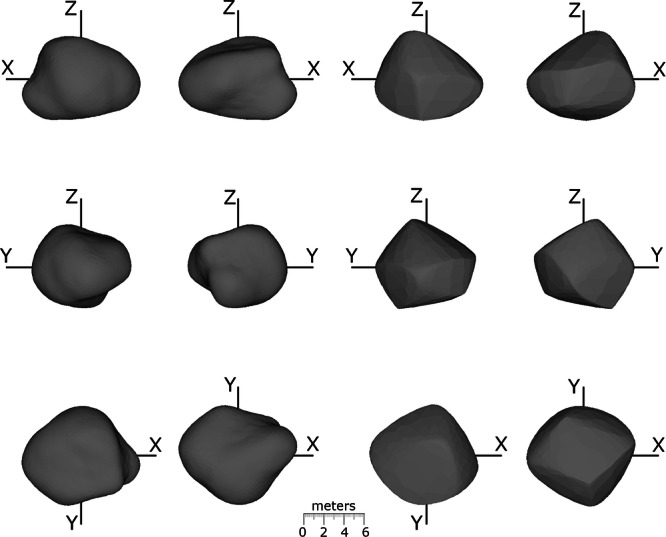
Reprocessing the 1998 Goldstone radar measurements with the faster rotation and new shape solutions produced the preferred 11 ± 2 m (36 ± 7 feet) diameter. The revised value is roughly one-third of the previously published central estimate and changes the area-to-mass relationship that controls the acceleration produced by incoming and re-emitted radiation.
The observing campaign also found no resolved dust around the asteroid. The reported 5-sigma upper limit on resolved dust mass was below 0.5 kg (1.1 lb) at the epochs observed. A lack of detectable dust does not rule out all gas release, but it provides no observational evidence for conventional visible cometary activity.
Farnocchia et al. (2025) then replaced the earlier empirical treatment of the unexplained acceleration with a high-fidelity physical model. It includes the asteroid’s nonspherical shape, direct solar radiation pressure and thermal emission from the surface.
Solar radiation pressure results from the transfer of photon momentum when sunlight is absorbed or reflected. Absorbed energy is subsequently emitted as infrared radiation. Because the asteroid rotates and its shape and surface do not return heat uniformly in every direction, this thermal emission generates recoil. The orbital component caused by delayed thermal emission includes the Yarkovsky effect.
How can sunlight change an asteroid’s orbit?
Individual photons carry extremely little momentum, but an asteroid receives sunlight continuously. Direct radiation pressure pushes on the illuminated surface, while delayed infrared emission pushes back as stored heat escapes. For large asteroids the resulting acceleration is tiny, but the same force produces a larger acceleration when less mass is being moved. That makes radiation effects increasingly important for very small near-Earth objects such as 1998 KY26.
The radiation-force model produced an excellent fit to the astrometric measurements without requiring an additional contribution from undetected cometary activity. Because the acceleration is connected to the asteroid’s size, shape, spin and reflectivity, the model also constrained its bulk density to 2.8+1.6-1.0 g/cm³ at the 90% confidence level. The central value corresponds to about 2 800 kg/m³ (175 lb/ft³).
The dynamical result does not prove that 1998 KY26 contains no volatiles. It establishes that its observed trajectory can be reproduced by radiation forces without requiring an additional cometary thrust.
That left a separate physical question: could enough water ice survive inside such a small asteroid to support sustained outgassing anyway?
Hansen and Hirabayashi addressed that question using a three-dimensional thermophysical finite-element model. Their calculations track heat conduction through the irregular body while accounting for solar heating, local geometry and changing orbital position. The researchers tested 13 thermal characterizations, varying equivalent diameter, thermal conductivity, Bond albedo, specific heat capacity and spin-pole orientation.
Each thermal test was sampled at 20 orbital positions. Although the asteroid can develop temporary colder patches during parts of its orbit, the relevant question for long-term ice survival is whether any location remains cold enough on average for buried water to persist.
| Thermal quantity | Value | Physical meaning |
|---|---|---|
| Base-case bulk-average temperature | 225.737 K (-47.4°C / -53.3°F) | Modeled long-term average temperature of the asteroid |
| Buried-water stability threshold used in the study | 145 K (-128.2°C / -198.7°F) | Above this temperature, buried water ice is not considered stable over long timescales in vacuum |
| Thermal characterizations tested | 13 | Checks whether plausible changes in physical assumptions overturn the result |
| Orbital positions per test | 20 | Samples temperature changes as the asteroid moves around the Sun |
The base case produced an orbit-averaged bulk temperature of 225.737 K, equivalent to -47.4°C (-53.3°F). The study compared that result with 145 K, equivalent to -128.2°C (-198.7°F), a commonly used long-term sublimation threshold for buried water ice in vacuum.
Every modeled surface and interior location remained above that threshold in its orbit-averaged temperature. Changing the assumed size, thermal conductivity, albedo, heat capacity and spin-pole coordinates did not reverse the basic result. Across the 13 tested thermal characterizations, the modeled interior remained too warm for stable buried water ice over long periods.
The water-loss calculation provides another constraint. If buried water is warm enough to sublimate, maintaining a continuous outgassing force requires a reservoir capable of surviving those losses over time. Hansen and Hirabayashi found calculated loss rates too high for present-day buried water to remain a sustainable source under the asteroid’s modeled thermal conditions.
Keep reading
Water also provides a conservative volatile test. It is more thermally stable than several other common cometary volatiles, so replacing water with a species that sublimates at a lower temperature would not solve the long-term heating problem under the same present orbital environment.
The two studies therefore constrain different parts of the same problem. Farnocchia et al. showed that solar radiation pressure and thermal emission can reproduce the measured orbit without requiring cometary activity. Hansen and Hirabayashi independently found that the asteroid’s thermal environment is unfavorable for maintaining the buried water reservoir needed by a sustained water-outgassing interpretation.
Together, those results weaken the case that 1998 KY26’s unusual acceleration requires hidden water-driven activity. They do not establish that every volatile process is impossible, nor do they prove that every small object classified as a dark comet can be explained in the same way.
What the studies establish — and what they do not
Established: 1998 KY26 is substantially smaller and faster-spinning than earlier estimates; its astrometry departs from a gravity-only solution; a physical radiation-force model reproduces the observations without requiring cometary activity; present thermal models are unfavorable for long-lived buried water.
Not established: that the asteroid contains absolutely no volatile material, that radiation forces explain every object described as a dark comet, or that the broader dark-comet hypothesis has been disproved.

The asteroid’s internal structure remains less certain. Santana-Ros et al. calculated that cohesive strengths of roughly 4 to 20 Pa are sufficient to maintain the modeled body under its extremely rapid rotation, depending on assumed density and location inside the asteroid. Those low values permit a rubble-pile interpretation but do not rule out a coherent monolithic fragment.
The 2025 physical-characterization study also derived a high geometric albedo and found colors compatible with B-, C- and X-complex asteroids, with the combination of reflectivity and color favoring an enstatite-rich Xe-type interpretation. Composition remains an inference from remote measurements rather than a laboratory analysis of returned material.
The mission context changed on November 17, 2026. JAXA reported that Hayabusa2’s ion propulsion system had experienced repeated discharge problems after the July 2026 Torifune flyby, making the previously planned Earth swingby and trajectory toward 1998 KY26 difficult to execute reliably.
JAXA’s revised plan replaces the 1998 KY26 rendezvous with a flyby of asteroid 2015 BM510 in April 2028. The agency identified that object as a D-type fast rotator reachable with about 24 m/s of additional velocity change under the spacecraft’s remaining propulsion constraints.
The cancellation removes the expected opportunity to compare the remote models of 1998 KY26 directly with spacecraft observations. Its size, shape, surface properties, density, internal structure and volatile content will therefore continue to depend on remote sensing and dynamical constraints unless another mission targets the object in the future.
The significance extends beyond a single asteroid. Nongravitational acceleration can be an important clue when researchers assess whether a small body is active, but the KY26 results show why radiation forces must be modeled carefully before an unexplained trajectory is attributed to hidden outgassing.
That distinction also matters for near-Earth-object orbit prediction. Radiation pressure and thermal recoil are small forces, but they accumulate over time. For decametre-scale asteroids, improved measurements of size, shape, rotation, density and thermal properties can determine whether those forces are large enough to alter a predicted trajectory measurably.
1998 KY26 remains unusual: it is tiny, spins once in little more than five minutes and exhibits a measurable nongravitational acceleration. What has changed is the number of physical mechanisms needed to explain that behavior. A radiation model now reproduces its orbit without invoking undetected cometary activity, while independent thermal calculations make a long-lived buried-water source increasingly difficult to sustain.
References:
1 Hansen, K., & Hirabayashi, M. (2027). Thermally unfavorable conditions of volatile existence in near-Earth asteroid 1998 KY26, the Hayabusa extended mission’s target. Icarus, 463, 117361. DOI: 10.1016/j.icarus.2026.117361. Available online October 28, 2026.
2 Farnocchia, D., Vokrouhlický, D., Santana-Ros, T., Bartczak, P., Micheli, M., & Chesley, S. R. (2025). Radiation forces and trajectory of Hayabusa2♯ target 1998 KY26. The Astrophysical Journal Letters, 993(1), L9. DOI: 10.3847/2041-8213/ae10b8
3 Santana-Ros, T., Bartczak, P., Muinonen, K., Rożek, A., Müller, T., Hirabayashi, M., Farnocchia, D., Micheli, M., Cannon, R. E., Brozović, M., Hainaut, O., Oszkiewicz, D., Virkki, A. K., Benner, L. A. M., Campo Bagatin, A., Benavidez, P. G., Cabrera-Lavers, A., Martínez-Vázquez, C. E., & Vivas, K. (2025). Hayabusa2 extended mission target asteroid 1998 KY26 is smaller and rotating faster than previously known. Nature Communications, 16, 8275. DOI: 10.1038/s41467-025-63697-4
4 小惑星探査機「はやぶさ2」拡張ミッションに関する記者説明会 資料 – Japan Aerospace Exploration Agency – November 17, 2026
5 Can Hayabusa2 touchdown? New study reveals space mission’s target asteroid is tinier and faster than thought – European Southern Observatory – September 18, 2025

I’m a science journalist and researcher at The Watchers, contributing to the Epicenter edition, where I cover peer-reviewed scientific research and emerging discoveries across Earth and space sciences. With a background in astronomy and a passion for environmental science, I’ve worked in shark and coral conservation in Fiji, conducting reef and shark-behavior research, contributing to mangrove restoration, and earning PADI Open Water and Coral Reef Certifications. I bring a blend of scientific rigor and storytelling to illuminate the discoveries shaping our planet and beyond.
More reporting
- KIC 4737720 changes its dominant pulsation as Kepler’s own cycle mimics stellar drift
- Global simulation reveals how successive solar eruptions overtake and magnetically merge
- Ancient Martian lavas were more fluid than younger basalts, Perseverance study finds
- Howard Carter found an iron dagger on Tutankhamun's right thigh in 1925; modern XRF analysis supports a meteoritic origin of the iron
