
Europa’s vast sodium cloud stays unexpectedly stable across decades
The enormous sodium cloud surrounding Jupiter’s moon Europa changes far less than earlier observations and models had predicted, according to a new analysis of Keck Observatory measurements spanning more than two decades. The stability strengthens evidence that much of the sodium originates at Europa itself rather than being dominated by material from volcanic Io, while a tentative detection close to the moon’s surface adds a second clue to how sodium is distributed above the ice.
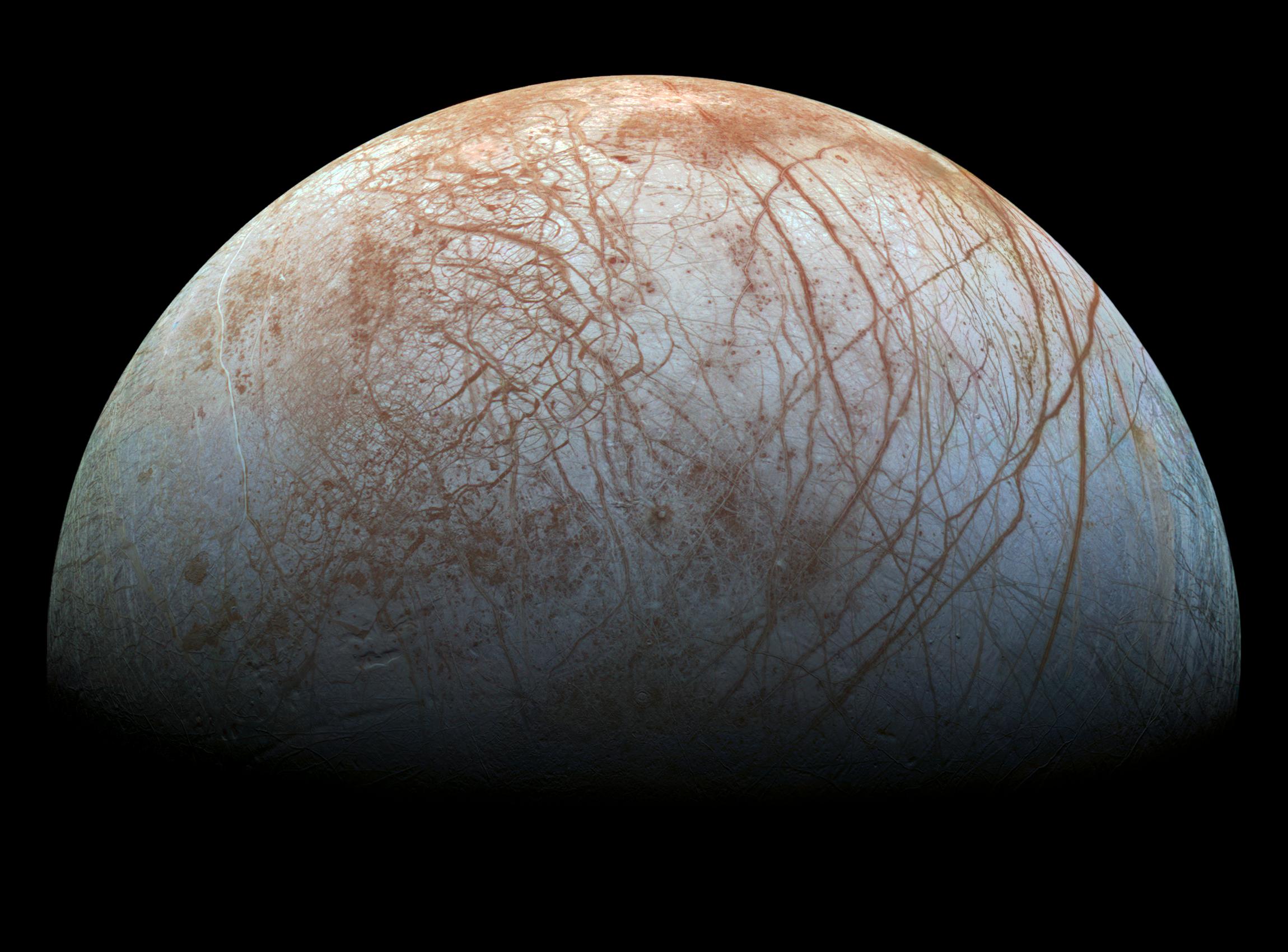
Europa in a reprocessed color view assembled from Galileo spacecraft images obtained in 1995 and 1998. Long fractures and ridges cross the icy surface, while reddish and brownish areas contain concentrations of non-ice material. Credit: NASA/JPL-Caltech/SETI Institute
Lovett et al. (2026) compared seven Keck I observing epochs covering Europa under substantially different orbital and magnetic conditions. The sequence combines archival observations from December 1999 with six sodium maps obtained between May 2018 and November 2025, giving the researchers a way to test whether the cloud changes as Europa moves through Jupiter’s highly variable plasma environment.
The result addresses a long-standing problem in interpreting Europa’s sodium. Energetic particles continually strike the moon’s icy surface and release atoms from it, while Europa repeatedly moves above and below the dense plasma associated with Io’s orbit. Earlier measurements and models allowed much larger changes in the sodium cloud. The new observations instead describe a comparatively persistent environment whose large-scale abundance shows little correlation with Europa’s orbital longitude or magnetic longitude.
Beyond 20 Europa radii, equivalent to about 31 200 km (19 400 miles) from the moon’s center using the radius adopted in the study, sodium abundance changed by less than about a factor of two between observing dates. Earlier measurements compiled for modeling had spanned approximately a factor of five. The observed distant cloud extends through the region between roughly 20 and 30 Europa radii, or about 31 200–46 800 km (19 400–29 100 miles).
What does a factor-of-two variation mean?
The comparison refers to the range of measured sodium abundance at large distances from Europa across the observing epochs. A factor-of-two range means the stronger measurements were roughly twice the weaker ones. Earlier observations used in Europa sodium models had spanned about a factor of five, so the new dataset describes a substantially more stable distant cloud.
The cloud was also generally oval-shaped and more extended along the dawn-dusk direction than north-south. Individual observing nights showed asymmetries, but those differences did not repeat in a consistent pattern tied to Europa’s orbital position or its location relative to Jupiter’s plasma sheet.
That weak relationship is physically important because plasma bombardment can regulate how rapidly sodium is knocked from Europa’s surface. Plasma associated with the Io Plasma Torus sweeps past Europa at nearly 100 km/s (62 miles/s), and the incoming flux changes as Jupiter’s tilted magnetic field rotates.
The researchers propose that transport time can blur the relationship between local plasma conditions and sodium measured far from the moon. Sodium released near Europa requires hours to travel outward to the altitudes accessible to ground-based observations. During that interval, Jupiter’s magnetic environment continues rotating, allowing short-lived local differences in sputtering to become mixed through the extended cloud.
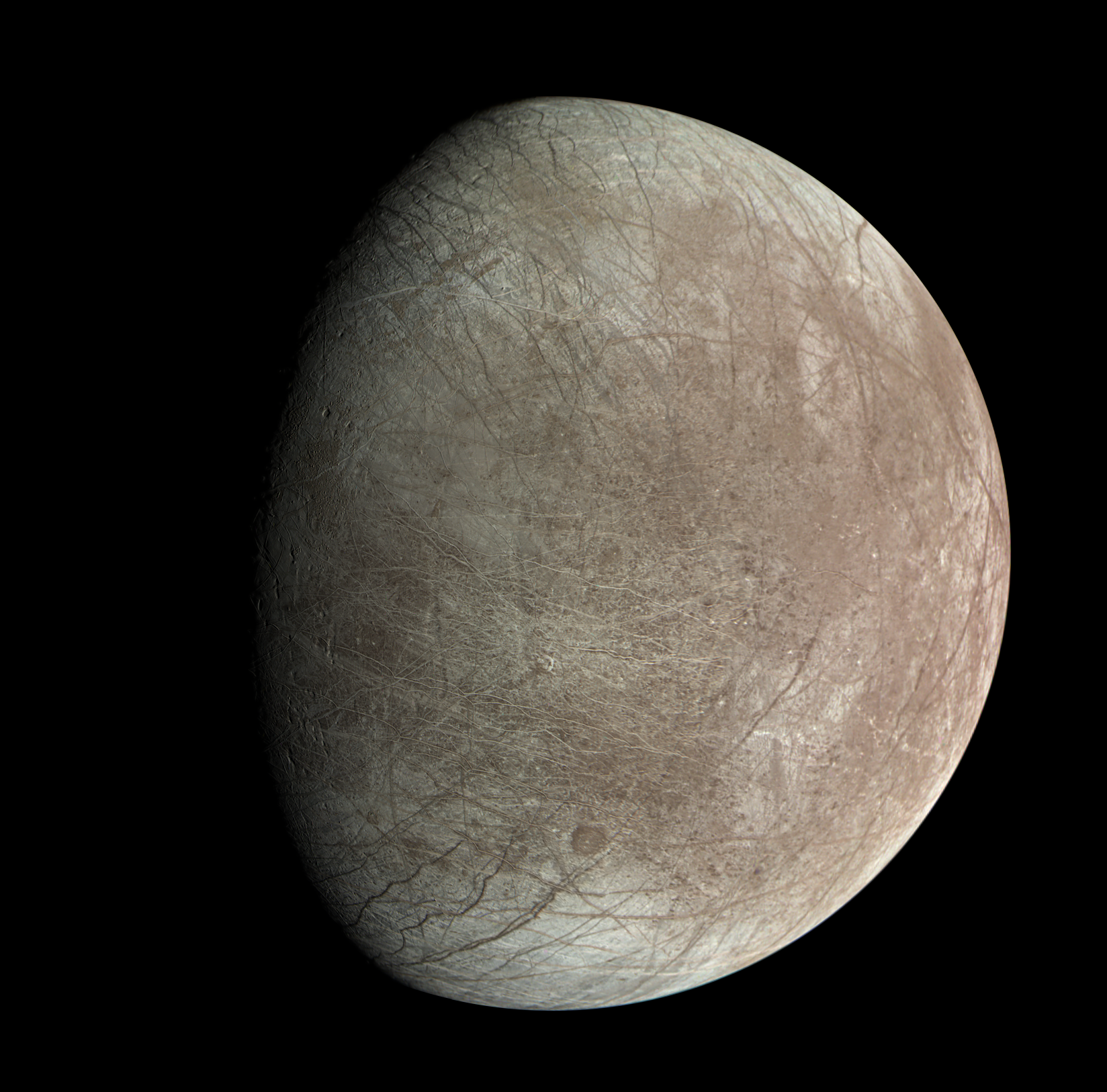
One of the seven observing epochs took place on September 29, 2022, while NASA’s Juno spacecraft was making a close Europa flyby. Keck observed the moon from Earth while Juno sampled the surrounding Jovian environment, providing context for the plasma conditions associated with that sodium map.
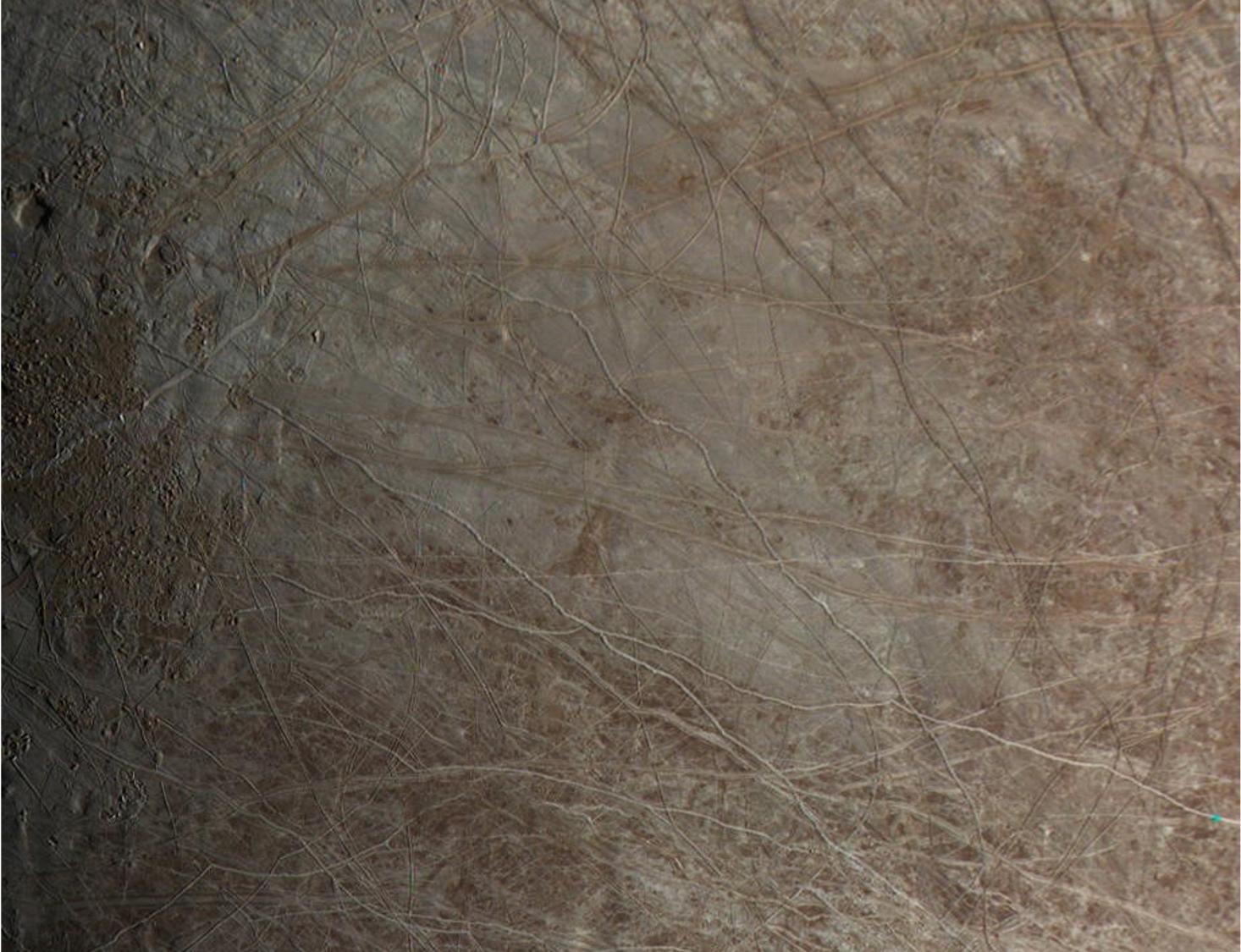
Seven observing epochs
| Observation date | UTC interval | West orbital longitude | System III magnetic longitude |
|---|---|---|---|
| December 28, 1999 | 04:28–05:33 | 101.85° | 19.70° |
| May 26, 2018 | 10:17–11:30 | 93.59° | 259.72° |
| September 29, 2022 | 09:35–11:30 | 278.24° | 135.81° |
| August 25, 2023 | 14:33–15:00 | 242.15° | 319.90° |
| October 16, 2023 | 11:09–12:06 | 95.03° | 248.51° |
| February 5, 2024 | 07:11–08:21 | 261.57° | 225.91° |
| November 29, 2025 | 11:45–12:40 | 116.53° | 218.11° |
Keck I’s High Resolution Echelle Spectrometer (HIRES) detects the two strong sodium D emission lines at visible wavelengths. Its long slit preserves spatial information as well as spectral information, enabling the researchers to construct maps of sodium around Europa instead of measuring the gas at only one point.
Bright sunlight reflected from Europa’s ice creates an important limitation. In ordinary sunlit observations, faint sodium emission cannot be separated reliably from the intense reflected continuum close to the disk, so the measurements mainly sample material several Europa radii above the surface.
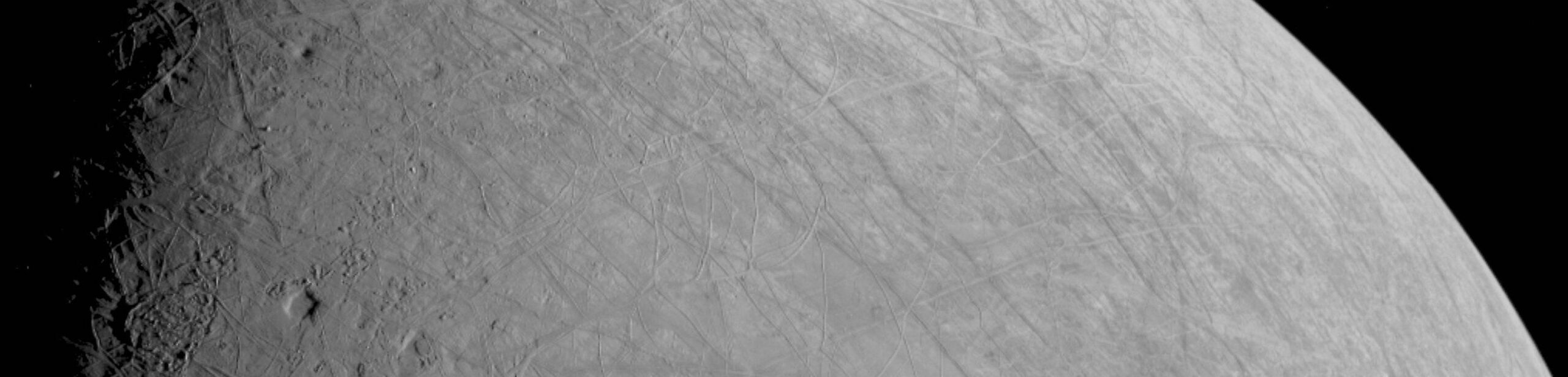
The team used Europa’s passage through Jupiter’s shadow to examine the low-altitude region that sunlight normally hides. With direct sunlight removed, electrons in the surrounding plasma can excite sodium atoms and make them emit light close to Europa’s visible disk. Ten spectra obtained on August 18, 2022 were processed individually and then combined.
The resulting sodium signal measured 16 ± 11 rayleighs. A rayleigh is a unit used to quantify faint diffuse atmospheric and auroral emission. The feature reached only 1.5σ statistical significance, so the paper treats it as a tentative detection rather than a secure measurement.
Why the 1.5σ result is described as tentative
A 1.5σ signal sits only modestly above the estimated background uncertainty. The statistical strength is too low to call the detection secure. The paper therefore uses the result as supporting evidence rather than treating it as a confirmed standalone detection.
The inferred disk-averaged sodium column density was (2 ± 1.4) × 1011 atoms/cm2, equivalent to (2 ± 1.4) × 1015 atoms/m2. The eclipse emission was about six times brighter than expected if the high-altitude escaping population were simply extrapolated back toward Europa’s disk.
The difference supports the presence of an additional population of sodium that remains gravitationally bound close to Europa, although the low statistical significance prevents the eclipse measurement from establishing that population on its own. The study considers collisions with Europa’s denser molecular oxygen atmosphere and the initial velocity distribution of sodium released from the surface as possible contributors to the altitude structure.
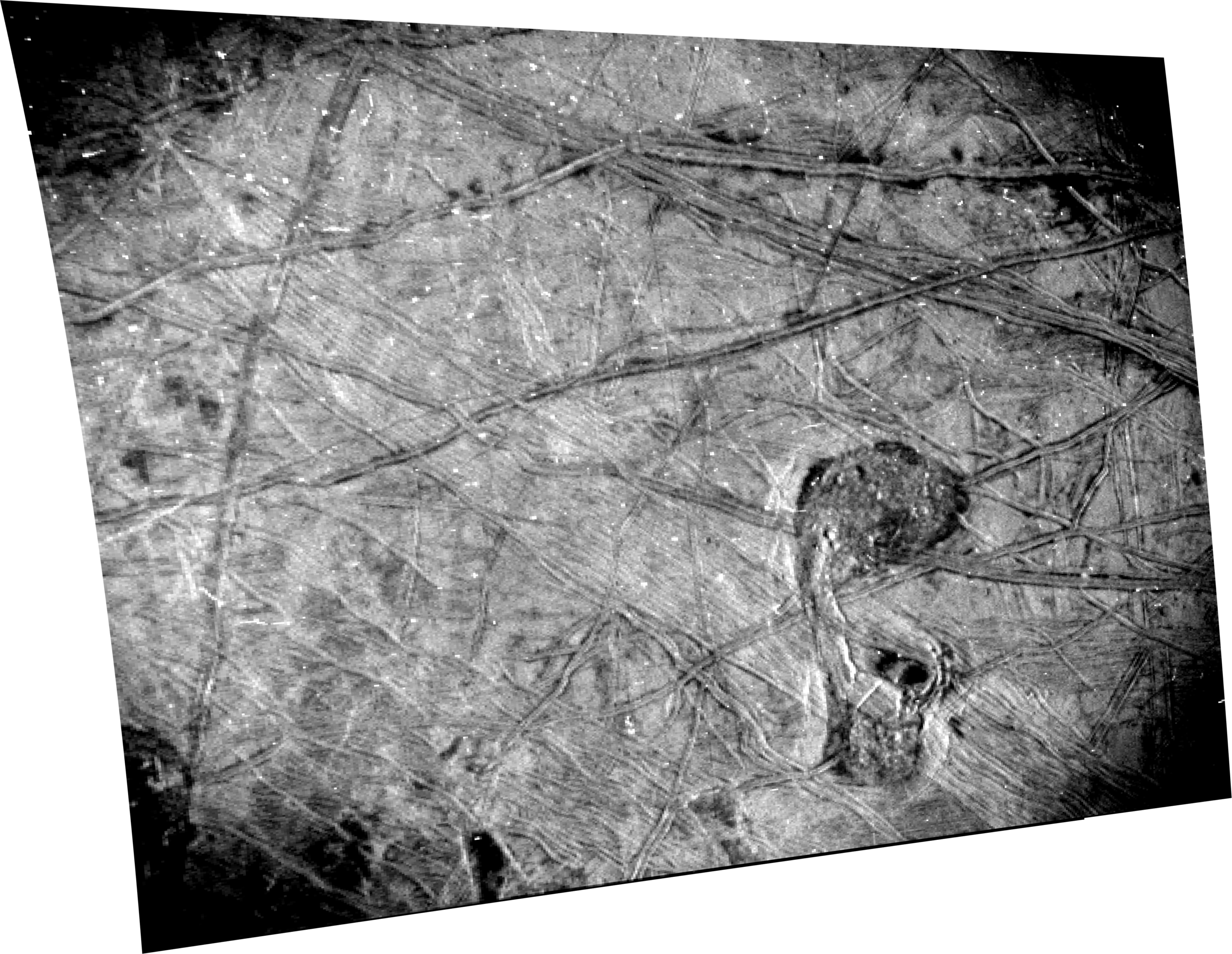
Sodium measured much farther from Europa behaves as a predominantly escaping population. Its radial decrease is close to the R-1 profile expected for escaping gas, and the researchers conclude that nearly all sodium in the distant exosphere must receive speeds of at least 2 km/s (1.2 miles/s) to enter escape trajectories.
Keep reading
The distinction between bound and escaping sodium matters because the cloud records what happens to material after it is liberated from Europa’s ice. Irradiated sodium chloride has previously been identified on Europa’s surface, and Europa’s sodium-to-potassium ratio differs from values associated with Io. The authors describe the combined evidence as strong support for an endogenic source at Europa.
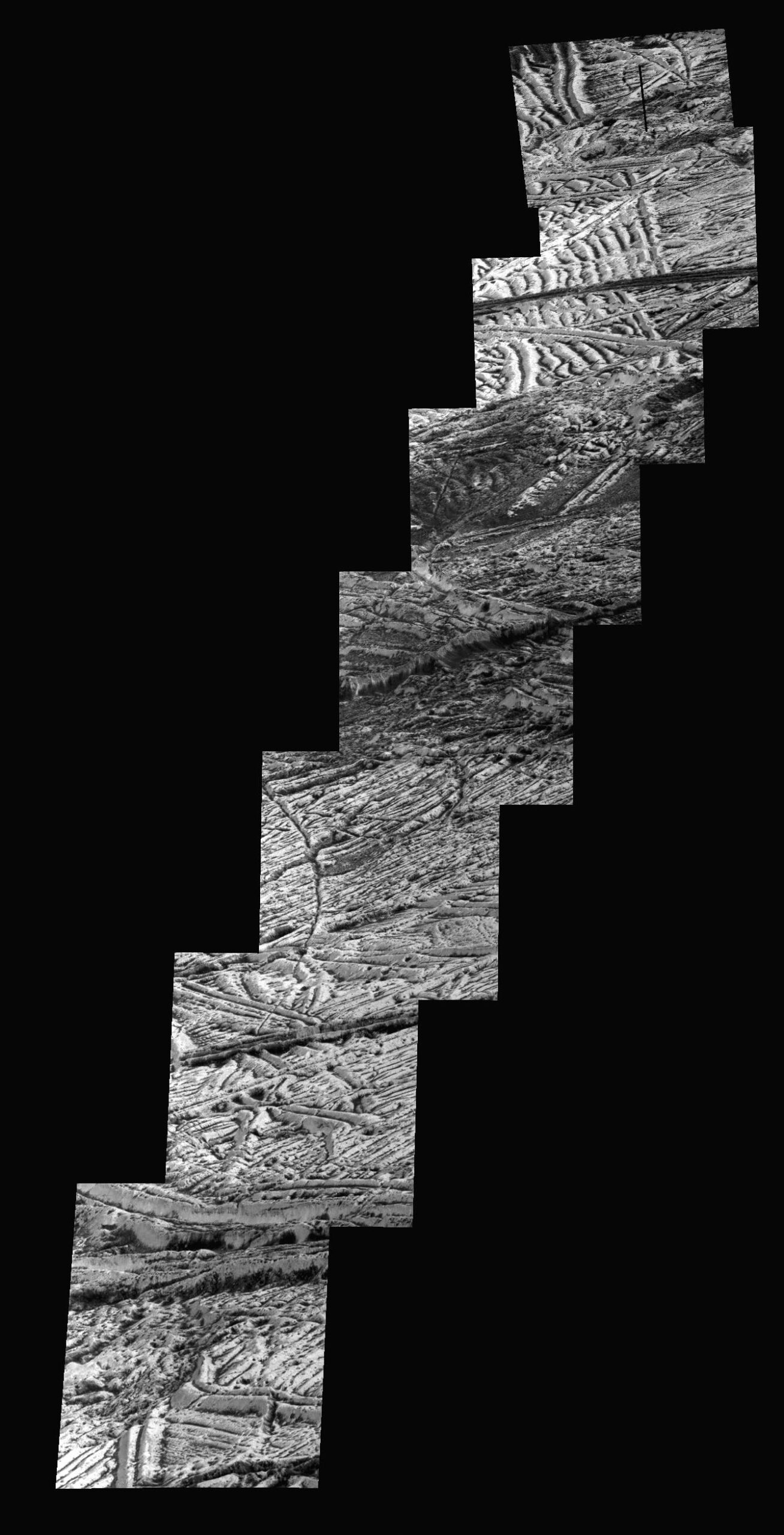
An endogenic source does not mean that the new observations directly sampled Europa’s subsurface ocean. If sodium chloride contained in subsurface seawater is transported upward by geological processes and incorporated into surface material, irradiation and energetic particles can release sodium from the ice into the neutral cloud.
What the study establishes about Europa’s hidden ocean
The observations establish that Europa’s distant sodium environment is more stable than earlier work implied. Together with previous measurements, they support an endogenic source for the sodium.
They do not directly measure subsurface seawater, ocean salinity or a continuous pathway carrying ocean material into space. The ocean connection depends on the broader evidence that internally sourced salts can reach Europa’s irradiated surface.
Io remains an important observational complication even if it is not the dominant source of Europa’s sodium. Volcanic activity at Io injects sodium-bearing material into the Jupiter system, creating extended neutral structures that can overlap lines of sight toward Europa. The researchers found that residual sodium originating from Io can affect some geometries and make Europa’s intrinsic variability harder to isolate.
Two modern radial profiles, from October 16, 2023 and November 29, 2025, were particularly flat. The authors examined contamination from Io’s extended sodium environment as one possible contributor to these unusual profiles.
The analysis also corrects a consequential numerical error in the research group’s earlier 2025 Keck study. Sodium and potassium column densities reported in that work had been overestimated by exactly a factor of 10 because of a conversion error.
After correction, the sodium densities agree more closely with previous measurements and no longer require the unusually energetic surface-release mechanism invoked in the earlier interpretation. The authors state that the previous collisionless interpretation should therefore be treated with caution.
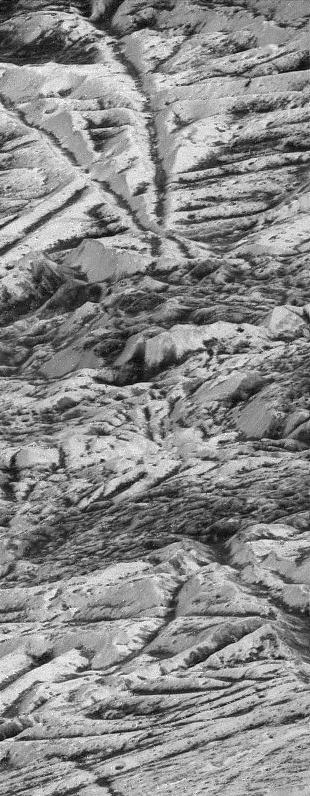
The correction changes the physical interpretation without removing the central observational result. Fast sodium still dominates at large distances, while the tentative eclipse measurement leaves room for a denser, lower-energy population near the surface. How collisions with molecular oxygen and the sodium release-energy distribution divide the cloud into bound and escaping components remains unresolved.

The sodium environment is relevant to spacecraft investigations because neutral atoms released from Europa provide one route for connecting surface composition with measurements of the surrounding plasma and gas. NASA’s Europa Clipper and ESA’s Juice mission are expected to examine Europa and the Jupiter system with instruments unavailable to ground-based telescopes.
NASA’s Eyes on the Solar System provides an interactive 3D view of Europa Clipper’s journey, allowing users to explore spacecraft trajectories and mission geometry.
Future observations can test whether the faint sodium seen during eclipse is reproducible, determine how much material remains bound close to Europa’s surface and improve separation of Europa’s sodium from material distributed through the broader Jovian system.

Keck’s observations establish a distant sodium cloud that stays unexpectedly stable across different orbital and magnetic geometries, with an escaping population and a tentative low-altitude signal consistent with additional gravitationally bound sodium. Connecting those measurements to Europa’s hidden ocean requires determining how salts move from the moon’s interior into its irradiated surface and subsequently into space.
References:
1 Lovett, E. L., Schmidt, C. A., Milby, Z., Ellis, S. P., & Szalay, J. R. (2026). Europa’s neutral sodium exosphere is quasi-stable over decades. Journal of Geophysical Research: Space Physics, 131(10), e2026JA035421. DOI: 10.1029/2026JA035421
2 Astronomers Reveal the Oceanic Origin of Europa’s Sodium Cloud – W. M. Keck Observatory – November 19, 2026
3 Europa – NASA Science
4 A JunoCam View of Europa – NASA Jet Propulsion Laboratory – May 15, 2024
5 JunoCam Close-Up of Europa – NASA Jet Propulsion Laboratory – December 14, 2022

I’m a science journalist and researcher at The Watchers, contributing to the Epicenter edition, where I cover peer-reviewed scientific research and emerging discoveries across Earth and space sciences. With a background in astronomy and a passion for environmental science, I’ve worked in shark and coral conservation in Fiji, conducting reef and shark-behavior research, contributing to mangrove restoration, and earning PADI Open Water and Coral Reef Certifications. I bring a blend of scientific rigor and storytelling to illuminate the discoveries shaping our planet and beyond.
More reporting
- Antarctica’s blue ice has yielded more than 45 000 meteorites, but about 5 000 a year are becoming inaccessible
- Chipmaking plasma releases oxygen-related gases from lunar-regolith simulants below 400°C
- KIC 4737720 changes its dominant pulsation as Kepler’s own cycle mimics stellar drift
- Global simulation reveals how successive solar eruptions overtake and magnetically merge
