
Extreme heat reversed which mussel sizes survived along the same Washington shoreline
Extreme heat during the 2021 Pacific Northwest heat dome produced opposite survival advantages within the same California mussel population at Cattle Point, Washington, with smaller mussels favored high on the shore and larger animals favored lower down. A peer-reviewed analysis published in 2026 traced the reversal to the interaction between body size, tidal exposure, evaporative cooling and heat loss to moving air.
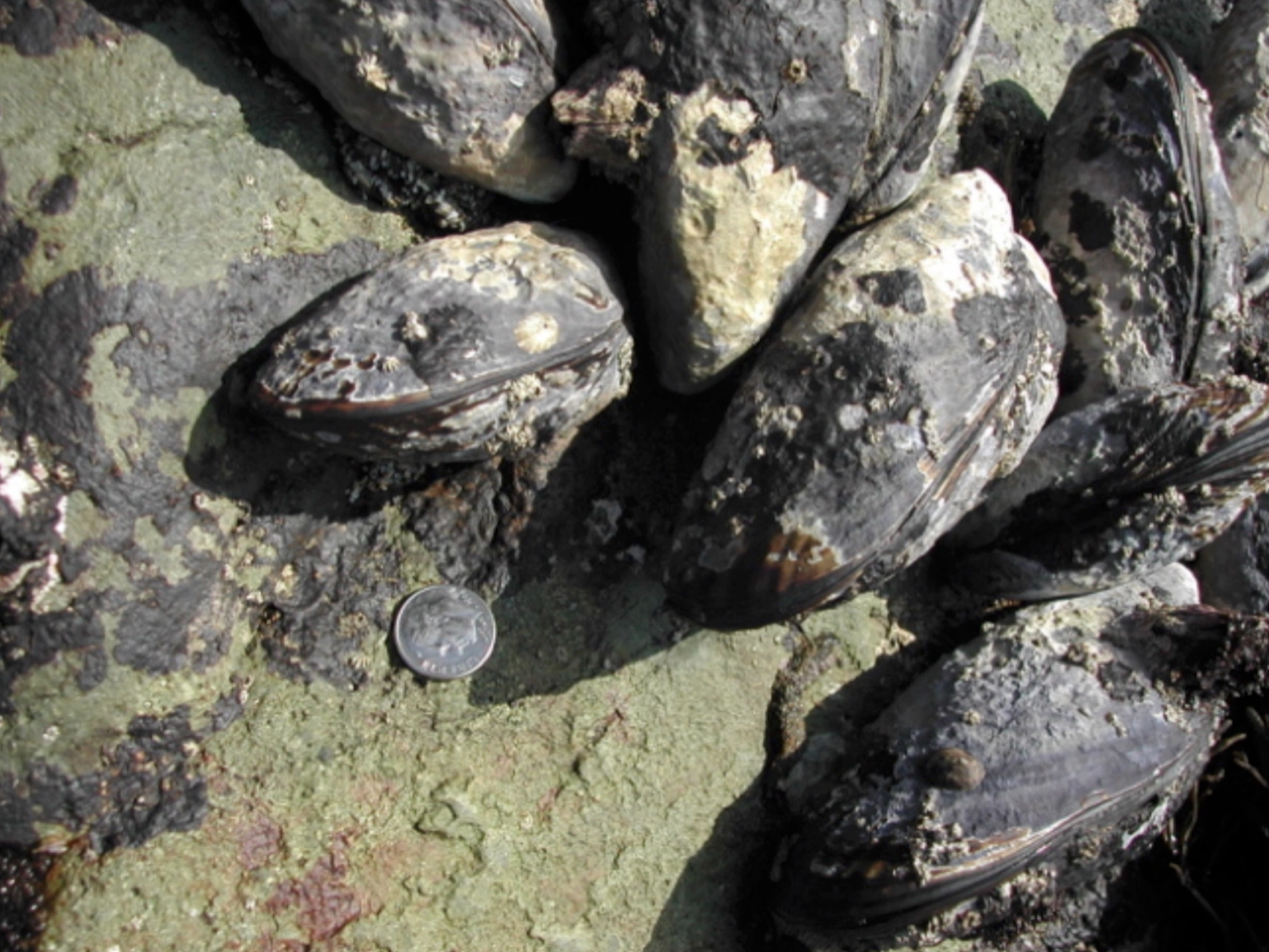
California mussels (Mytilus californianus) attached to intertidal rock. Body size affects both the quantity of water available for evaporative cooling and the rate at which heat can be exchanged with surrounding air. Credit: National Park Service / Wikimedia Commons, public domain

Litle et al. (2026) examined Mytilus californianus, the California mussel, at Cattle Point on San Juan Island after the June 2021 Pacific Northwest heat dome. The population provided a natural test of how extreme heat interacts with microhabitat: animals occupying the same shoreline experienced the same regional heatwave, but their time out of seawater and exposure to sunlight and wind changed with tidal elevation.
The result addresses an important limitation in attempts to estimate heat vulnerability from biological traits alone. Body size can affect water storage, heat exchange and desiccation, but the study found that its effect on survival was not fixed. The same broad trait favored opposite ends of the size distribution at different positions on the shore.
The survival pattern reversed across the shore
The University of Washington research team returned to Cattle Point one, two and three weeks after the onset of the heatwave to examine recently dead mussels and compare them with surviving animals. Overall mortality at the site was relatively low, but the size distribution of the deaths did not follow the pattern the researchers initially expected.
Smaller mussels were more common high on the shore, so the team initially expected more small animals to have died there. Larger mussels were more common farther down, where the researchers expected deaths to be weighted toward larger individuals. The observations showed the reverse: mussels that died high on the shore were larger than the survivors around them, while animals that died lower down were smaller than nearby survivors.
Small mussels were favored high on the shore, while large mussels were favored lower down.
Central field result reported by Litle et al. (2026)
| Shore position | Exposure conditions | Cooling constraint | Observed survival advantage |
|---|---|---|---|
| High intertidal | Longer aerial exposure | Greater desiccation pressure limits prolonged evaporative cooling | Smaller mussels |
| Middle intertidal | Intermediate exposure | Transition between cooling regimes | No equivalent strong directional pattern reported |
| Low intertidal | Shorter aerial exposure | Water stores can support evaporation for more of the exposure period | Larger mussels |
The contrast occurred over metre-scale habitat differences. That spatial scale matters because tidal height controls how long an intertidal animal remains outside seawater. During low tide, mussels lose the strong thermal buffering provided by the ocean and become exposed to solar radiation, warm air and wind.
A heat dome met a daytime low tide
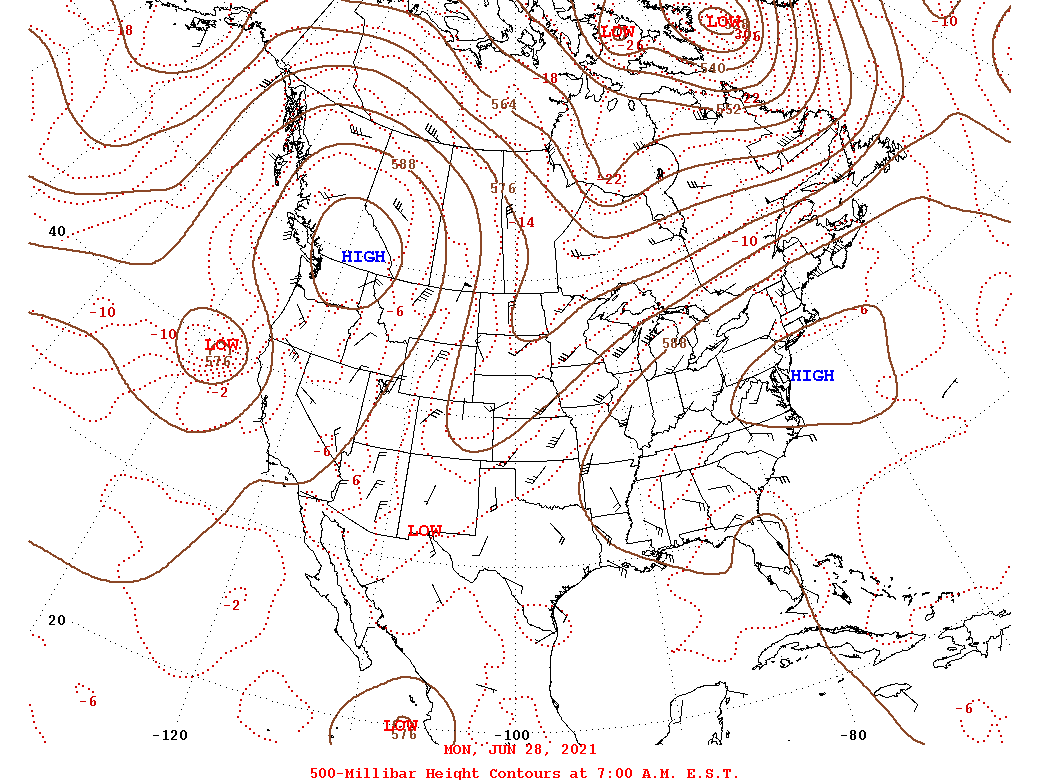
The June 2021 Pacific Northwest heat dome brought temperatures around 38°C (100°F) to a region where the University of Washington described normal summer highs as being in the mid-20s Celsius (mid-70s Fahrenheit). At Cattle Point, the extreme atmospheric heat coincided with daytime low tides, exposing mussels above the water during some of the hottest hours.
That coincidence is central to the biology of the event. An intertidal mussel can remain relatively cool while submerged, but low tide replaces seawater with a much more variable thermal environment. Solar radiation adds heat to the shell, evaporation removes heat while water remains available, and moving air can cool the animal through convection.
Why large and small mussels cool differently
The survival reversal emerged from two cooling processes that scale differently with body size. Larger mussels retain more seawater and therefore have a greater reservoir available for evaporative cooling. That can keep body temperature lower while the shell remains open and water is still available to evaporate.
Smaller mussels have a greater surface area relative to their volume. Once evaporation becomes constrained, that geometry allows a small body to exchange heat with surrounding moving air more rapidly than a larger one. The researchers describe that process as convective or wind cooling.
How the cooling trade-off works
Evaporative cooling: water absorbs heat as it evaporates. Larger mussels can carry greater internal water stores, extending the period during which evaporation can remove heat.
Convective cooling: moving air carries heat away from the body surface. Smaller mussels have more surface area relative to their volume, making this process comparatively more effective.
Desiccation: prolonged aerial exposure progressively removes the water needed for evaporation. The balance therefore changes with tidal elevation and exposure duration.
High on the shore, prolonged aerial exposure increased the risk that animals would deplete the water available for evaporative cooling. Under those conditions, smaller bodies retained an advantage through more efficient convective heat exchange. Lower on the shore, where exposure periods were shorter, larger animals could continue benefiting from their greater water reserves.
Robomussels recorded the thermal environment
Cattle Point was unusually useful for reconstructing the event because researchers had already been monitoring the mussel bed with biomimetic sensors known as “robomussels.” The devices are designed to reproduce important thermal properties of living mussels and contain temperature sensors sealed in dark material that records the operative temperatures experienced within the bed.
The monitoring record meant the researchers did not have to reconstruct the thermal environment from regional air temperature alone. They could compare mortality with measurements designed to represent the temperatures mussels actually experienced at the shoreline.
What the researchers combined
- Post-heatwave observations of surviving and recently dead mussels
- Shell-size measurements across different tidal elevations
- Long-term Friday Harbor Laboratories weather observations
- Temperature records from biomimetic robomussel sensors
- A physics-based heat and mass-transfer model
- Publicly archived simulation code and model outputs
The model tested the mechanism behind the field pattern
The mortality observations showed which body sizes survived at different tidal elevations, but they could not by themselves establish why the pattern reversed. Litle and colleagues therefore developed a dynamic heat-flux model that represented the transfer of heat and water between a mussel and its environment.
Keep reading
The model included incoming solar energy, thermal radiation, conduction with the substrate, convection with surrounding air and heat lost through evaporation. It also accounted for the progressive depletion of water available for evaporative cooling during aerial exposure.
Simulations reproduced the central field pattern: body size and microhabitat interacted rather than acting as independent predictors. Greater desiccation pressure high on the shore constrained evaporative cooling and favored smaller individuals that could cool efficiently through convection. Lower down, reduced desiccation pressure allowed larger individuals to use their greater water stores for longer.
| Physical process | Effect of larger body size | Effect of smaller body size |
|---|---|---|
| Water storage | More internal water available | Less internal water available |
| Evaporative cooling | Can persist longer when exposure is limited | Water reserve is depleted sooner |
| Surface area relative to volume | Lower | Higher |
| Convective wind cooling | Comparatively less efficient | Comparatively more efficient |
| Result | Advantage under shorter, less desiccating exposure | Advantage when prolonged exposure makes convection more important |
The 2021 event caused much broader marine mortality

The 2021 heat dome caused severe mortality across parts of the Pacific Northwest intertidal zone, including large losses of mussels and other marine organisms. The Cattle Point study addresses a narrower question than those regional estimates: why animals of different sizes within one mussel population survived differently over short distances during the same event.
That distinction keeps the 2026 result from being interpreted as a new estimate of regional mortality. Its contribution is mechanistic. The work links field observations with heat-transfer physics to explain why the direction of selection on body size changed with position on the shore.
Why the finding matters
Climate-impact assessments often use traits such as body size, physiology or thermal tolerance to estimate which organisms are most vulnerable to extreme heat. The Cattle Point results show why such traits cannot always be interpreted independently of habitat. A characteristic that reduces thermal risk under one exposure regime can increase risk under another because the physical routes for gaining and losing heat change with the environment.
The study therefore does not identify one universally heat-resistant mussel size. It shows that survival depends on an interaction among organismal traits, local exposure time, water loss and heat exchange. That interaction can vary over distances of only metres within a single population.
The University of Washington said the physics-based framework can be extended to other tidal shellfish and could eventually help examine questions relevant to shellfish cultivation, where growers can move animals between tidal elevations. The Cattle Point field study itself examined wild California mussels, so applications to aquaculture remain an extension of the model rather than a demonstrated management outcome.
What remains unresolved
The study concerns one California mussel population at one site during one exceptional heatwave. The physical mechanisms represented by the model are general, but the size distribution, tidal environment, wind conditions, water availability and thermal tolerance of mussels differ among locations and populations.
Testing whether the same reversal appears elsewhere will require comparable field observations during future extreme-heat events. Such work would establish how broadly trait–microhabitat interactions can improve ecological projections and whether the relationship remains consistent across different coasts, species and tidal regimes.
References:
1 Litle, J. W., Fales, R. J., Murie, K. A., & Carrington, E. (2026). Extreme heat drives opposing patterns of size-dependent survival across microhabitats. Proceedings of the Royal Society B: Biological Sciences, 293(2083), 20262200. DOI: 10.1098/rspb.2026.2200
2 Mid-size mussels fared the worst during the 2021 Pacific Northwest heat dome – University of Washington – November 17, 2026
3 Litle, J., Fales, R., Murie, K., & Carrington, E. (2026). Data and code from: Extreme heat drives opposing patterns of size-dependent survival across microhabitats. Dryad. DOI: 10.5061/dryad.1zcrjdg6j
4 Heat Wave Impacts 1 Billion Sea Creatures In The Pacific Northwest – MS NOW / YouTube – July 9, 2021
5 500-mb pressure chart, June 28, 2021 – NOAA Weather Prediction Center – June 28, 2021

I’m a science journalist and researcher at The Watchers, contributing to the Epicenter edition, where I cover peer-reviewed scientific research and emerging discoveries across Earth and space sciences. With a background in astronomy and a passion for environmental science, I’ve worked in shark and coral conservation in Fiji, conducting reef and shark-behavior research, contributing to mangrove restoration, and earning PADI Open Water and Coral Reef Certifications. I bring a blend of scientific rigor and storytelling to illuminate the discoveries shaping our planet and beyond.
More reporting
- Recurrent flooding linked to higher odds of depression, anxiety and stress among farmers in southern Thailand
- Roman bath at Stratonikeia reveals centuries of earthquake damage, repair and final collapse
- New mapping finds widespread landslide susceptibility along Amarnath pilgrimage corridor, India
- Sudden heat shock linked to poorest honey bee survival in laboratory study
