
Why ESA’s Plasma Observatory needs seven spacecraft to study Earth’s magnetosphere
The European Space Agency (ESA) has selected a seven-spacecraft mission designed to tackle a measurement problem that existing four-spacecraft constellations cannot fully resolve: how energy moves between different physical scales inside Earth’s magnetosphere. Plasma Observatory will measure the plasma simultaneously at fluid and ion scales, giving scientists two three-dimensional views at once and allowing them to investigate how processes operating at different scales interact as they evolve.
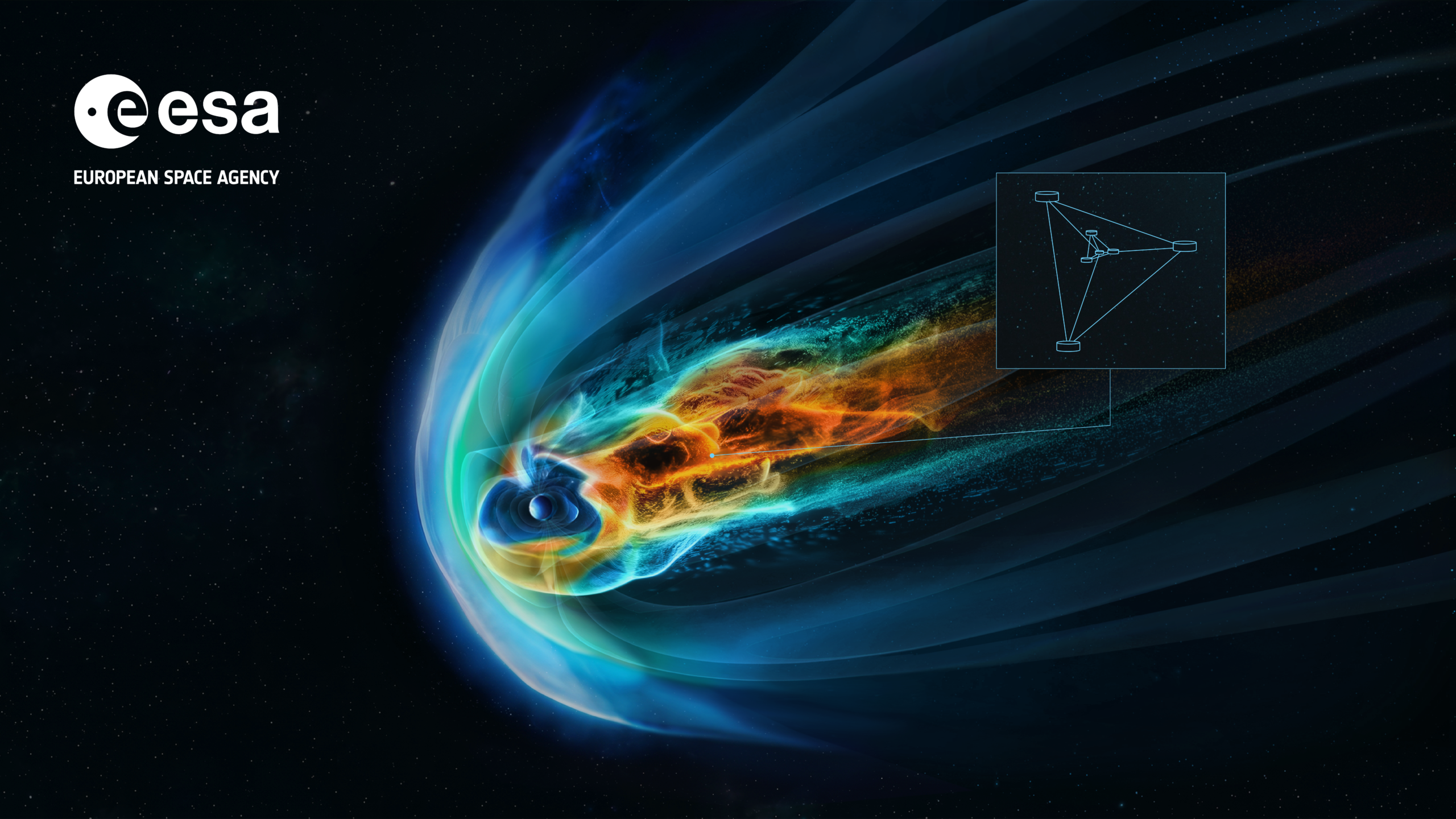
Artist impression of Earth’s magnetosphere interacting with the solar wind. Plasma Observatory will use seven spacecraft to investigate how plasma is energized and transported across different spatial and temporal scales. Credit: ESA. Licence: CC BY-SA 3.0 IGO or ESA Standard Licence.
Earlier multi-spacecraft missions established that the interaction between the solar wind and Earth’s magnetic environment does not occur on a single characteristic scale. ESA’s four-spacecraft Cluster mission showed that relevant plasma processes extend from a few kilometres to tens of thousands of kilometres and evolve over periods ranging from milliseconds to minutes, but a four-spacecraft constellation can optimally examine only one scale of space and time at once.
That limitation matters because particle energization is produced through processes that interact across different scales. Collisionless shocks, magnetic reconnection, turbulence and plasma jets can transfer electromagnetic energy into particle motion, heating and acceleration while structures at ion scales evolve inside much larger fluid-scale systems. Existing observations have provided detailed measurements of individual scales, but they cannot simultaneously resolve the cross-scale coupling, three-dimensional structure and time evolution required to separate those effects completely.

ESA Member States formally selected Plasma Observatory as the agency’s next medium-class science mission on November 19, 2026. The mission fills the M7 slot and will become the first medium-class mission in ESA’s Voyage 2050 science programme. The decision is a mission selection rather than formal adoption or launch approval; ESA said the project now moves toward adoption and construction, with launch provisionally foreseen for the late 2030s.
Seven coordinated spacecraft will measure particles together with magnetic and electric fields at seven locations. ESA describes the objective as tracking how energy moves through Earth’s magnetic environment across different scales of distance and time, allowing scientists to connect small, rapidly changing processes with larger changes throughout key regions of the magnetosphere.
Why seven spacecraft change the measurement
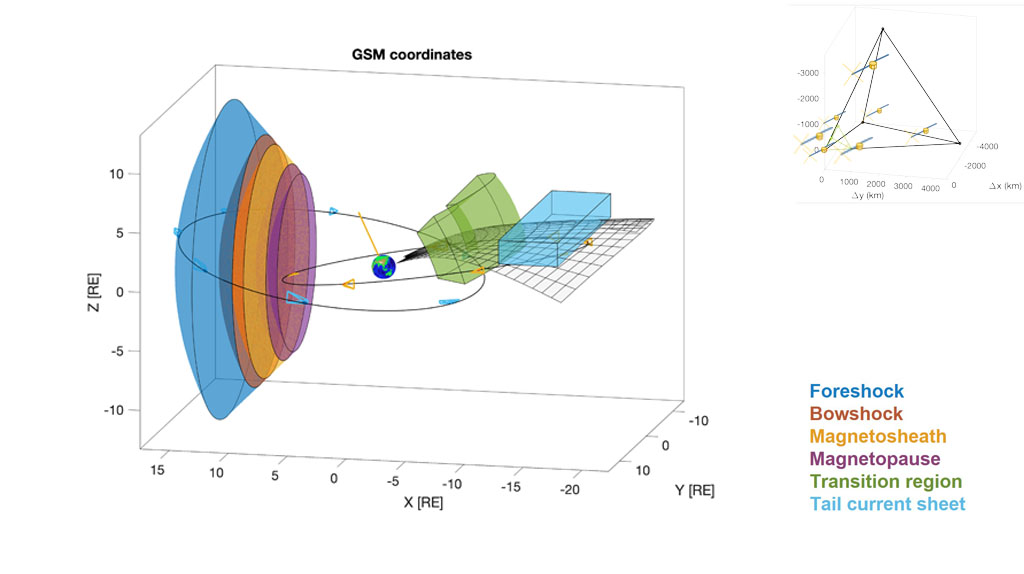
The current mission design arranges seven identical spacecraft into two tetrahedra that share one common spacecraft. Four measurement points form a tetrahedron capable of sampling three-dimensional spatial variations. Sharing one spacecraft between two differently sized tetrahedra creates two simultaneous three-dimensional measurement volumes with seven spacecraft rather than eight.
The smaller formation is designed to resolve ion-scale physics, while the larger tetrahedron provides the surrounding fluid-scale context. The baseline spacecraft separations range from about 30 km (19 miles) at ion scales to about 5 000 km (3 107 miles) at fluid scales. The mission team gives a baseline highly elliptical orbit of 8 × 17 Earth radii with an inclination of 15°. Using a mean Earth radius of 6 371 km (3 959 miles), those geocentric distances correspond to approximately 50 968 × 108 307 km (31 670 × 67 299 miles) from Earth’s centre.
| Mission element | Verified specification |
|---|---|
| Mission | Plasma Observatory |
| ESA slot | M7 medium-class mission |
| Programme | First medium-class mission of Voyage 2050 |
| Spacecraft | 7 identical spacecraft |
| Formation | Two tetrahedra sharing one common vertex |
| Primary simultaneous scales | Ion and fluid |
| Ion-scale separation | About 30 km (19 miles) |
| Fluid-scale separation | About 5 000 km (3 107 miles) |
| Baseline orbit | 8 × 17 Earth radii, approximately 50 968 × 108 307 km (31 670 × 67 299 miles) geocentric distance |
| Inclination | 15° |
| Current status | Selected by ESA Member States; formal adoption still ahead |
| Provisional launch | Late 2030s |
The scientific rationale for a larger constellation predates the M7 selection. Retinò et al. (2022) developed an earlier L-class Plasma Observatory concept around a fundamental question: how charged particles gain energy in space plasmas. Their peer-reviewed white paper identified five broad processes and combinations of processes that require better measurements: shocks, magnetic reconnection, waves and turbulence, plasma jets, and interactions among those mechanisms.
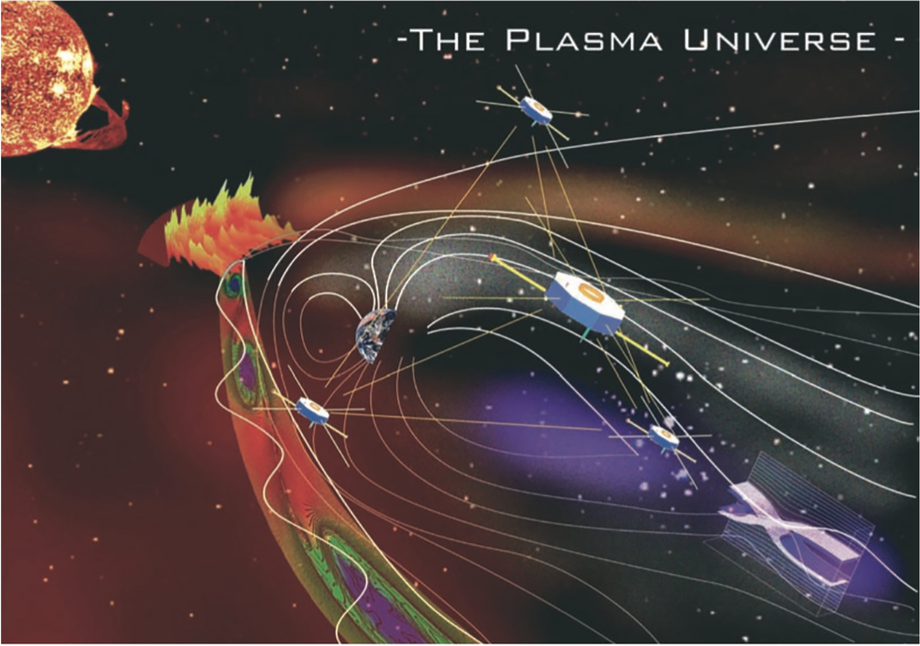
The earlier study proposed at least seven spacecraft spanning fluid, ion and electron scales. That proposal should not be treated as an exact specification of the mission selected in 2026. Plasma Observatory evolved during ESA’s subsequent M7 studies, and the selected design retains seven spacecraft while concentrating its simultaneous multi-scale measurements on fluid and ion scales.
The underlying measurement problem, however, remains closely related. Plasma structures responsible for particle energization can be three-dimensional, nonlinear and non-stationary. If several spacecraft measure different values as one structure moves across the constellation, scientists need to know whether those differences reflect the structure’s shape, changes occurring with time, or both.
Separating a changing structure from its shape
Retinò et al. used short large-amplitude magnetic structures (SLAMS) upstream of collisionless shocks as one example. Cluster observations showed structures whose amplitude changed as they propagated, meaning four points could not completely separate spatial form from temporal growth. The study proposed seven measurement points so that additional spacecraft could sample both the direction of propagation and directions perpendicular to it.
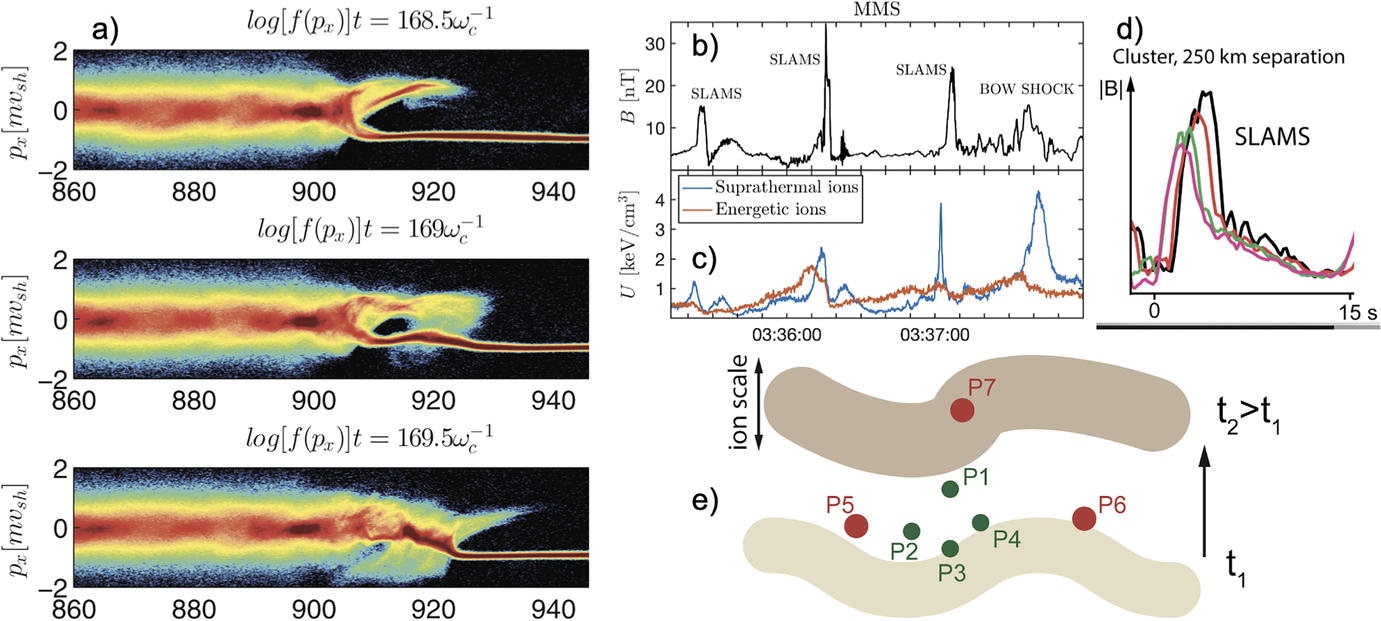
This distinction between space and time is central to the mission concept. A four-spacecraft tetrahedron can reconstruct gradients under assumptions about the structure being measured, but rapidly evolving or strongly nonlinear plasma features can violate those assumptions. Additional simultaneous measurement points provide more constraints on the geometry and evolution of the same event.
Keep reading
Magnetic reconnection links small and large scales
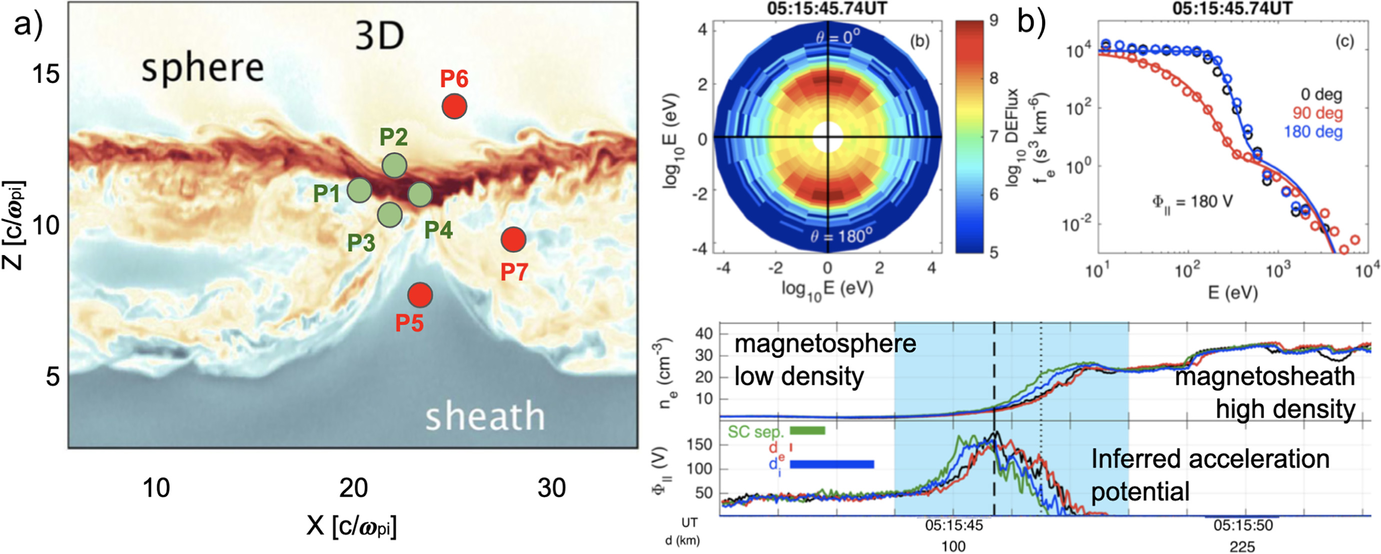
Magnetic reconnection provides another example. Reconnection occurs in thin current sheets where magnetic-field configurations change and magnetic energy is transferred into particle motion, heating and acceleration. Ion-scale and smaller kinetic processes occur inside a much larger system whose conditions influence where reconnection begins and how it develops.
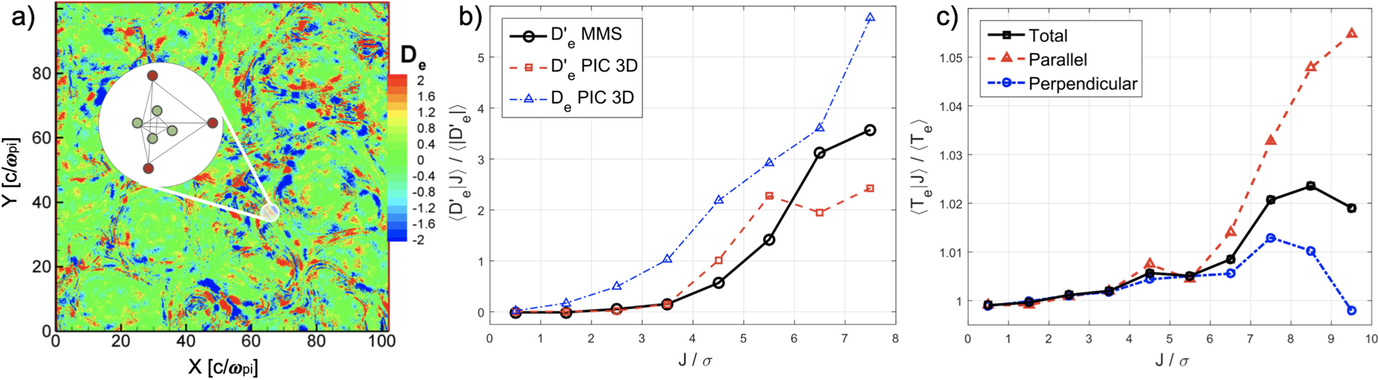
NASA’s four-spacecraft Magnetospheric Multiscale (MMS) mission has measured reconnection with much higher temporal resolution than earlier missions and has resolved processes associated with electron-scale regions. The scientific gap identified by the Plasma Observatory work is different: measurements at one scale cannot simultaneously provide the larger-scale three-dimensional context required to determine how the scales are coupled.
Turbulence concentrates energy into smaller structures
Turbulence creates a related cross-scale problem. Energy introduced into a plasma at larger scales can cascade into smaller structures where currents become concentrated and particles are heated or accelerated. Measurements from MMS and numerical simulations show that strong dissipation can occur in localized coherent structures, but a four-point constellation cannot simultaneously map the broader turbulent environment and the smaller structures at all required scales.
Plasma Observatory’s selected M7 architecture approaches that problem with simultaneous ion- and fluid-scale measurements. The mission is designed to travel through the foreshock, bow shock, magnetosheath, magnetopause, magnetotail current sheet and transition region, allowing the same seven-spacecraft geometry to investigate different plasma environments around Earth.
Where the seven spacecraft will make their measurements
Near-Earth space is especially valuable for this work because instruments can directly sample the plasma rather than observing it only from a distance. Spacecraft can measure particle distributions, magnetic fields and electric fields while passing through the physical structures responsible for energy conversion. Similar shock, reconnection, turbulence and jet processes occur elsewhere in the heliosphere and in astrophysical plasmas, where equivalent in-situ measurements are usually impossible.
From Cluster to Plasma Observatory
Cluster provided a major step toward three-dimensional plasma measurements by operating four spacecraft in formation around Earth. The mission began operations in 2000 and officially ended on September 8, 2024, after almost 24 years of scientific operations. Its results established both the power and the limitations of four-point measurements, creating part of the observational foundation on which Plasma Observatory is being developed.

MMS represents another important step. Its four spacecraft were launched in 2015 to study magnetic reconnection with instruments optimized for rapid particle and field measurements. MMS can resolve small-scale reconnection physics that Cluster could not, but it remains a four-point constellation and therefore cannot simultaneously provide the two three-dimensional scales targeted by Plasma Observatory.

Scientific relevance to space weather
The solar wind continuously carries plasma away from the Sun and into Earth’s magnetic environment. Strong solar–magnetosphere interactions produce auroras, and sufficiently severe space-weather disturbances can affect satellites and electrical infrastructure. Plasma Observatory will investigate fundamental processes involved in those interactions, but ESA has not presented the mission as an operational forecasting system and its selection does not represent a current space-weather warning.
The distinction is important. Better measurements of energy transfer can improve fundamental understanding of the magnetosphere and provide constraints for future physical models, but improved physical understanding does not automatically translate into a demonstrated ability to forecast specific space-weather events. The selected mission remains years from launch and its scientific performance has not yet been tested in flight.
The remaining scientific question is whether the seven-spacecraft configuration can reveal cross-scale relationships that existing missions must observe separately or reconstruct under simplifying assumptions. Plasma Observatory is designed to make the fluid- and ion-scale measurements simultaneously, turning the geometry of the constellation into a central part of the experiment rather than simply increasing the number of instruments in space.
References:
1 Retinò, A., Khotyaintsev, Y., Le Contel, O., Marcucci, M. F., Plaschke, F., Vaivads, A., Angelopoulos, V., Blasi, P., Burch, J., De Keyser, J., Dunlop, M., Dai, L., Eastwood, J., Fu, H., Haaland, S., Hoshino, M., Johlander, A., Kepko, L., Kucharek, H., Lapenta, G., Lavraud, B., Malandraki, O., Matthaeus, W., McWilliams, K., Petrukovich, A., Pinçon, J.-L., Saito, Y., Sorriso-Valvo, L., Vainio, R., & Wimmer-Schweingruber, R. (2022). Particle energization in space plasmas: towards a multi-point, multi-scale plasma observatory. Experimental Astronomy, 54, 427–471. DOI: 10.1007/s10686-021-09797-7
2 Seven-spacecraft observatory to study plasma universe – European Space Agency – November 19, 2026
3 The Plasma Observatory Mission – Plasma Observatory / INAF-IAPS

I’m a science journalist and researcher at The Watchers, contributing to the Epicenter edition, where I cover peer-reviewed scientific research and emerging discoveries across Earth and space sciences. With a background in astronomy and a passion for environmental science, I’ve worked in shark and coral conservation in Fiji, conducting reef and shark-behavior research, contributing to mangrove restoration, and earning PADI Open Water and Coral Reef Certifications. I bring a blend of scientific rigor and storytelling to illuminate the discoveries shaping our planet and beyond.
More reporting
- Benjamin Franklin was right in 1784 when he guessed that a volcano in Iceland had filled Europe's summer sky with a sulfur-smelling haze
- Weather-disaster losses take larger share of national income in 13 of 20 countries, Munich Re finds
- Warming could make the same El Niño produce a larger Indian monsoon rainfall deficit
- Every New Year's Day, scientists move the South Pole marker about 33 feet because the ice it stands on is sliding toward the sea
