
Warming could make the same El Niño produce a larger Indian monsoon rainfall deficit
A warmer climate could make India’s summer monsoon respond more strongly to the same degree of El Niño warming in the Pacific, according to a new analysis of observations and climate-model simulations. After using historical observations to constrain the models, researchers estimated that the late-century rainfall response to ENSO could become nearly 40% greater in magnitude than the relationship measured during 1963–2023, although they caution that confidence in the projected strengthening remains relatively low.
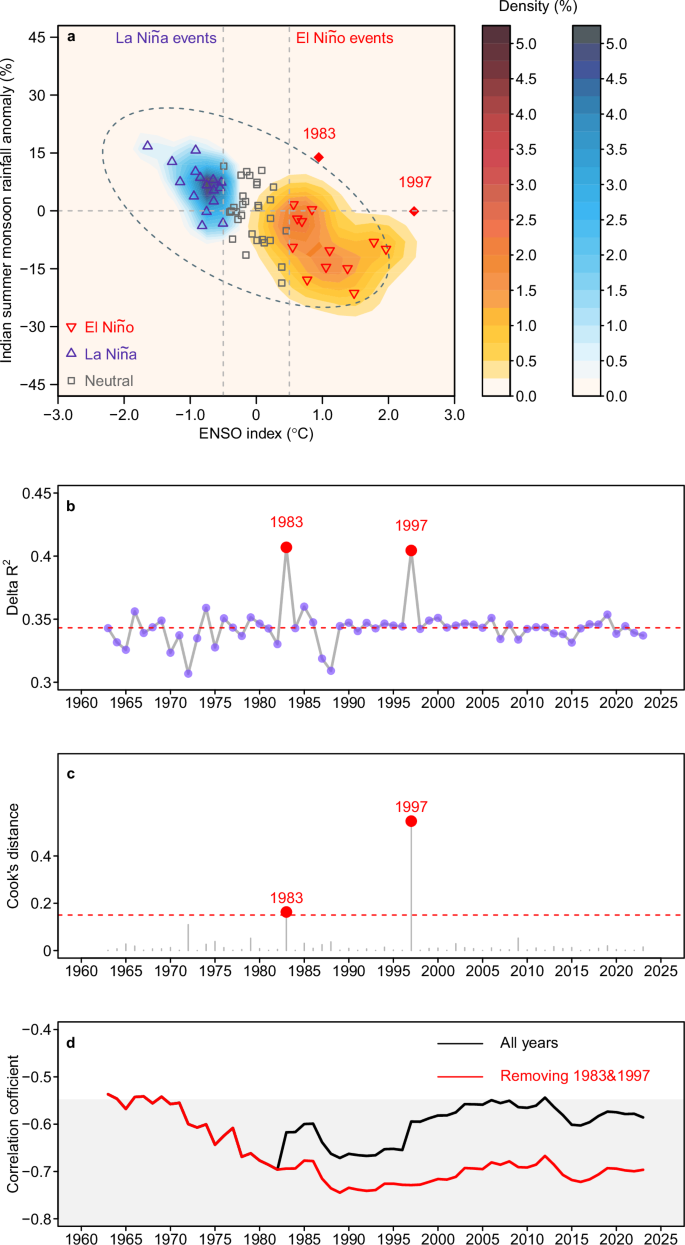
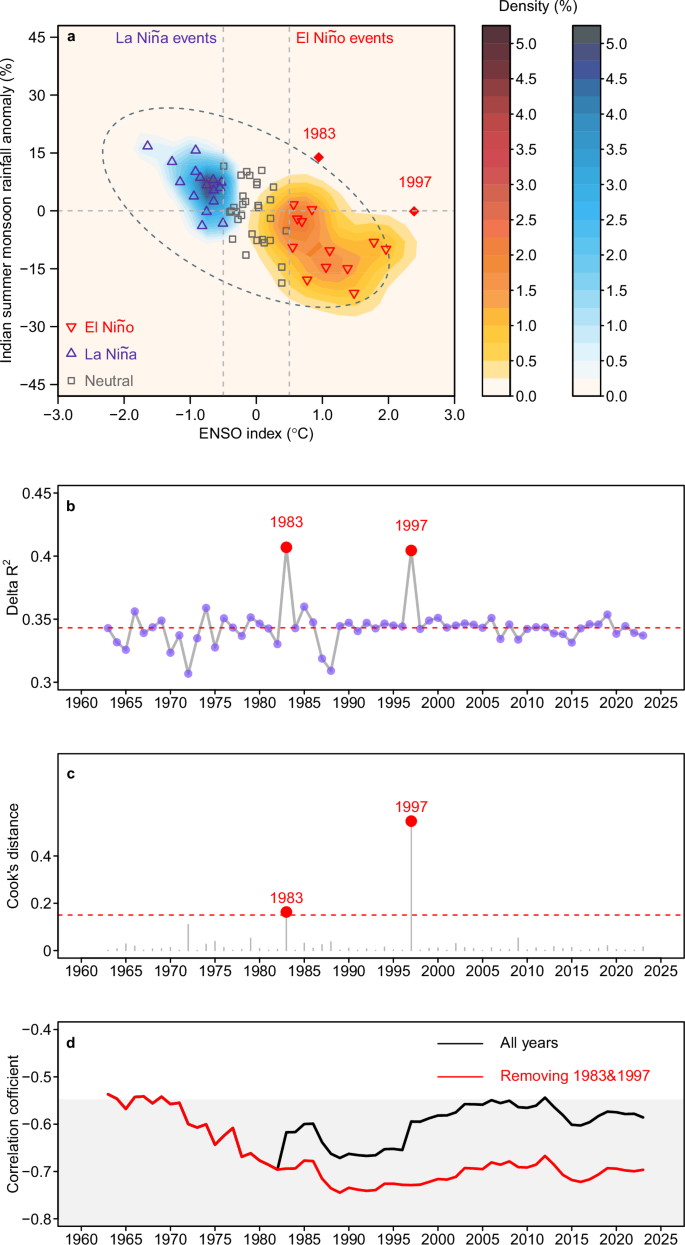
Relationships between ENSO and Indian summer monsoon rainfall. The 1983 and 1997 events stand out as unusually influential observations in the historical relationship. Credit: Zhao et al. (2026), Nature Communications.
For more than two decades, scientists have debated whether one of the most important climate connections affecting India was losing strength. El Niño, the warm phase of the El Niño–Southern Oscillation (ENSO), generally reduces Indian summer monsoon rainfall, but observations from the late 20th century appeared to show that this relationship had weakened substantially.
Zhao et al. (2026) found that much of that apparent breakdown can be traced to two unusual monsoon seasons, in 1983 and 1997. After accounting for those events, the researchers found that the inverse connection between ENSO and Indian summer monsoon rainfall remained strong and had intensified between the earlier and later parts of the observational record.
The distinction matters because Indian summer monsoon rainfall during June through September supplies about 80% of the annual precipitation over the Indian subcontinent. Changes in that seasonal rainfall affect water availability and agricultural production, so a shift in how strongly the monsoon responds to ENSO changes the climatic pressure associated with a given El Niño event.
The researchers measured this relationship as the percentage change in Indian summer monsoon rainfall for each 1°C (1.8°F) change in their ENSO index. A more negative sensitivity means that the same increase in ENSO strength is associated with a larger reduction in monsoon rainfall.
| Period or projection | ENSO–monsoon sensitivity | Meaning |
|---|---|---|
| 1902–1962 | −5.0% per °C | Earlier historical relationship after excluding 1983 and 1997 |
| 1963–2023 | −6.6 ± 0.2% per °C | Stronger historical rainfall response |
| Late-century constrained projection | −8.7 ± 1.4% per °C | Nearly 40% greater magnitude than 1963–2023 |
The two anomalous years behaved differently for different physical reasons. During 1983, surface warming persisted in the Niño3 region after the major 1982–83 El Niño, but the coupled ocean–atmosphere state had already begun changing. Subsurface temperatures in the equatorial Pacific had transitioned toward colder conditions, weakening the atmospheric response normally associated with an active El Niño.
At the same time, delayed warming in the North Indian Ocean increased moisture transport toward India and supported monsoon rainfall. The researchers describe this delayed response as the Indian Ocean capacitor effect, in which ocean warming left by the preceding El Niño influences atmospheric circulation after conditions in the tropical Pacific have started to change.
The 1997 monsoon departed from the expected response in a different way. Although the 1997 El Niño was exceptionally strong, all-India summer monsoon rainfall remained near normal, at about 2% above the reference level used in the study. Increased rainfall during July and August compensated for deficits during June and September.
The researchers linked the near-normal rainfall that year to several interacting processes, including changes in circulation around the Iranian Plateau, stronger moisture transport from the Arabian Sea and anomalous warming in the northern Indian Ocean. Those processes counteracted part of the drying normally associated with El Niño.
Removing 1983 and 1997 changed the statistical picture substantially. During 1980–1999, the interval in which the ENSO–monsoon relationship had previously appeared to collapse, the estimated rainfall sensitivity changed from −2.4% per °C to −5.7% per °C after those two years were excluded.
The researchers then tested whether the stronger relationship seen during the later observational period could fall within natural climate variability alone. They compared the observations with preindustrial-control simulations from climate models, which contain internally generated climate variations without changing external forcing.
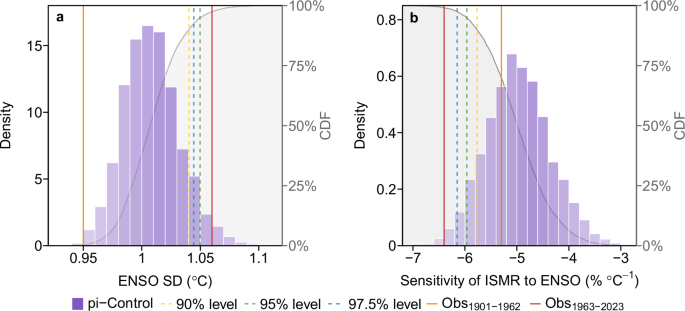
The ENSO–monsoon relationship for 1902–1962 remained within the simulated range of natural variability. For 1963–2023, after 1983 and 1997 were excluded, the observed relationship exceeded the 97.5th percentile of the preindustrial-control distribution. The authors interpret that result as evidence that anthropogenic warming strengthened rather than weakened the historical ENSO–monsoon relationship.
The future part of the study addressed a separate question: if an El Niño produces the same degree of tropical Pacific sea-surface warming in a warmer climate, will India’s monsoon respond in the same way?
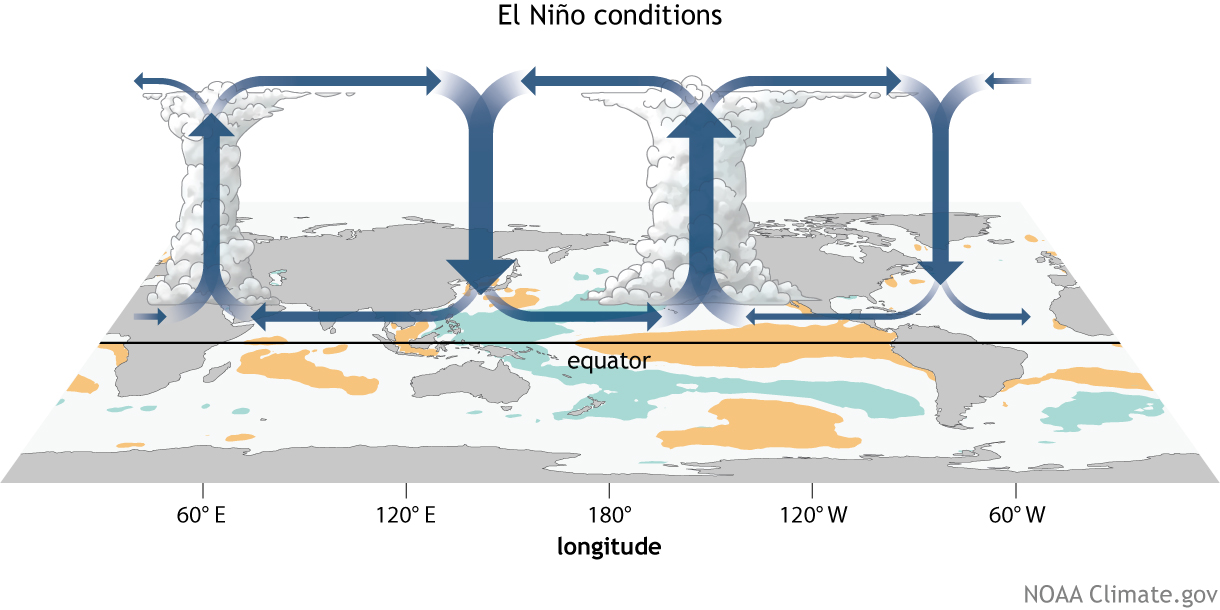
The physical mechanism centers on the Walker circulation, the large-scale tropical atmospheric circulation connecting zones of rising and sinking air across the Pacific and surrounding regions. During El Niño, warmer water in the central and eastern tropical Pacific shifts deep convection eastward. Changes in that circulation promote descending air over parts of the Indian subcontinent, suppressing cloud development and rainfall.
In a warmer atmosphere, the models analyzed by Zhao and colleagues produce a stronger tropical rainfall response to the same sea-surface-temperature anomaly. The stronger convection pushes the associated Walker circulation anomaly farther east and increases subsidence over India, producing a larger reduction in summer monsoon rainfall.
How can the same El Niño produce more drying?
The study does not require El Niño sea-surface warming itself to become larger. Its modeled mechanism is that a warmer atmosphere responds more strongly to the same tropical Pacific warming. That produces a stronger convective response, shifts Walker-circulation anomalies farther east and increases descending motion over India. Greater subsidence suppresses monsoon rainfall more strongly.
Raw projections from the Coupled Model Intercomparison Project Phase 6 (CMIP6) initially produced an extremely wide range of future responses. Under the SSP2-4.5 scenario used in the analysis, model estimates of the monsoon response to ENSO ranged from a small positive value of 0.14% per °C to a reduction of 18.8% per °C.
The researchers traced much of this spread to differences in how individual climate models represent the Walker circulation response to ENSO sea-surface-temperature anomalies and how those circulation changes affect Indian rainfall. They then used multiple observational datasets to constrain the atmospheric dynamic component responsible for much of that disagreement.
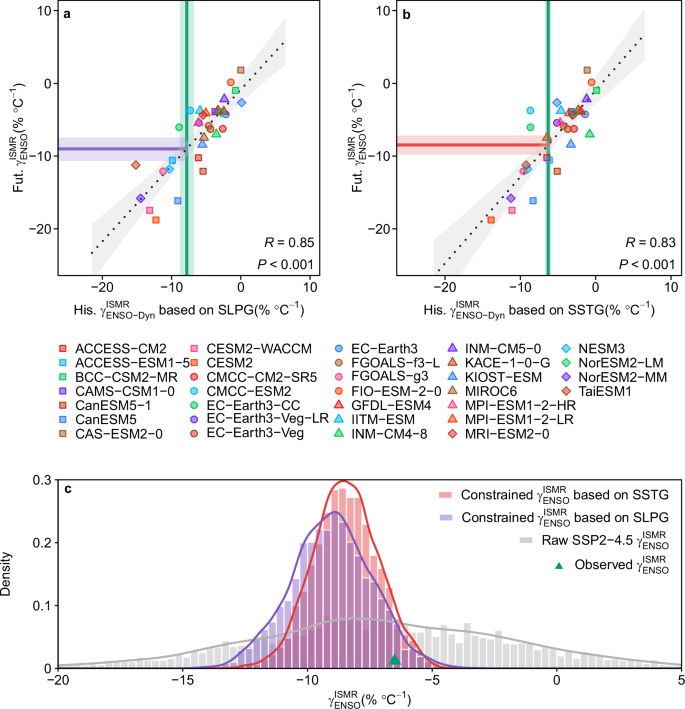
The observational constraint reduced the projected uncertainty range by more than 70%. The resulting late-century ENSO–monsoon sensitivity was −8.7 ± 1.4% per °C, compared with −6.6 ± 0.2% per °C during 1963–2023. In magnitude, the constrained future value is nearly 40% greater.
Keep reading
Using Niño3 or Niño3.4 rather than the broader ENSO index produced increases in the constrained response of about 35–55% relative to the historical period, providing an additional test of whether the result depended on a single ENSO definition.
What the 40% figure does — and does not — mean
It means: the magnitude of the observation-constrained late-century sensitivity of Indian summer monsoon rainfall to ENSO is nearly 40% greater than the historical 1963–2023 sensitivity reported in the study.
It does not mean: every future drought in India will be 40% worse, every future El Niño will reduce rainfall by 40%, or rainfall across India will decline by 40%.
The projected value is not a direct observation of future rainfall. It is an observation-constrained model estimate under the warming scenario used in the study, and the authors explicitly state that confidence in the projected strengthening remains relatively low.
The constraint reduces one important source of model disagreement but does not eliminate all model biases. In particular, the CMIP6 simulations did not reproduce the anomalous 1983 and 1997 events in those exact historical years. The models could generate similar combinations of El Niño and near-normal or above-normal Indian rainfall elsewhere in their simulations, but the researchers found no clear evidence that such events become more frequent under future warming.
That limitation means the projected strengthening describes the average ENSO–monsoon relationship rather than the outcome of every individual El Niño. El Niño type, the Indian Ocean Dipole, background Indian Ocean warming, synoptic weather systems and intraseasonal variations can still alter the monsoon response from one event to another.
The agricultural analysis adds a separate downstream consequence. Zhao et al. used Indian rice-yield data from the Food and Agriculture Organization covering 1963–2023 and examined year-to-year changes in yield alongside changes in monsoon rainfall and temperature.
The researchers used first differences rather than the raw long-term yield series to reduce the risk that technological improvements in agriculture or long-term climate trends would create a misleading statistical relationship. In their regression, variations in monsoon rainfall and temperature explained more than half of the historical year-to-year variation considered in the rice-yield analysis, with a correlation coefficient of 0.70 and P < 0.01.
Applying the stronger modeled monsoon response to that historical crop relationship, the researchers estimated that El Niño-associated crop-yield reductions in a warmer climate could be about 30% greater than those historically observed during El Niño events.
Evidence ladder
| Direct observations | Historical monsoon rainfall, sea-surface temperature, atmospheric fields and rice-yield records. |
| Statistical result | 1983 and 1997 strongly influence the apparent late-20th-century weakening of the ENSO–monsoon relationship. |
| Model attribution | Historical strengthening exceeds the modeled range of unforced natural variability in the later period. |
| Constrained projection | Late-century ENSO–monsoon sensitivity of −8.7 ± 1.4% per °C under the study scenario. |
| Derived agricultural implication | Potentially about 30% greater El Niño-associated crop-yield reductions than historically observed. |
The crop estimate is therefore several analytical steps removed from a direct forecast of agricultural losses. It combines the observation-constrained rainfall projection with a statistical relationship derived from historical crop yields. It should not be read as a prediction of losses during any particular future El Niño.
The broader climate analysis drew on three monthly precipitation datasets extending back to 1901, multiple sea-surface-temperature records, several sea-level-pressure datasets, atmospheric reanalyses, CMIP6 climate simulations and large-ensemble experiments. The authors also used different ENSO indices and different measures of the Walker circulation to test how strongly the result depended on methodological choices.
The study’s data and analysis code are publicly available. The authors archived data and code used for the main analyses and figure reproduction through Figshare and provided the analysis repository through GitHub, allowing the central calculations to be inspected and reproduced independently.
The remaining uncertainty is not whether El Niño can suppress India’s monsoon — that physical connection has long been established — but how much stronger the average coupling becomes as the climate warms and how often other processes override it during individual events. Continued observations of tropical Pacific convection, Walker circulation changes, Indian Ocean conditions and monsoon rainfall will be necessary to determine how closely future behavior follows the constrained projection.
References:
1 Zhao, Y., Wang, T., Xu, C., Li, X., Piao, S., & Yao, T. (2026). Greenhouse warming exacerbates El Niño-induced Indian monsoon droughts. Nature Communications, 17, 9217. DOI: 10.1038/s41467-026-76049-7
2 Study data and archived analysis code – Figshare – 2026
3 Analysis code repository – GitHub – Zhao research repository
4 El Niño Walker circulation schematic – NOAA Climate.gov – August 1, 2014

I’m a science journalist and researcher at The Watchers, contributing to the Epicenter edition, where I cover peer-reviewed scientific research and emerging discoveries across Earth and space sciences. With a background in astronomy and a passion for environmental science, I’ve worked in shark and coral conservation in Fiji, conducting reef and shark-behavior research, contributing to mangrove restoration, and earning PADI Open Water and Coral Reef Certifications. I bring a blend of scientific rigor and storytelling to illuminate the discoveries shaping our planet and beyond.
More reporting
- Desert Locust groups form in Mauritania as seasonal outlook favors further breeding through May 2027
- Extreme heat reversed which mussel sizes survived along the same Washington shoreline
- Benjamin Franklin was right in 1784 when he guessed that a volcano in Iceland had filled Europe's summer sky with a sulfur-smelling haze
- Weather-disaster losses take larger share of national income in 13 of 20 countries, Munich Re finds
