
Nearby triple-star system Welopō‘ai poses an unresolved stellar-evolution problem
Astronomers have characterized Welopō‘ai, a hierarchical triple system 8.46 pc (27.6 light-years) from Earth containing a red dwarf and two white dwarfs. The inner pair remains in a 9.83-year orbit despite an evolutionary history in which the white dwarf’s progenitor expanded into a giant star close enough to interact strongly with its companion, leaving astronomers without a complete explanation for how the present system reached its unusually wide configuration.
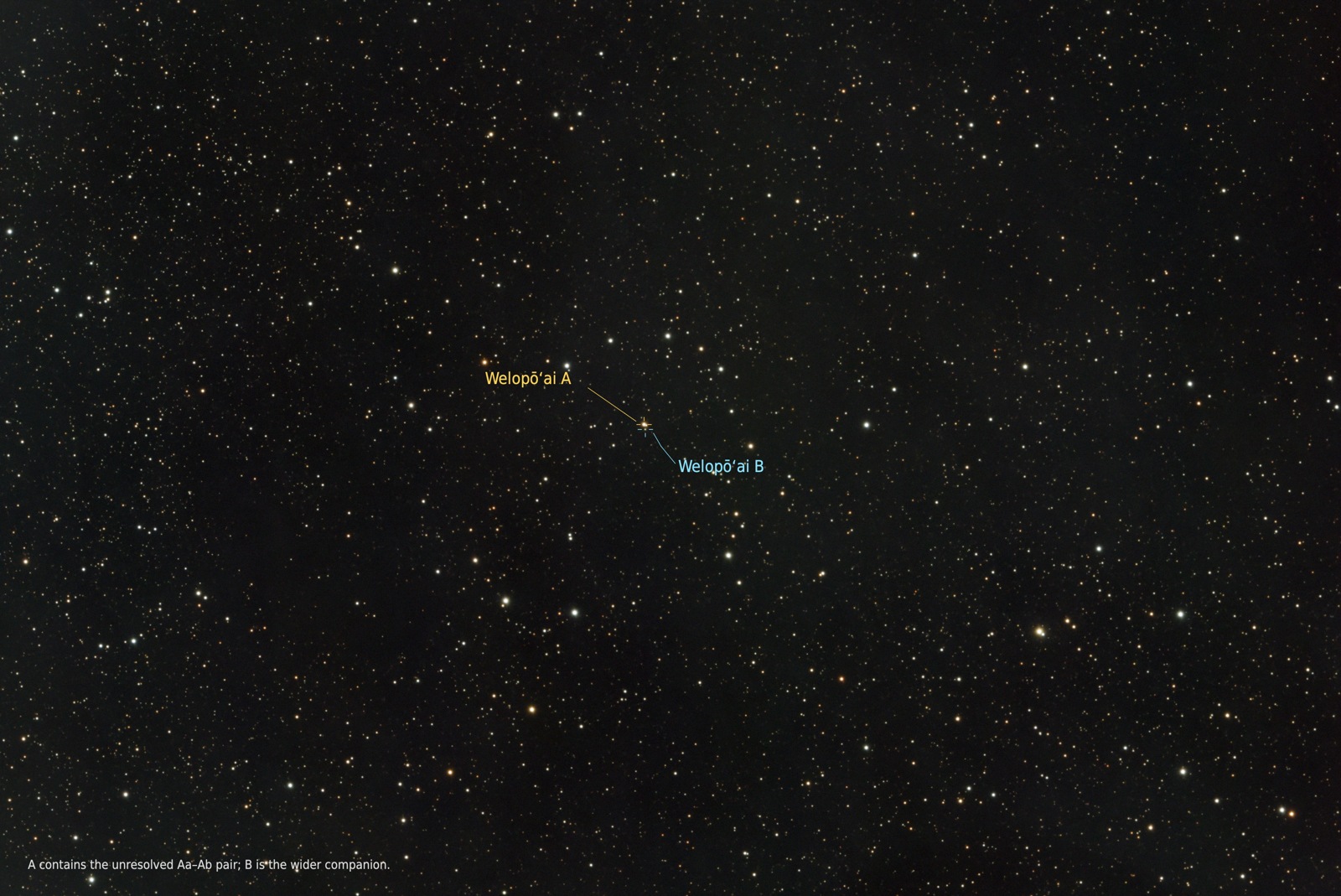
The Welopōʻai triple-star system in Cepheus. The close pair A contains a red dwarf and an unresolved white dwarf. B marks the outer white dwarf. Credit: Ray Madhira / Wikimedia Commons (CC BY-SA 4.0, resized). https://commons.wikimedia.org/wiki/File:Welop%C5%8D%CA%BBai_triple_star_system,_labelled_A_and_B_%E2%80%93_Ray_Madhira_2026-11-20.png
Welopō‘ai is unusual not simply because it contains three stars, but because the present orbit of its inner pair is difficult to reconcile with the late evolution of the star that became the white dwarf. The system contains an M4 V red dwarf, Welopō‘ai Aa, and a white dwarf, Welopō‘ai Ab, in the inner binary, while a second white dwarf, Welopō‘ai B, lies much farther away. Artigau et al. (2026) identify Welopō‘ai as the nearest known hierarchical triple containing multiple white dwarfs and report no known analogue within 30 pc (about 98 light-years).
The central problem is the survival of the inner binary in a comparatively wide orbit. Before Welopō‘ai Ab became a white dwarf, the researchers estimate that its progenitor had a mass of about 1.4 times that of the Sun. It later entered the asymptotic giant branch (AGB), a late phase of stellar evolution during which a star expands dramatically while shedding much of its outer material. The progenitor lost roughly 0.8 solar masses before leaving the approximately 0.62-solar-mass white dwarf observed today.
Under a simplified reconstruction in which stellar mass loss alone changes the orbit, the authors calculate an earlier orbital separation of about 2.6 AU (about 389 million km / 242 million miles). They compare that distance with a maximum AGB radius of about 1.2 AU (about 180 million km / 112 million miles) for a star of comparable initial mass. At those scales, the giant and the red dwarf would have been close enough for strong tidal interaction and possible grazing of the giant’s outer envelope.
Such an encounter can lead to a common-envelope phase, in which one star moves within the greatly expanded outer layers of its companion. Drag inside the envelope removes orbital energy, and in conventional common-envelope evolution the two stellar cores can spiral much closer together or eventually merge. The vast majority of post-common-envelope binaries discussed in the scientific literature have orbital periods measured in hours to days. Welopō‘ai Aa and Ab instead require almost a decade to complete one orbit.
The discrepancy does not prove that Welopō‘ai passed through a conventional common-envelope phase. The earlier orbit is a reconstruction based on simplifying assumptions, and the paper states that the system’s route to its present configuration remains poorly understood. Detailed calculations that evolve the stars, mass loss, tides, mass transfer and the three-body dynamics together are still needed to determine which evolutionary path can reproduce the system observed today.
| Welopō‘ai parameter | Measured or derived value | Physical meaning |
|---|---|---|
| Distance | 8.46 pc (27.6 light-years) | A nearby system in the solar neighborhood |
| Inner orbital period | About 9.83 years | Much longer than typical hour-to-day post-common-envelope binaries |
| Inner semi-major axis | 4.644 ± 0.017 AU (about 694.7 million km / 431.7 million miles) | Defines the scale of the present Aa–Ab orbit |
| Inner eccentricity | 0.1898 (+0.0016 / −0.0015) | The orbit is measurably non-circular |
| Welopō‘ai Aa mass | 0.4189 (+0.0073 / −0.0072) solar masses | M4 V red dwarf |
| Welopō‘ai Ab mass | 0.6180 (+0.0046 / −0.0045) solar masses | Inner white dwarf |
| Ab mass precision | About 0.7% | Most precise dynamical white-dwarf mass among the small sample within 20 pc cited by the study |
| Outer projected separation | 123.9 AU (about 18.54 billion km / 11.52 billion miles) | Projected distance from the inner binary to Welopō‘ai B |
| Outer orbital period | More than 1 000 years | Shows the strongly hierarchical structure of the triple system |
The present orbit is unusually well constrained. Combining radial-velocity measurements with relative astrometry, the researchers measured the mass of Welopō‘ai Aa as 0.4189 (+0.0073 / −0.0072) solar masses and Welopō‘ai Ab as 0.6180 (+0.0046 / −0.0045) solar masses. The inner orbit has a semi-major axis of 4.644 ± 0.017 AU (about 694.7 million km / 431.7 million miles), an eccentricity of 0.1898 (+0.0016 / −0.0015), and a period of about 9.83 years.
The approximately 0.7% uncertainty on the white dwarf’s mass is scientifically valuable because it is a dynamical measurement: the mass follows from the motion of the stars in their orbit rather than being inferred only from models of a white dwarf’s atmosphere, temperature or cooling history. The study describes it as the most precise dynamically determined mass among the small number of white dwarfs within 20 pc for which comparable measurements exist.
Welopō‘ai Ab has an estimated effective temperature of about 5 210 ± 320 K (about 4 937°C / 8 918°F). Its cooling age depends slightly on the atmospheric model used. The study derives about 5.3 (+1.6 / −1.4) billion years for a hydrogen-dominated atmosphere and about 5.52 (+0.91 / −1.05) billion years for a helium-dominated atmosphere. Those values represent the time since the star became a white dwarf, not the total age of the system.
When the cooling ages of the white dwarfs are combined with estimates of how long their progenitor stars spent on the main sequence, the study places the system’s total age at roughly 9–11 billion years. That long history means Welopō‘ai has already passed through at least two major episodes of stellar mass loss, adding another layer of complexity to attempts to reconstruct its present architecture.
The newly identified white dwarf was not initially found through direct imaging. Astronomers were monitoring Welopō‘ai Aa with SPIRou, the high-precision near-infrared spectropolarimeter on the Canada-France-Hawaiʻi Telescope on Maunakea, Hawaiʻi, during a search for exoplanets. Measurements spread over 4.8 years revealed a peak-to-peak radial-velocity change of about 16 km/s (9.9 miles/s), far larger than the small stellar wobble expected from a planetary companion.
By the middle of 2023, curvature in the radial-velocity signal allowed the team to constrain the companion to a roughly decade-long orbit and a mass well above the range expected for a planet or brown dwarf. Its mass was greater than that of the red dwarf itself, but it contributed very little light, making an ordinary main-sequence stellar companion difficult to reconcile with the observations.
The team then used the ‘Alopeke speckle instrument on Gemini North to resolve the faint companion directly. Near-infrared observations with GNIRS provided additional constraints and established that the object was a white dwarf. A second white dwarf was already known at a much larger separation, converting the previously recognized wide system into a hierarchical triple consisting of one red dwarf and two stellar remnants.
Keep reading
Welopō‘ai B lies at a projected separation of 123.9 AU (about 18.54 billion km / 11.52 billion miles) from the inner binary. Its orbital period is estimated to exceed 1 000 years, compared with only about 9.83 years for Aa and Ab. The large difference between those two orbital scales is what makes Welopō‘ai a hierarchical triple: two stars form the relatively compact inner system while the third follows a much wider orbit around them.
The outer white dwarf may also have influenced the inner pair’s evolution. In a hierarchical triple, a sufficiently inclined outer orbit can exchange eccentricity and inclination with the inner orbit over long timescales through a process known as Kozai-Lidov dynamics. In physical terms, the gravity of the distant third star can periodically make the inner orbit more elongated while changing its orientation in space.
Astronomers do not yet know the complete three-dimensional orientation of Welopō‘ai B’s orbit relative to the inner binary. That missing geometry prevents the team from determining how strongly the Kozai-Lidov interaction shaped the system in the past or whether it contributed to the unusual survival of the wide inner orbit.

The simulation illustrates a possible dynamical behavior rather than a measured reconstruction of the system’s past. The research team expects the outer component to influence the inner orbit, but the existing observations do not yet determine how pronounced those oscillations are. Measuring the relative inclination of the inner and outer orbits is therefore one of the important next steps.
The paper identifies several paths toward better constraints. The slow sky-plane acceleration of the outer component may eventually be measurable with individual Gaia astrometric observations, while historical photographic plates extending back to the 1950s could lengthen the observational baseline for the wide pair. The authors estimate that a roughly 75-year baseline could correspond to a change of about 25° in the position angle of the outer pair, providing additional information about its orbit.
The researchers also report a tentative near-infrared excess toward Welopō‘ai Ab. The signal has not been confirmed and does not establish the presence of circumstellar material. The paper discusses a debris disc and a close brown-dwarf companion among possible explanations, while stressing that additional photometry or spectroscopy is required to determine whether the excess is real and, if so, what produces it.
Future observations therefore have to resolve several different pieces of the same history: the true three-dimensional outer orbit, the atmospheric properties of the inner white dwarf, the tentative infrared excess and the coupled tidal and dynamical evolution of the inner pair. Those measurements will determine whether the distant white dwarf helped preserve or reshape the present system, whether the inner stars only grazed a common envelope, or whether another evolutionary pathway is needed to explain why Welopō‘ai Aa and Ab remain hundreds of millions of kilometres apart today.
Official visual resources
The Université de Montréal and Canada-France-Hawaiʻi Telescope discovery pages contain the verified artistic illustration of the three-star system and the observational composite combining the wide Pan-STARRS1 view with the Gemini North ‘Alopeke detection. The still-image credits are Benoît Gougeon, Université de Montréal, for the illustration; Pan-STARRS1/STScI/MAST and International Gemini Observatory/NSF NOIRLab for the observational images; and Étienne Artigau and Heidi White for the graphical construction.
References:
1 Artigau, É., Parent, C.-A., Stefanov, A. K., Le Bourdais, É., Ouedraogo, S., L’Heureux, A., Dufour, P., Doyon, R., Cook, N. J., Cadieux, C., Fontanive, C., Arnold, L., Donati, J.-F., Schreiber, M. R., Cloutier, R., Delfosse, X., Reylé, C., Forveille, T., Cang, T., Moutou, C., & Correia, A. C. M. (2026). Welopō‘ai: A peculiar triple system 8 pc from the Sun. Astronomy & Astrophysics, 715, A321. DOI: 10.1051/0004-6361/202661214
2 Astronomers Discover Remarkable Triple-Star System Just 28 Light-Years from Earth – Trottier Institute for Research on Exoplanets, Université de Montréal – November 19, 2026
3 Astronomers Discover Remarkable Triple-Star System Just 28 Light-Years from Earth – Canada-France-Hawaiʻi Telescope – November 23, 2026

I’m a science journalist and researcher at The Watchers, contributing to the Epicenter edition, where I cover peer-reviewed scientific research and emerging discoveries across Earth and space sciences. With a background in astronomy and a passion for environmental science, I’ve worked in shark and coral conservation in Fiji, conducting reef and shark-behavior research, contributing to mangrove restoration, and earning PADI Open Water and Coral Reef Certifications. I bring a blend of scientific rigor and storytelling to illuminate the discoveries shaping our planet and beyond.
More reporting
- Why ESA’s Plasma Observatory needs seven spacecraft to study Earth’s magnetosphere
- Civilian satellite observations reveal 18% velocity gap in South Atlantic fireball reconstruction
- JWST infrared pulses from magnetar 4U 0142+61 strengthen case for magnetospheric origin
- Rain intensifies before marine stratocumulus break into open cells, EarthCARE study finds
