
Researchers identify 2026 QQ8 as first observed example of long-predicted Earth-capture path
A meter-scale asteroid temporarily captured by Earth is following an unusually long path that researchers identify as the first observed example of an “orbit of maximum lunation,” a configuration predicted to keep small bodies near Earth for extended periods without completing a full revolution around the planet. Orbital integrations place 2026 QQ8 in a 225-day capture from April 26 through December 7, 2026, making it the first long-duration temporary flyby in the small observational record of Earth’s transient natural companions.

The Nordic Optical Telescope at Roque de los Muchachos Observatory on La Palma. Photometric observations of QQ8 were obtained with the telescope’s ALFOSC instrument. Credit: Bob Tubbs. Public domain
Asteroid 2026 QQ8 was discovered on August 19, 2026, by Krisztián Sárneczky using the 0.60 m (2.0 feet) Schmidt telescope at Piszkéstető Mountain Station in Hungary. Initially designated Sar2901, the object immediately drew attention because its distant geocentric trajectory could not be clearly associated with any known artificial satellite or piece of space debris.
The object subsequently became a rare test of two problems at once: how very small asteroids can become temporarily bound to Earth, and how astronomers distinguish natural bodies from artificial objects when both can initially occupy geocentric-looking trajectories. Two independent research teams now agree that QQ8 is a temporarily captured flyby rather than a temporary orbiter, although its detailed surface composition remains unresolved.
| Object | 2026 QQ8 |
| Discovery | August 19, 2026 |
| Modeled capture | April 26–December 7, 2026 |
| Capture duration | 225 days (about 7.5 months) |
| Dynamical class | Temporarily captured flyby |
| Fedorets size estimate | 1.3–1.9 m (4.3–6.2 feet) |
| Key orbital result | First reported observational example of an orbit of maximum lunation |
| Research status | Two November 2026 preprints |
Temporary Earth companions are divided into two dynamical classes. A temporary orbiter completes at least one revolution around Earth while it remains gravitationally captured. A temporary flyby becomes bound to the Earth-Moon system but escapes before completing that revolution. QQ8 falls into the second category.
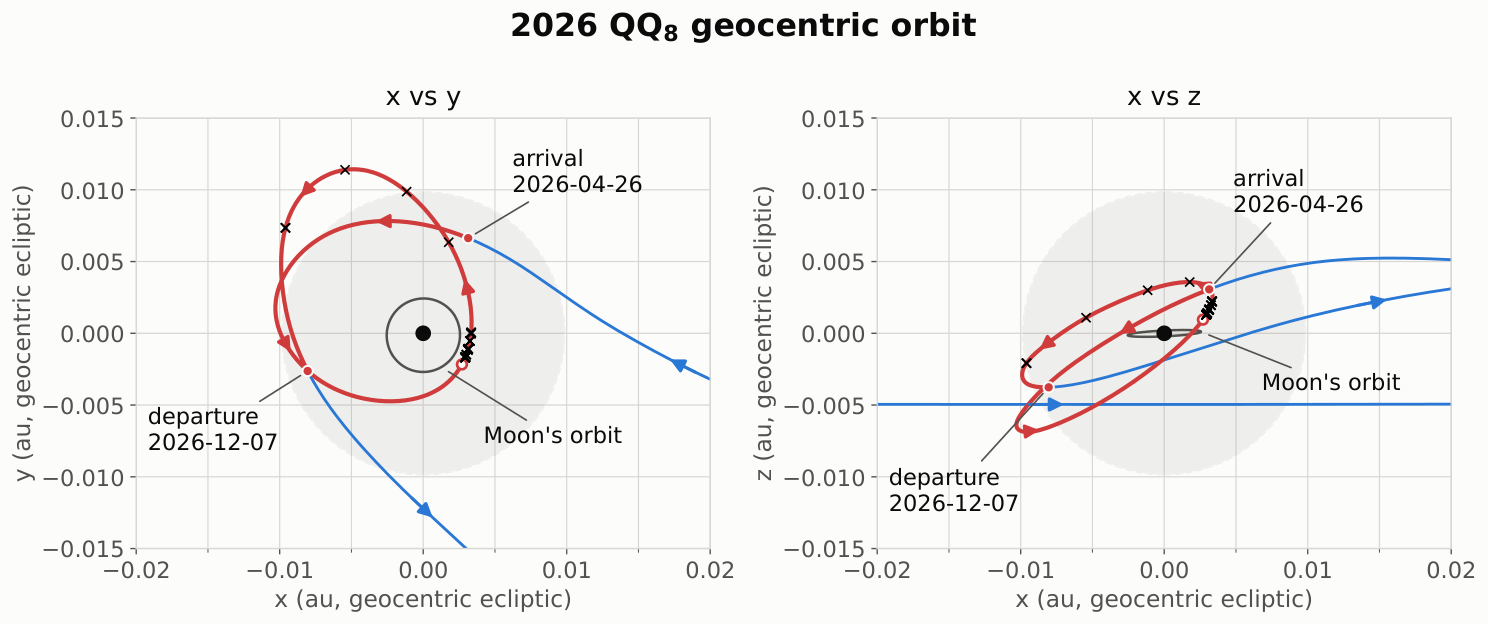
Fedorets et al. calculate that QQ8 remains gravitationally bound to Earth for 225 days, from April 26 through December 7, 2026. The December 7 date is still a modeled future endpoint as of November 27. In the Sun-Earth co-rotating frame used to study the capture, the asteroid does not complete one revolution around Earth before escaping.
The duration is exceptional for a flyby. Fedorets et al. place QQ8 among the longest 0.3% of modeled temporarily captured flybys. The two previously discovered flybys identified in the study, 2022 NX1 and 2024 PT5, remained bound for only about one month each.
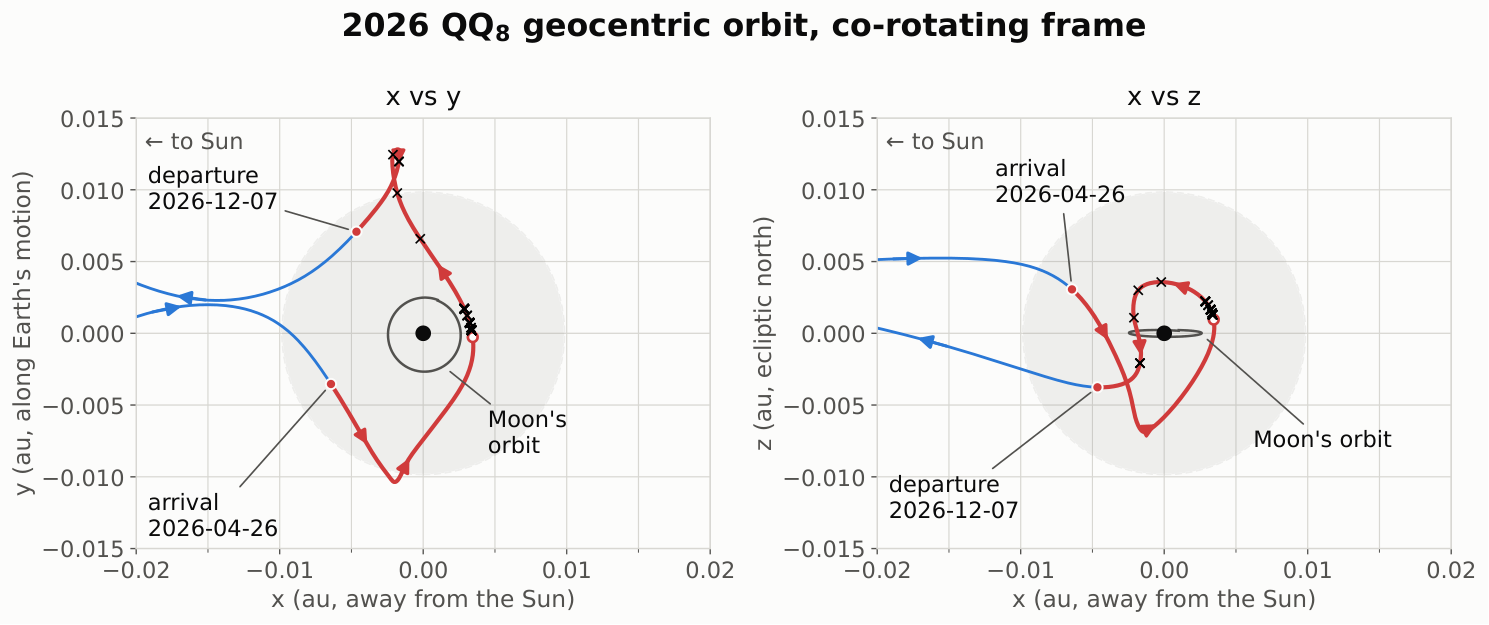
The unusual duration is tied to the shape of the trajectory. In a Sun-Earth co-rotating frame, QQ8 spends extended intervals near Earth’s quadratures, positions roughly 90° from the Sun as seen from Earth. This closely matches the “orbit of maximum lunation,” a configuration considered theoretically long before QQ8 was discovered.
George William Hill described the underlying class of trajectories in the 19th century, while later work on temporary satellites predicted an excess of captured objects near quadrature. Fedorets et al. identify QQ8 as the first observational evidence for that orbital configuration. Because the result is currently presented in a preprint, the first-observation claim remains a finding of the research team rather than a peer-reviewed consensus result.
What does “orbit of maximum lunation” mean?
The term describes a temporary capture geometry in which an object spends unusually long intervals near Earth’s quadrature directions in a frame that rotates with Earth around the Sun. The object can remain gravitationally associated with Earth for months without behaving like a conventional satellite that repeatedly circles the planet.
The question of what QQ8 physically is required a separate observational campaign. Objects on geocentric trajectories are difficult to classify because the overwhelming majority are artificial. A natural meter-scale asteroid, an upper-stage rocket component and other spacecraft hardware can initially produce orbital solutions that demand additional observations before their origins can be distinguished reliably.
Fedorets et al. obtained photometric observations with the 2.5 m (8.2 feet) Nordic Optical Telescope on La Palma. Measurements through Sloan Digital Sky Survey filters gave the closest match to the S-complex in the visual portion of the Bus-DeMeo asteroid taxonomy.
Using an absolute magnitude of H = 31.34 and an assumed S-complex reflectivity, the team estimated a diameter of 1.3–1.9 m (4.3–6.2 feet). That range is not a direct measurement of QQ8’s width. Diameter inferred from optical brightness depends on how reflective the surface is, so a darker object with the same apparent brightness would need to be larger than a brighter one.
The researchers also measured a small non-gravitational acceleration consistent with solar radiation pressure. Photons carry momentum, so sunlight exerts a weak but measurable force on sufficiently small objects. The strength of that response depends partly on how much surface area an object presents relative to its mass, making the effect useful for distinguishing compact natural rock from lightweight artificial hardware.
Fedorets et al. derived an area-to-mass ratio of 0.5 ± 0.19 m²/t (about 4.9 ± 1.9 square feet per US short ton). They report that value as comparable with measurements from other small natural objects and substantially below the lowest value cited in their study for an artificial rocket booster.
Why solar radiation pressure helps identify the object
A hollow or lightweight artificial object generally has much more surface area for a given mass than a compact rock. Sunlight therefore accelerates it more strongly. As observations accumulate and the orbit becomes better constrained, the fitted radiation-pressure signal can help astronomers test whether a small geocentric object behaves more like natural material or spacecraft hardware.
A second research team led by Bryce Bolin used the Very Large Telescope in Chile, Keck I and Gemini North in Hawaiʻi to obtain another set of measurements between November 7 and 21. Their 71-position astrometric solution independently gives a temporary capture lasting 224.96 days from April 26 to December 7 and a co-rotating longitude advance of 0.76 turns, again placing QQ8 in the flyby category rather than the orbiter category.
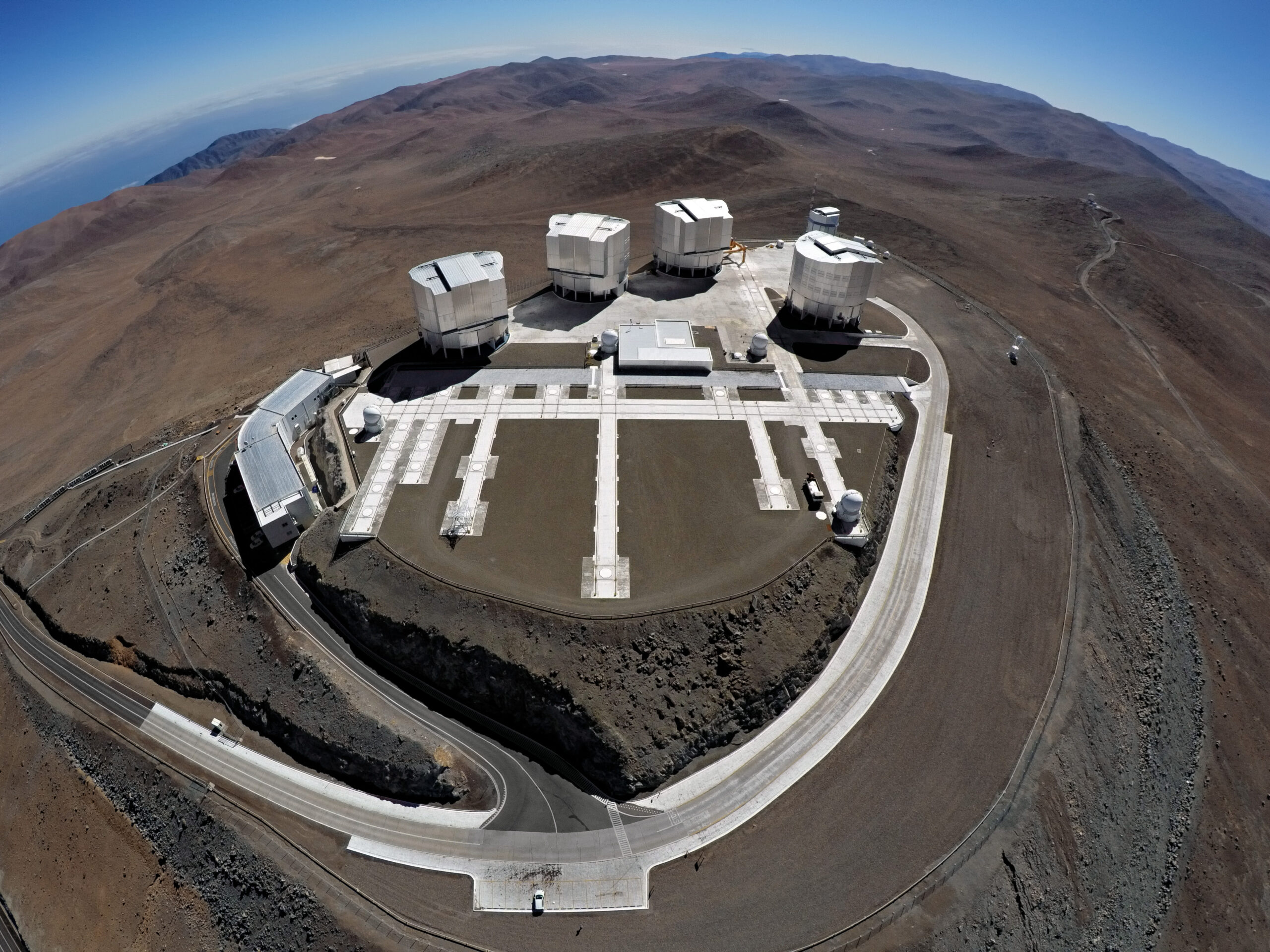

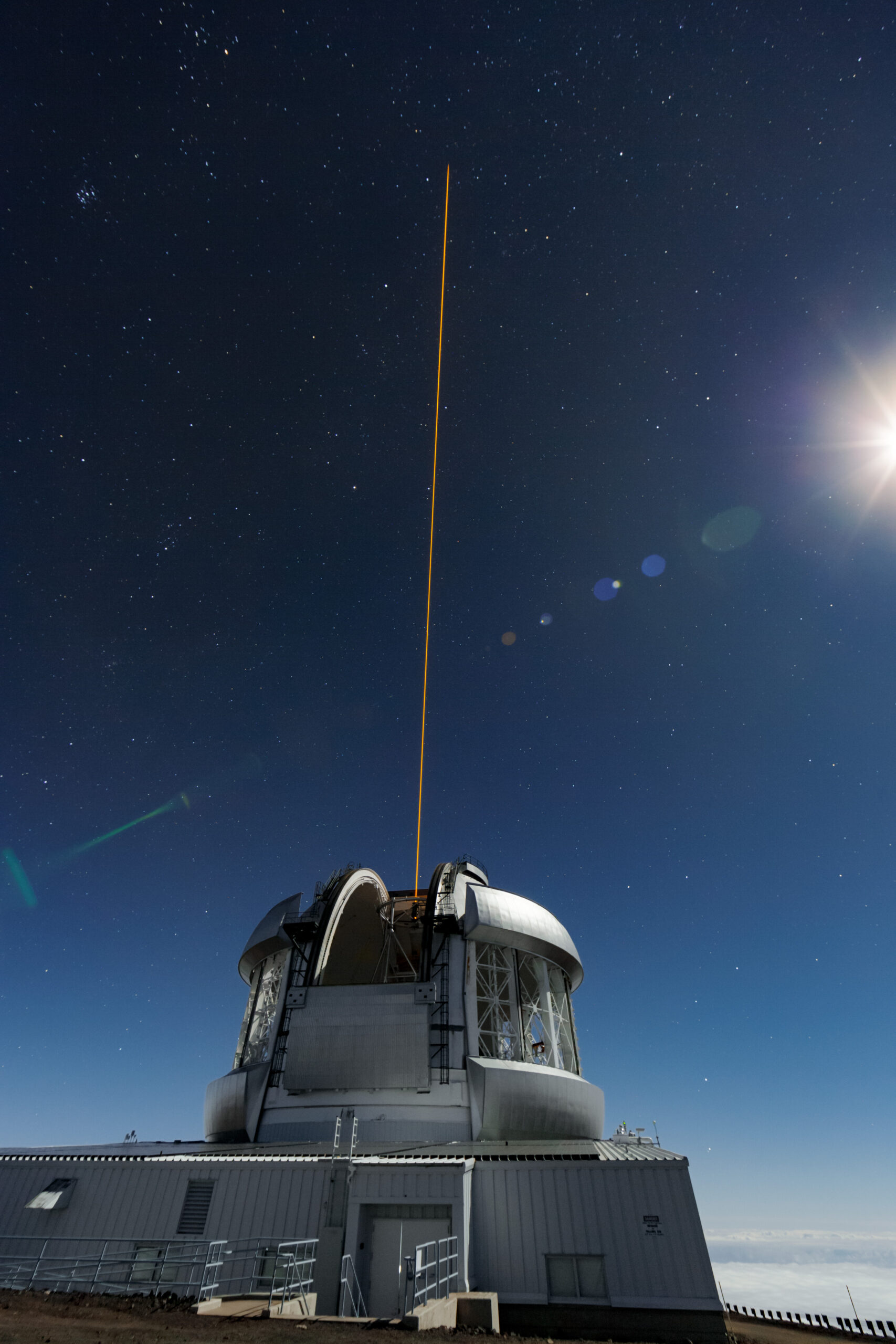
Bolin et al. derived an area-to-mass ratio of (6.02 ± 0.40) × 10−4 m²/kg, equivalent to 0.602 ± 0.040 m²/t (about 5.88 ± 0.39 square feet per US short ton). The close agreement with the independent Fedorets result strengthens the interpretation that the measured non-gravitational acceleration is compatible with a small natural body.
Keep reading
The two teams do not reach an identical conclusion about surface composition. Bolin et al. find that QQ8’s measured colors fit an Sq-like asteroid, but they also fit exposed basalt samples returned by Apollo 17. Their analysis therefore leaves open both an asteroidal surface and a possible lunar-basalt interpretation.
| Evidence | What was found | What it contributes |
|---|---|---|
| Orbital integrations | About 225 days of temporary capture; less than one co-rotating revolution | Classifies QQ8 as a temporary flyby |
| Fedorets photometry | Best match to S-complex asteroid colors | Supports natural asteroid interpretation |
| Solar radiation pressure | Low area-to-mass ratio from two independent analyses | Argues against lightweight artificial hardware |
| Bolin photometry | Compatible with Sq-like asteroid or exposed lunar basalt | Leaves detailed surface origin unresolved |
| Capture geometry | Extended residence near Earth quadratures | Matches the predicted maximum-lunation configuration |
The Minor Planet Center formally published MPEC 2026-U95 at 16:50 UTC on October 29, reporting that orbital integrations showed QQ8 to be temporarily bound to Earth. The circular included a solar-radiation-pressure solution, stated that no link to a known artificial object had been found and encouraged additional observations and dynamical work.
The discovery history also exposed a weakness in the way unusual geocentric candidates are handled. Fedorets et al. report that QQ8 was removed twice from the Minor Planet Center’s Near-Earth Object Confirmation Page (NEOCP), remaining absent from late August until the October 29 circular was issued.
The removal mattered because many observatories rely directly or indirectly on MPC services to select targets for follow-up. QQ8 faded to approximately magnitude 23–25 during September and October, requiring telescopes in roughly the 2–4 m (6.6–13 feet) class. Direct circulation of astrometry through the Minor Planet Mailing List allowed continued observations after normal automated follow-up channels had been interrupted.
Fedorets et al. report similar early treatment of the temporary natural satellites 2006 RH120 and 2020 CD3. The team argues that automatically removing geocentric objects can create a selection effect: natural temporary satellites may disappear from follow-up before enough data are collected to establish what they are.
The researchers propose a staged procedure instead. Candidate objects could first be checked for orbital characteristics associated with natural temporary satellites, searched for possible links with known artificial objects, and monitored to see how the fitted solar-radiation-pressure signal changes as the observational arc becomes longer.
If one or more tests point toward natural origin, the candidate could remain on the NEOCP under a special flag while physical characterization continues. Photometry, spectroscopy, polarimetry or radar could then be combined with a constrained radiation-pressure measurement before a final natural-versus-artificial classification is made.
Why QQ8 matters beyond one unusual asteroid
Temporary satellites offer one of the few observational windows onto the poorly measured population of meter-scale near-Earth objects. If survey pipelines systematically discard natural geocentric candidates, the observed discovery rate can become biased, making it harder to compare real detections with population models.
The issue could become increasingly important as the Vera C. Rubin Observatory’s Legacy Survey of Space and Time expands the discovery of faint moving objects. Fedorets et al. expect the survey to increase the number of recognized temporary natural satellites, making consistent candidate handling more important for both individual follow-up and population statistics.
QQ8 therefore links orbital dynamics, asteroid characterization and survey operations. Its path provides the first reported observational example of the maximum-lunation configuration, while the effort required to determine whether it was natural illustrates how easily meter-scale asteroids can overlap observationally with artificial geocentric objects.
Important uncertainties remain. Both detailed QQ8 studies available as of November 27, 2026, are preprints. Fedorets et al. favor an S-type asteroid interpretation, while Bolin et al. find that the colors also permit exposed lunar basalt. Additional observations, independent analyses and peer review will be needed to determine how securely those physical interpretations hold after QQ8 leaves temporary Earth capture.
References:
1 Fedorets, G., Micheli, M., Hemmelgarn, S., Moskovitz, N., Sárneczky, K., Tholen, D. J., Djupvik, A. A., Granvik, M., Gray, B., Jedicke, R., Ryan, W. H., & Ryan, E. V. (2026). 2026 QQ8: Earth’s temporary flyby of maximum lunation. arXiv. DOI: 10.48550/arXiv.2611.27770
2 Bolin, B. T., Alcorn, L. Y., Tholen, D. J., Lemaux, B. C., Kim, E., Alamos, L., Berghuis, J. L., Boffin, H. M. J., Häußler, B., Kasikov, A., Miller, J., Pessi, T., Rodríguez-Henríquez, M., Sedaghati, E., Stephens, A. W., & Wahl, M. (2026). VLT, Keck, and Gemini characterization of the temporarily captured flyby 2026 QQ8. arXiv. DOI: 10.48550/arXiv.2611.31213
3 MPEC 2026-U95: 2026 QQ8: Temporarily Captured Object – Minor Planet Center – October 29, 2026
4 2026 QQ8: Earth’s temporary flyby of maximum lunation – arXiv HTML edition and research figures – November 2026 – CC BY 4.0

I’m a science journalist and researcher at The Watchers, contributing to the Epicenter edition, where I cover peer-reviewed scientific research and emerging discoveries across Earth and space sciences. With a background in astronomy and a passion for environmental science, I’ve worked in shark and coral conservation in Fiji, conducting reef and shark-behavior research, contributing to mangrove restoration, and earning PADI Open Water and Coral Reef Certifications. I bring a blend of scientific rigor and storytelling to illuminate the discoveries shaping our planet and beyond.
More reporting
- Why ESA’s Plasma Observatory needs seven spacecraft to study Earth’s magnetosphere
- Civilian satellite observations reveal 18% velocity gap in South Atlantic fireball reconstruction
- JWST infrared pulses from magnetar 4U 0142+61 strengthen case for magnetospheric origin
- Rain intensifies before marine stratocumulus break into open cells, EarthCARE study finds
