
Researchers link hydrogen chloride over Alba Mons to ongoing igneous processes on Mars
Localized hydrogen chloride detections over fissured volcanic terrain at Alba Mons are best explained by ongoing igneous processes in the Martian interior, according to research published in Science Advances on November 4, 2026. The ExoMars Trace Gas Orbiter detected the gas during an unusual season, while orbital images showed fresh, narrow fissures in the same volcanic region. No new lava flow or volcanic eruption has ever been observed on Mars.
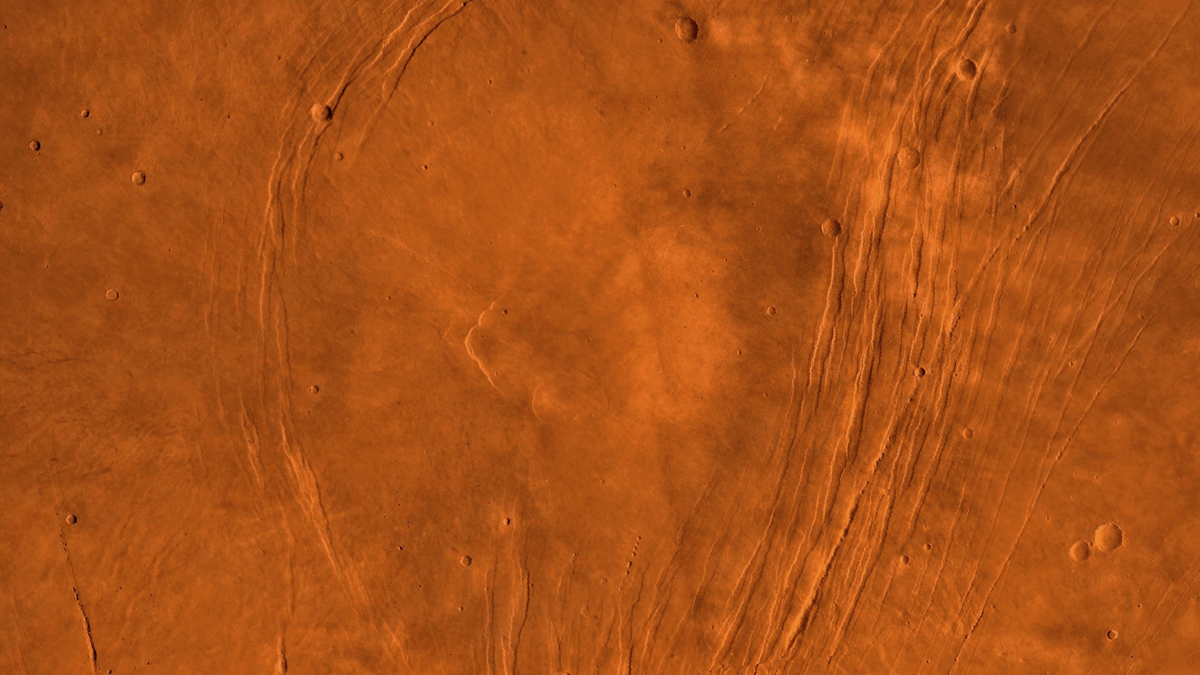
Fractured terrain in the Tharsis volcanic province on Mars. Alba Mons, where researchers detected the localized hydrogen chloride signal discussed in the study, lies in the northern part of the broader Tharsis volcanic region. Credits: NASA/JPL/USGS
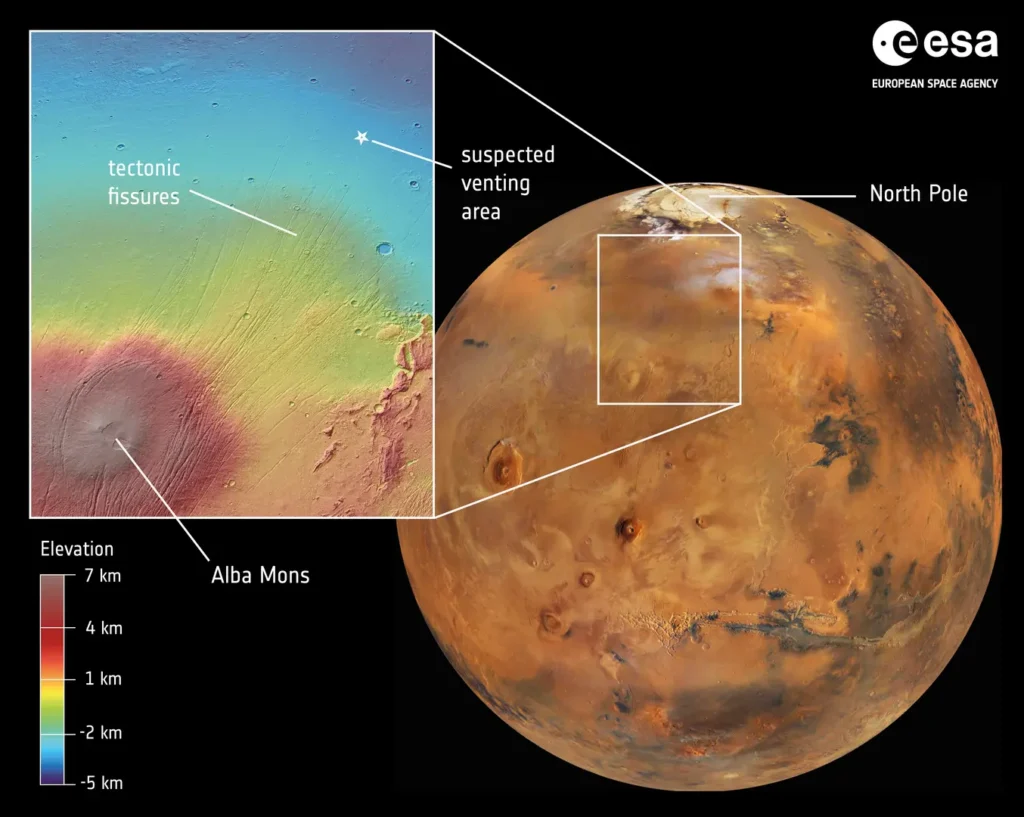
The ExoMars Trace Gas Orbiter (TGO) first reported hydrogen chloride (HCl) in the Martian atmosphere in 2021. Most detections since then have followed a broad seasonal pattern associated with dust, water and atmospheric chemistry. The new observations differ because HCl appeared during the colder aphelion part of the Martian year and was strongly localized around Alba Mons rather than distributed widely across the planet.
Trokhimovskiy et al. (2026) examined the localized gas detections together with geological observations of Alba Mons. Their analysis combines measurements from TGO’s Atmospheric Chemistry Suite (ACS) with images from its Colour and Stereo Surface Imaging System (CaSSIS), linking an unusual atmospheric signal with a heavily fractured volcanic region.
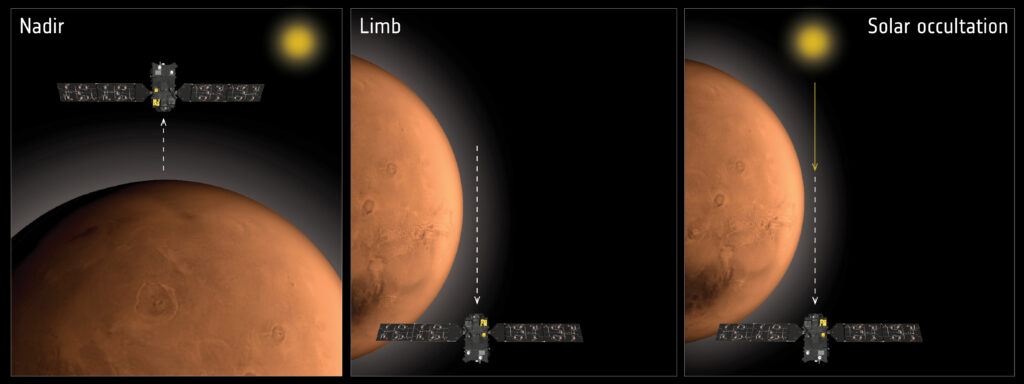
The Atmospheric Chemistry Suite detects trace gases by measuring how molecules absorb infrared light at characteristic wavelengths. The concentrations involved are extremely small. Daniel Mège, co-lead author of the study, said the HCl concentrations measured around Alba Mons are of the order of two parts per billion by volume, equivalent to about two HCl molecules for every billion molecules in the atmosphere.
Hydrogen chloride alone does not establish volcanism. Earlier TGO measurements showed that HCl can be produced and redistributed through processes involving Martian dust, salts, water vapour and seasonal atmospheric changes. A large part of the new analysis therefore involved testing whether known atmospheric chemistry could account for the Alba Mons detections before considering a source below the surface.
ESA reports that Martian HCl normally reaches its seasonal maximum during northern winter and mostly disappears during summer. The Alba Mons observations break from that pattern because the anomalous detections occur during early northern summer and repeatedly over the same volcanic region. Their timing and geographic concentration distinguish them from the broader HCl cycle measured elsewhere on Mars.
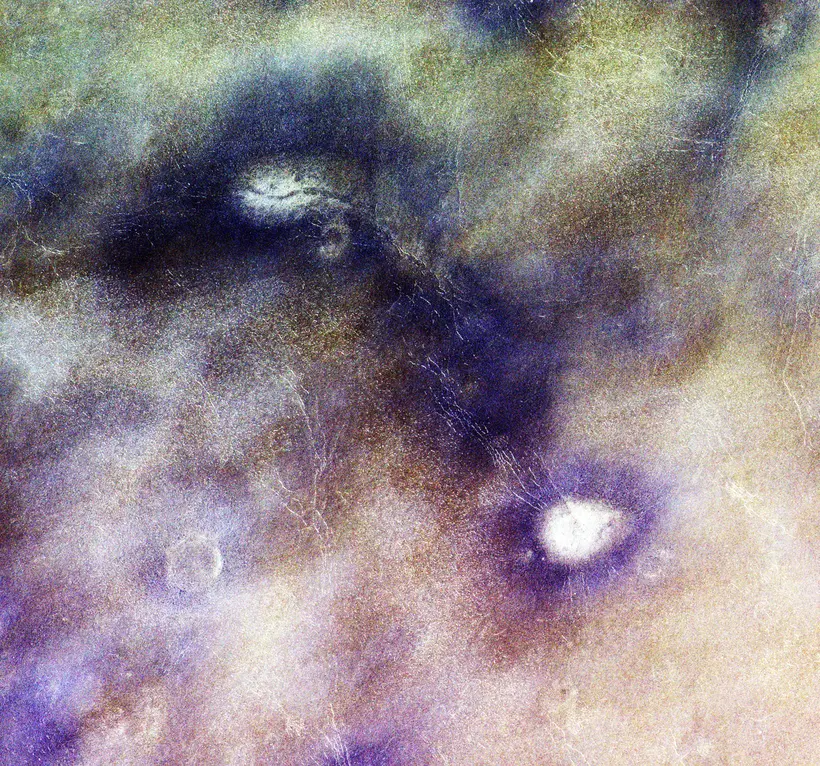
CaSSIS supplied the geological part of the analysis. Researchers identified fresh, narrow fissures in the Alba Mons region, in some cases extending hundreds of metres, together with colour changes on the surrounding surface. The study reports fissures narrower than 1 m and interprets them as possible pathways linking the atmosphere with magmatic bodies at depth.
The atmospheric and geological observations were assessed together rather than treating either dataset as proof on its own. The authors conclude that the complete set of observations is best explained by ongoing igneous processes in the Martian interior. The interpretation does not amount to a direct detection of magma, an active lava flow or an eruption.
One proposed mechanism connects the seasonal gas detections with freezing and sublimation inside the fissures. ESA describes a scenario in which winter temperatures down to about -120°C could allow ice to block gas pathways. As the ice sublimates during early northern summer, changing directly from solid ice to vapour, gases trapped below could escape through the fractures.
Surface discolouration around the fissures provides another part of the interpretation. The researchers propose that deposits left by escaping gases could produce some of the colour differences visible in CaSSIS images, similar to deposits around terrestrial fumaroles. The team connects the proposed seepage with a dormant magma chamber beneath the surface, but neither the chamber nor the proposed underground gas pathways have been directly imaged.
Keep reading

The earlier HCl detections are important because they establish that chlorine chemistry on Mars has a non-volcanic atmospheric component. The gas was detected in both hemispheres following the 2018 global dust storm, a distribution that made a localized volcanic source unlikely for those observations. The Alba Mons study instead concerns a separate group of detections with an unusual season, restricted geographic distribution and associated volcanic geology.
No new lava flow or volcanic eruption has ever been observed on Mars. Orbital imagery nevertheless indicates that some Martian volcanoes were active within the last few million years, while seismic instruments have detected marsquakes. The Alba Mons observations add atmospheric chemistry concentrated over volcanic structures to the evidence used to assess how recently geological activity persisted inside the planet.
The interpretation also bears on how much heat Mars retains. Mège said the observations support the possibility that Mars preserved enough internal heat to sustain volcanic activity until geologically recent times and possibly into the present. The peer-reviewed paper uses the more constrained conclusion that the observations are best explained by ongoing igneous processes in the interior.
Remaining internal heat would also affect the study of possible habitable environments below the Martian surface. ESA presents that connection conditionally. If magma moving through the crust encounters groundwater, the interaction can form hydrothermal environments where heat and chemical reactions provide energy. The Alba Mons measurements do not directly establish the presence of such a hydrothermal system.
The evidence therefore stops short of an observed eruption or directly detected magma body. TGO measured anomalous hydrogen chloride concentrated around Alba Mons and imaged fissured volcanic terrain in the same region. The proposed subsurface igneous source is the researchers’ interpretation of those combined atmospheric and geological observations.
References:
1 Trokhimovskiy, A., Mège, D., Korablev, O., Olsen, K. S., Fedorova, A. A., Taysum, B., Tesson, P.-A., Luginin, M., Montmessin, F., Vlasov, P., Grigoriev, A., Alday, J., Belyaev, D., Ignatiev, N., Patrakeev, A., Kokonkov, N., Ivanov, Y., Gurgurewicz, J., Pommerol, A., Cremonese, G., & Thomas, N. (2026). Enigmatic HCl detections as a potential signature of igneous activity on Mars. Science Advances, 12(45), eaeb9422. DOI: 10.1126/sciadv.aeb9422
2 European orbiter detects hints of volcanic activity on Mars – European Space Agency – November 5, 2026
3 Geological intuition for Mars – European Space Agency – November 4, 2026

I’m a science journalist and researcher at The Watchers, contributing to the Epicenter edition, where I cover peer-reviewed scientific research and emerging discoveries across Earth and space sciences. With a background in astronomy and a passion for environmental science, I’ve worked in shark and coral conservation in Fiji, conducting reef and shark-behavior research, contributing to mangrove restoration, and earning PADI Open Water and Coral Reef Certifications. I bring a blend of scientific rigor and storytelling to illuminate the discoveries shaping our planet and beyond.
More reporting
- Researchers identify 2026 QQ8 as first observed example of long-predicted Earth-capture path
- Astronomers trace seven-year stellar inspiral inside a giant star in Andromeda
- Nearby triple-star system Welopō‘ai poses an unresolved stellar-evolution problem
- Why ESA’s Plasma Observatory needs seven spacecraft to study Earth’s magnetosphere
