
NASA’s ORDEM 3.2 turns sparse debris measurements into spacecraft risk estimates
NASA’s Orbital Debris Engineering Model, ORDEM 3.2, converts radar, optical and in-situ measurements into a statistical description of the debris spacecraft can encounter from low Earth orbit to the geosynchronous region. The model gives engineers estimates of debris flux, impact speed, direction, size and material density, including populations too small to maintain as individually tracked objects, while recent research shows that uncertainty grows sharply below the routine cataloging regime.
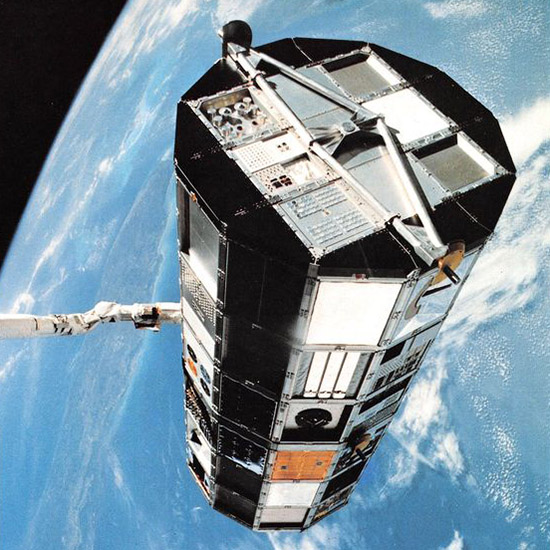
The Long Duration Exposure Facility (LDEF) spent about 5.7 years in low Earth orbit before Space Shuttle Columbia retrieved it in January 1990. Its exposed surfaces became a major source of in-situ impact data for the small-particle environment. Credit: NASA
NASA released ORDEM 3.2 in March 2022 after updating the previous model to include fragments from the deliberate destruction of the Cosmos 1408 satellite on November 15, 2021. The update preserved the underlying ORDEM 3.1 populations while adding the new debris cloud, allowing engineers to account for a major change in the orbital environment without rebuilding the complete environmental model.
The harder engineering problem extends beyond the large fragments that can be individually cataloged. Much of the debris capable of damaging spacecraft is too small for routine object-by-object tracking, forcing engineers to reconstruct the environment statistically from radar detections, optical observations, impacts on returned spacecraft surfaces and other measurements. A 2026 peer-reviewed review found that current debris models can differ by roughly a factor of two to three around the centimeter scale, with disagreements expanding to an order of magnitude or more below 1 mm (0.039 inches).
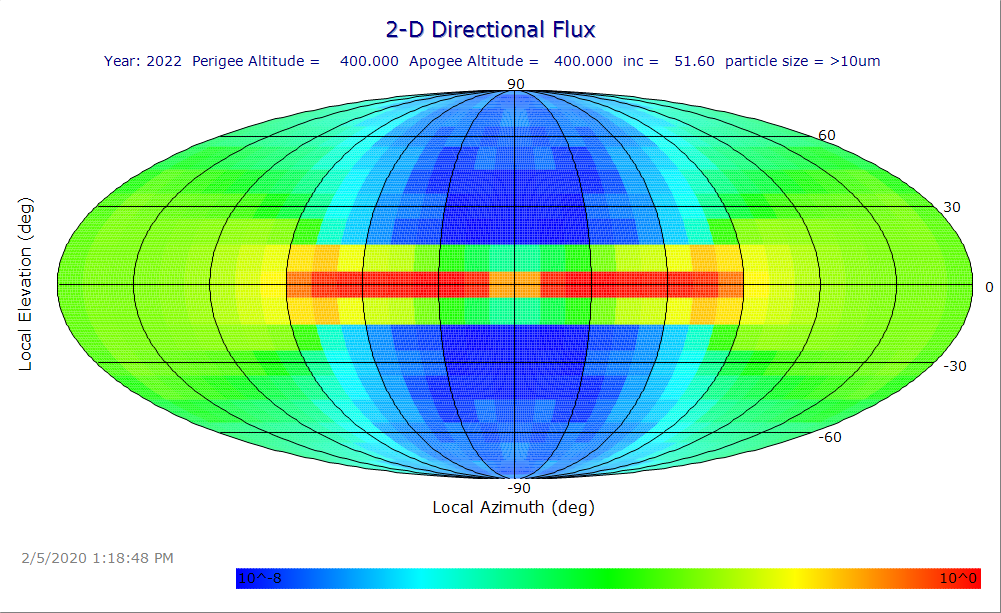
ORDEM addresses the observational gap by estimating debris flux rather than attempting to supply a trajectory for every object. Flux describes how frequently debris from a defined population is expected to cross a given area along a spacecraft orbit. For engineering purposes, that converts incomplete observations into estimates of how much debris a spacecraft may encounter, from which direction, at what relative velocity and with what material properties.
| ORDEM 3.2 parameter | Verified scope | What it means |
|---|---|---|
| Model years | 2016–2050 | The software can calculate engineering environments for mission epochs within this interval. |
| General altitude domain | 100–40 000 km (62–24 855 miles) | The model spans low Earth orbit through the geosynchronous region. |
| Observational size range incorporated | 10 µm–1 m (0.00039 inches–3.3 feet) | Different datasets constrain different portions of this range; coverage is not uniform at every altitude. |
| Primary spacecraft outputs | Flux, direction, relative velocity, size and material density | These quantities describe the environment relevant to impact-risk and shielding calculations. |
| High-altitude caveat | Sub-10 cm flux above 2 000 km (1 243 miles) is not validated | Small-particle estimates become less constrained outside the better-observed orbital regions. |
NASA’s software guide places the general ORDEM 3.2 environmental domain from approximately 100 km (62 miles) to 40 000 km (24 855 miles) altitude and allows calculations for model years from 2016 through 2050. The model spans low Earth orbit and extends through the geosynchronous region, but its smallest debris populations are not equally constrained at every altitude.
The observational datasets incorporated into ORDEM cover characteristic debris sizes from 10 µm (0.00039 inches) to 1 m (3.3 feet). That range does not mean NASA can observe or validate every one of those sizes throughout near-Earth space. The ORDEM 3.2 user guide warns that calculated fluxes for debris below 10 cm (3.9 inches) above 2 000 km (1 243 miles) have not been validated.
What ORDEM can — and cannot — tell an engineer
ORDEM can: estimate the statistical debris flux expected along a specified spacecraft orbit; separate populations by size and material density; resolve modeled impact direction and relative velocity; and provide uncertainty estimates associated with its reconstructed debris populations.
ORDEM cannot: identify every individual debris object, provide a live trajectory for uncataloged fragments, or replace conjunction assessment for a known object approaching a specific spacecraft.
Different instruments fill different portions of that observational spectrum. The U.S. Space Surveillance Network supplies information on larger cataloged objects, while NASA uses specialized radar measurements to sample smaller populations statistically. The Haystack Ultrawideband Satellite Imaging Radar (HUSIR), for example, is NASA’s principal measurement source for debris approximately 5 mm (0.20 inches) to 30 cm (11.8 inches) across.
NASA also uses the Goldstone Orbital Debris Radar in California to characterize still smaller objects. The agency says Goldstone has collected orbital-debris observations since 1990 and can detect a metallic sphere approximately 3 mm (0.12 inches) across at a distance of 1 000 km (621 miles).
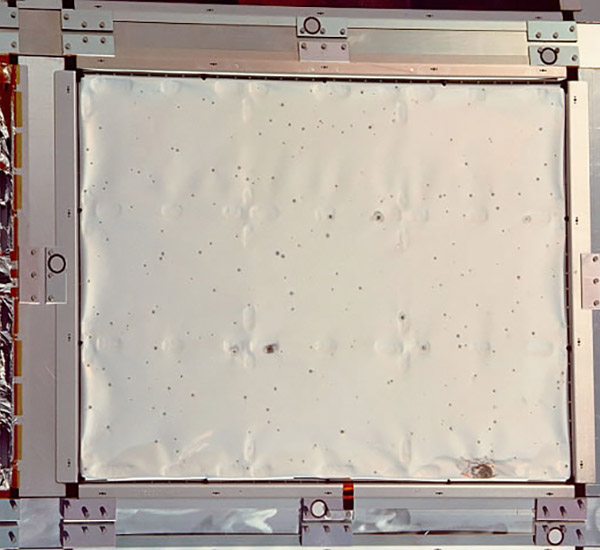
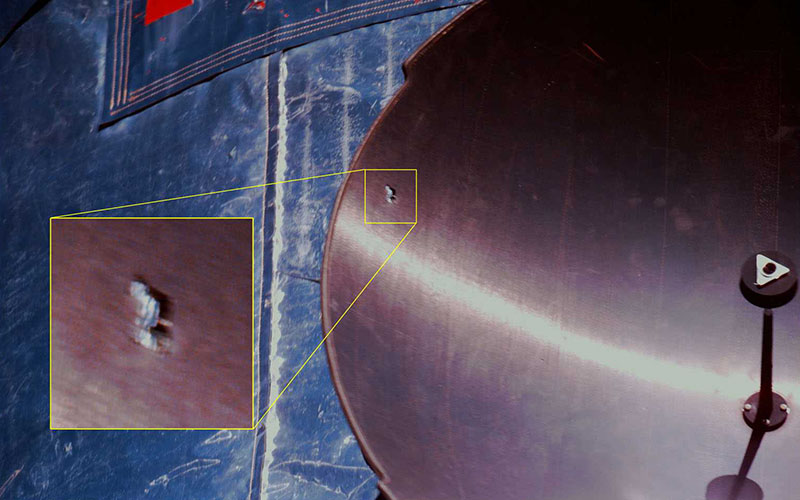
Returned spacecraft provide another type of measurement. Hypervelocity particles leave pits, craters and penetrations in exposed surfaces, preserving evidence from debris that may never have been individually detected by a ground-based sensor.
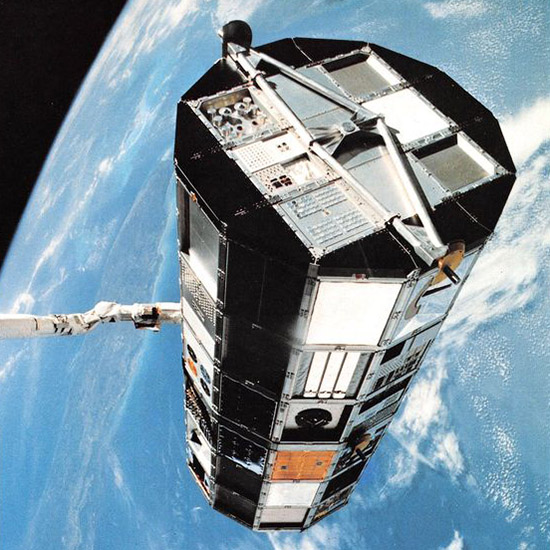
The Long Duration Exposure Facility (LDEF) remains one of the most important examples. NASA documented more than 20 000 impacts after the spacecraft spent about 5.7 years in low Earth orbit. Approximately 1 000 of those impacts were chemically analyzed in attempts to determine whether the projectile originated from human-made debris or the natural meteoroid environment.
Those impact records matter because debris size alone does not determine damage. ORDEM 3.2 divides the environment into five material categories: intact objects, low-density debris, medium-density debris, high-density debris and sodium-potassium droplets. Material density changes the mass represented by a fragment of a given size and therefore changes the damage that fragment can produce during a hypervelocity impact.
| ORDEM material population | Representative density | Example interpretation |
|---|---|---|
| Low density | 1.4 g/cm3 | Lower-density fragments such as some plastics and lightweight materials |
| Medium density | 2.8 g/cm3 | Representative of materials near aluminum density |
| High density | 7.9 g/cm3 | Representative of denser metallic debris |
| Sodium-potassium droplets | 0.9 g/cm3 | A distinct population associated with coolant released from Soviet nuclear-powered radar ocean reconnaissance satellites |
| Intact objects | Modeled separately | Cataloged or large intact spacecraft and rocket-related objects |
ORDEM does not return only one overall collision number. In spacecraft mode, output can be divided by debris size, relative velocity, impact direction and material density. Directional results can be represented around the spacecraft in local elevation and azimuth, allowing engineers to identify surfaces with greater modeled exposure.
The physical use of those results is straightforward even though the statistical reconstruction is complex. Spacecraft designers can compare the modeled environment around different surfaces and use that information when evaluating shielding, component placement and other design decisions intended to reduce vulnerability to hypervelocity impacts.
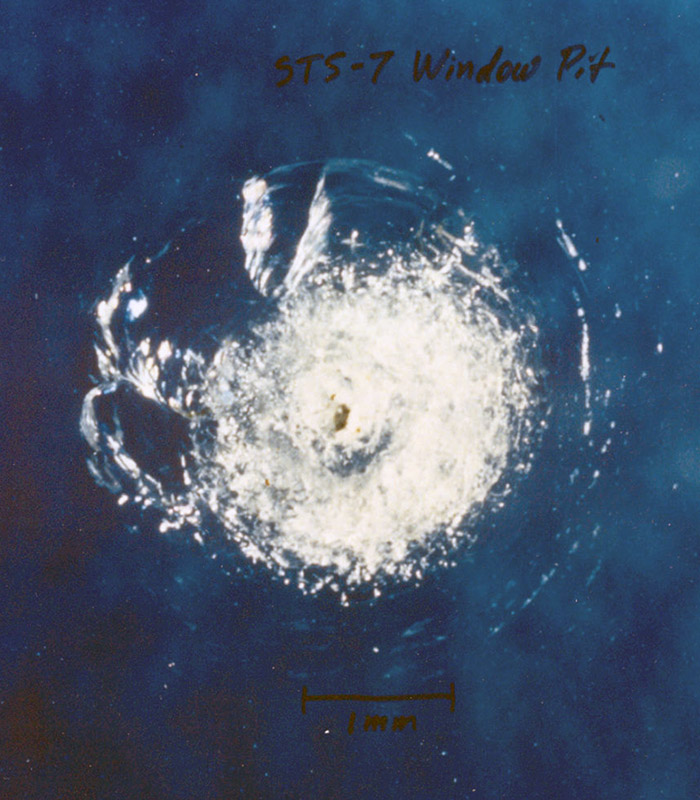
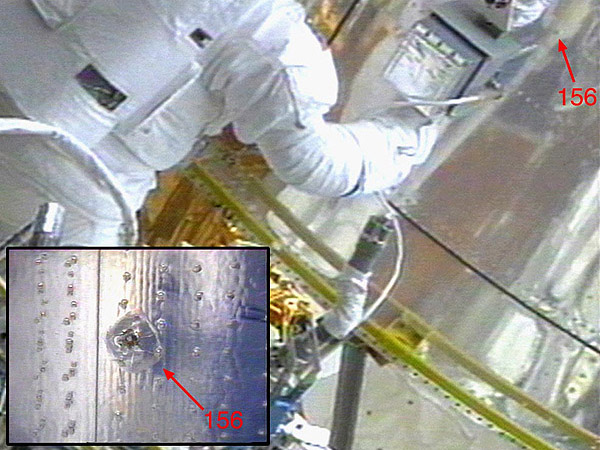
NASA’s Space Shuttle impact archive demonstrates the scale difference between a particle and the damage it can cause. During STS-118, impact testing and residue analysis indicated that an orbital-debris particle approximately 1.6 mm (0.063 inches) across struck a radiator at about 9 km/s (5.6 miles/s). The impact produced an entry hole approximately 6 mm (0.24 inches) across and penetrated the radiator to the payload-bay-door structure.
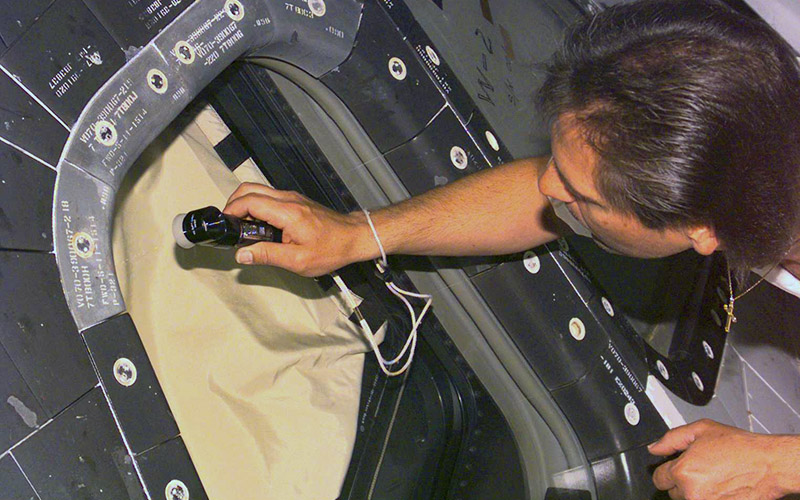
Impact analysis also supplies information about what the particles were made of. NASA’s archive lists Shuttle impact residues containing combinations of iron, chromium, titanium, aluminum, silicon, copper, zinc and other elements, helping investigators distinguish orbital debris from natural meteoroids and refine the material populations represented in engineering models.
Keep reading
Environmental model, collision warning and long-term evolution are different problems
ORDEM
Reconstructs the statistical debris environment and estimates flux relevant to spacecraft engineering and impact risk.
Conjunction assessment
Uses trajectories of identified, tracked objects to evaluate a specific close approach between known objects.
LEGEND
Models how the orbital-debris environment can evolve over long periods under launches, fragmentations, collisions, atmospheric effects and mitigation practices.
The distinction is important because ORDEM is not a live collision-warning system. Conjunction analysis requires trajectories for individually tracked objects and addresses a particular encounter. ORDEM instead describes the statistical environment over mission timescales, including populations that cannot be maintained as individual catalog entries.

ORDEM 3.2 builds its non-geosynchronous populations using statistical techniques that combine measurements with modeled distributions. NASA’s software documentation describes maximum-likelihood and Bayesian methods used to adjust population estimates where observations constrain the environment and to extend the reconstruction into regions where direct measurements are sparse. The result remains a model output rather than a direct census of every fragment in orbit.
The largest uncertainty sits below the normal cataloging regime
Kirk and Kilic (2026) reviewed environmental and evolutionary debris models and found that uncertainty becomes increasingly important below 10 cm (3.9 inches). Direct comparisons between modern model versions show roughly factor-of-two to factor-of-three differences near the centimeter scale, with much larger divergence toward millimeter and sub-millimeter sizes.
The disagreement does not mean the models have no engineering value. It identifies where risk calculations are most sensitive to the available evidence and modeling assumptions. Larger debris is comparatively easier to detect and catalog, while progressively smaller objects require reconstruction from observations covering limited altitude ranges, time intervals and sensor geometries.
Why small debris is difficult to model
Ground-based sensors become less capable as debris size decreases, while in-situ measurements sample only the orbit, orientation and time period experienced by a particular spacecraft. Environmental models therefore combine several incomplete datasets rather than relying on one complete observational census.
Older exposure missions such as LDEF remain scientifically valuable, but the orbital environment has changed since those measurements were collected. The 2026 review identifies the lack of sustained, spatially diverse modern in-situ observations as a major validation limitation for sub-10 cm debris models.
The Cosmos 1408 breakup illustrates why the environment represented inside an engineering model cannot remain static. NASA incorporated the 2021 debris cloud into ORDEM 3.2 because a fragmentation event had materially changed the population. The agency states that engineering models require periodic updates as launches, breakups, collisions, observations and analysis techniques alter scientists’ understanding of the environment.
ORDEM 4.0 is designed to add debris shape
NASA’s next major ORDEM generation is now under development. A 2025 NASA technical paper describes ORDEM 4.0 as incorporating updated debris populations based on newer radar, optical and in-situ measurements while adding debris shape as an explicit model parameter.
Shape matters because fragments with the same characteristic size and material density can present different cross-sectional areas and geometries when they strike a spacecraft. NASA’s ORDEM 4.0 work uses laboratory measurements of recovered DebriSat fragments to represent debris with simplified geometric forms, including right circular cylinders, so damage calculations can account for more than size and density alone.
NASA describes that shape treatment as an improvement rather than a complete physical representation of every possible fragment. The broader limitation remains observational: no existing system provides a complete, continuously updated census of small debris across all orbital altitudes. Better measurements would not eliminate the need for environmental models such as ORDEM, but they would constrain the populations that spacecraft engineers currently have to reconstruct statistically.
References:
1 Vavrin, A., Manis, A., Seago, J. H., Gates, D., Anz-Meador, P., Matney, M., & Liou, J.-C. (2023). NASA Orbital Debris Engineering Model ORDEM 3.2 – Software User Guide. NASA/TP-20230014989. NASA Technical Reports Server
2 ORDEM 3.2: OD Engineering Model – NASA Orbital Debris Program Office – accessed November 27, 2026
3 Kirk, J. H., & Kilic, C. (2026). A review of modeling assumptions, uncertainty, and validation limits in the evolution of sub-10 cm orbital debris populations. Frontiers in Space Technologies, 7. DOI: 10.3389/frspt.2026.1893179
4 Matney, M., Vavrin, A., Poehlmann, M., King, A., Seago, J. H., Anz-Meador, P., Liou, J.-C., Cruz, C., & Manis, A. (2025). ORDEM 4.0: NASA’s Orbital Debris Engineering Model — A Status. 9th European Conference on Space Debris. NASA Technical Reports Server
5 Radar Measurements – NASA Orbital Debris Program Office – accessed November 27, 2026
6 Spacecraft Impact Research – NASA Orbital Debris Program Office – accessed November 27, 2026
7 Space Shuttle impact images – NASA Johnson Space Center Hypervelocity Impact Technology – accessed November 27, 2026
8 ODPO Impacts Gallery – NASA – accessed November 27, 2026

I’m a science journalist and researcher at The Watchers, contributing to the Epicenter edition, where I cover peer-reviewed scientific research and emerging discoveries across Earth and space sciences. With a background in astronomy and a passion for environmental science, I’ve worked in shark and coral conservation in Fiji, conducting reef and shark-behavior research, contributing to mangrove restoration, and earning PADI Open Water and Coral Reef Certifications. I bring a blend of scientific rigor and storytelling to illuminate the discoveries shaping our planet and beyond.
More reporting
- Researchers identify 2026 QQ8 as first observed example of long-predicted Earth-capture path
- Astronomers trace seven-year stellar inspiral inside a giant star in Andromeda
- Nearby triple-star system Welopō‘ai poses an unresolved stellar-evolution problem
- Why ESA’s Plasma Observatory needs seven spacecraft to study Earth’s magnetosphere
