
Zero-field NMR resolves molecular fingerprints from natural-abundance carbon-13
Researchers have shown that zero-field nuclear magnetic resonance can resolve molecular fingerprints from naturally occurring carbon-13 in ordinary liquid samples without isotopic enrichment or hyperpolarization. The system reached linewidths of ≤250 mHz across a 13-molecule library and detected doubly carbon-13-substituted acetic acid occurring at a natural probability of only 0.0121%, while density functional theory calculations helped predict and interpret the dense coupling patterns.
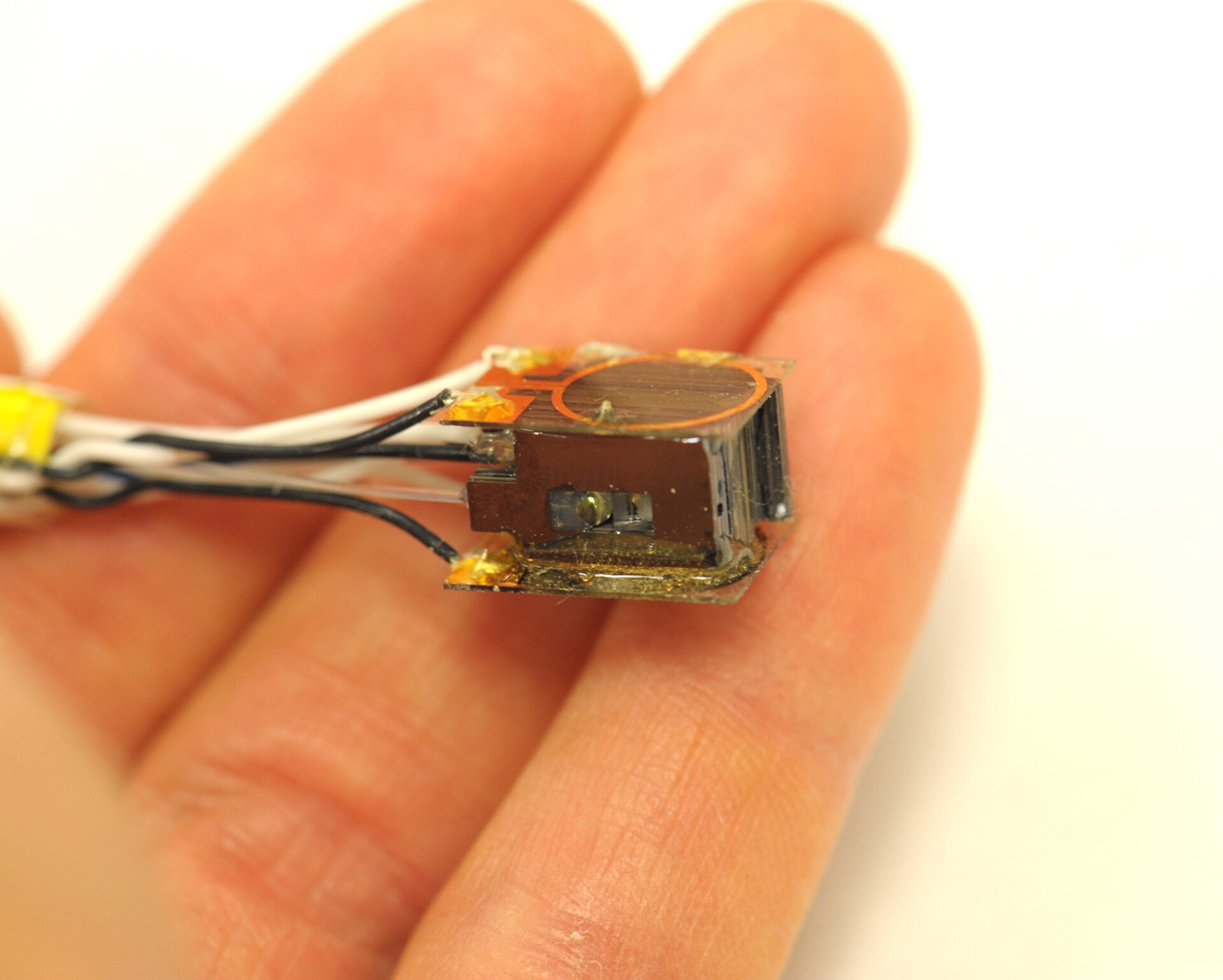
NIST’s atom-based magnetic sensor contains rubidium atoms and micro-optics used to detect magnetic fields. Credit: Knappe/NIST
Conventional nuclear magnetic resonance spectroscopy identifies chemical environments by observing nuclear spins inside a strong, exceptionally homogeneous magnetic field. Zero-field NMR takes a different route: the measurement is made with essentially no applied detection field, so the spectrum is governed mainly by scalar J couplings between nuclei rather than conventional chemical shifts.
That change relaxes one of the defining engineering constraints of high-field NMR, but it creates two other problems. Natural-abundance carbon-13 is scarce, accounting for about 1.1% of carbon atoms, so its signals are weak, while molecules containing several interacting spins can produce dense zero-field multiplets that are difficult to identify from the spectrum alone. Andrews et al. (2026) addressed both limitations by combining long-term-stable optical magnetometry with quantum-chemical calculations of the expected coupling networks.
Key results
| Result | Verified value | What it represents |
|---|---|---|
| Natural carbon-13 abundance | 1.1% | The fraction of carbon atoms contributing the rare isotope used for most measurements |
| Spectral linewidth | ≤250 mHz | The reported high-resolution performance of the zero-field measurements |
| Molecule library | 13 molecules | Experimental natural-abundance spectral fingerprints measured across multiple molecular structures |
| Rare double-carbon-13 species | 0.0121% probability | Doubly carbon-13-substituted acetic acid resolved after extended signal averaging |
| Long-term averaging | More than 10 days | Signal-to-noise scaling remained stable over extended acquisition |
| Formic acid detection | 100 mM | Natural-abundance formic acid remained detectable after dilution |
| Prepolarization field | 9.4 T | Strong magnetic field used before transfer into the zero-field detection region |
What does “zero-field” actually mean?
Zero-field refers to the spectroscopy and detection stage, not the complete experimental sequence. The samples were first polarized in a 9.4 T magnet, then shuttled into a magnetically shielded region where residual fields were reduced to the low-nT range before the nuclear-spin signal was measured.
The experiment therefore should not be described as magnet-free NMR. Samples were polarized for approximately 17.5 seconds in an inhomogeneous 9.4 T magnet and transferred in about 0.9 seconds under a guiding field into the shielded detector. The spectroscopy itself begins only after the sample reaches the near-zero-field region.
Detection used a commercial dual-axis rubidium-87 optically pumped magnetometer positioned about 2 mm (0.08 inches) from a standard sample vial. Instead of detecting radio-frequency induction in a conventional NMR coil, the optical magnetometer measures the tiny magnetic field generated by the evolving nuclear magnetization. The sensor used in the study had a reported sensitivity of approximately 40 fT Hz−1/2.
The samples were predominantly ordinary, off-the-shelf liquids measured at natural carbon-13 abundance. They were used without hyperpolarization, freeze-pump-thaw oxygen removal or isotopic enrichment, apart from one specifically identified enriched formate measurement used later in the study as a time-saving step.
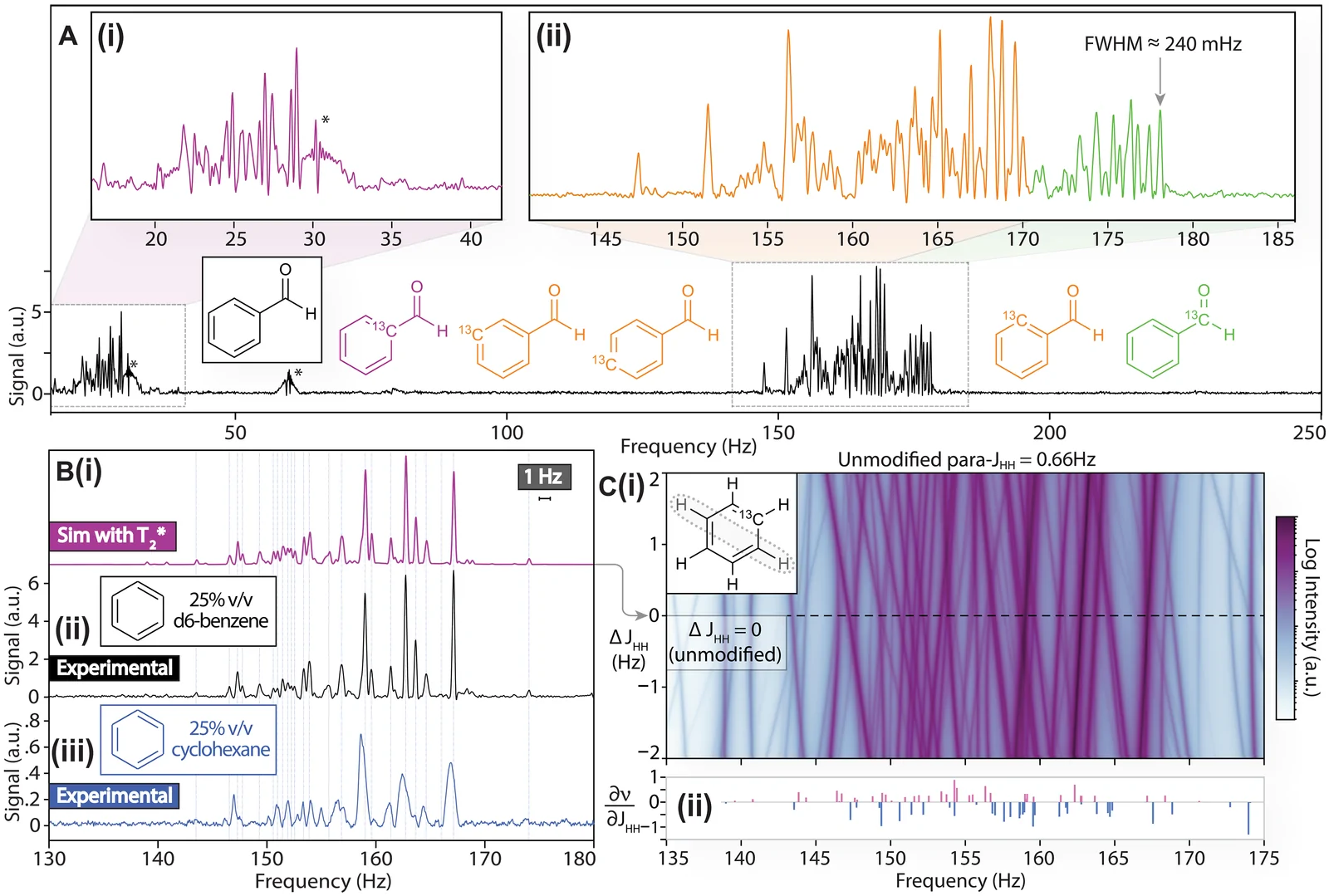
Benzaldehyde shows how much structural information survives in the zero-field regime. A spectrum accumulated over 9 247 scans contained separate contributions from five carbon-13 isotopomers, meaning molecules that differ only in which carbon site contains the rare isotope. Fine structure in the high-frequency region reached a full width at half maximum of approximately 240 mHz.
Benzene demonstrates why those narrow lines matter. When the researchers measured natural-abundance benzene in different solvents, numerous lines shifted by roughly 100 to 500 mHz and broadened. The benzene molecule itself had not changed; its coupling network and relaxation behavior were responding to the surrounding chemical environment.
Why are J couplings useful?
J couplings arise from interactions between nuclear spins transmitted through molecular bonds. Their values depend on molecular connectivity, local geometry and electronic structure. At zero field, these couplings directly set many of the observed frequencies, allowing small changes in molecular environment to reshape an entire multiplet rather than merely moving one isolated peak.
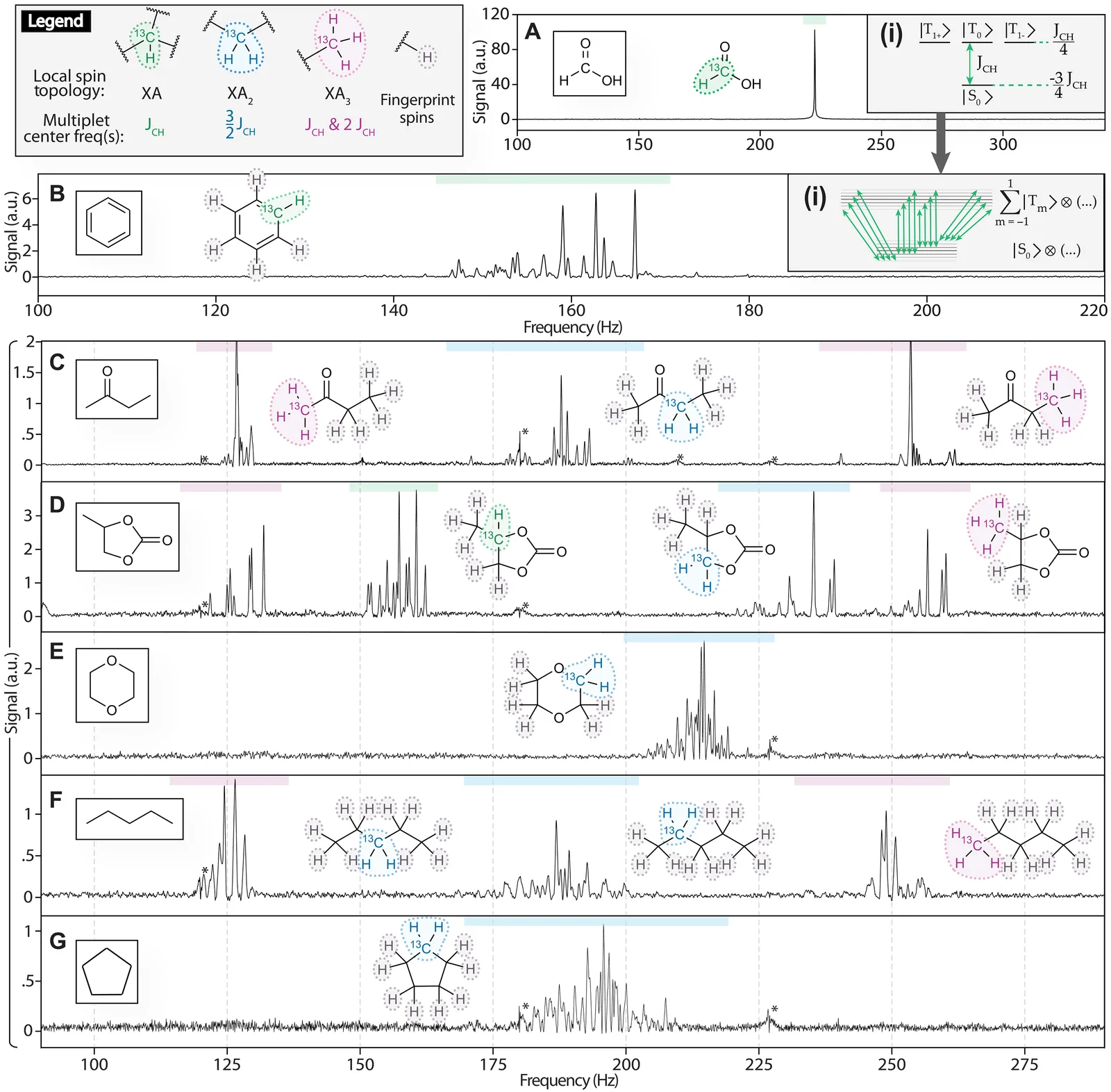
The experimental library contained 13 molecules. Representative examples ranged from formic acid, which produces a comparatively simple pattern, to benzene, methyl ethyl ketone, propylene carbonate, 1,4-dioxane, n-pentane and cyclopentane. Cyclopentane produced one of the densest manifolds because its couplings extend through an 11-spin network.
Different positions of a single naturally occurring carbon-13 atom create different coupling networks within the same molecule. The resulting isotopomer spectra therefore act as fingerprints of both molecular identity and the position of the carbon-13 nucleus.

Acetic acid provided a more demanding sensitivity test. After 23 215 scans, the researchers resolved the two more abundant singly carbon-13-substituted species together with much weaker resonances assigned to molecules containing two carbon-13 atoms. At natural isotopic abundance, the probability of that double substitution is 0.0121%.
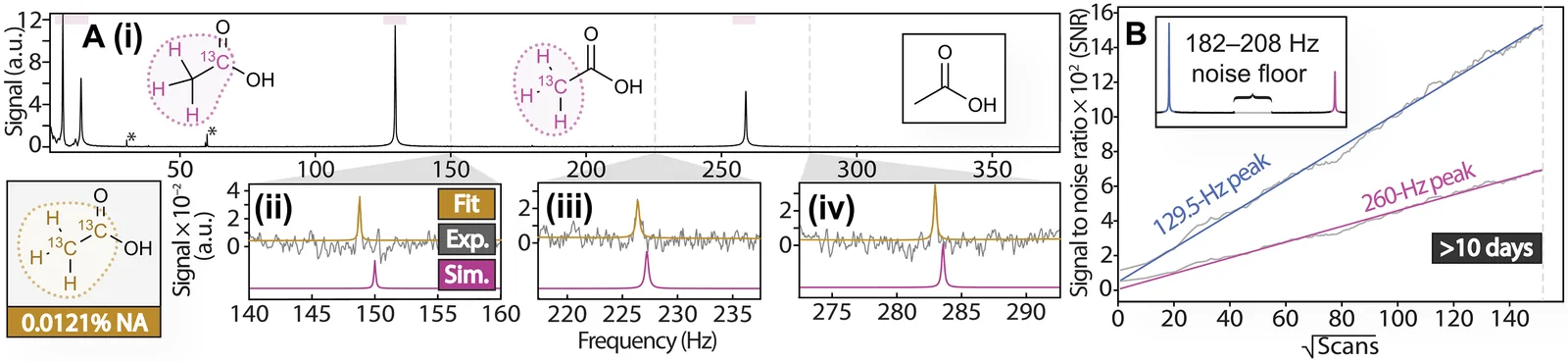
The ability to average for so long depended on instrumental stability. Signal-to-noise ratio continued to grow approximately with the square root of the number of scans for more than 10 days. The authors describe that result, with an explicit “to our knowledge” qualification, as the best reported zero-field NMR signal-to-noise stability.
The same system detected natural-abundance formic acid at a concentration of 100 mM. Zero-field measurements also intrinsically suppress the dominant water background in this class of experiment because water does not contain the heteronuclear carbon-13–hydrogen spin pair required to produce the measured spectrum.
From measurement to molecular prediction
Sensitivity solves only part of the problem. Complex zero-field spectra can contain many closely spaced transitions, and small errors in the underlying J couplings can produce substantially different predicted multiplets. A measured pattern becomes more useful if a molecular structure can first be converted into an accurate theoretical spectrum.
The researchers calculated scalar couplings with a PBE0-based density functional theory workflow and included explicit vibrational corrections before propagating the resulting coupling networks through spin-dynamics simulations. Vibrational corrections matter because atoms in a real molecule are continually moving rather than remaining fixed at their equilibrium coordinates, and that motion changes the couplings averaged by the experiment.
What does DFT contribute?
Density functional theory provides predicted J couplings from a proposed molecular structure. Those couplings can then be used in a spin-dynamics calculation to generate the zero-field spectrum expected from that molecule. The comparison does not replace the experiment; it provides a theoretical fingerprint against which the measured multiplet can be interpreted.
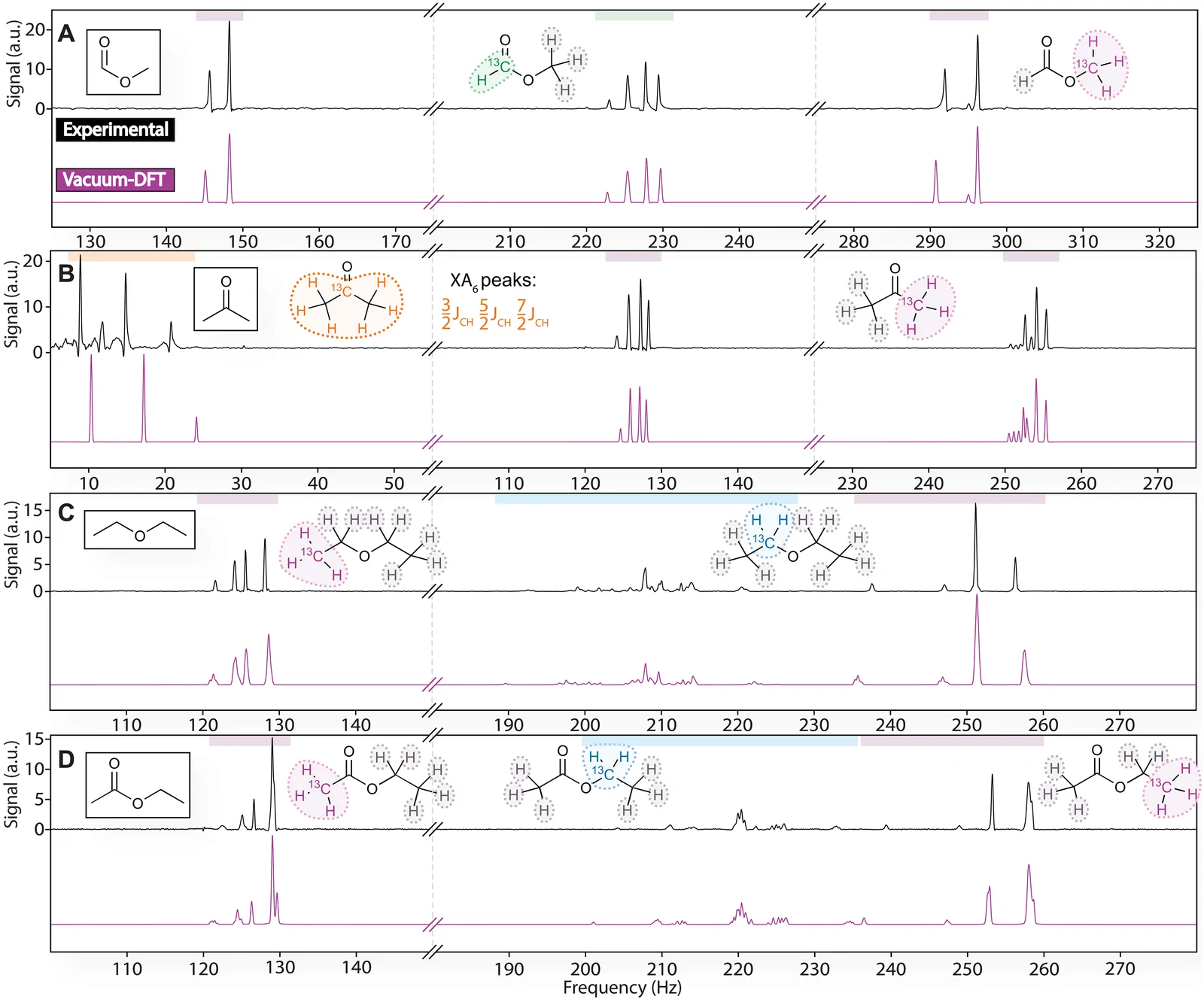
Predicted spectra for methyl formate, acetone, diethyl ether and ethyl acetate reproduced the principal experimental fingerprints with good qualitative agreement. For visualization, the researchers applied a small uniform adjustment of the dominant one-bond carbon-hydrogen coupling by a few percent where specified. The smaller couplings responsible for the detailed internal multiplet structure were not individually tuned.
Keep reading
The remaining disagreement between an isolated-molecule calculation and a real liquid then became another source of information. Instead of treating every residual frequency difference as computational error, the researchers asked whether those differences followed controlled changes in solvation, protonation and counterion environment.
The spectrum changes with the chemical environment
Formic acid provided the clearest test. Across an aqueous dilution series, the measured one-bond carbon-hydrogen coupling shifted by 4.4 Hz relative to neat formic acid. Explicit-solvent calculations reproduced the direction of the trend as hydrogen-bonding arrangements changed and water reorganized the local electronic environment around the molecule.
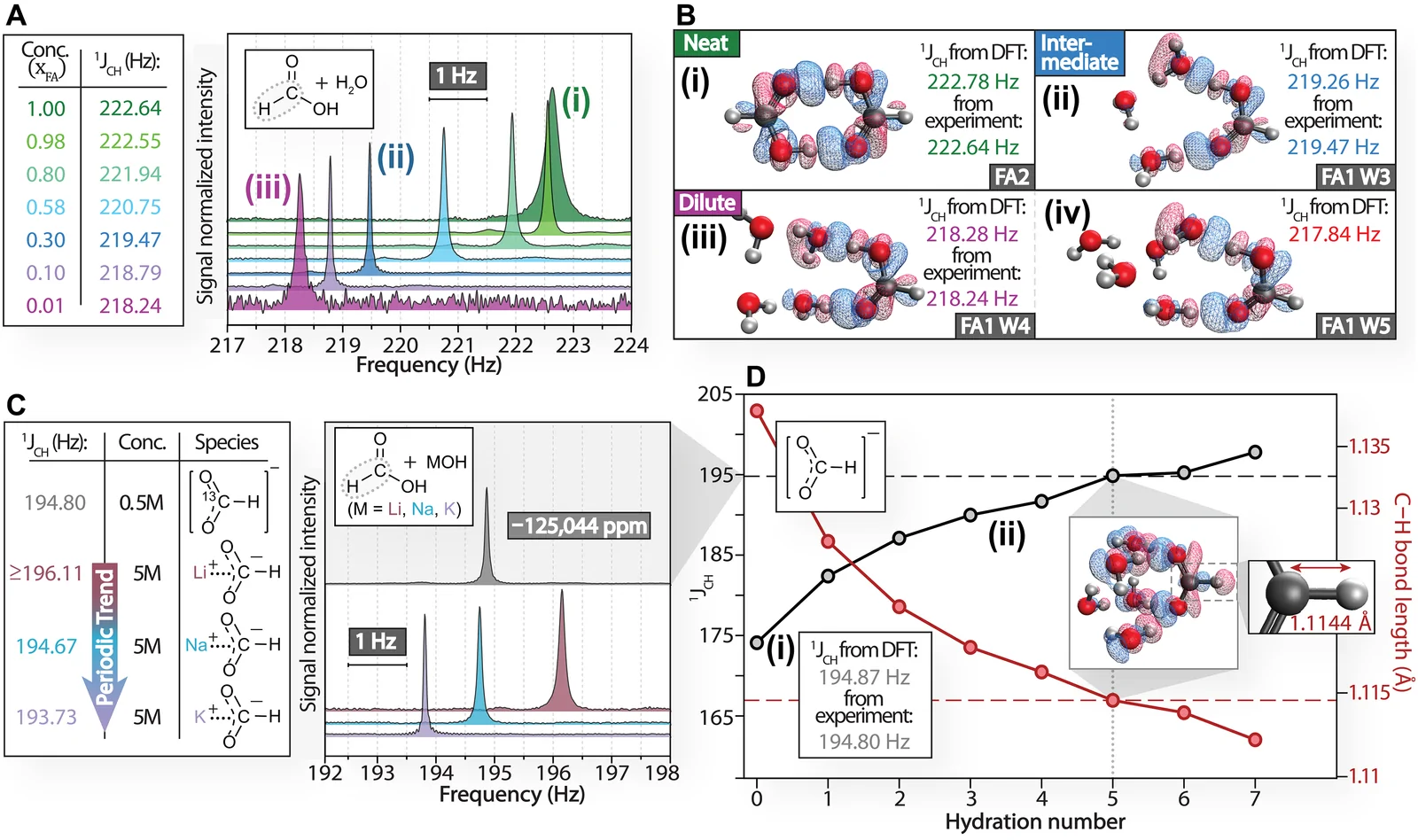
Converting formic acid to formate produced a much larger change. The 0.5 M formate resonance shifted by 27.8 Hz relative to neat formic acid. Within the explicit-solvent model used in the study, matching the measured coupling with the calculated hydration series corresponded to an average hydration number of approximately five and a predicted carbon-hydrogen bond length of 1.1144 Å.
Those structural values are model-derived quantities rather than direct measurements. The experimentally observed quantity is the zero-field resonance frequency from which the scalar coupling is obtained; the hydration number and bond length depend on the solvation model used to interpret that measurement.
Concentrated 5 M formate solutions produced another layer of contrast. Lithium, sodium and potassium counterions generated systematic differences in the carbon-hydrogen coupling, and calculations incorporating contact ion pairs reproduced the same periodic trend. The researchers interpret that agreement as evidence that the zero-field observable responds to counterion-dependent changes in local electronic structure.
| Evidence type | Finding | Status |
|---|---|---|
| Direct measurement | ≤250 mHz linewidths | Experimental |
| Direct measurement | 0.0121% doubly carbon-13-substituted acetic-acid species detected | Experimental |
| Direct measurement | 4.4 Hz formic-acid shift across aqueous dilution | Experimental |
| Direct measurement | 27.8 Hz shift after conversion to formate relative to neat formic acid | Experimental |
| Model interpretation | Average hydration number of approximately five | DFT-derived |
| Model interpretation | Carbon-hydrogen bond length of 1.1144 Å | DFT-derived |
| Future application | Routine analysis or deployable industrial monitoring | Prospective, not demonstrated |
What the study does not yet show
The technique is not a demonstrated replacement for conventional high-field NMR. Some of the weakest signals required thousands or tens of thousands of repeated scans, and the samples still had to be prepolarized before zero-field detection.
The authors identify more sensitive optically pumped magnetometers, permanent-magnet or compact superconducting prepolarization, flux concentration and faster sample transfer as possible routes to higher sensitivity. State-of-the-art potassium magnetometers cited in the paper have reached a noise floor of 1.2 fT Hz−1/2, compared with approximately 40 fT Hz−1/2 for the commercial sensor used in these experiments.
Those improvements could eventually make natural-abundance zero-field NMR useful for routine chemical analysis or real-time, deployable, in-situ monitoring of industrial chemical processes. Those are prospective applications. The 2026 experiments establish the spectroscopy, long-term stability, computational prediction and sensitivity to solution chemistry rather than an operational industrial monitoring system.
Study limitations and interpretation boundaries
- The method still uses a 9.4 T prepolarization magnet before zero-field detection.
- Very weak natural-abundance signals can require long acquisition periods and many thousands of scans.
- DFT agreement is qualitative rather than exact for the complete spectra.
- The inferred hydration number and bond length depend on the computational solvation model.
- Routine industrial or field deployment was proposed as a future possibility, not demonstrated experimentally.
The paper also discloses that Blake Andrews, Emanuel Druga and Ashok Ajoy are inventors on international patent application PCT/US2025/023273, filed on April 4, 2025, for a multichannel zero- to ultralow-field NMR spectrometer using optically pumped magnetometers. The remaining authors declared no competing interests.
The data and code required to evaluate and reproduce the reported results are publicly deposited on Zenodo. Replication additionally requires the relevant chemicals and the custom-built apparatus described in the paper and its supplementary material.
The next scientific test is whether improvements in sensitivity and computation can preserve the same chemical specificity in larger, more heterogeneous and more operationally relevant samples. The present measurements show that very weak natural-abundance spin signals can remain stable enough to build detailed molecular fingerprints; extending that performance beyond carefully controlled laboratory liquids remains an engineering and analytical challenge.
References:
1 Andrews, B., Liu, X., Zumbrunn, R., Lee, C., Adibnia, S., Druga, E., Head-Gordon, M., & Ajoy, A. (2026). DFT-assisted natural abundance 13C zero-field NMR via optical magnetometry. Science Advances, 12(47), eaej0517. DOI: 10.1126/sciadv.aej0517
2 Code/data Repository for “DFT-assisted natural abundance 13C zero-field NMR via optical magnetometry” – Zenodo – August 7, 2026 – DOI: 10.5281/zenodo.21830867

I’m a science journalist and researcher at The Watchers, contributing to the Epicenter edition, where I cover peer-reviewed scientific research and emerging discoveries across Earth and space sciences. With a background in astronomy and a passion for environmental science, I’ve worked in shark and coral conservation in Fiji, conducting reef and shark-behavior research, contributing to mangrove restoration, and earning PADI Open Water and Coral Reef Certifications. I bring a blend of scientific rigor and storytelling to illuminate the discoveries shaping our planet and beyond.
More reporting
- Study links Fentale magma intrusion to methane outburst from buried sediments, Ethiopia
- Google's WeatherNext cyclone model cuts intensity error but gives an overly narrow range of possible outcomes
- Tibetan Plateau landslide susceptibility expands beyond July–August peak under warming scenarios
- Higher summer temperatures linked to increased mortality among people with cardiovascular disease in UK study
