
Etchless photonic crystal reaches high-Q resonances in the deep ultraviolet
Researchers at Pohang University of Science and Technology in South Korea have experimentally observed symmetry-protected bound-state-in-the-continuum behavior in a photonic crystal operating in the deep ultraviolet, using a fabrication method that avoids directly patterning or etching its high-index zirconium dioxide layer. The device reached a measured Q factor of approximately 83 at an incidence angle of −13°, which the authors report as the highest experimentally measured value among deep-ultraviolet resonant metasurfaces characterized by reflectance or transmittance spectra.
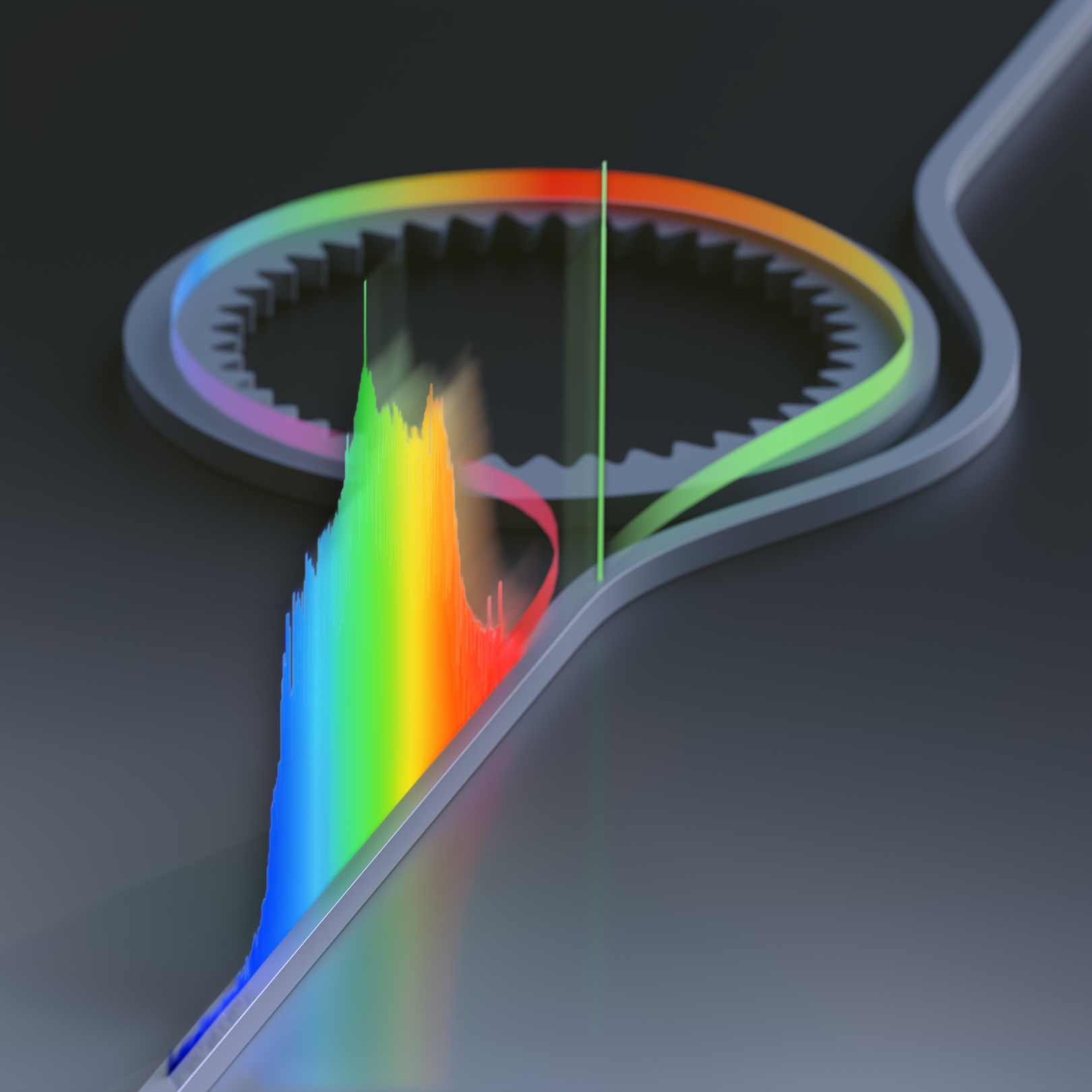
Artist’s illustration of a laser exciting a photonic-crystal ring resonator with periodic corrugations, generating a microcomb of light at near-infrared wavelengths. Representative photonic-crystal technology, not the deep-ultraviolet device reported in this study. Credit: S. Kelley/NIST
High-Q photonic resonances allow electromagnetic energy to remain associated with an optical mode for longer before it is lost, strengthening interactions between light and matter. Extending those resonances into the deep ultraviolet (DUV), which Jeong et al. define as wavelengths from 200 to 300 nm (0.00000787 to 0.00001181 inches), has remained difficult because many common high-index photonic materials absorb strongly at these wavelengths and because the structures required to manipulate DUV light must be fabricated on exceptionally small scales.
The new work addresses both constraints with a shell-type photonic crystal rather than a conventional solid high-index structure. A patterned low-index photoresist supplies the nanoscale geometry, while a conformal zirconium dioxide (ZrO₂) coating provides the refractive-index contrast required to sustain the optical modes. The approach separates formation of the nanoscale pattern from direct etching of ZrO₂, removing one of the fabrication steps that complicates deep-ultraviolet metasurfaces.
200–300 nm
Deep-ultraviolet range examined in the study.
Q ≈ 83
Highest measured Q factor reported in the experiment.
−13°
Incidence angle at which the Q ≈ 83 resonance was measured.

Photonic-crystal slabs control light through periodic structures with dimensions smaller than the wavelengths being manipulated. Their resonances can be described by a quality factor, or Q factor, which relates the resonance frequency to its linewidth. A larger Q corresponds to a spectrally narrower resonance and lower total energy loss, allowing the optical field to interact more strongly with material inside or near the structure.
DUV operation makes those losses difficult to control. Amorphous silicon, silicon nitride, crystalline silicon and titanium dioxide are widely used in photonic structures at longer wavelengths but absorb strongly in the deep ultraviolet. Zirconium dioxide and hafnium dioxide have more favorable optical properties in this spectral range, but fabricating them into very small high-quality resonators presents additional processing difficulties.
The wavelength itself creates another constraint. Because the lattice period of a photonic crystal generally scales with the wavelength it is designed to control, deep-ultraviolet structures require substantially smaller features than devices operating in the visible or infrared. Jeong et al. designed their platform around a lattice period below 200 nm.
How does the shell-type fabrication method work?
The researchers first patterned ZEP520A positive photoresist on fused silica using electron-beam lithography. The photoresist provides the physical nanoscale shape but has a refractive index of approximately 1.68 in the DUV, close enough to that of the substrate that the uncoated structure does not provide sufficient optical contrast for strongly confined resonances.
Atomic layer deposition then coats the photoresist conformally with higher-index ZrO₂, whose refractive index is approximately 2.4 in the spectral region examined. The experimental Methods report a 15 nm (0.000000591 inches) deposited ZrO₂ layer. The high-index material therefore follows a structure already defined in the photoresist rather than being directly etched into the final nanoscale pattern.

The principal angle-resolved simulation used a lattice period of 180 nm (0.00000709 inches), a diameter of 115 nm (0.00000453 inches) and a height of 60 nm (0.00000236 inches). The authors modeled a 12.5 nm (0.000000492 inches) ZrO₂ shell in this configuration.
That 12.5 nm value applies specifically to the geometry used for the Figure 2 calculation. It is separate from the 15 nm (0.000000591 inches) ZrO₂ deposition stated in the experimental Methods and from the 15 nm shell used in the later bulk-versus-shell comparison.
The calculations identified transverse-electric-like modes at the Γ point, the center of the photonic crystal’s Brillouin zone. Their electromagnetic-field symmetry allows the modes to be classified as A₁, B₁ and E. The A₁ mode is the symmetry-protected bound state in the continuum at the center of the study.
What is a bound state in the continuum?
Ordinarily, an optical state whose frequency lies within a range of freely propagating radiation can leak energy into that surrounding radiation field. A bound state in the continuum behaves differently: despite existing within that radiative frequency range, it remains decoupled from the radiation channels that would otherwise allow the energy to escape.
In the symmetry-protected case studied here, the A₁ mode at the Γ point has a symmetry that does not match the relevant free-space plane waves. That mismatch prevents ordinary radiative coupling. In an ideal mathematical structure the radiative contribution to its Q factor therefore diverges toward infinity, although real devices remain limited by absorption, disorder, finite dimensions and other loss processes.
The ideal BIC is effectively dark to the corresponding external radiation channel, which means an experiment cannot simply illuminate it and observe an infinitely sharp transmission resonance at the exact symmetry-protected point. Instead, angle-resolved measurements reveal the mode branches around the BIC. Once the angle moves away from the exact symmetry condition, the mode couples weakly to radiation and develops a finite linewidth that can be measured.

Angle-resolved transmittance measurements under x- and y-polarized illumination reproduced the principal mode structure predicted by the calculations. Under y-polarized illumination, the experimental spectrum showed the branches associated with the A₁ symmetry-protected BIC.
The researchers fitted selected spectral resonances with Fano line shapes to determine their Q factors. The measured spectra gave Q = 39 at normal incidence, Q = 48 at −7° and Q ≈ 83 at −13°. At normal incidence the measured resonance is associated with an E mode, while the tilted-angle resonances lie on the branch emerging from the A₁ BIC.
| Quantity | Value | Evidence type | Physical meaning |
|---|---|---|---|
| DUV range used in study | 200–300 nm (0.00000787–0.00001181 inches) | Defined spectral range | Region in which the photonic crystal was designed to operate |
| Measured Q at 0° | 39 | Experimental | E-mode resonance at normal incidence |
| Measured Q at −7° | 48 | Experimental | Finite-Q resonance on the branch associated with the BIC |
| Measured Q at −13° | ≈83 | Experimental | Highest measured Q reported in the experiment |
| Figure 2 lattice period | 180 nm (0.00000709 inches) | Model geometry | Period of the simulated photonic lattice |
| Experimental ZrO₂ thickness | 15 nm (0.000000591 inches) | Fabrication Methods | Deposited high-index shell thickness |
The approximately 83 Q factor measured at −13° is the study’s strongest quantitative experimental result. Jeong et al. report it as the highest experimentally measured Q factor among deep-ultraviolet resonant metasurfaces characterized using reflectance or transmittance spectra.
The scope of that claim matters. It is a comparison within a defined category of experimentally characterized DUV resonant metasurfaces, not an unrestricted record for every high-Q optical structure or every BIC system. Other BIC platforms operating at longer wavelengths can reach far larger Q factors.
Keep reading
Earlier work had also produced resonant structures in the deep ultraviolet. A 2025 Nano Letters study, for example, experimentally measured Q = 37 at approximately 4.6 eV using a silicon interband-plasmonic system whose localized plasmonic resonance was hybridized with a Fabry–Pérot resonance. The POSTECH result therefore advances an established DUV nanophotonics field rather than representing the first resonant optical device at these wavelengths.
Does the shell behave like a conventional photonic crystal?
The researchers also tested whether replacing a conventional solid high-index photonic crystal with the shell architecture changed the defining far-field behavior around a symmetry-protected BIC. They compared three calculated structures: a uniform bulk photonic crystal with refractive index 2.4, a virtual bulk structure with an averaged refractive index of 2.0, and the shell-type structure containing the lower-index photoresist core.

All three comparison models used a period of 180 nm (0.00000709 inches), a diameter of 110 nm (0.00000433 inches) and a height of 60 nm (0.00000236 inches). The shell-type model used a 15 nm (0.000000591 inches) ZrO₂ coating. Those dimensions differ slightly from the 115 nm diameter and 12.5 nm shell used in the earlier angle-resolved simulation because the paper uses separate modeled configurations for different parts of the analysis.
In the idealized calculations, all three structures produced Q factors that diverged at the Γ point. Their far-field polarization states also formed the same winding pattern around the BIC. The researchers interpret this agreement as evidence that the shell implementation preserves the principal far-field characteristics of the conventional bulk structures examined in their comparison.
Measured structure versus modeled structures
| Configuration | Period | Diameter | Height | ZrO₂ shell |
|---|---|---|---|---|
| Figure 2 simulation | 180 nm (0.00000709 inches) | 115 nm (0.00000453 inches) | 60 nm (0.00000236 inches) | 12.5 nm (0.000000492 inches) |
| Fabrication Methods | Sub-200-nm design | Not represented by a single universal value in the Methods text | Not represented by a single universal value in the Methods text | 15 nm (0.000000591 inches) |
| Figure 4 comparison | 180 nm (0.00000709 inches) | 110 nm (0.00000433 inches) | 60 nm (0.00000236 inches) | 15 nm (0.000000591 inches) |
What the experiment does — and does not — demonstrate
The study demonstrates a deep-ultraviolet photonic platform and experimentally characterizes its resonant behavior. It does not demonstrate a finished molecular sensor, nonlinear optical device, semiconductor product or communications component.
The authors identify molecular detection as a possible application because molecules can exhibit strong electronic absorption and other characteristic responses in the DUV, while a high-Q resonance provides a route for increasing interaction between an optical field and material placed in or near the resonator.
Possible future directions discussed in the paper include refractive-index sensing, enhanced Raman and absorption measurements, luminescence enhancement and nonlinear optical processes. Those uses remain prospective extensions of the platform rather than experimental outcomes established by the present work.
Why does Q ≈ 83 remain far below the ideal BIC value?
The infinite-Q description applies only to the radiative component of an ideal symmetry-protected BIC. A physical device introduces other ways for optical energy to disappear.
The paper identifies material absorption as one limiting mechanism. It also points to structural variations, disorder across the periodic array and finite-size effects as additional loss channels that can reduce the experimentally measured Q factor below the value predicted for an ideal structure.
The small dimensions required for deep-ultraviolet operation also impose tight fabrication tolerances. Variations that would represent only a small fraction of a wavelength in a visible or infrared system can become more consequential when the lattice itself is below 200 nm.
Future improvements will therefore depend on reducing optical absorption, improving structural uniformity and designing modes that place less of their electromagnetic energy inside lossy regions. The researchers also propose dispersion and mode engineering that could permit DUV operation with larger structural dimensions, relaxing some of the manufacturing constraints that currently separate ideal calculations from measured performance.
References:
1 Jeong, M., Lee, J., Lee, S., Lim, J., An, J., & Rho, J. (2026). Deep ultraviolet bound states in the continuum. Science Advances, 12(47), eaej0568. DOI: 10.1126/sciadv.aej0568
2 Csányi, E., Liu, Y., Kai, D., Sugiarto, S., Lee, H. Y. L., Tjiptoharsono, F., Ruan, Q., Rezaei, S. D., Chi, X., Rusydi, A., Leggett, G., Yang, J. K. W., & Dong, Z. (2025). Achieving high quality factor interband nanoplasmonics in the deep ultraviolet spectrum via mode hybridization. Nano Letters, 25(10), 3906–3913. DOI: 10.1021/acs.nanolett.4c06247
3 Hsu, C. W., Zhen, B., Stone, A. D., Joannopoulos, J. D., & Soljačić, M. (2016). Bound states in the continuum. Nature Reviews Materials, 1, 16048. DOI: 10.1038/natrevmats.2016.48

I’m a science journalist and researcher at The Watchers, contributing to the Epicenter edition, where I cover peer-reviewed scientific research and emerging discoveries across Earth and space sciences. With a background in astronomy and a passion for environmental science, I’ve worked in shark and coral conservation in Fiji, conducting reef and shark-behavior research, contributing to mangrove restoration, and earning PADI Open Water and Coral Reef Certifications. I bring a blend of scientific rigor and storytelling to illuminate the discoveries shaping our planet and beyond.
More reporting
- Very strong El Niño favors wetter 2026–27 winter in Philadelphia region, but snowfall remains uncertain
- Rain intensifies before marine stratocumulus break into open cells, EarthCARE study finds
- Study links Fentale magma intrusion to methane outburst from buried sediments, Ethiopia
- Google's WeatherNext cyclone model cuts intensity error but gives an overly narrow range of possible outcomes
