
NASA selects 302 small-business projects for lunar power, robotics and surface infrastructure
NASA selected 302 small-business technology projects for up to USD 171 million through its SBIR/STTR program, combining 204 Phase I selections with 98 Phase II projects, the agency announced on November 20, 2026. Among the technologies receiving support are ultra-cold batteries, robotic manipulators, rollable solar arrays and methods for preparing reusable lunar landing surfaces.
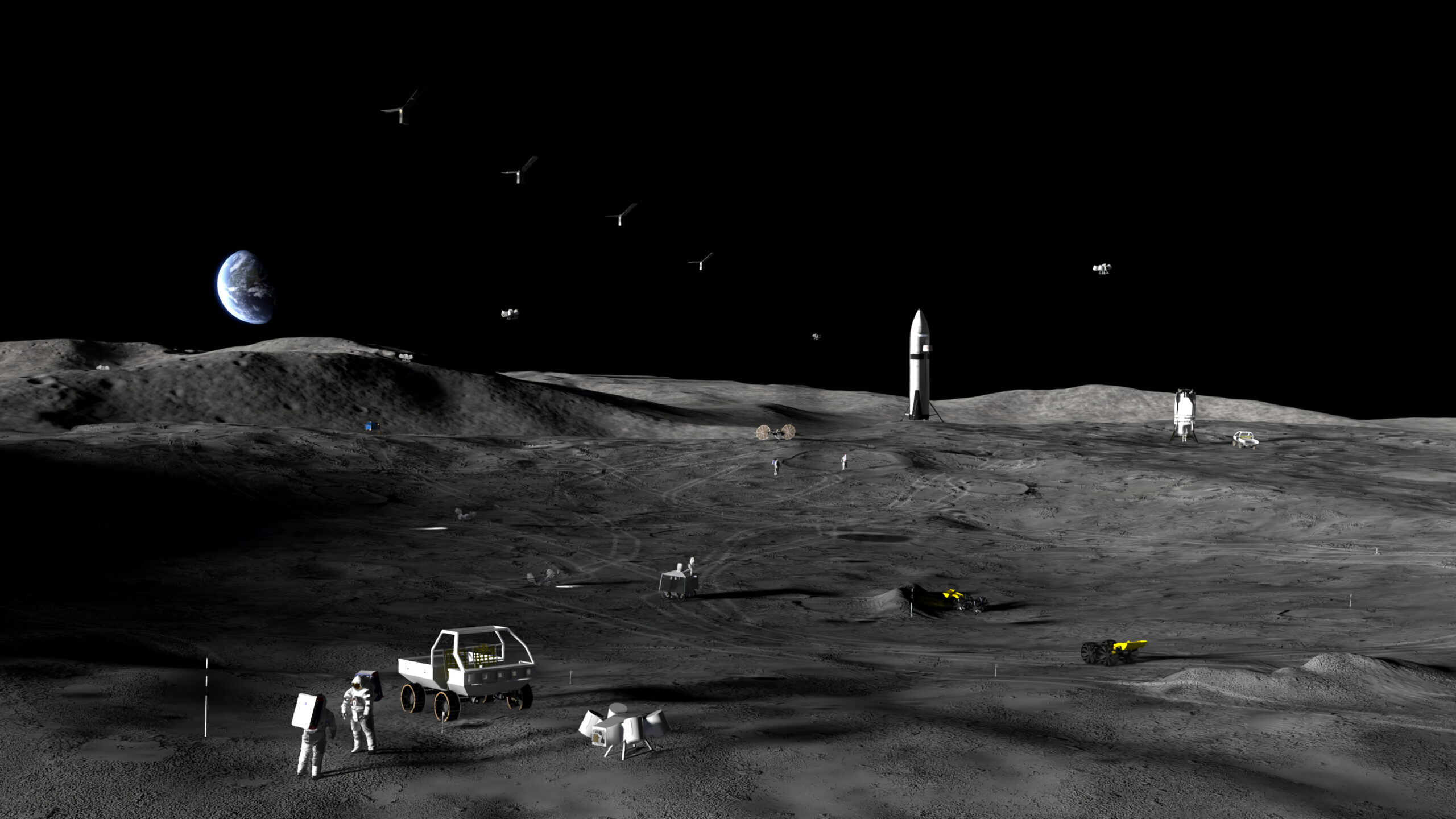
Artist's rendering of conceptual Phase One Moon Base activities near the lunar South Pole. The image shows the broader operating environment for future robotic systems, surface power and infrastructure and does not depict the SBIR/STTR projects described in this article. Credit: NASA
The 204 Phase I selections comprise 51 projects under NASA’s 2026 SBIR Appendix A, 121 under SBIR Appendix B and 32 under STTR Appendix B. Each Phase I team can receive up to USD 225 000 to establish the scientific, technical and commercial merit and feasibility of its proposed technology.
The other 98 projects are 2025 SBIR Phase II selections announced in July 2026. Phase II is used to develop, demonstrate and deliver technologies that previously established feasibility during Phase I. NASA’s November announcement describes the 98 contracts as valued at up to USD 1.3 million each, while the program’s standard Phase II investment ceiling is USD 1.275 million.
View the project illustration at its source. Illustration of a future lunar vehicle that could potentially be powered by NASA-funded research to develop an ultra-cold-tolerant battery module. Credit: Elementium Materials Inc.
Elementium Materials Inc. received an SBIR Phase I award for an ultra-cold-tolerant battery module intended for space applications and cold environments on Earth. NASA said the technology can operate down to approximately −60°C (−76°F) without active heating, reducing the need for heaters and insulating layers.
The battery concept is intended for equipment that must continue operating during prolonged cold conditions on the lunar surface. NASA identified rovers, habitats and other infrastructure among the potential applications and linked the work to the approximately 14-Earth-day lunar night, when solar power is unavailable at many locations.
Opterus Research and Development Inc. received an SBIR Phase II award for a modular system of rollable solar arrays intended for the surfaces of the Moon and Mars. NASA said the arrays are designed for robotic handling, compatibility with different support structures and operation in dusty surface conditions.
The Opterus system could be scaled to 50 kW, according to NASA. The agency described the work as a potential power source for infrastructure developed by NASA and commercial operators on the Moon.
Power generation is one of the infrastructure requirements NASA associates with longer-duration lunar surface operations. The agency’s broader Moon Base planning describes a phased buildup that begins with robotic missions and technology demonstrations before adding power, logistics, communications and other systems needed for sustained operations near the lunar South Pole.
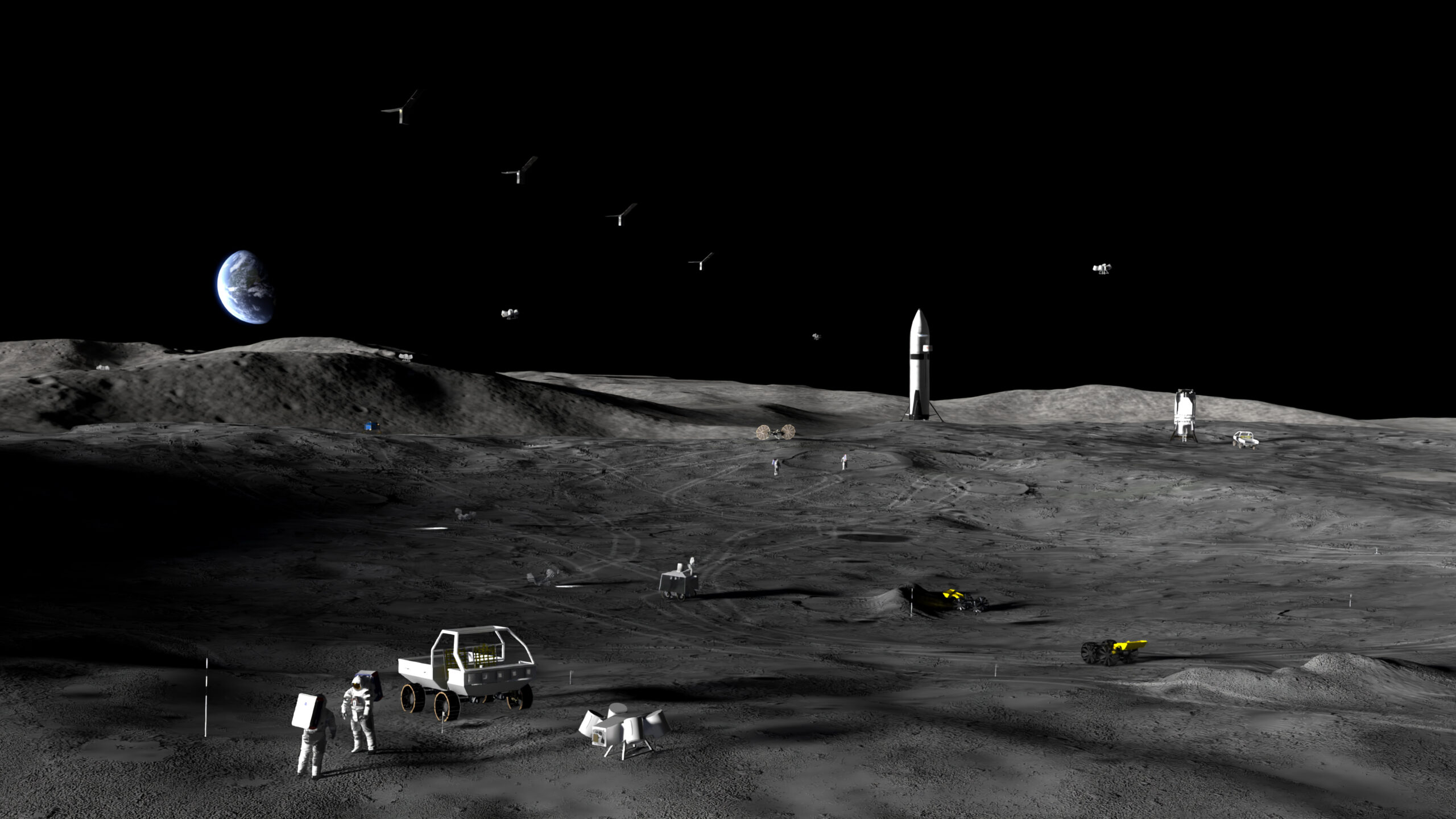
Intelligent Fiber Optic Systems Corporation received a Phase I award for a robotic manipulator intended to help lunar rovers perform complex tasks without direct human handling. NASA describes the system as a 3.05 m (10-foot) extendable arm combining a camera with sensors that detect and measure surface texture, contact force and temperature.
Keep reading
Potential tasks include cleaning solar panels, positioning habitat structures and collecting scientific samples from locations that are difficult for a rover to reach directly. The combination of visual and tactile sensing is intended to give the manipulator information about both the appearance and physical contact properties of objects it handles.
A separate STTR Phase I project brings Slate Geotechnical Consultants Inc. together with the Colorado School of Mines to examine two approaches to preparing lunar regolith for repeated landings. The work addresses a basic surface-engineering problem created when rocket exhaust interacts with loose lunar material.
Without a prepared landing surface, exhaust can displace regolith, throw dust and larger material away from the landing zone and excavate craters. NASA said the Slate project will also investigate the use of rovers to repair and maintain future landing pads between missions.
The four examples represent only part of the 302-project portfolio. NASA’s 2026 Phase I selections also cover navigation, hardware health assessment, flight diagnostics, very low Earth orbit operations and other agency technology needs, while the 98 Phase II projects continue work that began under Phase I selections made in 2025.
Phase I selection establishes funding for feasibility work rather than a commitment to use a technology on a particular flight or surface mission. Phase II provides a path toward development, demonstration and delivery after a company has established feasibility, but selection at either stage does not by itself mean that NASA has approved the hardware for operational deployment.
NASA’s Small Business Innovation Research/Small Business Technology Transfer program is part of the agency’s Research and Technology Mission Directorate and is managed by NASA’s Ames Research Center in California. SBIR awards support eligible U.S. small businesses, while STTR projects pair a small business with a research institution.
References:
1 New NASA Seed Funding Primes Small Businesses for Innovation – NASA – November 20, 2026
2 SBIR/STTR Phase I – NASA – accessed November 28, 2026
3 SBIR/STTR Phase II – NASA – accessed November 28, 2026
4 Moon Base Development – NASA – accessed November 28, 2026

I’m a science journalist and researcher at The Watchers, contributing to the Epicenter edition, where I cover peer-reviewed scientific research and emerging discoveries across Earth and space sciences. With a background in astronomy and a passion for environmental science, I’ve worked in shark and coral conservation in Fiji, conducting reef and shark-behavior research, contributing to mangrove restoration, and earning PADI Open Water and Coral Reef Certifications. I bring a blend of scientific rigor and storytelling to illuminate the discoveries shaping our planet and beyond.
More reporting
- Hundreds of deforming bedrock landslides cluster near glaciers across southern Alaska
- Projected 5G leakage can alter the satellite data behind weather forecasts
- Global analysis finds glacial lakes amplify ice loss while climate and glacier geometry remain dominant
- Antarctic sea ice sets daily records while October monthly extent remains second lowest
