
Distant earthquakes can weaken faults long after their seismic waves have passed
Researchers at The University of Hong Kong have developed a numerical model showing how passing seismic waves can progressively raise pore pressure inside fault gouge, leaving a distant fault weakened after the waves themselves have passed. The mechanism offers a physical explanation for two persistent puzzles in remote earthquake triggering: why seismicity can begin after a delay and why Rayleigh waves can be more effective triggers than Love waves despite imposing weaker direct shear stresses in some fault configurations.
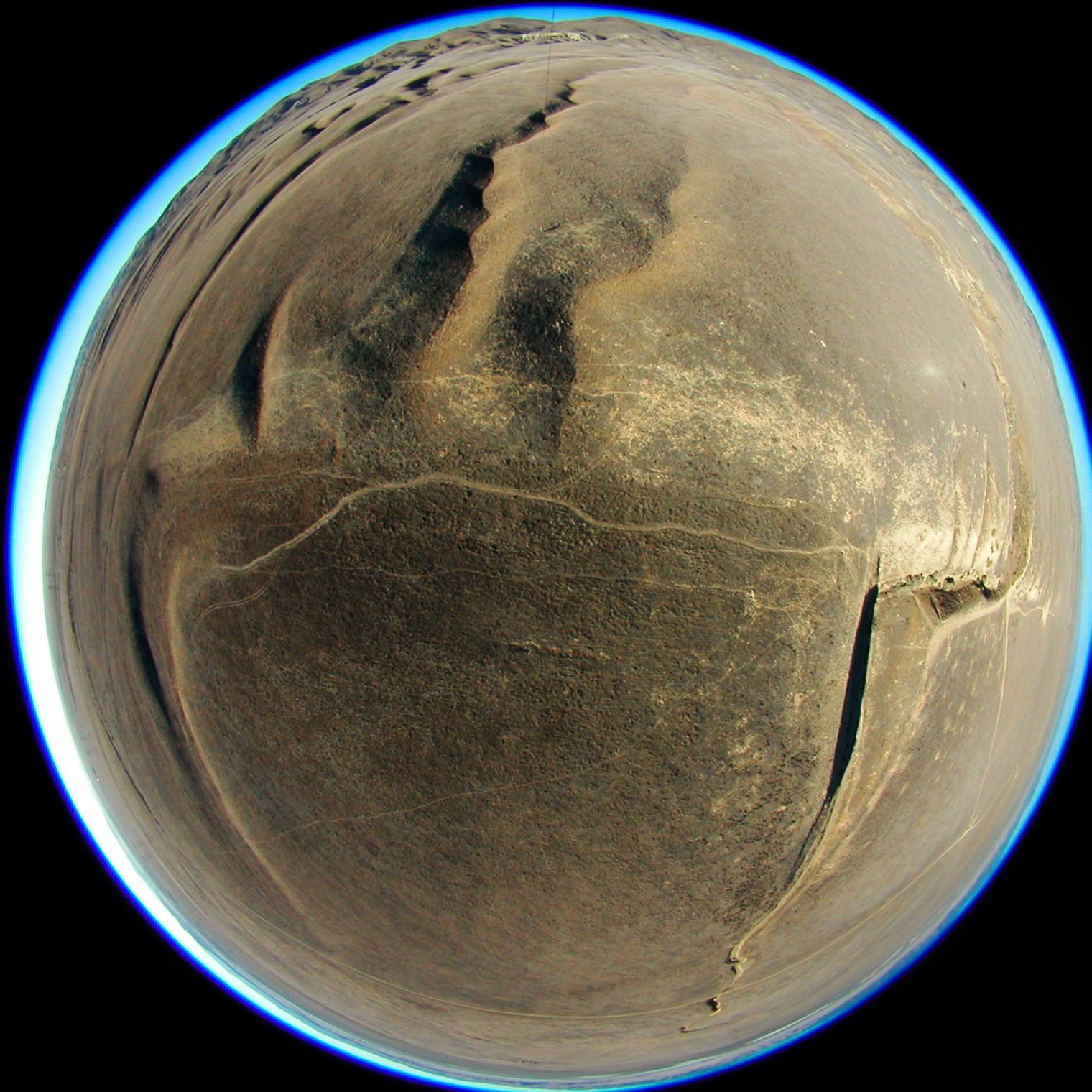
Aerial view of the San Andreas Fault on the Carrizo Plain, California. Representative fault landscape. Credit: USGS
Large earthquakes can alter seismicity far outside their conventional aftershock zones, sometimes thousands of kilometres from the mainshock. Most remotely triggered earthquakes discussed in the study are small, but their occurrence presents a difficult mechanical problem: the stresses carried by distant seismic waves are commonly far weaker than the forces resisting motion on faults at seismogenic depths.
Chao Huang and Jun Yang of The University of Hong Kong examined whether part of the missing process lies inside fault gouge, the porous, fine-grained material formed by repeated grinding along a fault. Their simulations indicate that passing seismic waves can produce a cumulative mechanical change inside the gouge rather than simply pushing a fault toward failure during one stress oscillation. The resulting pore-pressure increase can persist after the wave train ends, providing a mechanism for delayed remote triggering.
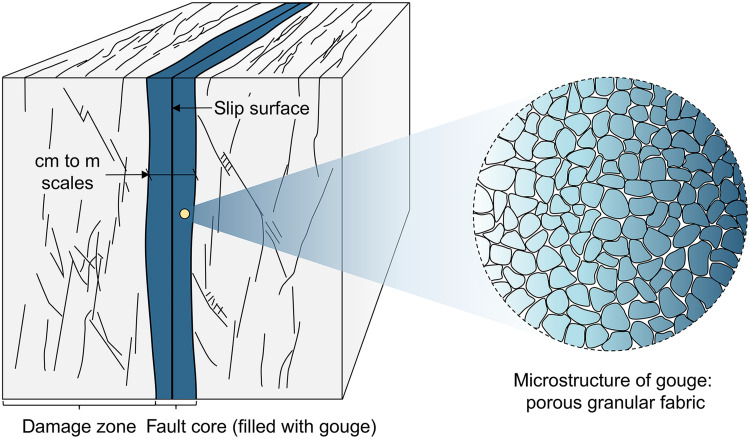
Fault gouge changes the problem because it behaves differently from intact rock. Its fine granular structure can contract or dilate as particles rearrange under changing stresses. The material is commonly clay-rich, compressible and poorly permeable, so fluid trapped between the grains cannot always move away rapidly when the gouge deforms.
When the gouge contracts faster than pore fluid can escape, pore pressure rises. That increase reduces effective normal stress, the part of the compressive load that actually clamps the solid fault surfaces together after fluid pressure is taken into account. A reduction in effective normal stress therefore weakens the fault without requiring an equally large increase in shear stress.
Why pore pressure matters
Fault strength depends partly on how firmly the two sides of a fault are pressed together. Fluid pressure inside the fault opposes that clamping force. As pore pressure rises, the effective normal stress decreases, reducing frictional resistance to sliding. The study tests whether repeated seismic-wave loading can create enough accumulated pore pressure to change a distant fault’s mechanical state.
Surface-wave stresses associated with remote triggering are typically about 0.01 to 1 MPa (1.5 to 145 psi), according to the scientific literature examined by Huang and Yang. Those perturbations are two to three orders of magnitude below the shear strength of faults at seismogenic depths. Under a purely Coulomb-stress interpretation, disturbances that small should initiate slip mainly on faults already extremely close to failure.
Field observations are more complicated. Triggering rates do not consistently follow the largest local ground motions, some remotely triggered seismicity begins minutes to months after the waves have passed, and earthquake catalogs have frequently associated triggering with later-arriving Rayleigh waves even though Love waves can impose larger direct shear stresses on some vertical strike-slip faults.
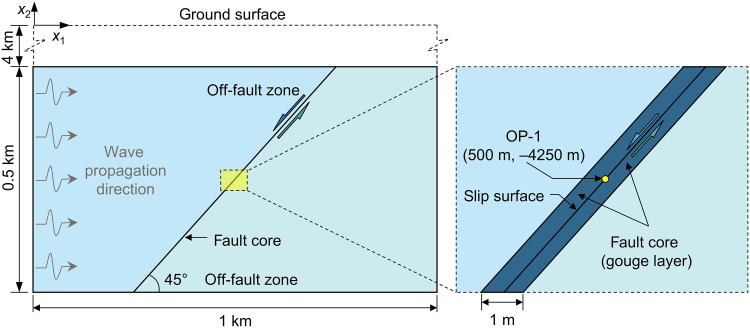
Huang and Yang investigated that problem with a poro-elasto-plastic numerical framework. A bounding-surface plasticity model rooted in critical-state soil mechanics represents irreversible deformation of the gouge under repeated loading, while poromechanical calculations describe the coupling between deformation and pore-fluid pressure.
The reference setup uses a simplified two-dimensional normal fault dipping 45° and centred 4.25 km (2.64 miles) below the surface. A 1 m (3.3 feet) thick gouge layer forms the fault core inside an off-fault zone measuring 1 km (0.62 miles) by 0.5 km (0.31 miles). The fault is planar, its slip surface is smooth and the surrounding host rock is treated as homogeneous.
The simplification is deliberate. Rather than reproduce the geometry of a particular earthquake, the calculations isolate how gouge responds to externally imposed seismic-wave stresses. The study follows the prerupture stress state of the fault rather than simulating the full dynamic rupture of an earthquake.
| Reference-model quantity | Value | Physical role |
|---|---|---|
| Fault depth | 4.25 km (2.64 miles) | Representative nucleation depth in the simplified model |
| Fault dip | 45° | Dipping normal-fault reference geometry |
| Gouge thickness | 1 m (3.3 feet) | Low-permeability fault core |
| Modeled zone | 1 × 0.5 km (0.62 × 0.31 miles) | Computational region surrounding the fault core |
| Rayleigh-wave loading | 200 seconds, 10 cycles | Transient external stress perturbation |
| Accumulated excess pore pressure | >1.7 MPa (>247 psi) | Reduces effective normal stress and weakens the modeled fault |
| Direct Coulomb-stress fluctuation | about 0.15 MPa (22 psi) | Comparison with direct wave-induced stressing |
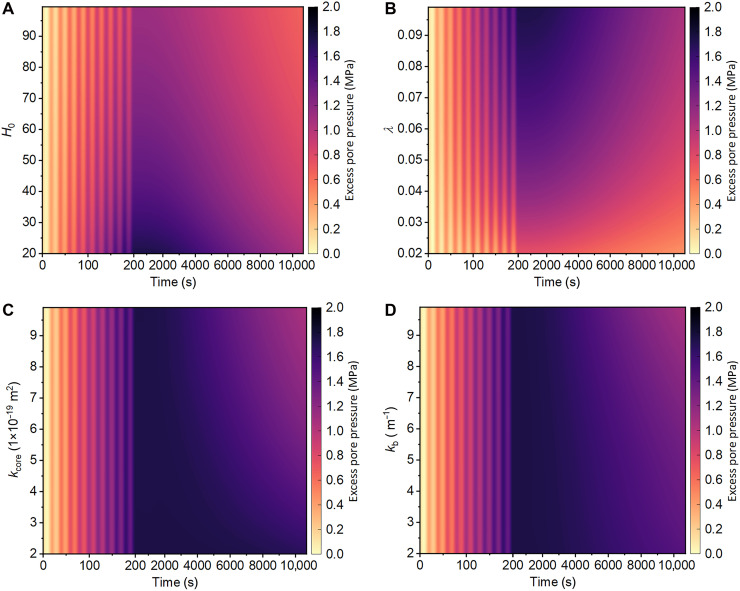
The researchers imposed a 200-second Rayleigh-wave stress history containing 10 loading cycles. The forcing is applied quasistatically, meaning the model tracks the imposed stress changes without explicitly simulating wave inertia throughout the fault zone.
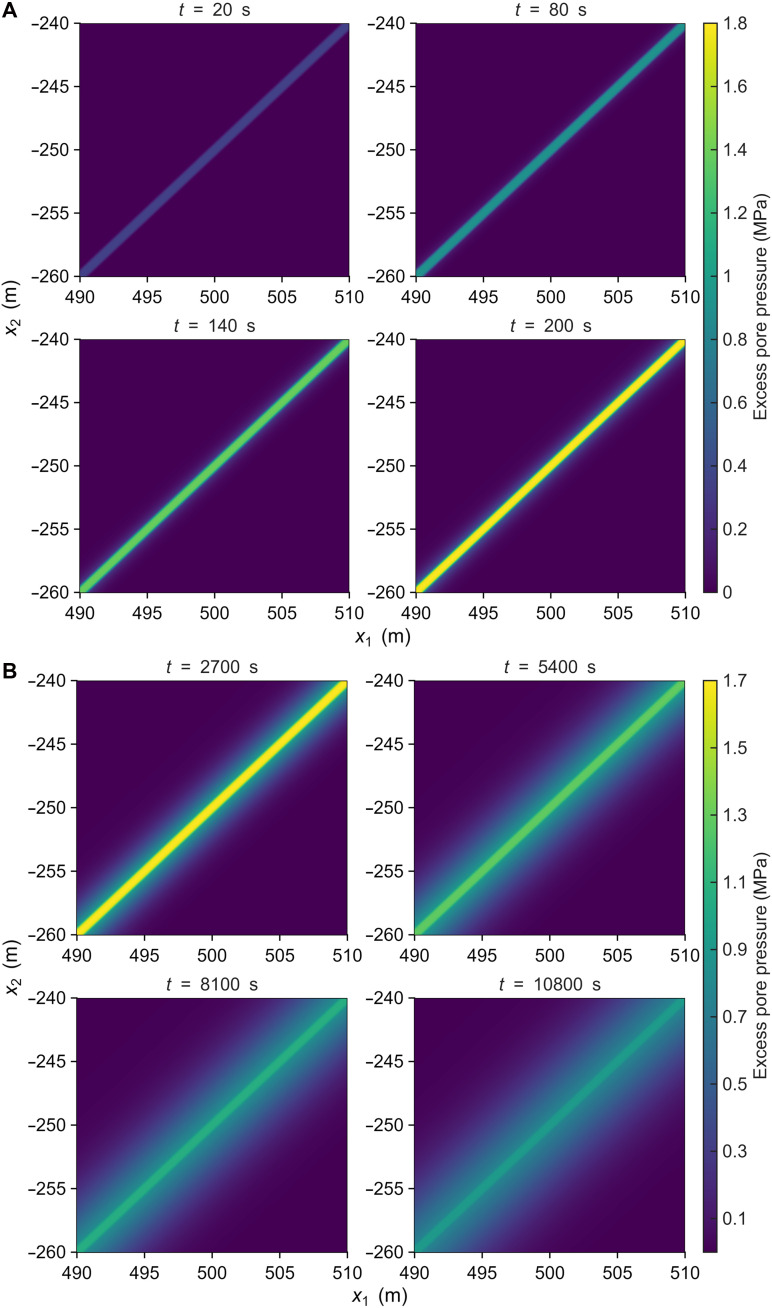
Individual wave cycles produced relatively small instantaneous changes. Pore pressure and effective normal stress on the modeled slip surface oscillated by less than 0.2 MPa (29 psi), while the shear-stress oscillation remained below 0.03 MPa (4.4 psi).
The cumulative response was much larger. After 10 cycles, excess pore pressure in the bounding-surface simulation had risen by more than 1.7 MPa (247 psi), with a comparable reduction in effective normal stress. The direct Coulomb-stress fluctuation calculated for the same perturbation was approximately 0.15 MPa (22 psi), making the accumulated pore-pressure change more than 10 times larger in the reference simulation.
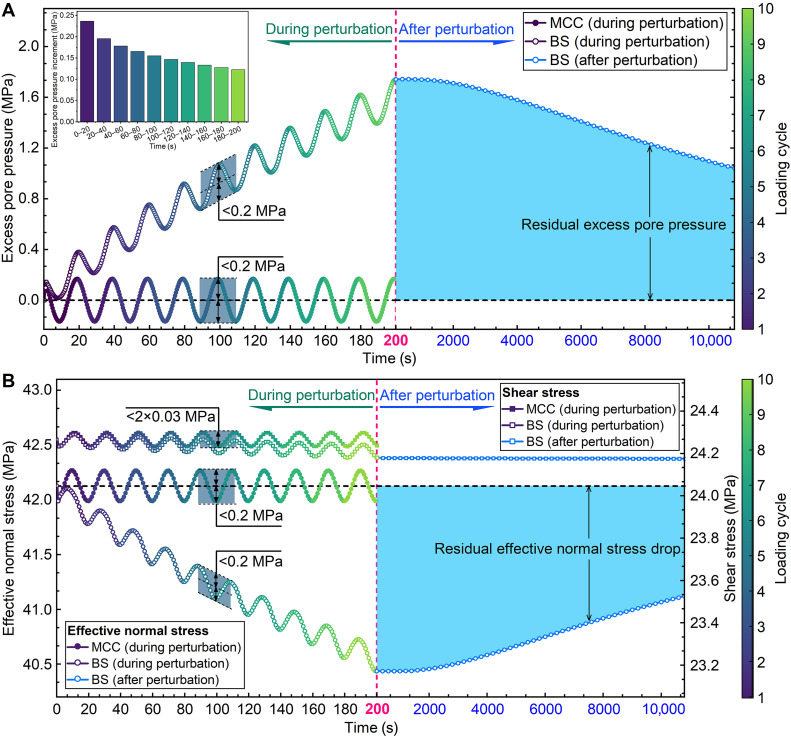
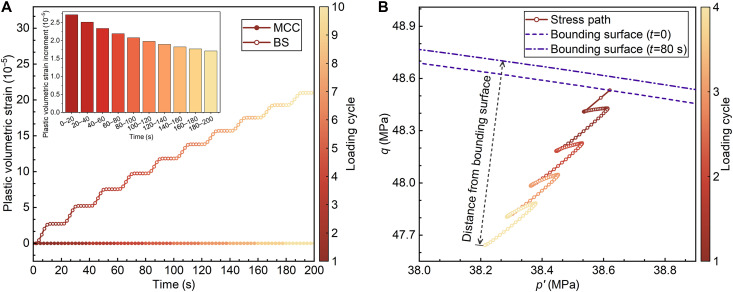
The distinction comes from irreversible deformation of the modeled gouge. The bounding-surface formulation allows small plastic strains to develop before the material reaches its nominal yield surface. Under repeated loading, those small changes accumulate from one cycle to the next.
A modified Cam-Clay comparison model behaves differently. Because it excludes the same subyield plastic deformation, its stress cycles remain largely closed and do not reproduce the progressive buildup in pore pressure. The comparison isolates accumulated volumetric deformation as the process responsible for the increasing pressure in the bounding-surface calculation.
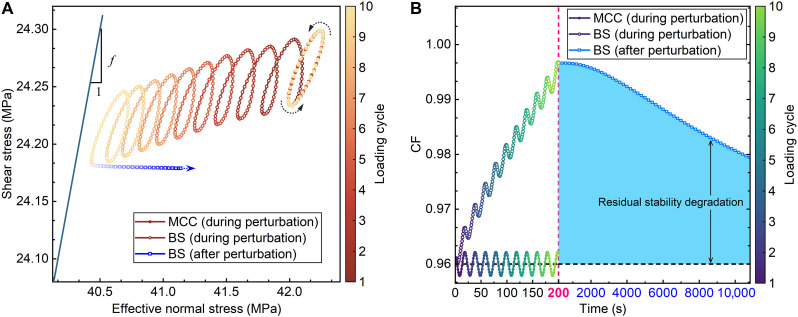
The pressure increase moves the fault closer to the model’s slip condition. Huang and Yang measure this with a closeness-to-failure coefficient, the ratio between shear stress and shear resistance on the slip surface. The value rises from 0.96 before loading to more than 0.995 by the end of the Rayleigh-wave perturbation. In the model, a value above 1 represents the onset of slip.
Why triggering can be delayed
The weakening does not disappear when the seismic waves stop. In the reference simulation, excess pore pressure along the slip interface declines from approximately 1.7 MPa (247 psi) to about 1.0 MPa (145 psi) during the following three hours.
At the central observation point, substantial dissipation begins only after roughly 30 minutes. The initial delay occurs because pore pressure is nearly uniform through the central part of the gouge when the forcing ends; the hydraulic gradient needed to drive drainage develops inward from the boundaries over time.
Fluid leaving the core also raises pressure across a surrounding zone roughly 10 m (33 feet) wide. Effective normal stress then begins to recover, but it remains below its preperturbation level at the end of the three-hour calculation. The modeled fault therefore remains more weakly clamped after the transient wave forcing has ended.
The paper connects that persistence with delayed dynamic triggering observed in earthquake catalogs. Reported delays extend from minutes to months, but the numerical experiment does not establish a universal delay. Huang and Yang propose that the timing depends on the degree of weakening, the rate of pore-pressure dissipation and subsequent stresses acting on the fault.
Keep reading
Model result versus real earthquake observation
The three-hour pressure evolution is a result of the study’s reference numerical simulation. It is not a measured three-hour recovery time for natural faults. Observed remotely triggered seismicity can begin over a much wider interval. The study proposes slow pressure dissipation as one physical process capable of preserving fault weakening long enough for later perturbations to initiate failure.
Why Rayleigh and Love waves behave differently
The same model addresses another long-standing puzzle. Love waves are dominated by horizontal shear motion and can produce larger Coulomb stress changes than Rayleigh waves on some vertical strike-slip faults. Rayleigh waves combine shear with compressional and vertical motion, yet remotely triggered seismicity has frequently appeared during their later arrival.
Huang and Yang separated the compressional and shear components of Rayleigh-wave loading and scaled them to comparable dynamic-stress amplitudes. Shear-only forcing produced pore-pressure oscillations but little net accumulation. Compressional forcing generated substantial cumulative pressure growth.
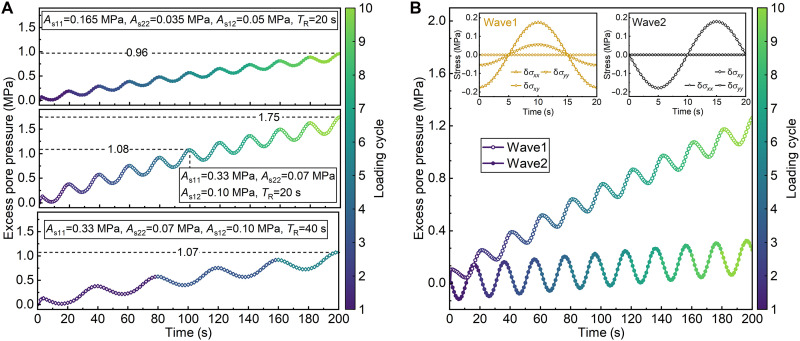
The difference is linked to the stress path imposed on the gouge. Compressional loading drives irreversible volumetric deformation more effectively in the modeled material, so triggering potential depends on how the stress state evolves through each loading cycle rather than on peak wave amplitude alone.
Wave duration and cycle count also change the result. Tests with different periods produced more accumulated pore pressure over a fixed interval when more loading cycles occurred. When the simulations were compared after the same five cycles, both produced 1.08 MPa (157 psi) of pore-pressure growth, showing that the apparent frequency effect in that comparison arose from cycle count rather than frequency acting independently.

Rayleigh-wave dominance is not universal. The authors identify circumstances in which Love waves can become more important, including faults with poorly developed gouge and situations where Love-wave amplitudes are sufficiently larger for their direct shear stresses to outweigh the weakening produced by Rayleigh-wave loading.
Fault geometry remains relevant for the same reason. Pore-pressure accumulation depends primarily on the stress path experienced by the gouge, while passing waves also apply stresses directly to the fault plane. The study treats these as interacting processes rather than competing explanations.
What the study does not establish
The simulations do not establish that every remotely triggered earthquake is produced by pore-pressure accumulation in fault gouge. Natural gouge can contract or dilate depending on its mechanical state. Contraction raises pore pressure in the modeled conditions, while sufficiently dilative behaviour can lower pore pressure and strengthen a fault instead.
The largest limitation is experimental calibration. The authors report that cyclic-loading experiments on natural fault gouge are not yet sufficient to constrain several important constitutive parameters in the bounding-surface model. Those values were therefore taken from representative geotechnical practice.
Huang and Yang describe the resulting rheology as a phenomenological framework for investigating fault mechanics rather than a quantitatively calibrated representation of natural seismogenic fault material. The reference geometry is also simplified, with a planar fault, homogeneous host rock and no branching or geometric irregularities.
Does this improve earthquake prediction?
The study improves physical understanding of variables that can affect remote triggering, but it does not provide an operational earthquake-prediction system. It does not establish a validated threshold that can determine which distant fault will rupture, when it will rupture or whether a particular incoming seismic wave will trigger an earthquake.
The central advance is a proposed physical pathway from transient wave loading to persistent fault weakening, not a method for predicting individual earthquakes.
The distinction matters because understanding a failure mechanism and forecasting a failure are different scientific problems. Applying the model prospectively would require detailed knowledge of fault geometry, stress state, gouge properties, pore pressure, permeability and the stress trajectory produced at nucleation depth by an incoming wave field.
The authors identify reconstruction of those subsurface stress trajectories from surface seismograms as a future research priority. Laboratory cyclic-loading experiments on natural fault gouge would also be needed to determine whether the modeled pressure accumulation and dissipation can be quantitatively reproduced in materials taken from real fault zones.
The peer-reviewed paper was published electronically in Science Advances on June 24, 2026. HKU returned attention to the work with institutional releases on November 22 and 23, 2026. The November coverage is therefore a new institutional presentation of research first published five months earlier, not the publication date of the underlying study.
References:
1 Huang, C., & Yang, J. (2026). What triggers seismicity thousands of kilometers away from a mainshock? Science Advances, 12(26), eaec4754. DOI: 10.1126/sciadv.aec4754
2 HKU Engineering study reshapes the understanding of remotely triggered earthquakes – The University of Hong Kong – November 22, 2026
3 HKU Study Explains How Earthquakes Can Trigger Seismic Events Thousands of Kilometres Away – The University of Hong Kong – November 23, 2026

I’m a science journalist and researcher at The Watchers, contributing to the Epicenter edition, where I cover peer-reviewed scientific research and emerging discoveries across Earth and space sciences. With a background in astronomy and a passion for environmental science, I’ve worked in shark and coral conservation in Fiji, conducting reef and shark-behavior research, contributing to mangrove restoration, and earning PADI Open Water and Coral Reef Certifications. I bring a blend of scientific rigor and storytelling to illuminate the discoveries shaping our planet and beyond.
More reporting
- Kīlauea keeps burying its own past — a 1.7 km drill core reveals what lies below
- 19 people were never recovered after the 1959 M7.3 Hebgen Lake earthquake triggered a massive landslide near Yellowstone
- Pressure waves reveal how fast Shishaldin erupted during 2023 paroxysm, Alaska
- Warming slows deep bedrock water renewal beneath Idaho headwaters
