
Hubble’s impact craters reveal the hidden role of cosmic dust in spacecraft damage
Natural cosmic dust accounted for about 90% of investigated impacts by particles larger than 50 μm (0.002 inches) on a radiator recovered from the Hubble Space Telescope, according to a 2024 study. Microscopic residues preserved inside the craters challenge earlier estimates of artificial debris impacts and raise questions about how accurately engineering models represent the particle environment through which spacecraft travel.
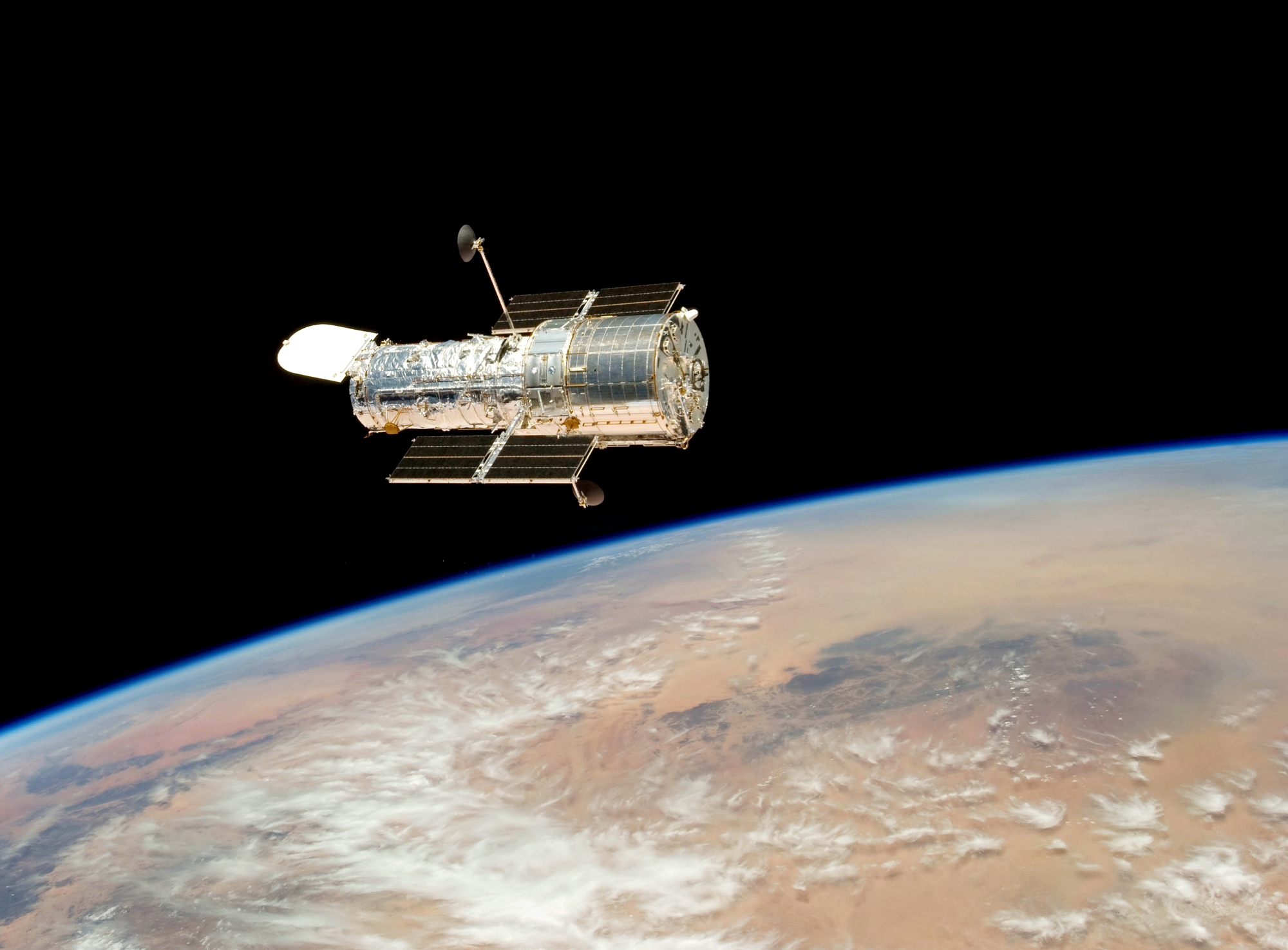
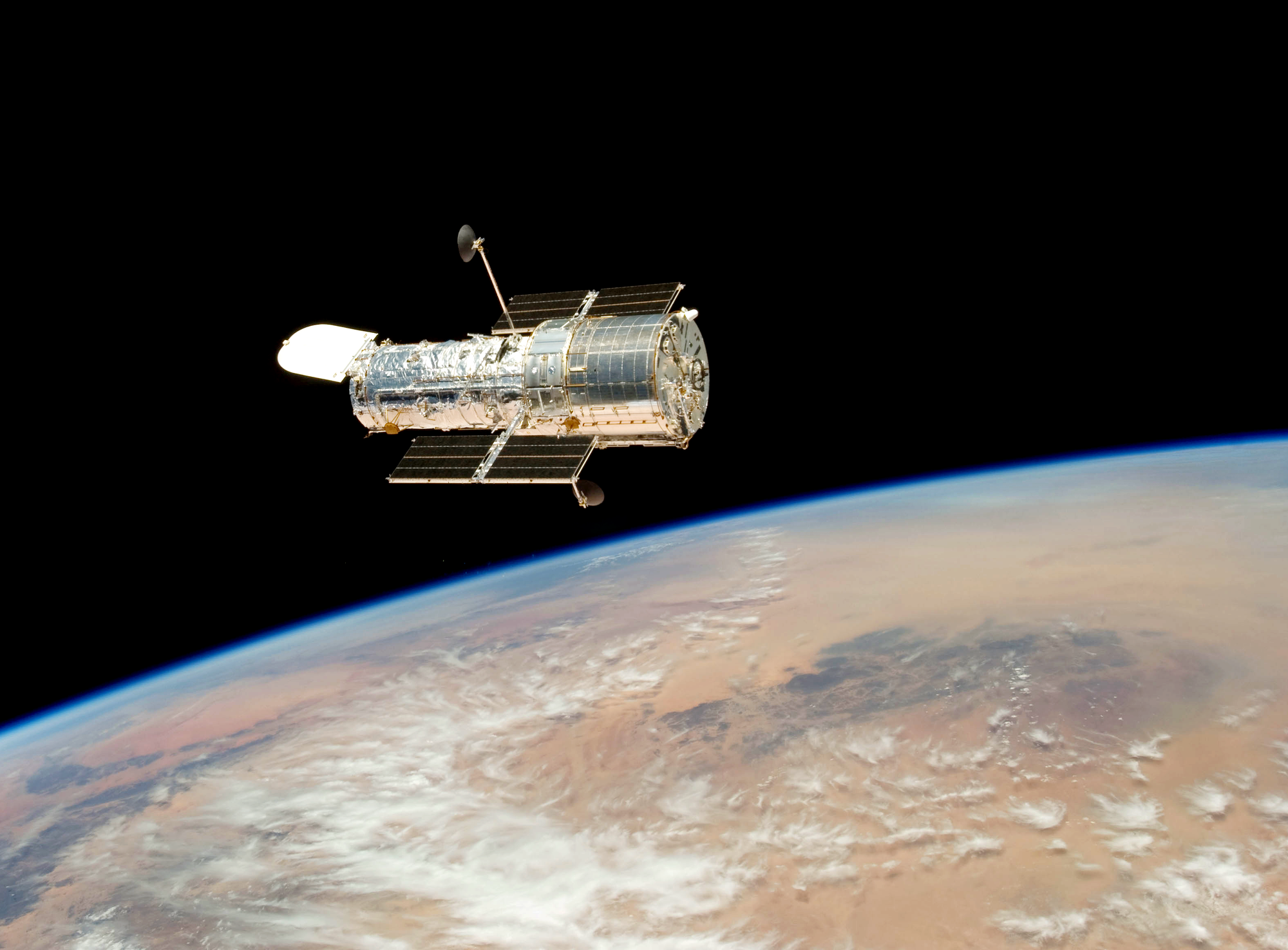
The Hubble Space Telescope above Earth following its release from space shuttle Atlantis on May 19, 2009. Credit: NASA
When astronauts removed the Wide Field Planetary Camera 2 (WFPC2) from the Hubble Space Telescope in May 2009, its external radiator carried a record of approximately 15.4 years of exposure to low Earth orbit. The instrument had been designed to photograph distant astronomical objects, but its exposed surfaces also collected evidence of microscopic collisions occurring much closer to Earth.
Kearsley et al. (2024) used chemical and mineralogical evidence preserved in those impact features to investigate the particles responsible for the damage. Their reassessment identified substantially fewer large artificial debris impacts than earlier investigations had reported, raising a fundamental question about the relative abundance of natural and human-generated particles in the orbital environment.
Spacecraft risk assessments depend on more than the number of particles encountered during a mission. Particle composition, mass, density and relative velocity influence the damage produced by a collision. Distinguishing between natural cosmic dust and artificial debris is important when developing models used to estimate that exposure.
NASA’s Orbital Debris Program Office (ODPO) catalogued 677 impact features during its 2009 inspection of the recovered WFPC2 radiator. The survey reached a limiting feature size of approximately 300 μm (0.012 inches). That measurement describes the damage left on the surface rather than the original diameter of the impacting particles.

| WFPC2 radiator survey | Measurement |
|---|---|
| Orbital exposure | 15.4 years |
| Hardware recovery | May 2009 |
| Radiator dimensions | 0.8 × 2.2 m (2.6 × 7.2 feet) |
| Surface area | 1.76 m² (18.9 square feet) |
| Catalogued impact features | 677 |
| Approximate survey threshold | 300 μm (0.012 inches) |
Two populations contribute to microscopic collisions in Earth orbit. Natural micrometeoroids include small grains of material released by asteroids and comets. Artificial orbital debris includes fragments of spacecraft, degraded surface coatings and other material introduced into orbit by human activities.
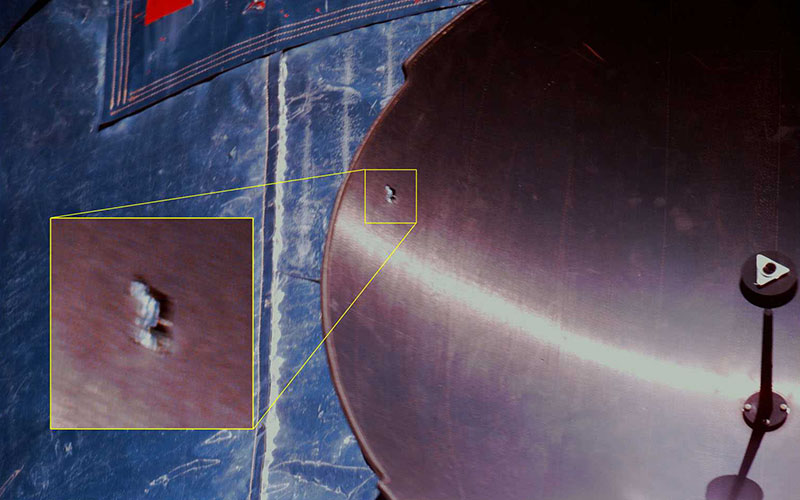
At hypervelocity, collisions can fragment, melt or vaporize material from both the projectile and the surface it strikes. The kinetic energy of an impactor increases with the square of its relative velocity, allowing particles much smaller than a millimeter to produce measurable damage.
Explore the physics: how does impact velocity affect kinetic energy?
The kinetic energy of a moving particle is calculated using E = ½mv², where m is its mass and v is its velocity relative to the target. If the mass remains unchanged, increasing the velocity produces a disproportionately large increase in kinetic energy.
At the same particle mass:
- Twice the velocity produces four times the kinetic energy.
- Three times the velocity produces nine times the kinetic energy.
- Four times the velocity produces 16 times the kinetic energy.
The actual damage also depends on the projectile’s composition, impact angle and the mechanical properties of the spacecraft material. Kinetic energy alone cannot determine the size of the resulting crater.
Returned spacecraft materials offer a way to measure parts of the orbital particle environment below the sensitivity of ground-based radar and optical instruments. Each exposed surface acts as a passive detector, accumulating impact features throughout its operational lifetime.
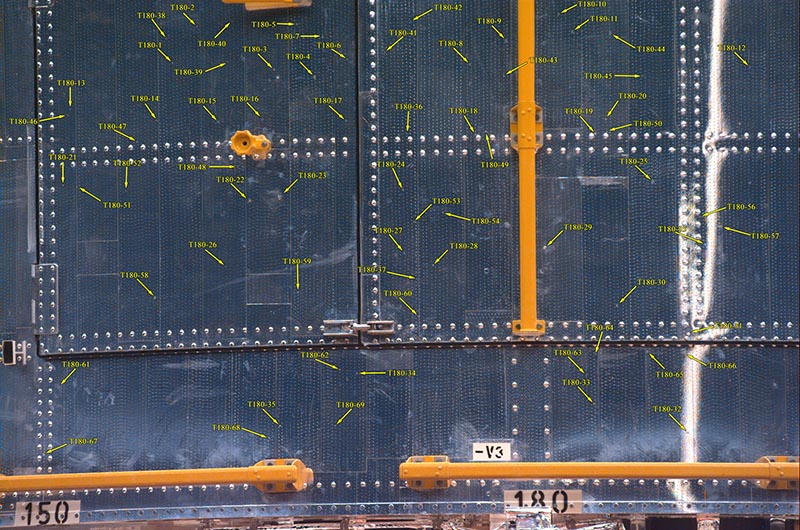
The WFPC2 radiator consisted of an aluminum alloy substrate measuring 4.06 mm (0.16 inches) in thickness. Cowardin et al. (2023) reported a white zinc orthotitanate thermal-control coating measuring 100–150 μm (0.004–0.006 inches) in thickness.
The composition of those materials complicates the identification of the particles responsible for individual impacts. Chemical elements originating from the radiator can become mixed with projectile residues during a collision. Aluminum-rich debris striking an aluminum substrate presents a particular identification problem because the projectile and target contain the same principal element.
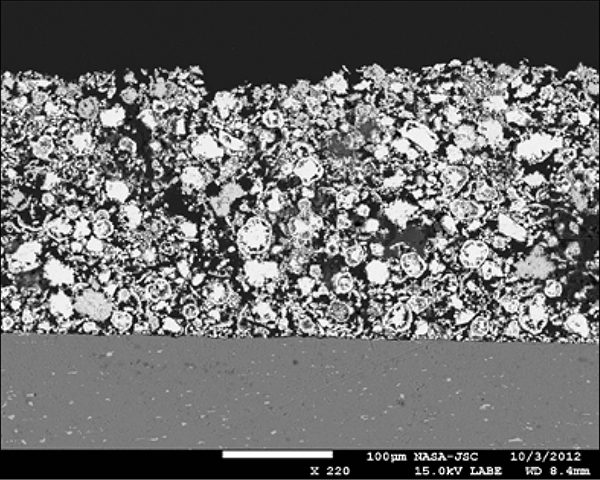
Smaller impact features can remain confined to the thermal paint, while larger impacts can excavate the coating and damage the underlying metal. Some collisions produce spallation, a process in which material surrounding an impact detaches from the surface. The detached material can carry away chemical evidence needed to establish the projectile’s origin.
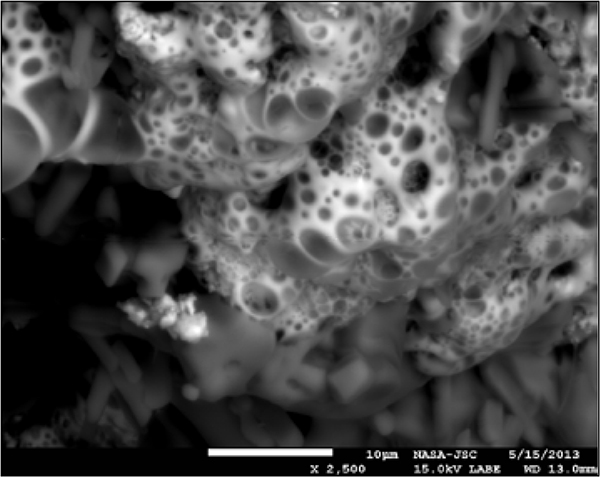
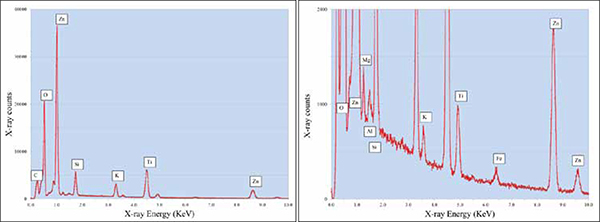
Researchers use energy-dispersive X-ray spectroscopy alongside scanning electron microscopy to investigate the remaining material. When an electron beam interacts with a sample, atoms emit characteristic X-rays. Measuring their energies allows scientists to identify which chemical elements are present.
One example is radiator impact sample WFPC2-68. NASA researchers detected magnesium and iron in solidified impact melt from a crater that had not reached the aluminum substrate. They interpreted those elements as possible evidence of a natural micrometeoroid. Silicon, by contrast, was already present in the paint and could not independently establish the projectile’s origin.
Anz-Meador et al. (2019) investigated limitations associated with the microscopic examination of deep craters. Their walls can interfere with the detection of X-rays emitted by material inside the impact feature, reducing the chemical information available from an overhead examination.
The researchers cut through extracted crater cores and polished the resulting surfaces to obtain better access to buried residues. The cross-sectioning campaign involved 21 radiator cores.
Changes in analytical methods had already altered some classifications. Of 12 large craters examined in earlier assessment campaigns, seven received different classifications in 2017 compared with 2014. Four changed from natural micrometeoroid to artificial orbital debris, illustrating the uncertainty involved in reconstructing the origins of highly fragmented particles.
Explore the measurements: why is crater size different from particle size?
An impact crater is the product of a collision rather than an imprint of the original particle. Its dimensions depend on the energy transferred during the encounter and the way the impacted material deforms, fractures or melts.
A feature measuring 300 μm (0.012 inches) across does not necessarily represent a particle of the same diameter. Researchers use calibrated laboratory experiments and physical damage relationships to estimate the original projectile’s dimensions.
NASA’s approximate 300 μm survey threshold refers to the size of visible damage. The 50 μm (0.002 inches) threshold discussed in the 2024 study refers to inferred projectile size. The two values describe different physical quantities.

Kearsley et al. (2024) examined larger impact features using electron, ion and X-ray fluorescence microscopy. Experiments supported the interpretation of chemical residues and estimates of the original impactors’ dimensions.
The study attributed about 90% of investigated impacts by particles exceeding 50 μm (0.002 inches) to micrometeoroids. The identified material included magnesium- and iron-bearing silicate minerals, iron sulfides, iron-nickel metal and chromium-rich spinel. These mineral associations resemble those found in ordinary chondrites, meteorites derived from asteroidal material.
Keep reading
The result differs from the earlier assessment summarized by Cowardin et al. (2023), who reported that artificial orbital debris accounted for most identified impactors in an examined subset of radiator cores. The studies do not necessarily describe equivalent particle populations, and their proportions cannot be compared directly without accounting for differences in sampling and identification criteria.
| Research finding | Reported result |
|---|---|
| Anz-Meador et al. (2019) | Seven of 12 classifications changed between assessment campaigns |
| Cowardin et al. (2023) | Artificial debris predominated in the examined subset of classified radiator impactors |
| Kearsley et al. (2024) | About 90% natural micrometeoroids among investigated impacts by grains larger than 50 μm (0.002 inches) |
The radiator was not the only recovered Hubble component to preserve evidence of particle collisions. Thermal insulation from equipment bays 5, 8 and 10 had accumulated approximately 19 years of orbital exposure before recovery during the 2009 servicing mission.

Multilayer insulation (MLI) reduces heat transfer between spacecraft components and their surroundings. The Hubble blankets described in the 2023 report contained two aluminized fluoropolymer outer films and 15 thinner aluminized polyimide inner films. Investigators selected Bay 5 because its outermost film remained available for examination.
| Recovered insulation | Recorded properties |
|---|---|
| Orbital exposure | 19 years |
| Number of outer films | 2 |
| Thickness of each outer film | 127 μm (0.005 inches) |
| Number of inner films | 15 |
| Thickness of each inner film | 7.62 μm (0.0003 inches) |
| Total number of layers | 17 |
| Number of sampled sections in the reported analysis | 4 |
| Approximate dimensions of each section | 200 × 200 mm (7.9 × 7.9 inches) |
Imaging campaigns in 2011 and 2018 documented perforations and craters, including complex damage extending through successive films. Some holes displayed petal-shaped deformation, with sections of the insulation bending outward around the damaged area.

Damage to thin films differs from cratering in solid metal. Fragments generated during a collision can encounter additional films beneath the initial impact point, producing a succession of damage features. The geometry of a perforation consequently provides only part of the information needed to reconstruct the impact.

NASA conducted 25 laboratory impact tests to help reconstruct projectile sizes from the insulation damage. Nine additional experiments in 2022 and 2023 examined a wider range of impact conditions, including changes in how the insulation was attached to its supporting structure.
The resulting particle flux estimate agreed well with the combined natural and artificial particle flux used for validation of NASA’s Orbital Debris Engineering Model (ORDEM) 3.1. Particle flux describes the frequency with which particles cross a specified area over time.
Explore the results: does the 90% finding mean orbital debris models are wrong?
No. The approximately 90% result concerns the population of impacts investigated in the 2024 study, restricted to grains larger than 50 μm (0.002 inches). It is not an estimate of the proportion of all impacts on every spacecraft.
Measurements of combined particle flux also cannot independently determine the relative abundance of natural and artificial particles. A model can reproduce the combined flux even when uncertainties remain in its estimates of the individual populations.
The research identifies questions that require further comparison of particle classifications, exposure histories, environmental measurements and model estimates. It does not establish that the complete orbital environment models are invalid.
Kearsley et al. proposed that discrepancies between their observations and NASA’s ORDEM and the European Space Agency’s MASTER environmental model might partly reflect an overestimate of artificial debris flux and an underestimate of larger natural micrometeoroid populations. The explanation remains a scientific interpretation rather than a demonstrated failure of either model.
Spacecraft environmental models support decisions about protective materials and expected collision exposure. Smaller particles cannot generally be avoided individually through conventional surveillance and orbital maneuvers, making statistical estimates of their abundance and physical properties important to spacecraft design.
The Hubble components represent historical periods of exposure ending in 2009. Establishing whether the particle classifications also represent spacecraft operating today requires measurements from other exposure periods and orbital configurations. Future observations capable of distinguishing particle composition as well as impact frequency would provide a stronger test of the individual populations represented in spacecraft engineering models.
References:
1 Kearsley, A. T., Webb, R. P., Grime, G. W., Wozniakiewicz, P. J., Price, M. C., Burchell, M. J., Salge, T., & Spratt, J. (2024). Cosmic dust impacts on the Hubble Space Telescope. Philosophical Transactions of the Royal Society A: Mathematical, Physical and Engineering Sciences, 382(2273), 20230194. DOI: 10.1098/rsta.2023.0194
2 Cowardin, H., Anz-Meador, P., Murray, M., Cruz, C., Opiela, J., Greene, B., & Siam, S. A. (2023). Highlights of NASA’s Orbital Debris Program Office in situ and laboratory measurements. Second International Orbital Debris Conference. NASA Technical Reports Server
3 Anz-Meador, P., Le, L., Ward, M., Thomas-Keprta, K., & Ross, D. K. (2019). Analysis of WFPC-2 core samples for MMOD discrimination. International Orbital Debris Conference. NASA Technical Reports Server

Rishav Kothari is Editor-in-Chief of The Watchers, where he runs the newsroom and covers earthquakes, volcanoes, severe weather and space weather.
More reporting
- Antarctic sea ice sets daily records while October monthly extent remains second lowest
- Early polar-vortex disruption during powerful El Niño exposes a complex stratospheric link
- Distant earthquakes can weaken faults long after their seismic waves have passed
- Kīlauea keeps burying its own past — a 1.7 km drill core reveals what lies below
