
Euclid finds massive black hole 630 million years after the Big Bang, pushing quasar frontier beyond redshift 8
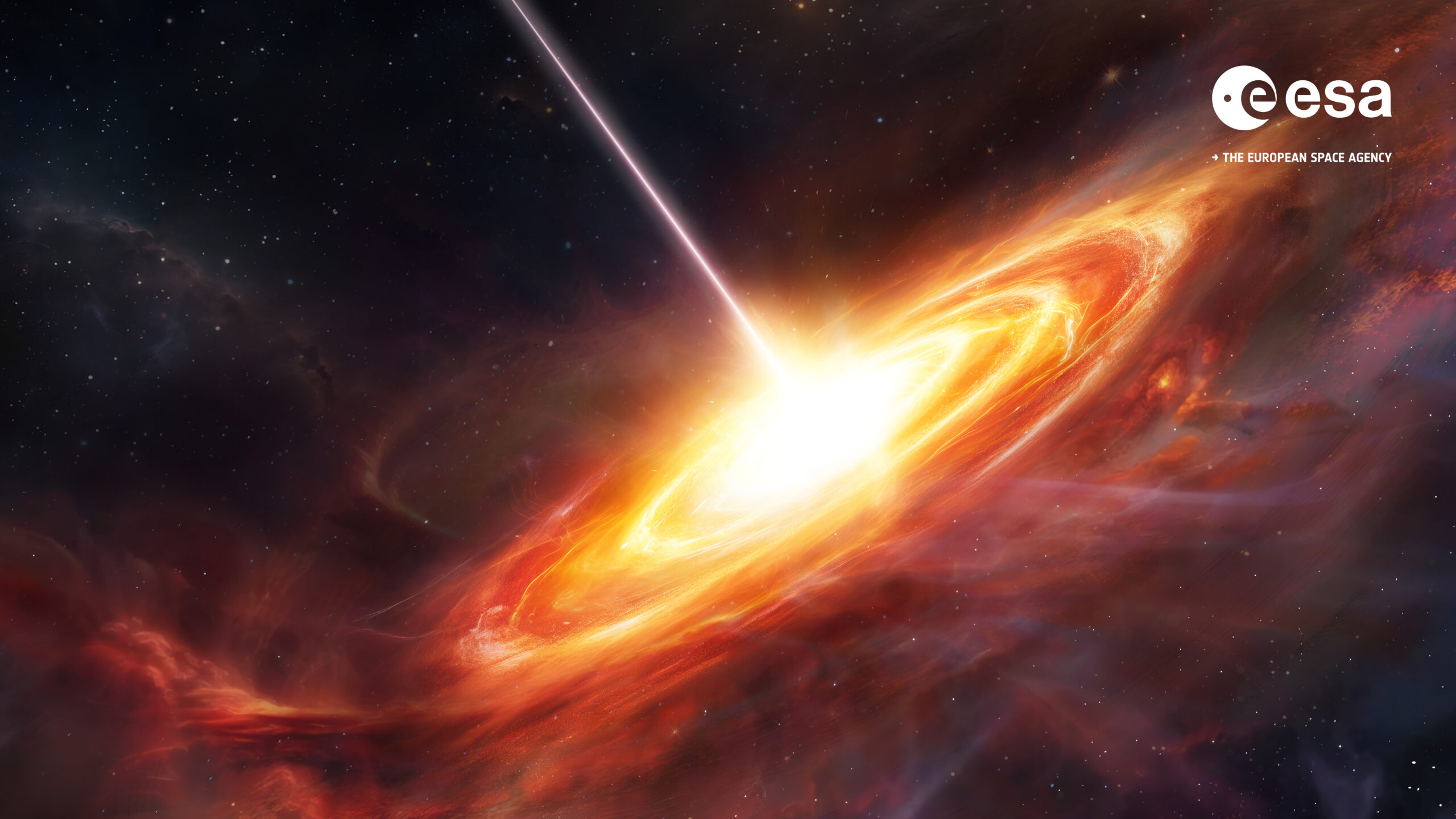
A supermassive black hole with an estimated mass of about 360 million Suns was already powering a luminous quasar only 630 million years after the Big Bang. The object, J1504+6252, has a systemic redshift of 8.129 ± 0.005, making it the first spectroscopically confirmed quasar beyond redshift 8 and tightening the time available for the formation and growth of the earliest massive black holes.
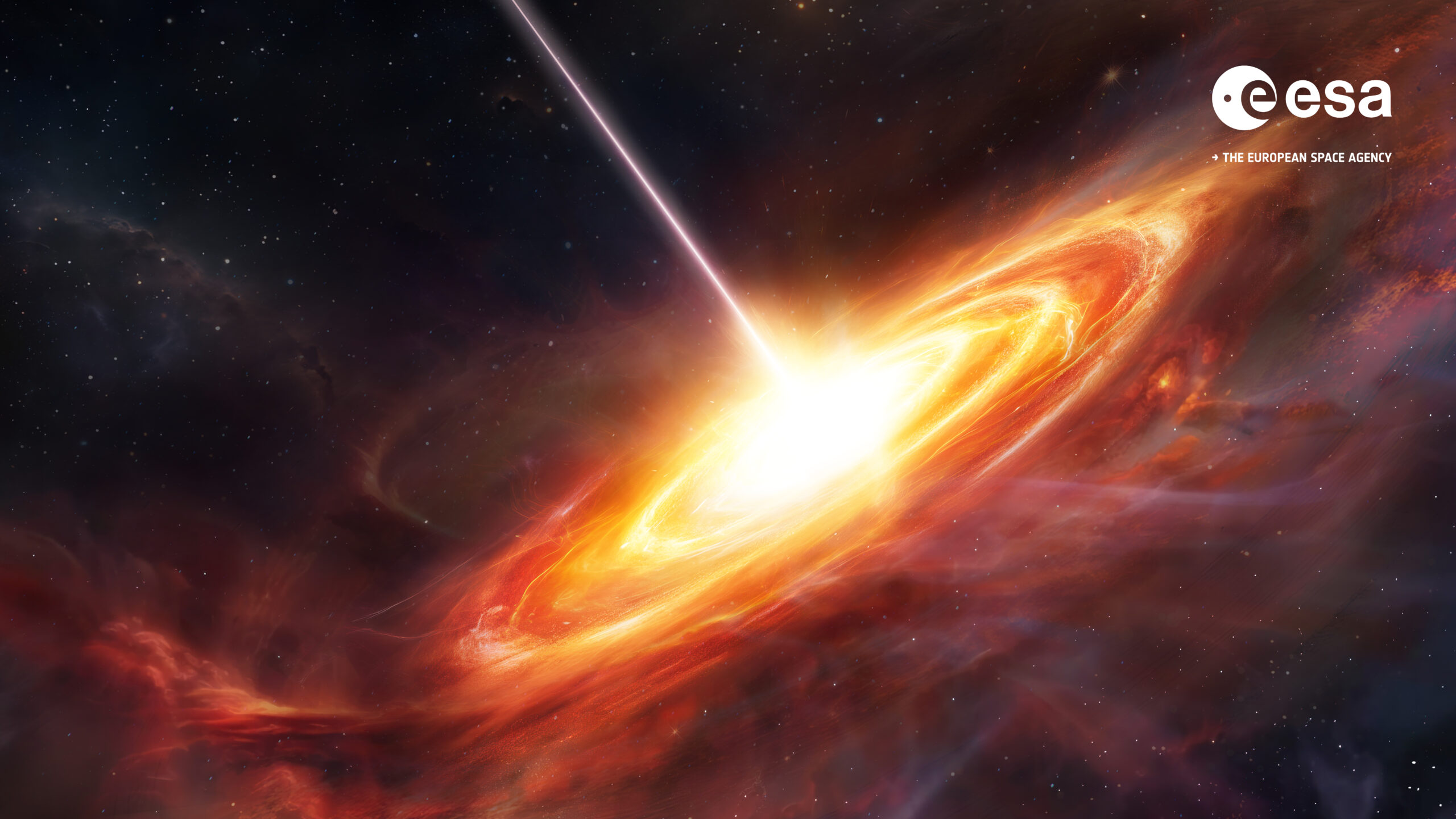
The newly confirmed quasar is formally catalogued as EUCL J150452.291+625224.39, shortened to J1504+6252 and nicknamed Dún Aonghasa. Euclid identified it as a high-redshift candidate in Wide Survey imaging, while observations with the W. M. Keck Observatory, the Hubble Space Telescope, the Large Binocular Telescope and the James Webb Space Telescope (JWST) progressively established its nature and distance.
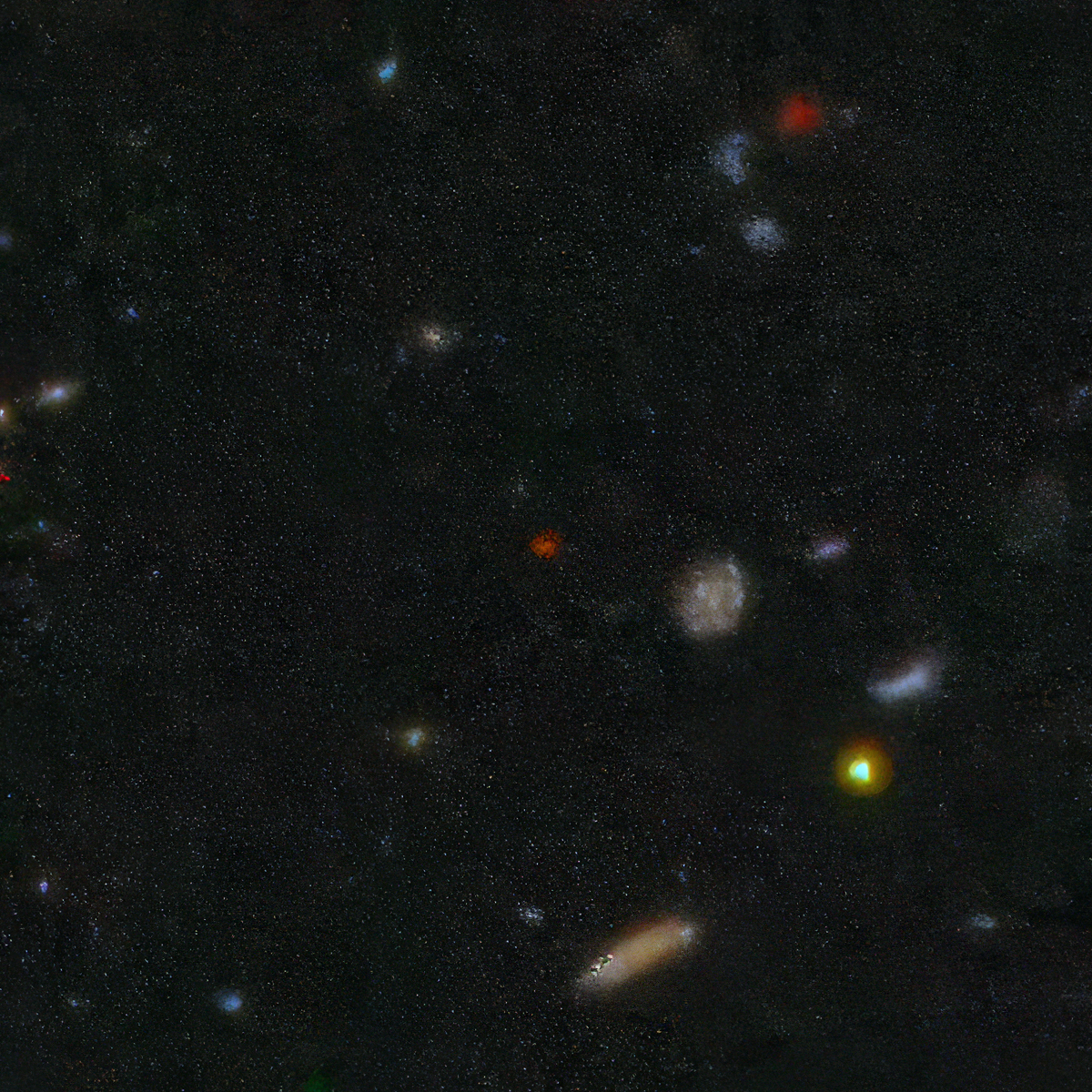
Wolf et al. (2026) measured a systemic redshift of z = 8.129 ± 0.005 from medium-resolution JWST/NIRSpec spectroscopy. Under the cosmological model adopted in the study, the measurement places the quasar about 630 million years after the Big Bang and moves the confirmed quasar redshift frontier approximately 39 million years earlier than the previous record.
The result is scientifically important for more than its distance. Astronomers already knew that supermassive black holes existed during the epoch of reionisation, but every move to a higher redshift leaves less cosmic time for their initial seeds to form and accumulate mass. J1504+6252 pushes a several-hundred-million-solar-mass black hole beyond z = 8 while showing that the object is currently accreting well below the Eddington limit.
| Verified property | J1504+6252 | What it represents |
|---|---|---|
| Systemic redshift | z = 8.129 ± 0.005 | Spectroscopic distance indicator measured with JWST/NIRSpec |
| Cosmic age | ≈630 million years after the Big Bang | Age of the Universe at the observed epoch under the adopted cosmology |
| Advance over previous quasar frontier | ≈39 million years | Additional lookback into early cosmic history compared with the z = 7.77 record |
| Reference black-hole mass | log₁₀(MBH/M☉) = 8.56 ± 0.43 | Single-epoch Hβ virial estimate, corresponding to a central value near 360 million solar masses |
| Mass range from adopted calibrations | log₁₀(MBH/M☉) = 8.33–8.89 | Spread among Hβ and Mg II single-epoch calibrations |
| Eddington ratio | 0.12–0.44 | Estimated luminosity relative to the Eddington luminosity |
| Hβ broad-line width | 3 160 ± 270 km/s (about 7.07 million mph) | Velocity width used in the reference mass estimate |
| Mg II broad-line width | 3 740 (+160/−170) km/s (about 8.37 million mph) | Independent broad-line measurement used in alternative mass calibrations |
What does redshift 8.129 mean?
Redshift measures how strongly cosmic expansion has stretched light while it travelled through the Universe. A redshift of 8.129 means the observed wavelengths have been stretched by a factor of about 9.129 relative to the wavelengths at which the light was emitted. Under the cosmological parameters adopted by Wolf et al. (2026), the measurement places J1504+6252 at a time when the Universe was about 630 million years old.
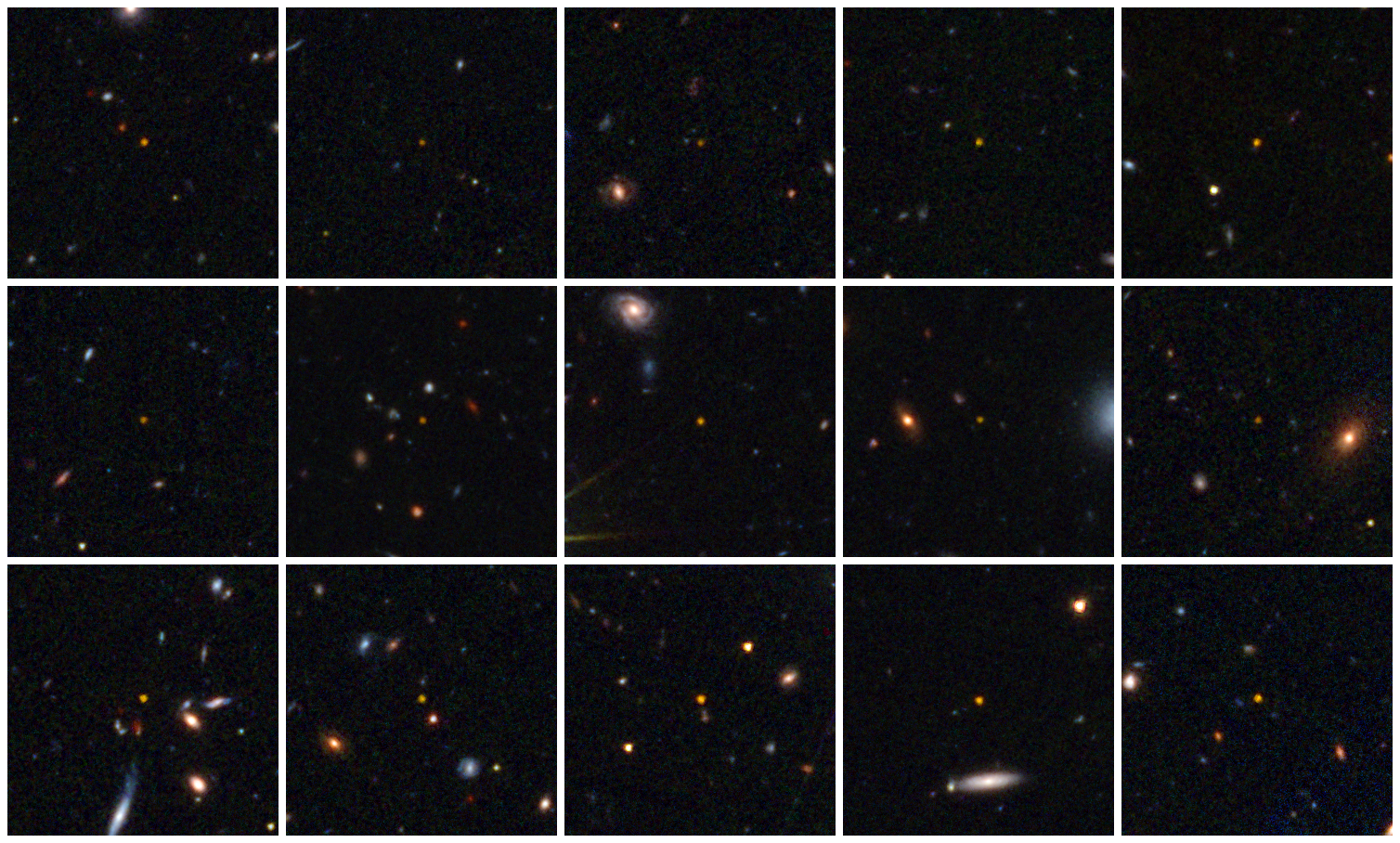
The previous record was also established by Euclid. A study announced in July 2026 reported 31 quasars at redshifts from 6.60 to 7.77. The farthest of those, EUCL J172902.75+641018.1, reached z = 7.77, corresponding to an epoch about 660 million years after the Big Bang. J1504+6252 moved that observational boundary beyond z = 8 only months later.
The new distance record is coupled to a second result: J1504+6252 already contains a very massive black hole. The mass cannot be read directly from an image or spectrum. Instead, researchers estimate it from the motion of gas in the quasar’s broad-line region and from the luminosity of the accretion flow.
How was the black-hole mass estimated?
Gas in the broad-line region orbits at very high velocities close to the central black hole. Those motions broaden emission lines such as Hβ and Mg II. Single-epoch virial calibrations combine the measured line width with the quasar’s continuum luminosity to infer the characteristic size and velocity of the emitting region and, from those quantities, estimate the gravitational mass responsible for the motion.
The method is indirect. Different empirical calibrations produce different mass estimates, which is why Wolf et al. report both a reference Hβ result and a wider interval derived from several Hβ and Mg II calibrations.
The intrinsic full width at half maximum of the Hβ broad-line component is 3 160 ± 270 km/s (about 7.07 million mph). Mg II has a width of 3 740 km/s (about 8.37 million mph), with an uncertainty of +160/−170 km/s. These widths trace gas moving at thousands of kilometres per second in the gravitational environment close to the active nucleus.
Using a widely adopted Hβ calibration, the researchers derive a reference mass of log₁₀(MBH/M☉) = 8.56 ± 0.43. The central value corresponds to approximately 360 million solar masses. Applying a broader set of accepted calibrations to both Hβ and Mg II produces central estimates ranging from log₁₀(MBH/M☉) = 8.33 to 8.89.
The distinction matters because the frequently quoted 360-million-solar-mass figure is an inferred virial estimate rather than a direct dynamical weighing of the black hole. Calibration scatter and the assumptions built into single-epoch mass relations contribute substantially to the uncertainty, while all of the adopted methods still place the object in the several-hundred-million-solar-mass regime.
The same spectrum constrains the black hole’s current accretion state. Wolf et al. derive a bolometric luminosity of log₁₀(Lbol/(erg/s)) = 46.08 ± 0.02. Combining that luminosity with the different black-hole mass calibrations gives Eddington ratios from 0.12 to 0.44, with a reference Hβ-based value of about 0.26.
Why does the Eddington ratio matter?
The Eddington luminosity is the characteristic luminosity at which outward radiation pressure on ionised material balances the inward pull of gravity for a given black-hole mass. The Eddington ratio compares a source’s inferred bolometric luminosity with that limit.
For J1504+6252, the adopted calibrations give ratios of 0.12–0.44. The reference value near 0.26 means the quasar is being observed well below the Eddington limit, even though its central black hole had already accumulated several hundred million solar masses by z = 8.13.
That combination of early cosmic age, large inferred mass and comparatively low current accretion rate is the main constraint on early black-hole growth. The observations do not show how the black hole accumulated its mass, but they restrict the histories capable of producing it within the available time.
One illustrative calculation in the paper assumes a black-hole seed forms at z = 20, accretes continuously at the Eddington limit and converts 10% of the accreted rest-mass energy into radiation. Under those assumptions, a seed of roughly 100 000 solar masses is required to reach a mass comparable to the reference estimate for J1504+6252 by z = 8.13.
The calculation is not a reconstruction of J1504+6252’s actual history. Lower duty cycles require larger starting seeds under otherwise similar conditions, whereas super-critical mass supply can allow black holes to gain mass more rapidly than in a conventional radiatively efficient, Eddington-limited growth model.
Massive seeds of roughly 10 000–1 million solar masses occur in direct-collapse scenarios considered in early-black-hole models. Other proposed routes involve lighter Population III stellar remnants, runaway stellar collisions in dense clusters, combinations of black-hole mergers and accretion, or periods of super-critical growth. The paper compares these possibilities but does not establish which pathway produced J1504+6252.
Keep reading
The authors explicitly conclude that the discovery does not permit a robust distinction between the proposed formation channels. Its value is instead as a new boundary condition: successful models must be able to create a several-hundred-million-solar-mass black hole by z = 8.13 while remaining compatible with the object’s observed spectral properties and sub-Eddington accretion state.
Euclid found J1504+6252 because very distant quasars acquire a distinctive colour signature. Neutral hydrogen along the line of sight absorbs radiation blueward of redshifted Lyman-alpha, causing the object to fade or disappear in sufficiently short-wavelength bands while remaining visible in the near-infrared. At z above 8, that creates a sharp optical-to-near-infrared spectral break.
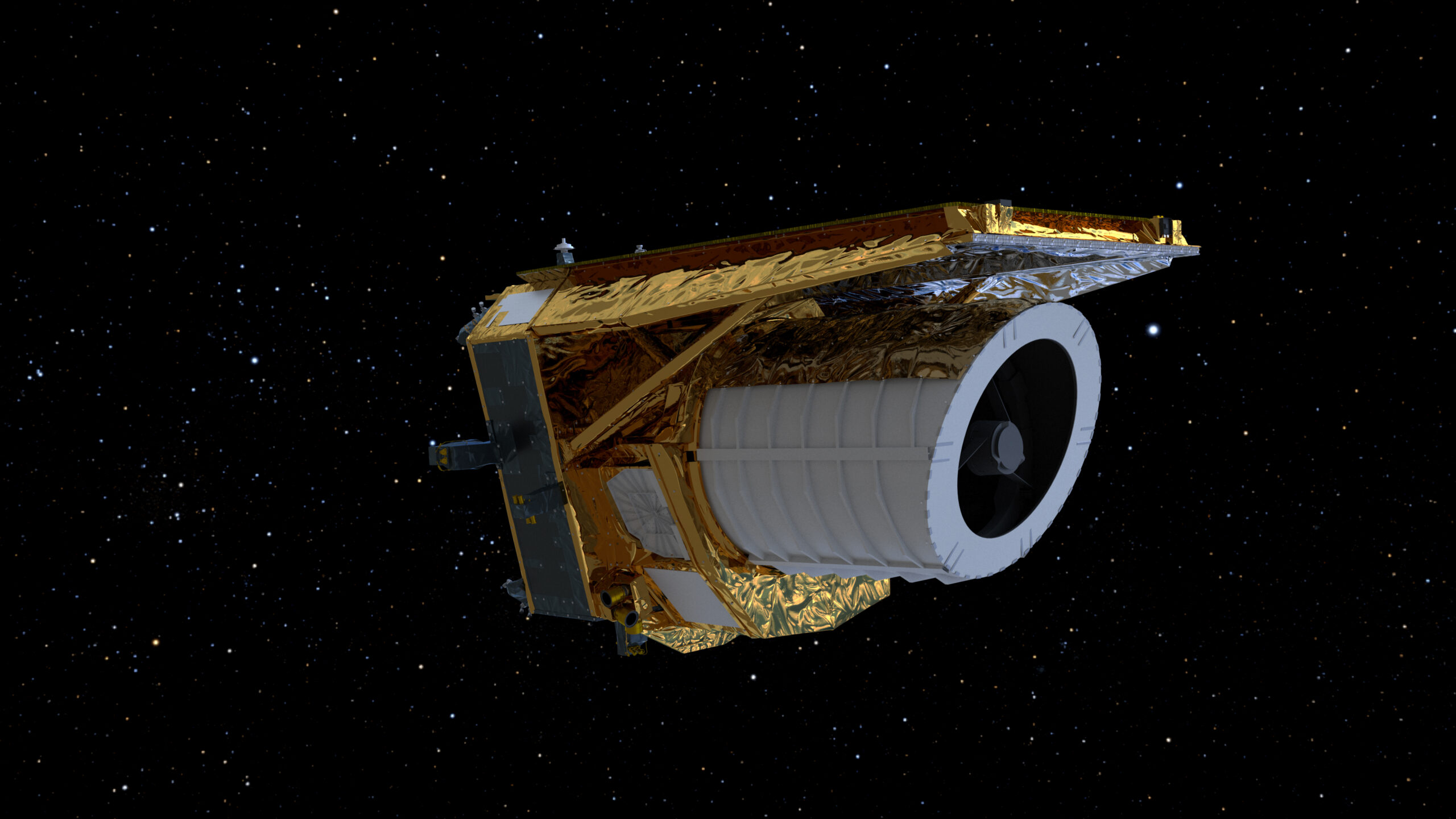
The Euclid Wide Survey is designed to cover about 14 000 square degrees of extragalactic sky over the nominal six-year mission. VIS provides a broad optical band from approximately 550–900 nm, while NISP supplies near-infrared imaging in three bands extending from roughly 950 to 2 020 nm. That combination allows distant optical dropouts to be identified across a survey area much larger than the deep fields of many other observatories.
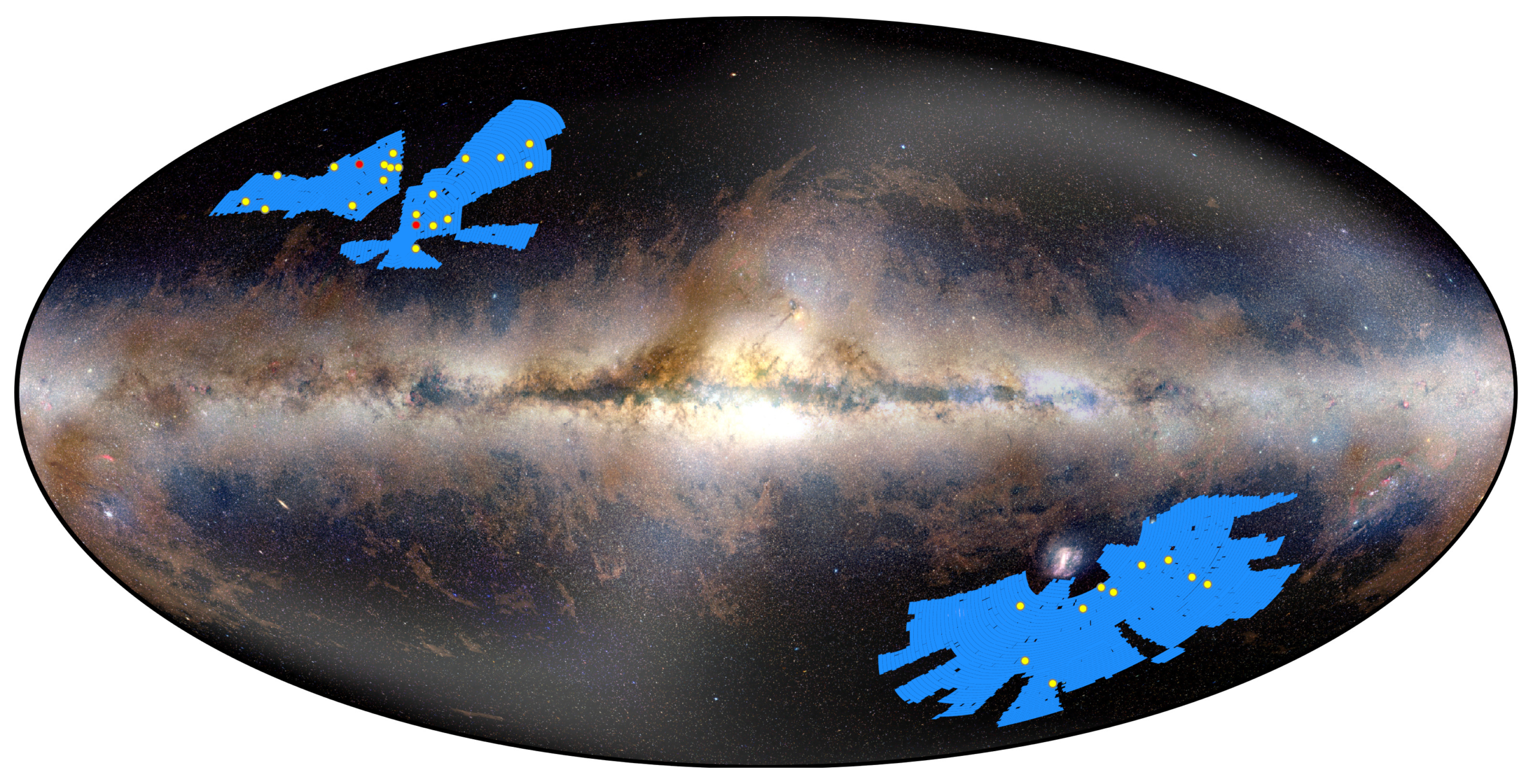
J1504+6252 was selected within a 3 644-square-degree region of Euclid survey data available in August 2025. Its measured magnitudes were YE = 24.10 ± 0.16, JE = 22.96 ± 0.06 and HE = 22.67 ± 0.06, while the source was not significantly detected in the broad optical IE band down to the survey’s nominal point-source depth near magnitude 26.2.
Three independent methods ranked the object as a high-priority quasar candidate. One modelled quasars and contaminants in photometric flux-ratio space, a second used an XGBoost classifier trained on simulated high-redshift quasars and empirical contaminants, and a third fitted spectral-energy-distribution templates for quasars, galaxies and stars.
The three methods returned photometric redshift estimates of 8.20, 8.21 and 7.98. Their mean estimate was z = 8.13 ± 0.10, close to the later spectroscopic result but not sufficient on its own to establish the record.
How J1504+6252 was confirmed
Keck/MOSFIRE observed J1504+6252 on January 18, 2026 for 4 800 seconds (80 minutes). The spectrum detected a blue continuum but did not cover the full spectral break required for a secure redshift.
Hubble/WFC3 observed the source on May 12 for 2 206 seconds (about 36.8 minutes). The Large Binocular Telescope followed on May 15 and 16 with retained integrations of 21 360 seconds (5.93 hours) and 23 520 seconds (6.53 hours), strengthening the evidence for the break.
JWST/NIRSpec observations on June 26 used three configurations with on-source integrations of 788 seconds (13.1 minutes), 591 seconds (9.85 minutes) and 788 seconds (13.1 minutes). The resulting spectrum secured the systemic redshift and provided the broad Hβ and Mg II measurements used to estimate the black-hole mass.
Available Euclid imaging also shows no obvious evidence for strong gravitational lensing. J1504+6252 appears as an isolated red point source without multiple images, arcs or an obvious foreground deflector. Wolf et al. nevertheless note that modest unresolved magnification cannot be excluded from the existing imaging.
The spectral properties are otherwise characteristic of a classical broad-line quasar. JWST shows a luminous blue power-law continuum and broad permitted emission lines similar to those seen in quasars at lower redshift, placing the source within the established quasar population rather than identifying an entirely different type of active nucleus.
Its accretion state, however, falls toward the lower envelope of known quasars beyond redshift 6. Ratios in this range are not unprecedented, but high-redshift surveys have historically favoured the most luminous objects, which can preferentially select rapidly accreting black holes.
At the same black-hole mass, raising the reference Eddington ratio from about 0.26 to 1 would increase the inferred luminosity by a factor of approximately 3.8, corresponding to a brightening of about 1.46 magnitudes. The researchers therefore argue that substantially brighter members of a similar black-hole population may remain to be found if they are not obscured by dust.
The broader Euclid sample is already changing the observational statistics at these redshifts. ESA reports that the mission has found 12 new quasars beyond redshift 7 and expects objects around redshift 8 to remain extremely rare, with no more than a few tens anticipated across the full Euclid survey.
The next major test will come from population size rather than from J1504+6252 alone. Additional quasars beyond redshift 8 with reliable black-hole masses and accretion estimates can show whether its relatively low Eddington ratio is unusual or characteristic of a broader population, narrowing the range of viable seed masses, growth histories and obscured phases during the first several hundred million years of cosmic history.
References:
1 Wolf, J., Belladitta, S., Yang, D., Guarneri, F., Bañados, E., Hennawi, J. F., Schindler, J.-T., Hviding, R. E., Jahnke, K., Mortlock, D. J., Fan, X., Stern, D., Eilers, A.-C., Wang, F., Yang, J., Bosman, S. E. I., Conselice, C. J., Davies, F. B., Decarli, R., … García-Bellido, J. (2026). Euclid: Discovery of a quasar at z = 8.13 hosting a 360-million-solar-mass black hole. Astronomy & Astrophysics, 715, A356. DOI: 10.1051/0004-6361/202662243
2 Euclid breaks own quasar record by 40 million years – European Space Agency – November 24, 2026
3 Euclid discovers the most ancient quasar in the Universe – European Space Agency – July 6, 2026

I’m a science journalist and researcher at The Watchers, contributing to the Epicenter edition, where I cover peer-reviewed scientific research and emerging discoveries across Earth and space sciences. With a background in astronomy and a passion for environmental science, I’ve worked in shark and coral conservation in Fiji, conducting reef and shark-behavior research, contributing to mangrove restoration, and earning PADI Open Water and Coral Reef Certifications. I bring a blend of scientific rigor and storytelling to illuminate the discoveries shaping our planet and beyond.
More reporting
- Hundreds of deforming bedrock landslides cluster near glaciers across southern Alaska
- Projected 5G leakage can alter the satellite data behind weather forecasts
- Global analysis finds glacial lakes amplify ice loss while climate and glacier geometry remain dominant
- Antarctic sea ice sets daily records while October monthly extent remains second lowest
